
In this interview, we get into Strikethrough, his psychological horror novel built around Harlem Ward, a man too clever and too damaged to trust. Zac Crook talks demons, both literal and figurative, the pull of Shirley Jackson and Thomas Harris, and why he wrote the payoff before the terror. He’s a Michigan musician and artist as much as a novelist, and it shows. This is a conversation about obsession, craft, and the horror we carry ourselves.
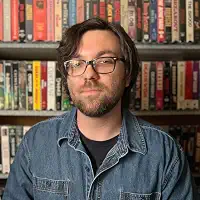
Let’s start at the very beginning. For our readers, please introduce yourself. Beyond the author bio, tell us a little about who you are when you’re not writing, what you love doing, what fascinates you, and what fuels your creativity.
When I’m not writing, I love spending time with my family, playing music, drawing, watching films, and reading. All of those things fuel my creativity. I’m mostly a guitar player and singer, but I can play drums if there’s a gun to my head. I’m a visual artist, so I do a lot of pencil and alcohol marker stuff. I’m a dismal painter.
The problem is it’s hard to get rolling on a project. I have ideas that I love, but until I get the momentum going, it’s tough to actually get started. I love all sorts of films. My top three would be Halloween, The Texas Chain Saw Massacre, and Taxi Driver. Beyond those it’s a jumble of stuff like The Mechanic (most Bronson films, really), Citizen Kane (most Welles films, really), Night of the Living Dead (most Romero films, really), Napoleon Dynamite, Monty Python films, and a million others.
In the early stages of a new project, what tends to come to you first: a compelling character voice, a central thematic question, or a vivid image/scenario? How does that initial spark then guide you in building the rest of the story?
I’m afraid to answer this, because I don’t want people to look too hard for the seams! Usually, I’ll get an idea for a cool scene. I tend to think and write cinematically – I project everything in my skull as a film segment and stress-test for pacing, coherence, etc. I will try to wring some information from the scene about the character(s). From there, I like to imagine who they might be (or who they try to be). The next time I get an idea for a scene, I’ll decide if it could relate to others I’ve had, and I’ll plug in characters I have kicking around in my head to see if there’s a story there.
Every book has its own unique set of problems to solve. What was the most difficult ‘puzzle’ you had to crack while writing this book? Was it a plot hole, a character’s motivation, the structure, or something else entirely?
Since I usually hoard my ideas as collections of scenes, cohesion is sometimes a challenge. Once I decide a few moments can exist in the same narrative, I need to create the connective tissue so it doesn’t come across as a disjointed clump of set pieces.
The trick is making the connective tissue not seem like connective tissue. Everything has to happen organically, and it has to make sense for the plot. Often, that process gives me plot threads that end up as some of my favorite moments in the story. For Strikethrough [MASSIVE SPOILER] I needed a way to reconnect Harlem Ward and Janet Fritz in adult life.
I wanted to avoid deus ex machina like the plague, so I leaned heavy into Ward’s obsessive nature. It killed a few birds with one stone: it deepened Ward’s character (his “pain fix”, intentionally reliving trauma, his compulsive mind); it got him to the place he’d most likely run into her; it helped flesh out Janet’s character (resilience, loneliness, trying to heal and move on). The “fix” for the “problem” ended up giving me a lot more story to play with.
The journey from a finished manuscript to a book in a reader’s hands can be a surprising one. What was the most significant way your book evolved during the editing and publishing process, something you didn’t anticipate when you typed ‘The End’?
Definitely the cover. I originally intended to draw the face in alcohol marker, but I decided to take a photo of my face instead. I bumped up the details and grit so I’d look a little shittier than normal. I printed it off, made the exclamation mark tear in the photo, scanned that in, and superimposed it on the digital photo (blending the edges). It was just like applying a scar appliance in makeup.
The text on the cover and back was done by me on an old electric typewriter. All the glitches and messiness are from me manipulating the machine as I typed. I didn’t plan it out much, it just all kind of flowed in one creative burst one afternoon.
Once a book is published, it no longer entirely belongs to the author; it belongs to the readers and their interpretations. Has a reader’s reaction or analysis ever revealed something about your own work that surprised you?
Yes! A friend of mine is a behavioral health therapist, so his insights were fascinating. There’s the line in chapter 9 about Ward’s ex-marriage: “his busted lip, her black eye”. That was really just to illustrate that he’s aways been volatile and the woman he’s pining for is tangled up in dark memories as well as good. My friend put for the idea that the line could suggest some kind of S&M element to the relationship.
I certainly didn’t intend that angle, but it was fascinating that he could get that from the short line. I was paranoid that the way I wrote it bordered on cliché, but his take and a few cringe reactions from early readers made me think maybe the matter-of-fact terseness of the line leaves a lot of room for the readers’ own baggage. Also, one reader wondered at some point if Ward was a vampire! Probably the line about him “feeding” when “she couldn’t provide”. The epigraph is also a Van Helsing quote, so I can’t blame them too much!
Writing is a demanding, often solitary pursuit. Beyond the apparent goal of ‘telling a story,’ what is the specific, personal fuel that keeps you going through the difficult stretches? Is it the joy of discovery, the need to understand something yourself, the connection with a future reader, or something else?
Everything above. Even more so is the burning itch to exhaust the idea. Strong ideas burn a hole in my brain like money in a kid’s pocket.
We often hear about authors being influenced by other books. What are some non-literary influences on your work, such as a specific piece of music, a historical event, a scientific theory, or even a landscape, that have profoundly shaped your storytelling?
Like I said, I’m a musician as well, so music is huge for me. I’ve been listening to a lot of pre-70’s country and early New Wave lately. That’s a broad spectrum. Playing music works both hemispheres of the brain simultaneously. There’s math and emotion involved. I strongly encourage everyone to pick up an instrument, even if you think you suck. I suck badly at piano/keys, but I still play my Alpha Juno-1 whenever I get a chance!
Films (“fillums” as Norm MacDonald would say) are also huge for me. I love stuff with a distinctive style: Carpenter, Romero, Welles, Scorsese. Actually, the way Romero edited Season of the Witch AKA Jack’s Wife was a big influence on the way I chopped up Strikethrough. Kolchak: The Night Stalker is another big one.
Is there an author, living or dead, whom you consider a ‘silent mentor’? Not necessarily someone you try to imitate, but whose approach to the craft made you feel permission to write in your own way?
I’m afraid to answer this too, because people will be able to tell where I ripped them off. I love everything I’ve ever read by Shirley Jackson. Her writing scratches itches I didn’t even know I had. What she does with efficiency and ambiguity is unmatched. I also adore Thomas Harris, Richard Matheson, and Tolkien. They would be my Mount Rushmore of authors. Jackson and Harris are among the greatest authors of all time in my opinion.
Who was the first person to see your early drafts, and why did you trust them with your unpolished work? What is the most valuable piece of feedback they gave you?
A few of my friends were probably the first to give me feedback. I had only written four or five chapters at that point, but they helped me see some stress fractures that needed reinforcing. They are all from totally different reading backgrounds and tastes as well, so that helped me really consider some of my choices (and what I wanted to lean into). I snuck a few of the early criticisms into the book.
Horror is often most potent when it’s internal. Beyond external monsters, how do you explore the slow unravelling of a character’s sanity or the horror of their own mind?
For Harlem Ward I decided he’s a classic case of overcompensating for insecurities. He’s mean, arrogant, antagonizing, and unsympathetic. In his mind, he has the right to be, because he’s smarter than everyone else and operates with all that unchecked pain. It’s your fault if you get hurt by him. That’s the cost of interacting with Harlem Ward. I wanted to put him through the wringer but still make him insidious and bitter enough that you don’t have complete sympathy for him. I told myself from the very beginning this story is about demons. Readers are welcome to take that literally or figuratively. I wrote the narrative so that both are completely valid at all times.
Setting in horror is often described as a character in its own right. How do you approach transforming a location, whether a house, a town, or a landscape, into a source of active dread?
What does it smell like? Is anyone there? What has been happening there before the reader showed up? Is it dusty? OK, it’s dusty. Are there windows? OK, there’s one dirty window. Should the moonlight stream in? OK, then it should catch the dust. Tell it. Does the roof leak? Well, there should be a dampness about the place. Tell it. I like to think of all five senses and how the setting could disturb some (or all) of them.
Writing a terrifying buildup is one skill; delivering a satisfying payoff is another. How do you decide when to finally show the monster or reveal the source of the horror?
I’m terrible with surprises. I want to give birthday gifts as soon as I get them for the person. When I write, the restraint and dread upset me more than the reader. I’ll typically write the payoff first and backtrack. Doing it that way often helps me build tension more efficiently, because I can hide hints and sprinkle doom behind as the reader follows my footpath. The old man in Ward’s dreams is an exception to that rule. I wrote the first nightmare, then I wrote the second, then the payoff where he sees the man in the mirror in Janet’s apartment struck me later. My technique is a mess, really.
The horror genre is rich with established tropes and archetypes. How do you engage with these familiar elements, the haunted house, the ancient curse, the final girl, in a way that feels fresh and surprising? Do you consciously seek to subvert a trope, or do you focus on executing it with such depth and authenticity that it becomes new again?
I typically write out the idea and say “that’s stupid and it sucks” and do it over until I’m happy. I do like to subvert tropes when I can, but sometimes they’re simply classic for a reason. When I do use a standard trope, I try to wrap it in a way I’ve personally never seen before (or often). I approach lyrics the same way. You can absolutely pull off lame rhymes if the content in between isn’t too tired. Anyway, the ending of Strikethrough isn’t exactly new territory, but the way it comes about and the context hopefully feels fresh. Once you finish the book, subsequent reads may be a bit of a different ride.
How do you approach writing scenes of intense terror or violence to make them feel physically impactful without tipping into gratuitousness?
Gratuitousness is so subjective, that I almost have to use my own tastes as a barometer. I’m not a fan of gore for gore’s sake unless it’s played for fun a la Evil Dead 2. The whole “torture you-know-what” thing is lost on me. I want to be scared and/or have fun – to be thrilled. I don’t want to sit through sadism without purpose. If it serves the plot, let it rip. If it does not, I’d rather skip. I don’t think I have ever written anything that goes too far. I think Chapter 21: Suffer inStrikethrough is about as gnarly as I typically go.
What is the specific, core truth you are trying to expose or explore through your horror?
I’m really just trying to exorcise ideas. If I think something is cool and interesting, I want to flesh it out so I can maybe share it with others. I don’t have any kind of philosophy or allegory I’m trying to communicate. I pretty much never write with any kind of true purpose other than how the work will resonate with the audience it may find.
You have precisely two minutes in a crowded bookstore to hook a reader who is sceptical of the entire horror genre. They look at your book’s cover and ask, ‘Convince me. Why should I read this? I don’t even like being scared.’
It might not scare you! I think it’s also funny and sad. Strikethrough is a study of a character who thinks he understands himself. He doesn’t believe in anything spiritual or supernatural. We get to decide if he’s right or not. And yes you do like being scared. Liar.
Zac Crook
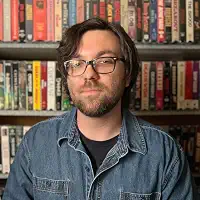
Zac Crook is a writer, musician, and artist from Michigan. He has been creating and performing since 2008. His work dances between horror, rock, pen-and-ink, satire, blues, short story, marker, jazz, pencil, and more.
Connect on Facebook & Instagram:
@zaccrookmusic
Ginger Nuts of Horror: The Heart and Soul of Horror Reviews
Looking to get your horror book or film in front of the genre’s most dedicated audience? Ginger Nuts of Horror is one of Europe’s largest independent horror review websites, with over 30 contributors publishing horror book reviews and horror movie reviews almost every single day.
We offer far more than reviews. Authors, filmmakers and publishers can promote their work through in-depth horror book reviews, horror film reviews, comic and video game coverage, news features, and our popular author and director interviews like Five Minutes With. Our guest feature series, The Horror of My Life, Childhood Fears, The ? That Made Me and more, let creators tell their story while promoting their latest release.
Every feature is built to sell your work. We include backlinks to your website or Amazon author page, a full synopsis, and a universal purchasing link that sends readers straight to their local store. Add a large, engaged social following and an 18-year archive of trusted horror coverage, and you have a platform genuinely built to grow your readership.
Whether you’re an established author, an indie filmmaker, or a debut voice in indie horror, there’s a way for us to help you reach more fans. Explore our horror book reviews and horror movie reviews, then get your horror book or film featured today.
Jim "The Don" McLeod has been reading horror for over 35 years and reviewing it for more than 16. He's the editor of Ginger Nuts of Horror, Europe's largest independent horror review and culture site, and a British Fantasy Award nominee for his work in the genre. When he's not busy inflicting his opinions on the horror community, he can be found annoying his family or getting thoroughly outwitted by his two dogs, Casper and Molly.


