
- Peace Mbengei Interview: We Run the Night and the Luo Night Runners
- We Run the Night Review: Kenyan Folklore After Lights Out
A grieving schoolgirl becomes the monster Luo folklore always feared.
Peace Mbengei Interview: We Run the Night | Interview
Peace Mbengei’s debut YA horror novel We Run the Night turns Luo folklore’s night runners into something painfully real. The Kenyan doctor, now based in Australia, builds her story around a strangler fig that remembers unjust death, dragging her heroine into a legend the school insists cannot exist. Shani Bara is sixteen, a scholarship student at an elite Kenyan boarding school, back home after her father’s hit and run death only to discover her own body is transforming into something no institution can explain away.
Mbengei draws on her medical training for the body horror, her background in theatre and scriptwriting for the pacing, and her own experience of losing a parent as a teenager for the grief underneath every page. Her work sits inside a growing wave of African speculative fiction that treats folklore as fact rather than decoration. In this Ginger Nuts of Horror interview, Mbengei talks through the countdown structure that traps Shani inside thirteen days, the institutional cover up that follows, and why she chose forgiveness over revenge as the mechanism that finally sets her heroine free.
Peace Mbengei turns a strangler fig into grief made flesh, drawing on her training as a doctor to render Shani Bara’s transformation with clinical precision. In We Run the Night, night running becomes a countdown across thirteen days, and forgiveness, not revenge, is the only way out of the curse
Peace Mbengei Interview: We Run the Night and the Luo Night Runners

The strangler fig in Peace Mbengei’s debut YA horror novel We Run the Night is not a metaphor for grief—it is grief made flesh, a tree that grows from unjust death and remembers blood. Shani Bara, a sixteen-year-old scholarship student at an elite Kenyan boarding school, returns after her father’s hit-and-run death only to discover that the night runners of Luo legend are real, and that she is becoming one of them. Mbengei, a Kenyan medical doctor now based in Australia, blends boarding school horror with supernatural dread and a quiet reckoning with loss. Here, she discusses folklore as fact, institutional failure, and forgiveness as survival.
The strangler fig in We Run the Night is more than a symbol; it has agency, memory, and a kind of moral logic. You’ve said the novel was seeded by an image of students running across a campus at dusk. At what point in the writing process did the tree become the novel’s engine? How did you go about establishing its rules?
The strangler fig tree was always there from the inception of the story, but it took on a bigger role during the revision process. As much as the night runner lore was the central concept driving the plot, I realised that something was missing. I needed a force that could bind Shani to the mystery in a more intimate way and connect the supernatural elements to her grief over her father’s death. The strangler fig became that connective tissue. It allowed me to explore not only the physical transformations in the book, but also grief and forgiveness. I particularly enjoyed expounding on the notion of retributive karma.
Establishing the rules meant figuring out a series of questions. Why would a tree punish people? How would it do it? What would it take to earn its forgiveness? But most importantly, how would all this intersect with the night runner myth?
Shani’s transformation is rendered with a clinical precision; the cracked skin, the dirt that won’t wash off, the sensation of her body becoming other. You’re a medical doctor. How did your training shape the way you wrote the physical horror of the night running? Did you find yourself resisting the impulse to diagnose rather than dramatize?
The body horror was actually one of my favorite aspects of the novel to write, simply because there were endless possibilities for the transformation to unfold. My guiding question was always: if a human being were slowly becoming a tree, what would that actually look and feel like?
From there, I approached it almost systematically. What happens to the skin first? How would the body respond? What sensations would accompany those changes? I wanted the transformation to feel gradual and inescapable, as though Shani’s body was following a set of biological instructions that she could neither understand nor stop.
Being a medical doctor definitely influenced that process. Medicine teaches you to observe the body very closely, to pay attention to patterns and small changes over time. I found myself applying that same mindset to the horror. I did occasionally dip into medical texts and anatomy references, not to diagnose Shani, but to make her transformation feel physically convincing.
That said, I was always careful not to let the science overwhelm the story. Horror lives in the gap between what we know and what we can’t explain. If I had approached Shani purely as a patient, I would have stripped away the mystery. Instead, I tried to write her the way many of us experience our own bodies during illness: as something suddenly unfamiliar. When you think about it, that’s what makes body horror so unsettling. Your body is the one place you’re supposed to feel at home, and suddenly it isn’t.
The novel is structured as a countdown across thirteen days. What did that architecture allow you to do with pacing and tension that a more conventional timeline would not? And why thirteen specifically?
Structuring the novel as a countdown allowed me to create a kind of pressure chamber. Every chapter brings Shani one day closer to an outcome she doesn’t fully understand but instinctively fears. There is something inherently unsettling about a countdown because it implies inevitability. The reader knows time is running out, even if they don’t yet know what happens when it does. It also helped with pacing. Because I was working within such a confined timeframe, there was very little room for either the characters or the reader to breathe. The tension could build incrementally alongside Shani’s transformation, her grief, and the unraveling of the mystery.
As for why thirteen, I wish I could tell you there was an elaborate piece of folklore behind it, but the truth is much simpler. Thirteen has always occupied a strange place in horror. It is a number burdened with superstition, bad luck, and cultural baggage. It felt like the perfect number of days to trap someone inside a nightmare.
Also, thirteen sits in an uncomfortable space. It exists just beyond twelve, a number we tend to associate with completeness: twelve months, twelve hours on a clock face, twelve zodiac signs. Thirteen feels like something spilling over its natural boundary, something that shouldn’t be there. That felt very true to the novel itself because We Run the Night is a story about people and bodies becoming something they were never meant to be.
Miss Chozi’s scientific explanation for the night runners (that it is a conversion disorder) is almost plausible. Why was it important to you to include a rational counter-narrative rather than let the supernatural stand uncontested? What does her character represent about how institutions respond to what they cannot explain?
It was important to me that the supernatural never stood entirely uncontested because that is rarely how people experience the unknown in real life. Whenever something strange happens, there is always someone trying to explain it away, to fit it into a framework that feels safer and more manageable.
As a medical doctor, I am naturally drawn to explanations. Medicine is very much an exercise in pattern recognition. You observe symptoms, formulate hypotheses, and search for answers. But as a horror writer, I’m equally interested in the possibility that some things resist being neatly categorized.
Miss Chozi exists at the intersection of those two impulses. Her explanation of night running as a conversion disorder is plausible, and I wanted it to be. The more believable the rational explanation, the more unsettling it becomes when the reader begins to question whether it is sufficient.
More broadly, though, I think Miss Chozi represents the way institutions often respond to things they cannot explain. Schools, governments, and even medicine itself have a tendency to name, classify, and contain the unfamiliar. There is comfort in saying, “This is what it is, and therefore we understand it.”
But institutions are not infallible. Sometimes, in their desperation to preserve order, they assign palatable labels to uncomfortable things without considering that there may be a deeper truth or a more profound suffering underneath. They mistake explanation for understanding.
You could argue that Miss Chozi isn’t the villain of the story. She is simply trying to make sense of the impossible using the tools she has available to her. I find that deeply human. Horror, for me, has never been about choosing between science and the supernatural. It’s about the uneasy space where both can exist at the same time.
The cleansing ritual at the climax requires Shani to forgive Ziki, the boy who killed her father. That is a radical choice; forgiveness as the mechanism of release rather than revenge or justice. What made you decide that was the way out for her, and did you ever write versions where she chose differently?
Iactually did wrestle with that decision for quite a while. Part of me felt that forgiveness can sometimes feel like an escape hatch for people who have caused genuine harm. But the more I sat with Shani’s story, the more I realised that revenge would only tether her more tightly to the thing that had wounded her. It didn’t feel true to her character for the story to end with her carrying that anger forever.
That isn’t to say that forgiveness absolves Ziki or erases what he did. In fact, one of the ideas I kept returning to while writing the novel was that forgiveness isn’t necessarily about absolution. If anything, it is an act of release. It is deciding that another person’s wrong-doing no longer gets to live rent-free inside you. Someone can still be responsible for the pain they caused, even if you choose not to let that pain define the rest of your life.
I did consider darker versions of the ending. Horror stories often make justice look like punishment. But ultimately, I kept returning to the same conclusion: grief asks enough of us already. I didn’t want Shani to spend the rest of her life carrying someone else’s sins.
For me, the cleansing ritual only works because forgiveness was never the tree’s to give. It belonged to Shani all along.
The final pages are quiet; Shani in the attic, reading her father’s letter, letting grief settle rather than running from it. Why did you choose to end on that note of stillness rather than a more dramatic resolution? Was that ending always in place, or did you discover it in revision?
The original ending was actually much more chilling. It suggested that Shani had never truly escaped the night runner curse, that the horror would continue long after the final page. You could say it was a more conventional horror ending.
But that version ultimately fell apart during revisions because I realized I had been asking the wrong question. At its heart, We Run the Night is not simply a story about monsters, curses, or folklore. It is the story of a teenage girl drowning in grief.
By the time I reached the ending, it became clear to me that surviving the curse was never Shani’s greatest challenge. Her greatest challenge was accepting that her father is gone. I chose to end on a note of stillness because grief itself is a quiet monster which settles into the empty spaces people leave behind.
In those final pages, Shani finally stops running. She accepts that there is no version of the world in which she gets her father back, and that realization is both devastating and freeing. The night runner curse is something she can survive, but her grief is the one thing she cannot outrun, erase, or hand to someone else. She has to carry it herself.
Your short story “Losing Papa” was longlisted for the 2019 Writivism prize. You have said you lost your father as a teenager. How does We Run the Night extend the work that story began, and what did writing that earlier piece teach you about approaching grief in fiction?
“Losing Papa” was the first time I ever put my grief into words. Writing that piece was deeply cathartic because it allowed me to explore an expression of grief that is often misunderstood, especially in children. It was about a little boy acting out because he was missing his father, while the adults around him interpreted that pain as mischief or bad behaviour. That short story taught me that grief does not always look the way we expect it to. Sometimes it looks like anger, silence, confusion, or even rebellion. Everyone carries loss differently.
We Run the Night continues that exploration, but on a much larger scale. I wanted to examine what happens when grief is not just something you carry internally, but something that changes the way you see yourself and the world around you. Shani’s journey is not simply about losing her father; it is about learning how to exist in a world that has been permanently altered by that loss.
My own father’s death was one of the defining experiences of my life. I loved him deeply, and I think some part of me has always wanted to put pieces of him into my writing. He was a storyteller himself, and I think there is something meaningful about becoming a storyteller too. Writing We Run the Night felt, in some ways, like a conversation across time. I wanted to create something that would have made him proud, while also exploring the complicated reality of loving someone who is no longer there.
Ultimately, both stories taught me that grief is not something you simply overcome or leave behind. It changes shape. It becomes part of who you are, and sometimes the most healing thing you can do is learn how to carry it.
Before this novel, your short fiction appeared in African Writer, Praxis Magazine, Kalahari Review, and Ilanot Review. You have also worked as a scriptwriter and playwright. How did writing for different forms (short fiction, theatre, scriptwriting) prepare you for the sustained work of a novel? Is there a craft lesson from one of those forms that proved unexpectedly useful here?
Writing across different forms taught me that every story has its own rhythm. Short fiction taught me precision. When you have a limited word count, every scene, every sentence, and every image has to earn its place. There is no room for anything that does not deepen the story or reveal something about the characters.
Theatre taught me the power of dialogue and subtext. When you write for the stage, you become very aware that characters cannot hide behind narration. Their appearance, how they move, and what exists in the silence between their words all become important.
Scriptwriting, on the other hand, taught me to think visually. Film and television are visual mediums, so I learned to focus on moments that can be seen and felt rather than simply explained. That was particularly useful when writing We Run the Night, especially with the body horror and supernatural elements. I wanted readers to experience Shani’s transformation almost as if they were watching it unfold.
The biggest lesson I carried into novel writing was understanding that stories are built from moments. A novel may be much longer than a short story or a script, but it still depends on individual scenes that create emotion, tension, and meaning.
I think my background in different forms also drew me to horror because horror is such a visual and atmospheric genre. Whether it is a shadow moving in the corner of a stage, a disturbing image in a screenplay, or a single unsettling sentence in prose, the goal is the same: to make the audience feel something before they even understand why.
The night runner legend, particularly in Luo tradition, describes figures who are feared, ostracized, and violently punished once discovered. You have said what fascinated you was “the idea of being trapped by something people believe makes you dangerous or wrong.” That framing resonates far beyond folklore. Were you consciously writing about other kinds of otherness (queerness, mental illness, class), or did that resonance emerge as you worked?
I think the resonance was there from the beginning, even before I had fully articulated it. The night runner legend fascinated me because, beneath the supernatural elements, there is a deeply human question: what happens when a community decides that someone is dangerous, different, or wrong?
That idea naturally connects to many forms of otherness. Whether it is queerness, mental illness, class, or any identity that exists outside what society considers acceptable, there is a recurring pattern of people being defined by fear rather than understood as individuals.
I was not trying to write a direct allegory for any one experience, because I think that can sometimes flatten the complexity of a story. Instead, I was interested in exploring the emotional experience of being treated as a monster, of feeling like something about you makes you unacceptable, and the damage that can come from internalizing that belief.
Shani’s transformation reflects that fear in a very literal way. She is not only afraid of what is happening to her body; she is afraid of what it means about who she is. She begins to question whether the world is right to fear her, and whether she is becoming the thing everyone believes she is.
For me, that is where horror becomes powerful. Monsters are often not frightening because they are different. They are frightening because of what people choose to do with difference. Horror allows us to examine the boundaries we create between “normal” and “other,” and ask who gets to decide where that boundary exists.
The boarding school setting is a horror tradition in its own right. What does that closed world allow you to do that other settings would not? Which boarding school stories (in any medium) do you feel a conversation with, whether as influence or counterpoint?
Boarding schools are fascinating settings for horror because they are places that are supposed to protect young people, yet they can also become incredibly isolating. You have teenagers removed from their families, placed in a controlled environment with strict rules and hierarchies, and expected to grow into themselves while navigating intense pressure. That combination creates a natural tension: a place that promises safety can also become a place where people feel trapped.
For We Run the Night, the boarding school setting allowed me to amplify Shani’s sense of isolation. When something goes wrong, she cannot simply go home. The adults who are meant to protect the students are part of the same system that is failing them, and the physical isolation of the school mirrors the emotional isolation she experiences while grieving.
I think boarding schools are especially effective in horror because adolescence itself is already a period of transformation. Teenagers are discovering who they are, questioning their place in the world, and feeling like their bodies and identities are changing. Adding a supernatural transformation into that environment felt like a natural extension of those fears.
In terms of influences, I think about stories that use schools and institutions as spaces where larger questions about identity, power, and belonging are explored. I’m drawn to works like Never Let Me Go by Kazuo Ishiguro, which examines young people within an institution that shapes and limits their futures, and A Separate Peace by John Knowles, which explores the emotional complexity and hidden tensions of boarding school life.
Ultimately, I was interested in turning the boarding school itself into a character. The walls hold secrets, the rules create fear, and the institution has its own idea of what its students should become. The question I wanted to explore was: what happens when the place that is supposed to shape you begins to consume you instead?
There is a lineage of African speculative fiction that draws on folklore without treating it as exotic. Who are the writers working in that space who have shaped your thinking, and is there a book (African or otherwise) that unsettled you in a way that changed how you approach horror?
I’m deeply inspired by writers who approach African speculative fiction as something expansive and rooted in lived experience rather than something borrowed or exoticized. Nnedi Okorafor has been a huge influence on me, particularly the way she blends African culture, mythology, and speculative ideas to create worlds that feel both unfamiliar and deeply grounded. I admire how her work shows that African stories can exist at the center of speculative fiction, not at the margins.
I’m also inspired by Akwaeke Emezi, whose work explores identity, transformation, and the relationship between the physical and spiritual worlds with incredible emotional depth. Their writing has influenced the way I think about bodies, belonging, and the invisible forces that shape us.
A book that particularly stayed with me was Who Fears Death. What I loved about it was the way it uses speculative fiction and African cultural elements to explore themes of identity, trauma, oppression, and survival. It does not treat mythology as decoration; the spiritual and cultural elements are woven into the very fabric of the world and the characters’ experiences. That approach deeply resonates with me because, growing up in Kenya, folklore was never just about frightening stories. It was a way communities made sense of fear, morality, and the unknown.
The novel critiques how institutions fail vulnerable people; the school administration gaslights students, covers up evidence, and ultimately experiments on them. You have trained and worked within institutional medicine. Did writing this book change how you think about the systems you are part of, or did your medical experience feed directly into the novel’s suspicion of institutional power?
My medical background definitely influenced the way I approached institutions in We Run the Night, but not because I believe institutions are inherently harmful. In fact, medicine has shown me the incredible good that systems can do when they are built around compassion, accountability, and the people they are meant to serve.
What interests me, though, is what happens when an institution becomes more focused on protecting itself than protecting the vulnerable people within it. That is where the danger begins. The school in We Run the Night is not frightening simply because it is isolated or because supernatural events occur there. It is frightening because the adults with power make choices that prioritize reputation, control, and order over the wellbeing of the students.
Working in medicine has taught me that people are complex, and institutions are no different. Most failures are not necessarily caused by individuals who believe they are doing harm. Sometimes they happen because systems reward certain behaviours, discourage questioning, or make it easier to ignore uncomfortable truths.
That was something I wanted to explore through the school. The most terrifying thing is not only the monster outside the walls, but what happens when the people inside those walls decide that acknowledging the truth is more dangerous than hiding it.
Writing the book did not make me more suspicious of institutions; it made me more aware of the responsibility they carry. Any institution that has power over vulnerable people has a duty to listen to them, believe them, and examine itself when something goes wrong. Otherwise, the very structures designed to protect people can become the source of their harm.
There is a moment where Shani’s mother refuses to believe her about the night runners. That refusal (from a parent) feels central to the novel’s emotional architecture. Why was it important that Shani face disbelief at home as well as at school, and what does that say about the isolation of grief?
Shani’s mother’s disbelief was important because I wanted to explore a particular kind of loneliness: the loneliness of experiencing something real to you while the people around you cannot see it.
Grief can already make you feel separated from the world. After losing someone, there is often a strange feeling that life has continued for everyone else while you are trapped in a moment that nobody else fully understands. For Shani, that feeling is intensified because the supernatural events she is experiencing are also dismissed by the people she needs most.
I never wanted her mother’s refusal to believe her to come from a lack of love. In many ways, it comes from her own grief and her desperate need for the world to make sense again. Accepting that something impossible is happening to her daughter would mean accepting that the world is far more frightening and uncontrollable than she wants to believe.
That was something I found very human. Sometimes people reject the truth not because they don’t care, but because the truth is too painful, too frightening, or too impossible to process.
For Shani, the horror is not only that monsters exist. It is that she has to face them while feeling unseen by the people who should protect her. That emotional isolation mirrors grief itself. When you lose someone, there are parts of that experience that nobody else can carry for you. People can stand beside you, love you, and support you, but ultimately you are the one who has to move through it.
If the strangler fig remembers blood, what does it forget? What does that tell us about the limits of justice (or the possibility of forgiveness) in a world that remembers everything?
I think the strangler fig remembers blood because blood is undeniable. It is evidence. It is difficult to question a wound you can see.
But perhaps what it forgets is everything that leaves no visible mark. It forgets the quiet humiliations, the words that linger for years, the loneliness of grief, and the countless ways people can be broken without ever bleeding.
To me, that is one of the limitations of justice. Justice is necessary because harm deserves to be acknowledged, but harm is not always measurable. Some of the deepest wounds never bleed.
I think we like to imagine that a world which remembers everything would be a world of perfect justice, but memory and understanding are not the same thing. You can remember what happened to someone without ever fully understanding what it cost them.
Perhaps that is why forgiveness exists. Not because memory has failed, but because memory, on its own, is not enough.
You have said you wrote this book to explore “how loss breaks and reshapes young people, especially when the academic world expects them to keep functioning as though nothing has changed.” Now that the novel is finished and in the world, has writing it changed how you carry your own loss? Is there something you understand now about grief that you did not when you started?
I think writing We Run the Night changed my relationship with grief more than it changed the grief itself. Loss does not disappear because we find a way to express it. If anything, writing the book reminded me that grief is something we learn to live alongside rather than something we eventually leave behind.
When I started writing the novel, I was drawn to the question of how young people are expected to continue functioning after a devastating loss. There is often an expectation, especially in academic environments, that grief should happen privately and briefly, and then life should return to normal. But grief does not follow a timetable. It can affect the way you see yourself, the way you relate to others, and the way you imagine your future.
Through Shani, I came to understand something I perhaps had not fully understood when I first experienced loss: grief is not only about missing someone. It is also about losing the version of yourself that existed before they were gone.
My father was a storyteller, and I think that has always stayed with me. Writing this novel felt, in some ways, like carrying a piece of that legacy forward. I could not bring him back, but I could place echoes of him into something I created. There was something healing about turning that absence into something tangible.
The biggest thing I understand now is that grief is not a wound that simply closes. It changes shape. Sometimes it hurts sharply, sometimes it becomes a quiet presence in the background, but it remains connected to love. We grieve because someone mattered.
In that sense, writing We Run the Night did not teach me how to let go of my father. It taught me that carrying him with me was never something I needed to let go of.
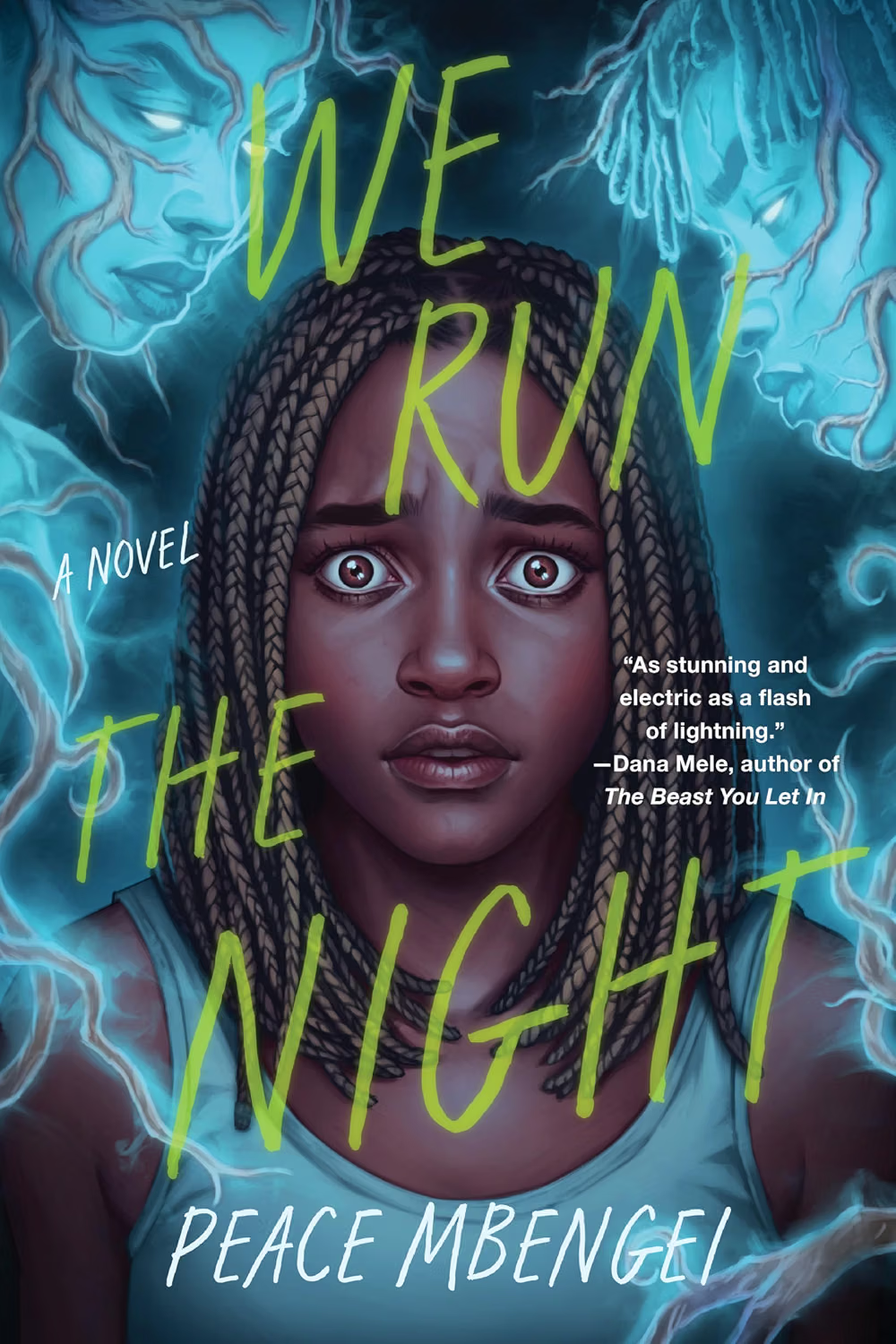
We Run the Night by Peace Mbengei
An elite, isolated Kenyan boarding school is terrorized by supernatural entities, grotesque maladies, and strange transformations in a chilling YA horror debut inspired by the urban legend of “night runners.”
Perfect for fans of She Is a Haunting and White Smoke
When Shani returns to her elite, isolated boarding school after her father’s mysterious death, she just wants to finish senior year with her scholarship intact—which means focusing on her work and staying out of trouble. Even with her best friend, Pendo, by her side, she’s never quite fit in at Taji Academy. But soon, strange things start happening at school—not only are students coming down with odd, grotesque skin maladies, someone is causing chaos on campus after curfew. Are they night runners, the supernatural entities that terrorize rural neighborhoods in the dark?
The strict administration insists it’s just students pulling pranks. Everyone knows that night runners are just an urban legend. But when one of the popular students, Adila, goes missing—and Shani wakes up one morning with mud on her feet, torn clothes, and a pounding headache—she knows it’s more than that. As she and others at Taji begin to transform with no way to contact the outside world, she must figure out what is happening—before it’s too late.
Jim "The Don" McLeod has been reading horror for over 35 years and reviewing it for more than 16. He's the editor of Ginger Nuts of Horror, Europe's largest independent horror review and culture site, and a British Fantasy Award nominee for his work in the genre. When he's not busy inflicting his opinions on the horror community, he can be found annoying his family or getting thoroughly outwitted by his two dogs, Casper and Molly.
Ginger Nuts of Horror: The Heart and Soul of Horror Reviews
Every feature is built to sell your work. We include backlinks to your website or Amazon author page, a full synopsis, and a universal purchasing link that sends readers straight to their local store. Add a large, engaged social following and an 18-year archive of trusted horror coverage, and you have a platform genuinely built to grow your readership.
Whether you’re an established author, an indie filmmaker, or a debut voice in indie horror, there’s a way for us to help you reach more fans. Explore our horror book reviews and horror movie reviews, then get your horror book or film featured today.