

- Bodies of Work by Clay McLeod Chapman Review: Supernatural Revenge Horror Delivers Ghosts, Art, and Unease
- Wake Up and Open Your Eyes by Clay McLeod Chapman: A Masterclass in Horror Writing
- What Kind of Mother by Clay McLeod Chapman
- Clay McLeod Chapman on Devil Inside and the Art of the Horrormance
- Devil Inside by Clay McLeod Chapman: The Horrormance That Makes Love Look Like an Infestation
Clay McLeod Chapman has spent a decade writing about the things that get inside people, and with Devil Inside he finally asks the obvious question: what if the thing getting inside you had feelings about it too? This is his horrormance, published by Titan here and Mira in the States, and it pairs a bike messenger who died for two and a half minutes with a demon who has never owned a body of her own. Demonic possession horror is a crowded shelf. Very little on it has this much heart, or this much nerve. Readers looking for horror romance books that actually commit to both halves have found the one.
Some romances end with two becoming one. This one means it literally, and it is not a metaphor you walk away from.
Devil Inside | Clay McLeod Chapman | Titan Books (UK) / Mira Books (US) | 11 August 2026 |
A horror novel about the thing romance never admits: that being wanted completely and being hollowed out are the same procedure, carried out by different hands.
Devil Inside by Clay McLeod Chapman: The Horrormance That Makes Love Look Like an Infestation
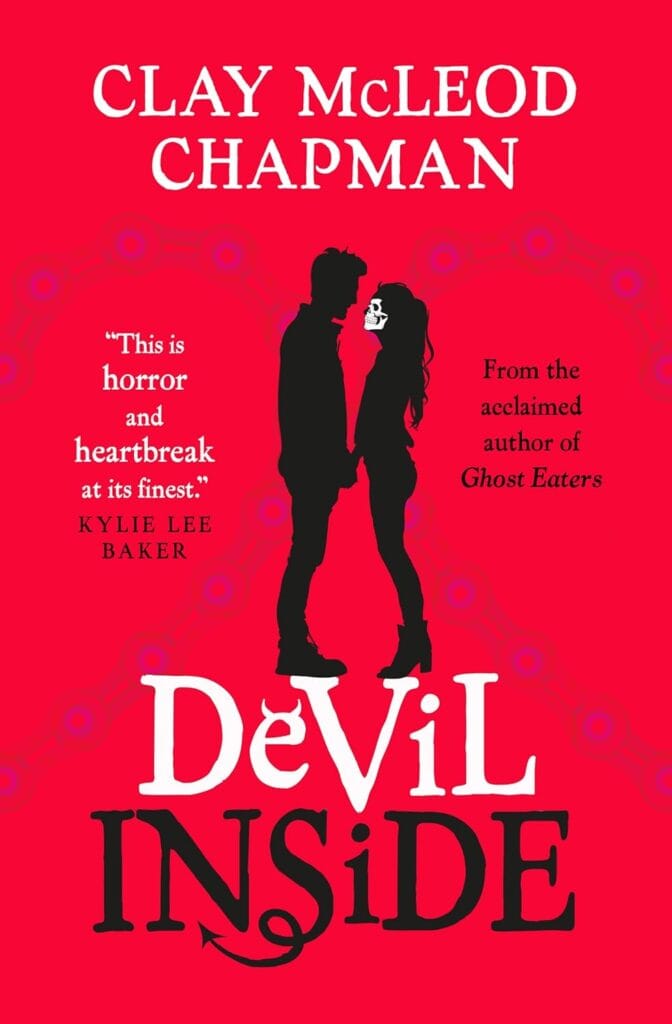
There is a particular dishonesty in the way we talk about falling in love. We say we were consumed. We say we lost ourselves in somebody. We tell a person we could just eat them up, and then we act startled when a novel takes us at our word.
Devil Inside takes us at our word.
Jordan is a bike messenger in New York, which in 2002 is still a job a young man can build an identity around, right at the point where mobile phones and email are quietly making the whole trade redundant. He is reckless because recklessness is the skill. Then a delivery goes wrong, the road wins, and he is clinically dead for two and a half minutes before somebody drags him back. A year on, he is technically fine. Food tastes of ash. Faces melt when he looks at them too long. His friends do the thing friends do, which is to keep suggesting he meet someone, as though a new relationship were a course of physiotherapy.
He meets Lilith in a club. She is not a woman. She is a demon wearing one, and she moves from host to host through touch, sampling souls the way a sommelier works a flight, grading each new body by what it tastes of. They have a night. She vanishes. And because Jordan came back wrong, he can see what nobody else can, which means he can find her again even when she is wearing a different face entirely.
That premise could have been a gimmick. What lifts it is that Chapman gives Lilith her own narration. The book opens with two prologues and then keeps volleying between them, so we are never allowed the comfortable position of watching a man be seduced by something unknowable. We know exactly what she is. We also know she is nervous. There is something genuinely destabilising about a creature that has ridden human bodies for centuries developing a case of does he actually like me, and Chapman plays it straight rather than for laughs. If even the demons are anxious about being wanted, the rest of us have no chance.
The wine conceit deserves its own paragraph. Every time Lilith enters a body she describes the soul she finds there in the vocabulary of tasting: notes, vintage, what it opens up into, what it leaves behind. It sounds like a clever flourish for about a chapter. Then it starts to curdle.
Because tasting notes are the language of connoisseurship, and connoisseurship is what you do to a thing you have already decided is a product. She is not being cruel when she does it. That is the point. It is simply how she has always understood people, and Chapman lets you sit with the discomfort of finding it charming before he shows you what it costs. By the time she is grading Jordan, you have already been enjoying her palate for a hundred pages.
There is a second thing the period setting is doing, and it is not just texture. A courier in 2002 is a man whose usefulness is being quietly withdrawn by technology he cannot argue with. Jordan loses his body to the road and his trade to the internet inside about a year. When a demon turns up offering to fill him, he is not being tempted so much as restocked.
The line the book keeps circling is the one that gives the whole thing away. Love is possession, Lilith says. We invite them in. Let them take over.
Look at what that does. Three sentences, and the last two are seven words between them. It refuses to build. The first sentence lands as a definition, flat and closed, the sort of thing said by someone who has thought about it far longer than you have.
Then the shift to we, which pulls the reader into the transaction rather than leaving them watching it. Then invite them in, which is vampire grammar, the old rule about thresholds and permission, imported into a possession novel where the whole argument is about who agreed to what. Chapman does not italicise it. He does not explain it. He drops it and moves on, and the reader is left holding a definition of love that also happens to be a legal defence.
That compression is the book’s default setting. The prose runs in short bent lengths, fragments, sentences that stop before you expect them to, and the recurring image bank is all wreckage: buckled metal, glass, the specific vocabulary of a collision. It works because Jordan’s body learned that language on the tarmac and never quite unlearned it. Reading it is like riding a bike frame that has already been through the crash, all short bent lengths welded back together, and the disconcerting thing is how well it still rolls.
I will say plainly that this style is the book’s dividing line. Some readers have found it choppy and repetitive, particularly through the first quarter, and I understand the complaint without sharing it. The early stretch is deliberately becalmed because Jordan is becalmed. A man who cannot taste his food is not going to narrate at pace.
Mild spoiler for the novel’s central theme
Now the difficult part, and the part that will decide how you feel about this book. Lilith has no body. To be with Jordan, she uses other people’s. The women she inhabits have not agreed to any of it, and for a long stretch Jordan does not let himself finish that thought. When the book finally does address it, the woman involved is not destroyed by the revelation. She is something closer to unbothered.
A significant number of early readers have called that a failure of nerve, and their reasoning is not stupid: raise a horror this size, they say, then hand-wave it. I think they have read the wrong scene as the answer. The horror here is not withheld, it is relocated. Chapman is not asking whether Jordan has done something monstrous, because the book has already established that he has and has watched him build the scaffolding of excuses in real time.
He is asking why a man will accept any terms at all rather than go back to a life where nothing tastes of anything. That is a bleaker proposition than a scene of condemnation would have been, and it is why the queasiness sits in the reader rather than on the page. You are not given the release of watching the book be angry on your behalf. You have to hold it yourself.
Whether that is bravery or evasion is a real argument, and it is being had loudly. My own view is that a horror novel which leaves you arguing with it a fortnight later has done the job that a tidier one would have ducked.
The interstitial chapters make the same case from a different angle. Every so often the narrative steps away from the couple to look in on ordinary households where a demon has taken up residence for an afternoon, and these are the most frightening pages in the book. The worst of the violence tends to be implied. One passage involving a family is devastating precisely because Chapman keeps the camera pointed slightly away from it. Some readers have found these chapters disconnected from the plot. They are not plot. They are evidence, submitted so that when Jordan tells himself Lilith is different, we know exactly what she is different from.
Placed against the rest of his work, this is a clarifying book. The Remaking was about a story that will not stop being retold. Whisper Down the Lane took the Satanic panic and traced how a lie eats a life. Ghost Eaters made addiction and grief the same appetite. What Kind of Mother went at parenthood with a scalpel. Then Wake Up and Open Your Eyes turned possession into a mass event, a whole country going under, families dissolving in front of their screens. Devil Inside is the chamber piece that had to follow it.
Having done possession as an epidemic, Chapman narrows it to two, which is the harder version, because a plague lets you blame the plague. He also has Bodies of Work out this year through Titan and Mr. Lonelyhearts due from Tor Nightfire in 2027, and the through line is now unmistakable. His subject is what happens when something else moves into the space where you keep yourself.
As for where it sits: this is horror first, and anybody arriving from paranormal romance expecting a safe pair of hands should be warned. The closest relatives are Sara Gran’s Come Closer, which understood decades ago that possession is most terrifying when the possessed is enjoying it, and Eric LaRocca’s studies of love as a mutual demolition. Barker’s The Hellbound Heart is in the family too, for the same reason: both books know that the truly unnerving thing is not the monster’s appetite but how reasonable its offer sounds.
Readers who took to Sarah Gailey’s Spread Me will find the ground familiar. What Chapman adds is that he genuinely honours the romance beats. The yearning is real. The dates are strange and specific and occasionally lovely. He has written a love story that works as a love story, which is the only reason it functions as horror.
The theme underneath all of it is consent, in the widest sense the word will stretch to. Not just the plot’s version, but the daily kind. What you agree to give up to be loved. How much of your own shape you will let a person reorganise before you notice. Chapman has said he wanted to know when two entities become one, and the answer the novel arrives at is that they do not, quite, and the trying is where the damage lives.
Five stars, then, and not because it is comfortable. Because it is a horror novel that understands the request at the centre of every love affair, which is let me in, and has the honesty to point out that it is also what the thing at the door says.
Devil Inside by Clay McLeod Chapman
A man who’s back from the dead meets a woman who’s from somewhere even worse in the new horrormance from the acclaimed author of Ghost Eaters, about love, possession, and just a little murder.
Perfect for fans of Rachel Harrison and Grady Hendrix.
After a traumatic accident that almost cost Jordan his life, he’s finally starting to feel normal again. Well, maybe not normal. Everything tastes like ash, and when he looks at the people around him, their faces start to melt. At least he’s not dead, right? His friends are doing their best to get him back on his feet, maybe find someone to talk to, perhaps even find someone to take his mind off his last failed relationship.
Then he meets Lilith. The two share an instant connection but after a wild and passionate night together, she ghosts him. Jordan searches the city for Lilith, desperate to see her again. But when a woman claiming to be Lilith shows up, wearing a different face but knowing intimate details about Jordan, he worries he’s losing his grip on reality. As he grows closer to this mysterious woman, he discovers that happily ever afters sometimes come at a cost. How far will Lilith take him, and how much darkness will he embrace to find love?
Ginger Nuts of Horror: The Heart and Soul of Horror Reviews

Every feature is built to sell your work. We include backlinks to your website or Amazon author page, a full synopsis, and a universal purchasing link that sends readers straight to their local store. Add a large, engaged social following and an 18-year archive of trusted horror coverage, and you have a platform genuinely built to grow your readership.
Whether you’re an established author, an indie filmmaker, or a debut voice in indie horror, there’s a way for us to help you reach more fans. Explore our horror book reviews and horror movie reviews, then get your horror book or film featured today.


Jim "The Don" McLeod has been reading horror for over 35 years and reviewing it for more than 16. He's the editor of Ginger Nuts of Horror, Europe's largest independent horror review and culture site, and a British Fantasy Award nominee for his work in the genre. When he's not busy inflicting his opinions on the horror community, he can be found annoying his family or getting thoroughly outwitted by his two dogs, Casper and Molly.