We Are For The Dark | Gretchen McNeil | Black Crow Books | 1 September 2026 |
A missing priest, an island with no way home, and a love that arrives too fast to be safe.
Some islands do not want to be found, and Bale Island is one of them. In We Are For The Dark, Gretchen McNeil drops a lapsed-FBI priest and a sidelined Newfoundland constable onto a scrap of rock with no boats, no shops, and a congregation that demands Mass every single day. What begins as a missing-person case curdles into religious folk horror of the slow, creeping kind. This is McNeil’s second adult novel, and it makes good on the promise of her first. Isolated, devout, and quietly merciless.
Be sure to read to the end of the review, as we have teamed up with Black Crow Books for a giveaway where one lucky UK resident can win a copy of We Are For the Dark
Gretchen McNeil takes a missing priest, a barren island, and a love that arrives too fast, and welds them into one question that follows you off the last page and out into the dark.
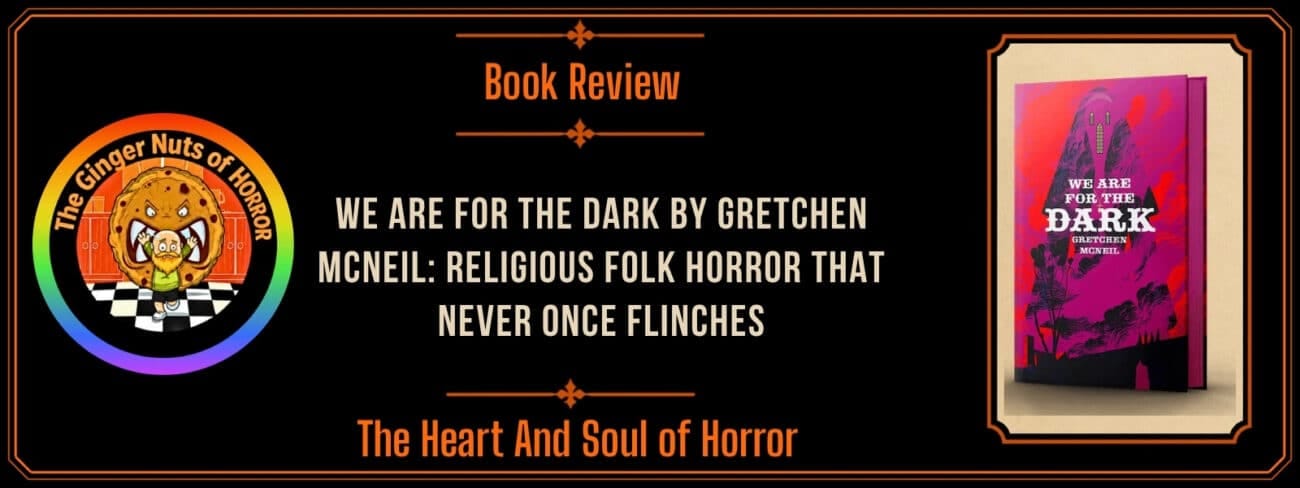
We Are For The Dark by Gretchen McNeil: Religious Folk Horror That Never Once Flinches
A fishing village keeps its boats where you can see them. That is the point of a fishing village. Take the boats away and you still have the harbour, the salt in the air, the church up on the hill. What you lose is the reason the place makes sense. You are left with a question in the shape of a town.
That is the first trick Gretchen McNeil plays in We Are For The Dark, and it is a good one. Bale Island has a harbour and no boats. It has streets with no shops and no cars. It has fat purple wildflowers growing over everything, as if the ground is trying to bury itself. And it has people who want Mass. Not on a Sunday. Every day, without fail. You work out quite fast that you are not on holiday.
The set-up is almost old-fashioned in its neatness. A priest goes missing off the coast of Newfoundland. Before he vanishes he makes a frantic call to a junior constable, then the line dies. Constable Miriam Rideout is stuck at a desk, talked over by the men around her, and told to leave it alone. She does not leave it alone. She books the ferry on her own time. Meanwhile a cardinal reaches out to Father Shane Ryan, a Maryland priest with a past he would rather forget, back when he worked for the FBI. Two outsiders, one island, and a case that neither of them was ever meant to solve together.
What follows starts as a mystery and does not stay one. This is where a lot of writers fumble the ball. The shift from one genre to another is a hard thing to pull off, because the reader signs a contract in the first chapter and hates having it torn up. McNeil does not tear it up.
She lets the detective story rot from the inside. The clues keep coming, the questions keep stacking, and then one day you notice that the answers have stopped being answers and started being warnings. By the time the book is openly a folk horror, you cannot point to the exact page where it changed. That is craft. The seam is meant to be invisible, and it is.
Her prose helps. It works like the island tide. It comes in slow and flat, it does not announce itself, and then you look down and the water is at your knees. She writes plainly, which suits a story about plain people doing an unspeakable thing for reasons they think are holy. There are no purple flourishes to match the purple flowers. When the horror lands, it lands harder for the quiet that came before it.
Look at how she builds the island through absence. The boats, again. The empty shops. A fishing town needs the sea and fears it, and McNeil keeps the sea close and the safety far. Every comfort of the modern world has been peeled away, and each thing that is missing tells you more than a thing that is present ever could. A monster on the page is a monster you can measure. A harbour with no boats is worse, because your own head fills the gap, and your head always picks something nastier than the writer would dare.
The two leads carry it. Miriam is prickly and stubborn and used to being underestimated, which makes her exactly the wrong person to fob off and exactly the right person to send somewhere she should not go. Ryan is the more layered of the pair.
A man who swapped one rigid institution for another, the Bureau for the Church, and who now stands on an island where both his old skills and his new faith are put to the test at once. They do not trust each other. Good. The best horror duos never do at the start, and the slow thaw between them gives the book a warmth to set against the cold coming up out of the ground.
Here is where I part company with some readers, so let me be plain about it. A fair few people have flagged the romance between Miriam and Ryan as a wrong turn. Too fast, they say. Out of place for a priest. A distraction from the real business of the island. I understand the objection. Three days is not long to fall for anyone. But I think the book is smarter than the complaint, and I think the romance is doing the heavy lifting, not the loafing.
Because this is a novel about how far you will go for someone you love. That is its motive. Strip the feeling out and you strip out the whole moral test at its centre. The island runs on a kind of love too, a warped and ancient version of it, and McNeil is holding the two up side by side to see which one bends. The romance is not a garnish on the horror. It is the horror’s mirror. Read it that way and the pace stops feeling rushed and starts feeling like a fuse.
A book that has spent three hundred pages telling you that faith costs something cannot then hand you a clean, cost-free finish. That would be the real betrayal. McNeil commits to the hard version. She makes her characters pay, and she makes the reader sit with the bill. You may not like where it leaves you. That is rather the point of it.
It helps to know where she has come from. This is McNeil’s second adult novel, after They Fear Not Men in the Woods, her 2025 turn into eco-horror set among the sentient forests of Washington State. Before that she spent well over a decade in young adult fiction, and not the shy kind. Ten put a body count on a storm-cut island back in 2012.
The #MurderTrending trilogy turned a prison island into livestreamed blood sport with a grin on its face. Four-Letter Word arrived only this year. So the isolated island is not new ground for her. It is home ground. What is new is the patience. The YA books move like a getaway car. We Are For The Dark takes its time, and the extra room lets the dread settle in properly, the way damp gets into a house.
You can feel her sharpening from one adult book to the next. Where the debut leaned on the wild and the green, this one leans on the built thing, the church, the ritual, the rules that outlast the people who wrote them. It is a cannier book about belief. She grew up in an Irish Catholic family, and that lived knowledge shows. She is not sneering at the faith from outside. She is prising it open from within, which is the only angle that ever truly unsettles a believer or anyone raised near one.
As for where it sits on the shelf, the obvious neighbours come to mind and the book earns the company. The Wicker Man is in its blood, of course, that same slow smile of a community that knows something you do not. There is Harvest Home in the old rites, and The Reddening in the sense of something buried and hungry under a coast. Robert Eggers and his witch and his lighthouse are close by in spirit.
But McNeil is not merely cosplaying the classics. She fuses a proper detective story to the folk horror, and she runs it through a Catholic frame rather than a pagan one, which flips the usual set-up. Most folk horror pits old gods against modern reason. This one pits the Church against something older than the Church, and lets you wonder, uneasily, whether the difference is as big as we tell ourselves.
Religious folk horror is having a real moment, and a lot of it is content to borrow the aesthetic, the candles and the chanting, without the ache underneath. This book has the ache. It is about the gap between the institution and the soul, the way an organisation built to save you can grind you down to fuel. It is about tradition as a trap, the kind you are born inside and cannot see the walls of. And under all of it, the plainest and hardest question the genre can ask. What would you burn to keep the person you love? Bale Island already knows its answer. That is why it is so frightening.
There are small rough edges. A couple of the islanders keep to type, and the mythology grows large in the back half. Minor things. They do not scratch the paint. A book that reaches this high is allowed a stretch mark or two, and I would take this swing over a safe, tidy near-miss any day of the week.
This book knows exactly what it is about and never once flinches from it. We Are For The Dark knows. It takes a missing priest, a barren island, and a love that arrives too fast, and it welds them into a single question that will follow you off the last page and out into the dark. Do not go looking for the boats. There are no boats. There was never going to be a way home.
Win a Copy of We Are For The Dark
Right, here is the good bit. We have teamed up with the fine folk at Black Crow Books to give one lucky reader a copy of We Are For The Dark, and it could be you.
Yes. You. The one still thinking about that island.
This is a five-star slice of religious folk horror, the sort of book you finish at 2am and then lie awake regretting. And we are giving one away for free. No catch. No small print the length of your arm.
Here is all you have to do:
- LIKE the social media posts for this review.
- SHARE them, so your whole feed can suffer along with you.
- COMMENT to tell us you are in.
BLUESKY
https://bsky.app/profile/gnofhorror.com/post/3mugt22qxnc2m
FACEBOOK
https://www.facebook.com/share/r/1HfJjwopF4/
INSTAGRAM
https://www.instagram.com/p/DcvEIQtNsjv/
Do all three and you are entered. Simple as that.
One winner. UK residents only, we are afraid, so if you are reading this from a boat-less island off Newfoundland, hard luck. Winner drawn at random.
So go on. Like it, share it, comment on it, and you could have We Are For The Dark on your shelf before the month is out. The dark is waiting. Do not keep it.
We Are For The Dark by Gretchen McNeil
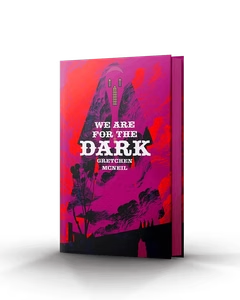
When Father Shane Ryan is summoned to a meeting with His Eminence Cardinal Jacobs, he’s confused. A recently ordained priest at a small Maryland parish, Father Ryan has no idea why His Eminence would want to meet him. When he arrives, the Cardinal opens by laying out Father Ryan’s past as an FBI analyst. It seems a priest has gone missing, and the case is…unusual.
Weeks ago, Constable Miriam Rideout from the Royal Newfoundland Constabulary fielded a frantic call from a priest on a remote Newfoundland island. He begged for help, but then the line went dead, and no one has since been reported missing. When permission to perform a wellness check is denied by her superiors, Miriam takes some vacation time and books a ticket on the ferry.
Thrown together with friendly but cagey locals, Miriam and Father Ryan soon learn that something about the island isn’t right. There’s a fishing port without boats, a town with no stores and no cars, and strange, bulbous purple wildflowers are growing everywhere. The two don’t trust each other, but they begin to learn that an alliance, however uneasy, is a necessity. Because something evil lurks beneath the island—something ancient, eternal, hungry—and neither it nor the uncanny islanders have any intention of letting these newcomers leave. A growing sense of dread intensifies until it explodes in this mystery turned nail-biting gothic horror.
Ginger Nuts of Horror: The Heart and Soul of Horror Reviews
Every feature is built to sell your work. We include backlinks to your website or Amazon author page, a full synopsis, and a universal purchasing link that sends readers straight to their local store. Add a large, engaged social following and an 18-year archive of trusted horror coverage, and you have a platform genuinely built to grow your readership.
Whether you’re an established author, an indie filmmaker, or a debut voice in indie horror, there’s a way for us to help you reach more fans. Explore our horror book reviews and horror movie reviews, then get your horror book or film featured today.

Jim "The Don" McLeod has been reading horror for over 35 years and reviewing it for more than 16. He's the editor of Ginger Nuts of Horror, Europe's largest independent horror review and culture site, and a British Fantasy Award nominee for his work in the genre. When he's not busy inflicting his opinions on the horror community, he can be found annoying his family or getting thoroughly outwitted by his two dogs, Casper and Molly.