
Death in Its Many Forms | S.H. Cooper | Independently published | 2 October 2026 |
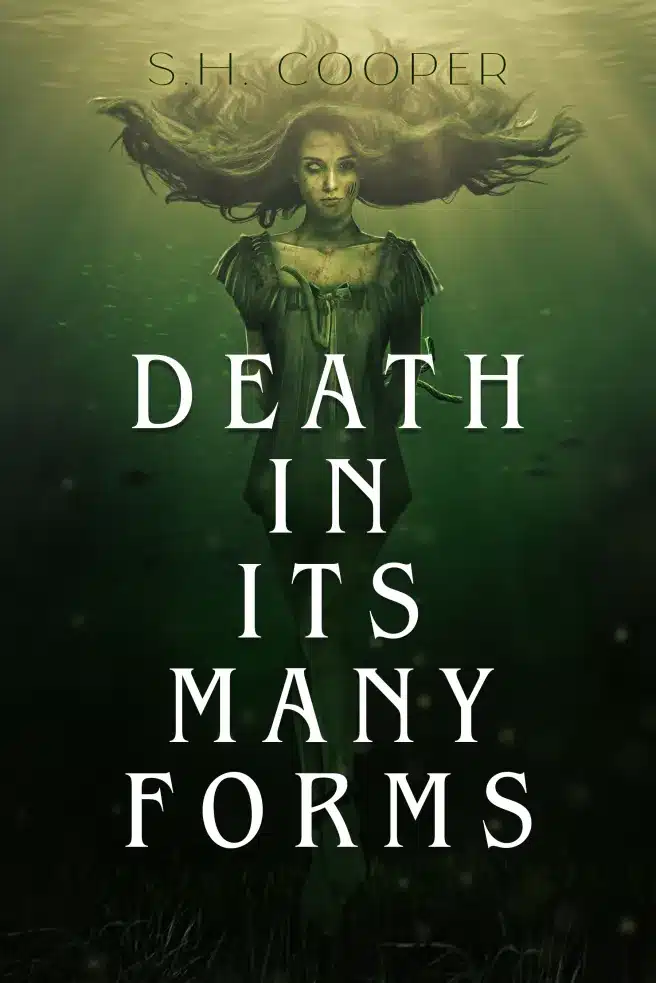
- Author S.H. Cooper
- Publisher Independently published
- Published 2 October 2026
- Format Kindle ebook
- Subgenre Supernatural horror collection
- Reviewed by Jim McLeod
Ten stories of the dead and the people they leave behind: a cursed maiden in a cave, a murdered girl in a swamp, a corpse that will not be ignored, and a ghost town held together by memory.
Death in Its Many Forms is the new horror short story collection from S.H. Cooper, self-published on 2 October 2026. It holds ten stories and ten deaths. A cursed maiden waits in a cave. A girl is drowned in a swamp by her own kin. A corpse lies on a station stair and will not be stepped over. An old woman climbs a mountain to visit a town where only the dead still live. In this Death in Its Many Forms review, I look at how Cooper builds a whole book around one hard question, and why the answer she finds is worth your time. Who gets to tell the story of a death?
Jim Mcleod
Ten stories and not one weak link. S.H. Cooper writes the dead as people with a grudge and a voice, and she hands them back the one thing death took from them: the right to tell their own story. Warm, furious and, at its best, truly frightening.
The Dead Take the Pen Back
Every death leaves a story behind, and the dead almost never get to write it. A coroner writes one. A news desk writes another. The man who did it writes the one he can live with, and he tells it often. The rest of us just pass on whichever version we heard first.
S.H. Cooper has noticed this, and it makes her angry. Death in Its Many Forms is ten stories in which the dead take the pen back. Some do it with teeth. Some do it by simply refusing to leave. One does it by walking out of a door and never coming back. The collection is about death, as the title promises, but it is really about custody. Who owns what happened? Who gets to say?
The pattern shows itself on the very first page. The Witch’s Path is told in the second person, to a young man walking into a cave with a sword and a head full of old tales. You think you are reading a hero’s quest. Then the voice turns, and the “I” in the dark is the woman he came to kill. A god wanted her. She said no. His curse makes everyone who sees her mad with love, and the men who come to slay her tear out their own hearts to prove it. She never lifts a hand. The stories call her a witch anyway.
This is a god’s idea of love meeting a man’s idea of glory.
That line is the whole book in small. The last line of the story sets the tone for the nine that follow: “The madness was never mine.”
Banbogach takes the same idea and makes it bleed. A soft, trusting girl is used and strangled by a golden-haired charmer and pushed into a bog. Something old, crowned in moss and rushes, pulls her out. She comes back with rage where her heart was and a hunger she does not yet understand.
She finds him, and she haunts him until his food rots on the plate. When his family calls in a wise woman, she names the ghost a banbogach: a girl who drowned herself for love and now lures men to the water. He grabs at the label with both hands. It makes her death her own choice. Cooper’s narrator sees the trick at once, and calls it a tale as old as womanhood. By the end she has taken the name back and made it mean what it should have meant all along.
The Space She Takes is where the idea goes fully strange, and it is the best story in the book. A homeless woman is stabbed on the steps down to a train platform. The police call her The Body. The news calls her an addict without saying the word. Soon after, a rich doctor is shot, and the city plants a garden in his memory even after his sins come out.
The Body never stood a chance against a name with that many letters behind it.
So she comes back. She lies face down on the same steps, and nobody moves her. She is a nuisance, a speed bump. Then she starts to grow. A few inches, then feet, then the whole stairwell. Her fingers reach out across 5th Street. Chainsaws fail. Machines cannot reach her. What finally shifts her is not force but care: a handful of strangers who decide she deserves a name and go and find it.
Cooper tells this one in a calm, flat third person, like a police report that slowly forgets to be cold. The capital B on The Body does the work. It is a proper noun standing in for a person, and the story only ends when the person returns.
Justice Has Teeth shifts to the American South and a warmer, funnier voice. An eighteen-year-old girl, too loud for church and too fond of the swamp, is bound and dropped into its deepest stretch by her Pa, her brother, and a fire-and-brimstone preacher, while her sister hands over the rope. Down in the green dark she meets a huge, scarred alligator. The girl names her Lady Justice.
What that gator then does is the most gleefully awful run of scenes in the collection. And yet the dead girl’s voice never loses its love for the family who killed her. She is not sure she can hate them. That is what makes it hurt. “I was used to not being everybody’s taste,” she says, as the fish nibble at her, and it is both a joke and a wound.
Is Death in Its Many Forms Scary?
Yes, and in more than one key. The most traditional fright comes in Charnel Mother, a tale of two body snatchers paid by a slippery doctor who wants corpses for his studies and wants to know nothing about where they come from. Every time they dig, a grave bell rings somewhere close. Then a veiled figure in burial shrouds starts to follow them. The thing under that veil is a black so deep the narrator nearly loses his mind looking at it, and what she does to his friend Tensley in a back alley is grim enough to stay with you for days.
For a reader in Edinburgh, a city that still keeps iron mortsafes over its old graves, the story lands very close to home. The doctor who hides behind science while poor men do the digging will feel familiar to anyone who knows the long shadow of Burke and Hare.
Breaking the Routine is scary in a quieter way, and it holds the finest piece of craft in the book.
Spoiler warning: the next three paragraphs give away the ending of Breaking the Routine.
A receptionist at an air-con firm called Hammet’s walks into work. The story opens with her morning in short, flat lines: key, lock, lights, stairs, pin code, purse, keys, mug. The list repeats, word for word, and then it repeats again. Cooper even sets the tasks out as a chant, ending each loop with “Rinse, repeat.” You start to skim. That is the point. Then, on the third pass, a line is missing and a new one sits in its place. The phone rings. Nobody speaks. The prose that felt safe a page ago now has a hole in it, and you feel the drop in your stomach just as she does.
Each new loop goes further. The coffee turns to blood. The office empties, then rots, then boards itself up. In the end she learns the truth. She died here. James, her boss’s sacked nephew, came up the stairs with a gun, and then turned it on himself. Since then he has kept them both in this loop so he never has to face what he did. He has been telling her a story to keep her still.
Now he wants to explain. He is sorry, he says, things were hard. She will not hear it. She picks up her purse and goes down the stairs. The last lines echo the first: she turns the key, the lock clicks, and she leaves. The routine that held her becomes the way out. It is a perfect ending, and it is the collection’s whole argument in one gesture. The dead owe their killers nothing, not even a listen.
End of spoilers.
The Key to Happiness flips that argument on its head, and it is a smart, nasty piece of work. Chris is hosting a dinner party. Her brother, his wife, her boss and her neighbour all turn up. We see the evening through her eyes, and every smile is a sneer, every gift an insult, every kind word a lie.
On the mantel sits a small white box with an old brass key inside. You do not need to know what it opens. You need only know that Cooper lets you sit inside Chris’s logic for long enough to half agree with her. In a book full of the truly wronged, here is someone who has decided she is wronged. The grievance that fuels Banbogach becomes, in her, a kind of poison.
Death of the Author is the wittiest story here. A struggling indie writer of horror romance, drinking alone at a convention bar, meets a man in a sharp suit who can make the barman jump with a tap of two fingers. He offers her what she wants most. She asks for bestsellers, and a film deal, while she is alive to see them. You know this kind of bargain. The Monkey’s Paw has been teaching it for more than a century. What Cooper adds is the twist of the pen name, and a dry, knowing look at the indie scene she knows from the inside. The sting is clean and cruel, and it is very funny until it isn’t.
If anything here falls short, it is Human Nature. A hole tears open in the sky on a perfectly ordinary Wednesday, and nothing comes out. Soon people are fighting over eggs. The narrator, a store manager with a cat called Baker the Biscuit Maker, is good company, and the shelf-by-shelf collapse of goodwill is sharp. But the shape of the ending is one you can feel coming from a long way off, and the final speech tells us what the other stories trust us to see. It is a small dip, and it is placed well, a breath between heavier stories. It does not dent the whole.
How Death in Its Many Forms Compares to Cooper’s Earlier Work
Cooper came up through Reddit’s NoSleep, and her first collection, The Corpse Garden, gathered stories that found their readers there. From Twisted Roots turned her eye to families and the harm they do. Since then she has written the gothic novella Inheriting Her Ghosts and its spiritual sequel Bottling His Ghosts, the cosmic horror of The Festering Ones, the grief horror novelette Reap, Sow, and more besides. She is a regular voice on The NoSleep Podcast and co-edited the anthology A Woman Built by Man.
You can hear all of that history here. The NoSleep habit of the close, confiding first person is still the default. But Cooper now bends it in clever ways: into the second person of The Witch’s Path, into the cool third of The Space She Takes, into the tender, sunlit third person of the final story. The anger she aimed at families in From Twisted Roots has grown more focused. And the grief that powered Reap, Sow has grown steadier and more patient. This is a writer who knows exactly what she wants to say and has found ten different doors to say it through.
Her prose works like the good lighting in a funeral parlour: soft, warm, kind to the face, and set up with great care so that you cannot look anywhere but at the body. She rarely shows off. The sentences are plain, short, often funny. Then a single image arrives, a heart cupped in loose fingers, a fork in an eye, a dead mother stirring bean soup, and it lands with full weight because nothing around it has been shouting.
On the shelf, the book sits with the revenge ghost and the drowned girl, a lineage as old as folk song. Justice Has Teeth will put some readers in mind of The Lovely Bones, with its murdered girl watching her family from beyond, though Cooper’s girl has a far sharper friend. Banbogach shares soil with Seamus Heaney’s bog poems and the punished women in them.
The Space She Takes would not look out of place beside Carmen Maria Machado’s Her Body and Other Parties, a book just as alert to how women’s bodies get named, used and forgotten. Readers who came to horror through Laurel Hightower’s Crossroads, or through Gemma Amor, Cooper’s partner on the audio drama Calling Darkness, will feel at home at once.
Then comes the closer, Haunting the Ghosts of Halftop, and Cooper does something brave. After nine stories of the dead taking their story back, she lets the living hold it for a while. Messy Sturgeon, now old, climbs a mountain each month to a dead mining town. The ghosts there shift with the light, young and old and bone, as the leaves move. Some homes she will not even look at.
One she always enters. Inside, her Momma is still cooking. Messy cannot touch her or hear her, so she just sits and talks. By the end Messy has decided that what lingers is not quite the dead at all, but the shape the living give them. It is the gentlest story in the book, and the one that pulls the rest together. Death takes the body. What we carry decides the rest.
Read this one slowly, a story a night, and watch who holds the pen. In Cooper’s hands, it is never the killer.
The Verdict: Is Death in Its Many Forms Worth Reading?
The verdict
A collection with no weak link, in which Cooper gives the dead back their voices and makes you feel every word they say.
Read it if: you like your ghost stories angry, tender and told by the people they happened to.
Skip it if: you want cosmic dread or wall-to-wall splatter, because Cooper’s horror is personal and grief always has a seat at the table.
Jim "The Don" McLeod has been reading horror for over 35 years and reviewing it for more than 16. He's the editor of Ginger Nuts of Horror, Europe's largest independent horror review and culture site, and a British Fantasy Award nominee for his work in the genre. When he's not busy inflicting his opinions on the horror community, he can be found annoying his family or getting thoroughly outwitted by his two dogs, Casper and Molly.
Ginger Nuts of Horror: The Heart and Soul of Horror Reviews