

Justin Dec talks Sentry, family, fear and the pull of the unknown.
Justin Dec | Interview | Ginger Nuts of Horror
Some horror starts with a monster. Some starts with a place, a memory, or the uneasy sense that the world is hiding more than it shows. For Justin Dec, Sentry grows from all of those things. Raised in Woburn, Massachusetts, Dec drew on his home town when creating the fictional Fall’s Landing, while a lifelong fascination with the supernatural, UFOs and unsolved mysteries helped shape the kind of stories he still wants to tell.
In this horror interview, Justin Dec talks about the fragments that become stories, the hard cuts that sharpen a novel, and the moment after publication when he realised his main character still needed one final emotional turn. He also discusses the influence of New England horror, the role of family at the heart of Sentry, and why atmosphere matters as much as plot when he wants readers to feel genuine dread.
Justin Dec on Sentry: A Horror Interview About Family and Fear
Sentry may be built from supernatural mystery and New England dread, but Justin Dec keeps returning to something more human: family, perspective, forgiveness and the need to face fear without letting darkness erase everything good that still remains.
Let’s start at the very beginning. For our readers, please introduce yourself. Beyond the author bio, tell us a little about who you are when you’re not writing, what you love doing, what fascinates you, and what fuels your creativity.
My name is Justin Dec. I grew up in Woburn, Massachusetts, a small town just outside of Boston which served as the inspiration for the fictional town of Fall’s Landing in Sentry. For as long as I can remember, I’ve been obsessed with storytelling. First through the movies and books that filled our house, and later by writing my own. My family had a huge collection of books and movies, and I’d spend hours in the basement reading or watching our old VHS tapes.
I started writing my own stories very young and sharing them with my family. My mother, who spent most of her career as a librarian at Cary Library in Lexington, always encouraged it.
Most of those early stories leaned into the unknown. I was fascinated by the supernatural, UFOs, unsolved mysteries. The kind of material The X-Files was made of. That fascination came from a deep, instinctive belief that there’s far more going on around us than we can ever fully see or understand. Those are still the kinds of stories I want to tell.
In the early stages of a new project, what tends to come to you first: a compelling character voice, a central thematic question, or a vivid image/scenario? How does that initial spark then guide you in building the rest of the story?
Everything I’ve ever written arrives in pieces. I keep a notes app on my phone and jot down every idea that surfaces. No filtering, no editing. Sometimes it’s a scene. Sometimes it’s a single image, a line of dialogue, or the outline of a character. I just let the fragments accumulate until patterns start to form. Then I group those pieces together, and that usually becomes the early backbone of an outline. Then I start filling in the rest.
Every book has its own unique set of problems to solve. What was the most difficult ‘puzzle’ you had to crack while writing this book? Was it a plot hole, a character’s motivation, the structure, or something else entirely?
With Sentry, the biggest challenge was a series of past-tense chapters I was deeply attached to. I held onto them for a long time. Then I did an exercise where I adapted the novel into a screenplay, which forced me to strip everything down to the central story. Once I finished that adaptation, it became clear that several of those flashbacks (including an entire section devoted to John’s childhood at Brookstones) had to go. Cutting them was painful, but it sharpened the novel.
The engine moved faster. Killing your darlings is never easy, but it’s often the most necessary step.
The journey from a finished manuscript to a book in a reader’s hands can be a surprising one. What was the most significant way your book evolved during the editing and publishing process, something you didn’t anticipate when you typed ‘The End’?
About two hours after I hit publish, a stark realization hit me: my main character hadn’t fully arced. He had been proactive in solving the book’s central mystery, but he hadn’t completed the emotional journey I’d envisioned. I knew exactly what I wanted the reader to feel, yet I knew somehow I hadn’t fully delivered it on the page.
I waited days for the published version to be approved so I could go back in and add two simple paragraphs that completely changed the novel. Then I hit publish again. That experience taught me something important: sometimes you have to push all the way to the end of the process (and, in my case, past it) before the missing piece finally reveals itself. You can’t wait for the answers to arrive. You have to create the pressure that forces your most creative self to deliver.
Once a book is published, it no longer entirely belongs to the author; it belongs to the readers and their interpretations. Has a reader’s reaction or analysis ever revealed something about your own work that surprised you?
Not yet, but I’m genuinely excited to see what comes back once readers start responding.
Writing is a demanding, often solitary pursuit. Beyond the apparent goal of ‘telling a story,’ what is the specific, personal fuel that keeps you going through the difficult stretches?
For me, it’s the gift (or the flaw, depending on how you look at it) of being all-or-nothing. I can’t leave something unfinished. I can’t do anything halfway. When I commit, I go all in. It’s lonely and frustrating at times, but ultimately deeply rewarding. I also like to put things out as soon as they are finished, whether it’s a short film or a full novel. I hate waiting. I just want to put it out so I can move on to the next thing.
I’ve been creating since I was a boy, and this moment we’re living in where you can put something into the world as soon as you’re ready (whether it’s Amazon KDP for novels or YouTube for films) feels like a remarkable time to be a storyteller.
We often hear about authors being influenced by other books. What are some non-literary influences on your work…
I grew up on a steady diet of Steven Spielberg, Stephen King, and Michael Crichton—the big-idea storytellers who push the boundaries of imagination and pure escapism. I love reading or watching something that completely transports me. That’s what I gravitate toward most, and it’s what I try to create.
Who was the first person to see your early drafts, and why did you trust them with your unpolished work? What is the most valuable piece of feedback they gave you?
My wife. Always my wife. I trust her with everything. She looks at my work from an emotional point of view and lets me know if something is working or isn’t.
Setting in horror is often described as a character in its own right. How do you approach transforming a location… into a source of active dread?
I love a good, spooky New England setting. I grew up in one, and on rainy or foggy days I would daydream about the dark possibilities lurking out there. Building that kind of atmosphere is a genuine joy, almost like writing poetry. I want readers to feel as if they’ve been transported not just to a place, but into a specific feeling.
How do you approach writing scenes of intense terror or violence…
It’s a careful balancing act that requires a lot of revision. I always start by writing far too much, then peel it back. I need to see the material with fresh eyes each time, so I’ll put a scene away for at least a month before returning to it. I do this repeatedly until it finally feels right. Even then, part of me still believes it needs more work. The truth is, if I didn’t hit publish, I could keep working on something forever.
Do you have a favourite line or passage from your work, and would you like to share it with us?
Yes, but it completes the main character’s arc and would spoil the book. Just know that it lives in the chapter titled “Save Him, Save Yourself.”
What is the specific, core truth you are trying to expose or explore through your horror?
That you can’t run from the bad without losing some of the good. Life is largely a matter of perspective. If you choose to see only the darkness, the world becomes a terrifying place. But if you focus on the light—if you face and conquer your fears—there’s a beautiful world full of possibility waiting on the other side.
You have precisely two minutes in a crowded bookstore to hook a reader who is sceptical of the entire horror genre…
I would ask: Do you have a sibling? Or someone in your family you haven’t spoken to in a while? Then this book is for you.
At its heart, Sentry is about the universal theme of family. The idea that our loved ones are still there for us even when we can’t see it. Strip away the supernatural elements and the horror, and what remains is the story of two brothers finding their way back to each other after years of estrangement. Who doesn’t want to see a family repair its bonds? Life is too short to keep holding on to the past. Let it go, forgive, and love one another while you still can.
This Justin Dec horror interview makes one thing clear: Sentry may be full of dark possibilities, but family estrangement is apparently still scary enough without the supernatural getting involved.
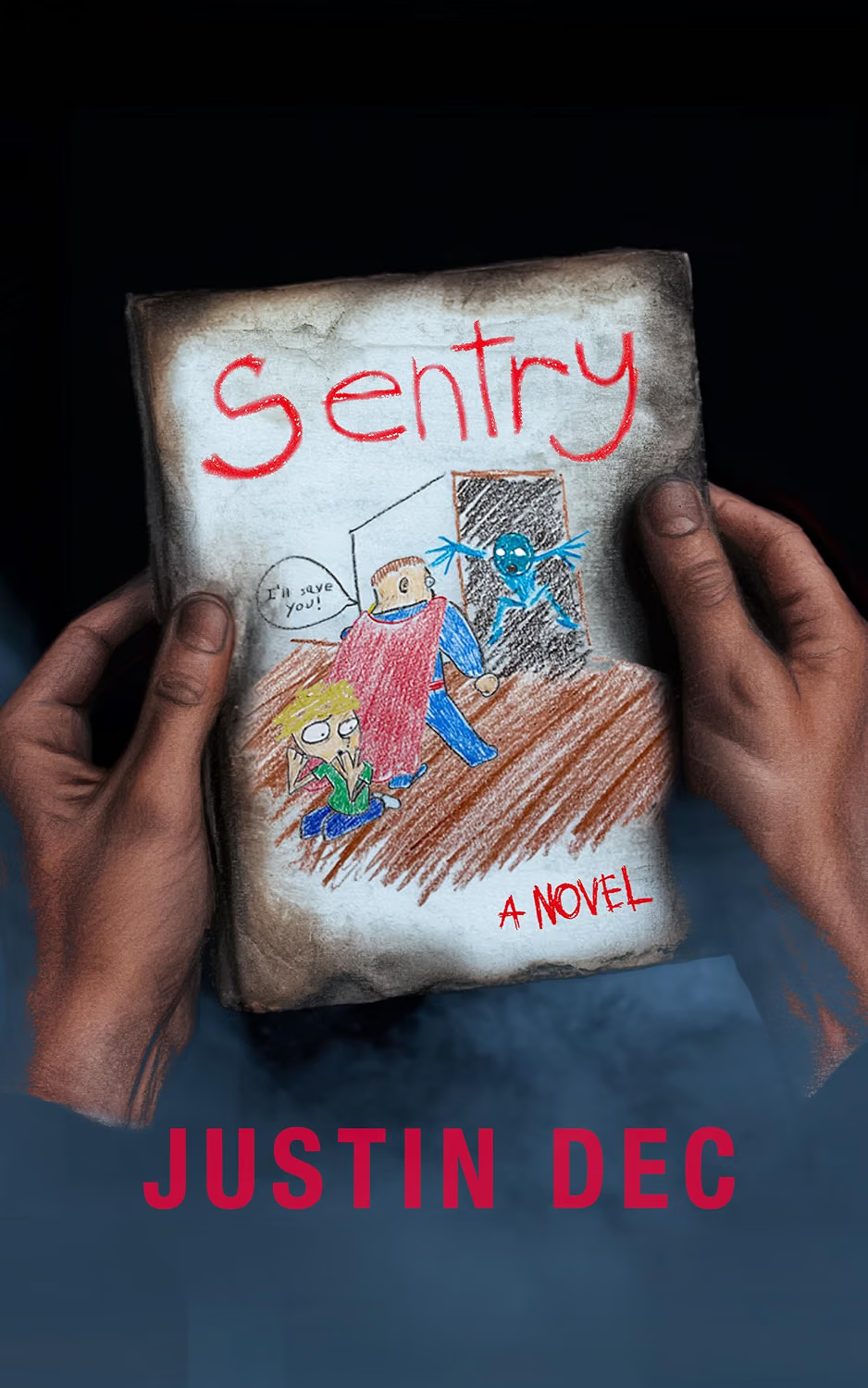
Sentry by Justin Dec
From the writer and director of the hit horror film Countdown comes a chilling debut novel.
While packing up their late father’s home, estranged brothers John and George Lawson unearth John’s childhood comic series SENTRY—a hero he invented as a boy to battle the ghosts only he could see. And at the center of the yellowed pages lurks the Blue Boy, a terrifying, monstrous figure who once terrified John from the darkness beyond his closet door.
As the weathered comics claw open a past full of monsters, long-buried secrets pour out, forcing the brothers to confront the trauma that shattered their family and unravel a deadly mystery thirty years in the making—one where the Blue Boy holds the terrifying truth.
Set against the haunting backdrop of a small New England town, SENTRY is a gripping supernatural thriller that explores the devastating strain mental health can place on a family, and the power of empathy, understanding, and forgiveness to heal even the deepest wounds. At its heart, it’s a story about how family is always there for you, even when you can’t see it.
Perfect for fans of emotional ghost stories, psychological suspense, and literary horror, SENTRY will linger with you long after the final page.
Ginger Nuts of Horror: The Heart and Soul of Horror Reviews
Every feature is built to sell your work. We include backlinks to your website or Amazon author page, a full synopsis, and a universal purchasing link that sends readers straight to their local store. Add a large, engaged social following and an 18-year archive of trusted horror coverage, and you have a platform genuinely built to grow your readership.
Whether you’re an established author, an indie filmmaker, or a debut voice in indie horror, there’s a way for us to help you reach more fans. Explore our horror book reviews and horror movie reviews, then get your horror book or film featured today.