Jeneva Rose trades her famous twists for dread, betrayal and consequences that never lift.
Jeneva Rose On Sometimes I Scare Myself | Interview

Jeneva Rose built her name on thrillers designed to fool sharp readers, so her arrival in horror comes as a jolt. Sometimes I Scare Myself is the New York Times bestseller’s first horror short story collection, and it drops the puzzle box entirely. In its place: three novellas built on dread rather than deduction, where saying yes to a dinner invitation, a new neighbour or a roadside curiosity shop turns out to be a fatal mistake.
Ginger Nuts of Horror sat down with Rose to talk about what changed when she stopped engineering twists and started asking how far a single bad decision could travel. She discusses writing Never Kill the Medium, The Nightmare House and All Curses Are Final, why she let the violence sit fully on the page for the first time, and how becoming a mother reshaped her fear of the world enough to write a postpartum narrator nobody in her own story will believe. She also talks candidly about Stephen King’s Pet Sematary, the grief she borrows from it, and why horror, unlike her thrillers, is under no obligation to hand the reader a reckoning at the end.
A woman crawls back into the cursed shop that has just cost her everything, slaps a cheap plastic pen on the counter, and pays three dollars and sixty-eight cents to make it stop. That is how All Curses Are Final ends, and it tells you most of what you need to know about Sometimes I Scare Myself, Jeneva Rose’s first horror collection and her first hard turn off the road that built her.
Rose sold millions of thrillers on twists a sharp reader could just about crack in time. Here she does the reverse. A séance nobody finishes. A town that will not let a family leave. A debt settled far too late. There is no puzzle to solve in these three stories, only the ugly arithmetic of one small bad choice compounding into slaughter. The Queen of Twists has traded fair play for something older and colder, and she sounds like she is having a wonderful time doing it. So let us start with the mechanism under the bonnet.
Jeneva Rose swaps her famous twists for something colder in Sometimes I Scare Myself, three novellas where hospitality curdles, motherly instinct gets dismissed as hormones, and every bad choice compounds into slaughter with no reckoning waiting at the end.
The Queen of Twists Stops Playing Fair: Jeneva Rose on Sometimes I Scare Myself
Your introduction to the collection describes stories that grew from the kind of thought that, if anyone knew you were thinking it, would get you locked up. That is a very different fuel from plotting a thriller backwards from its reveal. When a story starts as a dangerous what-if rather than a puzzle to be assembled, how does the writing itself change, and what did that shift let you get away with on the page?
It was very freeing. With a thriller, I’m always thinking about the reader and the contract I’ve made with them. I’m planting clues, hiding things in plain sight, deciding what they should know and when they should know it, and making sure that when the twist comes, it feels surprising but also earned. There’s a lot of engineering happening behind the scenes.
With these stories, I got to shut that part of my brain off a little. They all started with a thought that amused or disturbed me, and instead of asking, How do I turn this into a puzzle? I asked, How far can I take this? That gave me permission to be more reckless on the page. I could kill people I might normally need for another ten chapters. I could let one bad decision spin completely out of control. I could be grotesque and funny in the same scene. And I didn’t have to save the biggest moment for some perfectly engineered reveal at the end.
Never Kill the Medium announces early that this is not a case of finding out who did it but of staying alive after something has crossed over. You made your name on the reveal, on the moment the reader realizes they were looking the wrong way. What was it like to deliberately remove the solvable mystery and ask readers to sit in the dread instead of racing you to the answer?
There’s something almost more uncomfortable about knowing what the danger is. In a thriller, uncertainty creates a lot of the tension. You’re wondering who is lying, who can be trusted, what you’ve missed. With Never Kill the Medium, I wanted to take that away rather quickly. You know something has crossed over. You know these people are in serious trouble. Now you just have to sit there and watch them try to survive it. That creates a different kind of tension. It’s less, Can I figure this out before Jeneva tells me? and more, How bad is this going to get? And I had so much fun with that.
I also love the helplessness that comes with dread. You can see the bad decision before the character makes it. You’re practically screaming at them not to open the door, not to go upstairs, not to split up—and then, of course, they do. You can’t solve your way out of it. You’re just trapped in there with them. That’s one of the things I love most about horror as a reader and a viewer. Knowing the monster is there doesn’t necessarily make it less scary. Sometimes knowing it’s there and having to wait for it to come through the door is so much worse.
Across all three stories the horror arrives dressed as hospitality. Erica’s perfectly plotted birthday dinner, Judi Vee’s casseroles and welcome party, the roadside shop that will happily ring up a curse at the till. Was that corruption of the host and the guest something you built on purpose, or did you notice it curdling across the three stories only once they were sitting side by side?
I noticed it more once the stories were sitting side by side. I didn’t consciously set out to make hospitality this thread running through all three, but clearly my subconscious had other plans. Each story starts with some version of an invitation or welcome—a birthday dinner, new neighbors, a weird little roadside shop—and in every case, accepting it turns out to be a terrible idea. There’s something especially unsettling about taking a place or a gesture that should make you feel safe and corrupting it.
I’ve never been as scared by horror that announces itself. If I walk into a dark, abandoned house in the middle of nowhere, I already know I shouldn’t be there. But if I’m somewhere I’m supposed to feel comfortable and something is just slightly off, that gets under my skin. I love that moment when the familiar starts to feel wrong, because by the time you realize you should be afraid, you’ve already let the horror inside.

The Nightmare House hands its clearest eyes to Kristin, a woman twelve weeks postpartum, then makes her fear the one thing nobody around her will believe, filed away as hormones and exhaustion. Writing a newly postpartum narrator as the only person seeing the town clearly is a pointed choice. What drew you to making maternal instinct the exact thing that gets dismissed, and how did you keep the reader trusting her when the whole town insists she is unwell?
This one was incredibly personal for me because I wrote The Nightmare House after becoming a mother myself. I knew what it felt like to be newly postpartum—to be exhausted, anxious, fiercely protective, and sometimes unsure whether what I was feeling was instinct or fear. That felt like perfect ground for horror. Kristin is twelve weeks postpartum, so everyone around her has a reasonable explanation for why she’s frightened. She’s sleep-deprived. She’s overwhelmed. Maybe she’s imagining things. And the more scared she becomes, the easier it is to use that fear as evidence that she shouldn’t be trusted.
I wanted the reader to experience some of that uncertainty with her. Kristin questions herself because I questioned myself postpartum too. But underneath it is this primal instinct telling her something is wrong and she needs to protect her child. Motherhood gave me an entirely new set of fears, but it also showed me just how powerful that instinct can be. For Kristin, being afraid isn’t her weakness—it’s the reason she sees what everyone else refuses to.
None of these three endings lets anyone off. Beckie simply becomes the better host, the house rebuilds itself and waves in a fresh family, and Blair pays her debt too late to bring Noah or Maddie back. Your thrillers tend to deliver a reckoning, a verdict, a sense that the scales have moved. What made you want to withhold that release here and send readers out with the wound still open?
I think horror stays with me longer when it doesn’t give me the comfort of resolution. In a thriller, I love delivering that reckoning—the truth comes out, the pieces click into place, and even if the ending is dark, there’s usually some sense that things have shifted.
I didn’t want that comfort here. Horror feels more frightening to me when the terrible thing isn’t defeated just because the story is over. Sometimes there is no justice or closure, and realizing you made the wrong choice doesn’t undo its consequences. I wanted these endings to leave a little splinter behind—to make you close the book and still feel like something isn’t quite settled. Because it isn’t.
Your thrillers keep a lot of their violence behind the reveal or just off the edge of the frame. This collection does not. A neck unzips in an interrogation room, a throat opens under a running shower, a pen goes into an eye. What changed for you about putting the violence fully on the page, and how did you find the line between a moment that lands and a moment that only splatters?
I’m a huge horror movie fan, and I love a good, gruesome kill, so it was fun to finally let myself go there. In my thrillers, violence usually serves the mystery, so I’m much more restrained about what I put on the page. With these stories, the violence could be part of the experience.
But I never want gore just for the sake of gore. For me, the violence has to do something. It should scare you, shock you, make you laugh when you probably shouldn’t, or be the horrible payoff to what you’ve been dreading. If I’m describing a pen going into an eye, I want you to recoil, but I also want you to understand exactly why that moment belongs there.
From The Perfect Marriage through The Perfect Divorce you have turned marriage into a crime scene, and every story in this collection also rots outward from a poisoned relationship, whether that is Chad’s affair, a family under siege, or a couple two weeks into a breakup. Infidelity and quiet betrayal are clearly a nerve you keep pressing. In what way did horror let you be more honest about what that betrayal does to people than a courtroom plot ever allowed?
I don’t know that horror let me be more honest about betrayal, but it definitely let me be more visceral about it. In my thrillers, betrayal tends to become motive. Someone cheats, someone lies, someone keeps a secret, and that sets this larger machinery of revenge or consequence into motion.
In horror, I could make the emotional damage physical. It doesn’t just destroy a marriage or a family—it can literally invite something terrible into your home, turn the people you love against you, or follow you until there’s nowhere left to run. I think I keep returning to infidelity and betrayal because there’s something inherently frightening about realizing the person you trust most has a version of themselves you don’t know. Horror just allowed me to take that fear to its most extreme conclusion. The relationship is already cracked. Now, I get to see what crawls in through the opening.
You have crossed genres before this, from the time-slip of The Girl I Was to the zombie apocalypse romance of Dating After the End of the World. Horror is the newest room in a house you keep extending. Which of those earlier detours taught you the most about the thing horror lives or dies on, which is tone, and how did that lesson show up in these stages?
Probably Dating After the End of the World. Writing a zombie post-apocalyptic romance taught me that you can ask a reader to go almost anywhere with you as long as you establish the tone and stay true to it. The premise can be outrageous, but the characters still have to feel real and the stakes have to matter to them.
That carried into Sometimes I Scare Myself, especially Never Kill the Medium. That story is bloody and ridiculous and darkly funny, but I never wanted it to become a parody of horror. The characters may say something funny while something horrific is happening, but the danger’s still real to them.
I think that’s what I’ve learned from crossing genres. Something can be funny and scary and sad all at once, as long as the reader believes those things can exist in the same world.
Your route into publishing is well documented, and I have no interest in making you retell the rejections and the viral video. I am more curious about the writing itself once millions of people were watching specifically for you to fool them. Did the pressure to keep out-twisting yourself have anything to do with walking into a genre where the twist is no longer the job?
I don’t think the pressure pushed me into horror, because I’ve always loved the genre and wanted to write it. Horror was something I wanted to explore regardless of what was happening with my thrillers.
Once you become known for twists, readers start reading you differently. They’re suspicious of everything. They’re looking for the lie, studying every character, trying to figure out what I’m hiding. I love that relationship with my thriller readers, but there’s a great deal of pressure in knowing that I have to keep surprising people who have become very good at anticipating me.
So there was definitely something liberating about writing stories where nobody was waiting for me to pull the rug out from under them, and it reminded me that surprise is only one way to keep someone turning the pages. Sometimes telling the reader exactly what’s coming and making them dread its arrival can be just as powerful.
Now that you are writing on this side of the fence, I want to know what scares the person who scares everyone else. Which horror novel or story genuinely got under your skin and stayed there, and what was it doing that you found yourself wanting to learn?
Pet Sematary by Stephen King has always gotten under my skin, and what scares me most about it isn’t really the supernatural element. It’s the grief underneath it and the terrible choices people make when they’re desperate to undo something that can’t be undone. Becoming a mother has only made that story more horrifying to me.
What I admire about King, and what I’m always trying to learn from, is how he can make you understand a character’s terrible decision even when you know exactly where it’s going to lead. You know Louis should stop. You know nothing good can possibly come from what he’s doing. But you understand his grief so completely that you understand why he can’t.
A thriller, by design, tends to restore order. The killer is named, the puzzle closes, the world rights itself. Horror is under no such obligation and can leave the reader standing in the ruins. What can horror say about fear, or about people, that your thrillers by their very nature are not built to say?
I think thrillers tend to ask, Can you understand what happened? Horror gets to ask, What happens when understanding it doesn’t help you? Fear strips away all the versions of ourselves we like to believe in. We can say we’d be brave, that we’d protect someone else, that we’d make the rational choice—but you don’t really know who you are until you’re terrified and there is no good choice left.
The comedy in this book is doing dangerous work. Ricky’s gallows one-liners land inches from a body, and Kristin telling Judi her casseroles were shit arrives in the middle of a hunt. Get the timing wrong and a laugh punctures the tension for good. How do you calibrate the joke so it tightens the screw rather than releasing it?
I think the trick is that the joke can’t feel like I’m stopping the story to be funny. It has to come naturally from the character and the moment. Ricky uses humor because that’s who he is. Kristin telling Judi her casseroles were shit works because she’s terrified, furious, and out of patience. Neither of them is trying to entertain the reader.
I also love the discomfort of laughing when you know you probably shouldn’t. If the joke releases all the tension, it’s in the wrong place. But if you laugh and then immediately think, Oh God, why am I laughing right now? I’ve probably done my job.
You chose three long stories rather than a novel or a bag of shorter pieces, each one given room to simmer. The novella length seems central to how the dread accumulates here, the slow domestic build before the floor gives way. What does that middle length let you do to a reader that neither the novel nor the short story can?
The novella felt like the sweet spot for these horror stories. It gave me enough room to develop characters and make the reader care about what happened to them, but there was not enough space for the story to lose momentum. Once things go bad, they can go bad very quickly. I can build tension, accelerate, and get out before the reader has a chance to get comfortable again.
Your introduction is candid about the collection coming from thoughts you would rather nobody knew you had. There is a licence a writer gets to follow the worst idea all the way to the bottom and then hand it to a stranger to read. When you write one of those thoughts out in full, does putting it on the page quieten it, or does it feed the next one?
I wrote this collection postpartum, when I had more anxiety and fear than I was used to carrying around. Becoming a mother gave me a whole new list of things to be afraid of, and my brain was very good at imagining every terrible thing that could possibly happen. Writing horror became an outlet for that. Instead of sitting with those fears myself, I could give them to my characters.
I could take an intrusive thought, follow it to the absolute worst possible conclusion, make someone else live through it, and then close the document and walk away. There was something freeing about turning those darker thoughts into something useful. Apparently, my coping mechanism is just making fictional people suffer instead.
Every story here turns on a single moment that can never be taken back. The séance that cannot be un-started, the pen that was already stolen, the debt paid a corpse too late. In your thrillers guilt can at least be argued down in a courtroom, but a curse offers no appeal. What do you think horror understands about consequence, about the door that stays open once you have opened it, that the rest of us spend our lives trying not to look at?
I think we spend a lot of our lives believing there’s a way back. We can apologize, fix the mistake, pay the debt, explain ourselves, make a different choice tomorrow. Horror gets to take that comfort away and say, No. You already did it.
That’s really the engine underneath all three of these stories. The characters make choices that might seem small or survivable in the moment and then discover there are consequences that don’t care how sorry they are. Maybe that’s one of the most frightening things horror understands: regret and redemption aren’t the same thing.
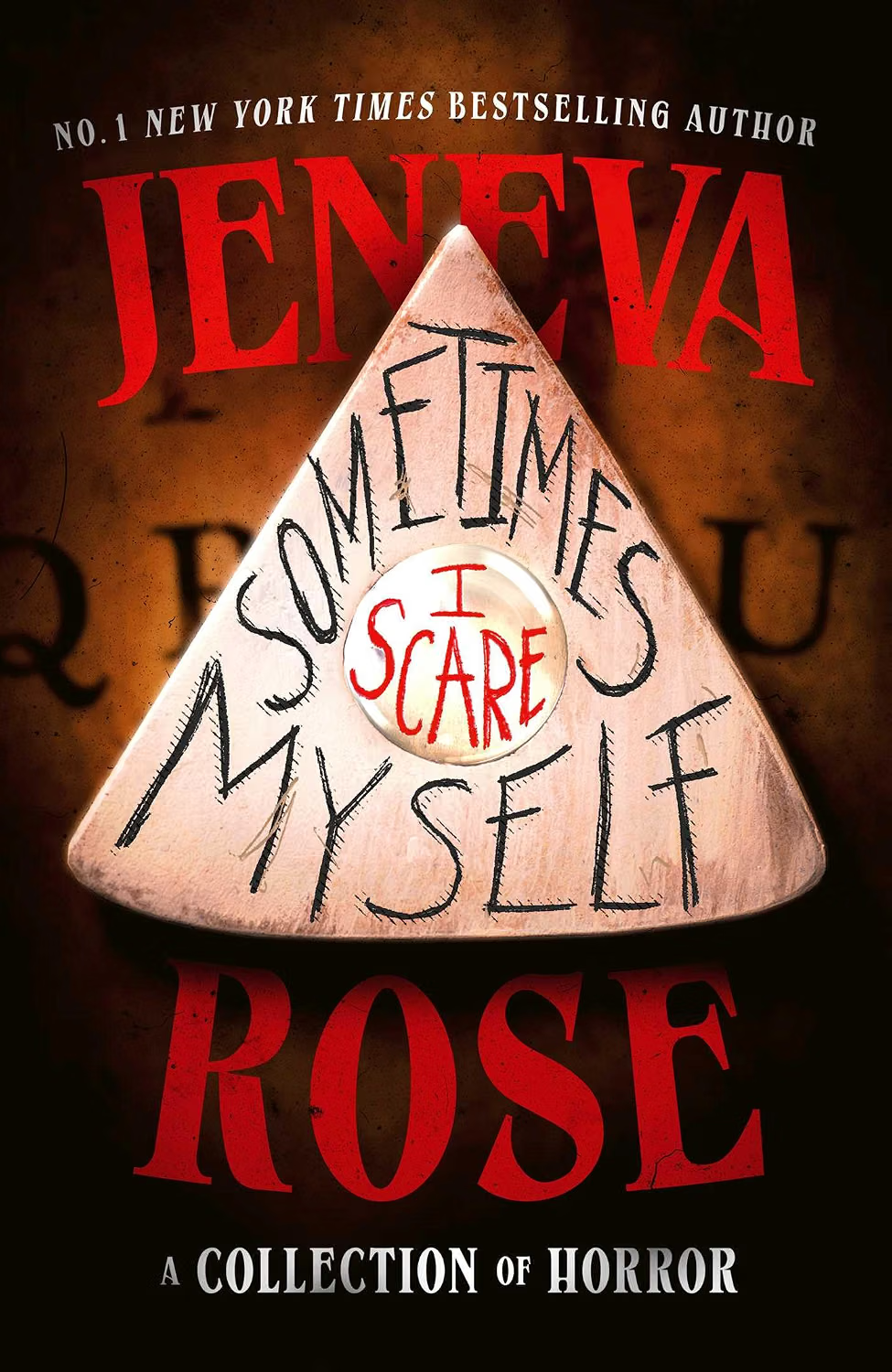
Sometimes I Scare Myself by Jeneva Rose
Not all nightmares come from sleep. Some come from #1 New York Times bestselling author Jeneva Rose in her most unsettling book yet.
A dinner party. A quiet house. A roadside stop.
Three familiar setups. Three terrifying turns.
In Never Kill the Medium, a thirtieth birthday dinner turns deadly when a playful séance spirals out of control – and the guests cover up a death without realizing they’ve left the ritual unfinished.
In The Nightmare House, a postpartum mother begins to suspect something is wrong with her family’s new forever home. The house whispers. The neighbors watch. And every family who has lived there has died or disappeared.
In All Curses Are Final, a group of friends stop at a roadside store with a hand-painted warning: ‘All items cursed. Curse lifted at time of sale.’ They laugh it off – until one of them finds an unpaid item in her bag. Snowed in at a remote cabin, they soon discover the curse is only the beginning.
Dark, twisty, and impossible to put down, this chilling collection proves that the most ordinary places can hide the most horrifying secrets.
Jeneva Rose

Jeneva Rose is the #1 New York Times bestselling author of several novels, including the multi-million-copy phenomenon The Perfect Marriage. Her work has been translated into more than thirty languages and optioned for film and television.
She lives in Wisconsin with her husband, son, and her English bulldog, Phyllis—named after Phyllis Vance of Vance Refrigeration (The Office), obviously.
When she’s not writing, she’s navigating motherhood, overthinking plot twists, and convincing herself she’ll relax after the next deadline.
Jim "The Don" McLeod has been reading horror for over 35 years and reviewing it for more than 16. He's the editor of Ginger Nuts of Horror, Europe's largest independent horror review and culture site, and a British Fantasy Award nominee for his work in the genre. When he's not busy inflicting his opinions on the horror community, he can be found annoying his family or getting thoroughly outwitted by his two dogs, Casper and Molly.
Ginger Nuts of Horror: The Heart and Soul of Horror Reviews
Every feature is designed to help sell your work, build your audience and connect your horror story with readers who are actively looking for their next frightening read. Our horror book reviews and features include backlinks to your website, publisher page or Amazon author page, a full synopsis, relevant author information and a universal purchasing link that directs readers to their local bookseller or preferred retailer.
All editorial coverage is provided completely free of charge. We do not charge authors, publishers, filmmakers or creators for reviews or features. Ginger Nuts of Horror exists to support the horror community and help great books, films and independent voices find the audiences they deserve.
With a large, engaged social following and an 18-year archive of trusted horror coverage, Ginger Nuts of Horror is a horror review website built to support authors, filmmakers and creators. Our coverage spans horror novels, indie horror, gothic fiction, folk horror, psychological horror, supernatural fiction, dark fantasy, horror films and the wider creative world surrounding the genre.
Whether you’re an established horror author, an indie filmmaker, a publisher, or a debut voice in indie horror, we offer opportunities to place your work in front of dedicated horror fans, readers, viewers and genre enthusiasts. A feature on Ginger Nuts of Horror can help improve discoverability, strengthen your online presence and give potential readers a clear route from discovering your work to finding out more or making a purchase.
Although our coverage is free, we do have a Ko-fi page for readers, authors and supporters who would like to help us continue promoting horror books, films and creators. All donations are entirely voluntary and greatly appreciated. Every contribution helps support the time, research and ongoing work involved in running an independent horror review website.
Explore our horror book reviews and horror movie reviews, discover the kind of horror coverage we publish, then get your horror book or film featured today.