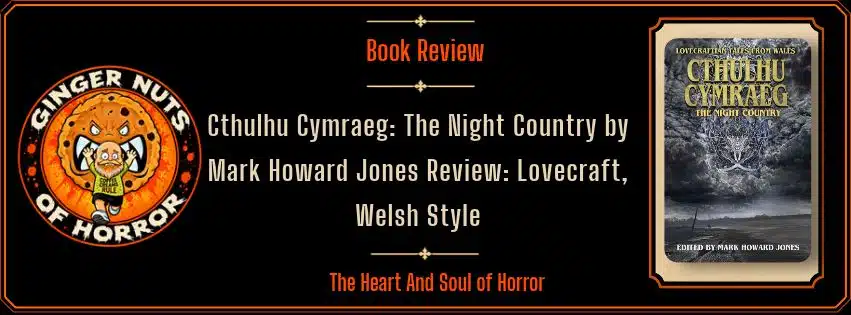
Cthulhu Cymraeg: The Night Country | Mark Howard Jones | Macabre Ink | 13 February 2026 |

- Editor Mark Howard Jones
- Publisher Macabre Ink
- Published 13 February 2026
- Format Paperback, ebook, audiobook
- ISBN 9781637894033
- Subgenre Lovecraftian horror
- Reviewed by Ben Unsworth
Seven new stories from Welsh writers carry Lovecraft’s cosmic dread into the land of Arthur Machen: a village with sinister meetings, a crate that should stay shut, and a bardic chair with a strange hold.
Cthulhu Cymraeg: The Night Country is the new book of Lovecraftian tales from Wales, edited by Mark Howard Jones for Macabre Ink. It picks up a series that began in 2013 and sets it in the land of Arthur Machen, the Welsh writer whose old evils fed Lovecraft’s own. This Welsh Lovecraftian anthology goes for length, not volume. There are just seven stories, and some run close to novella size. That gives each one room to build its mood. J. L. George, John Llewellyn Probert, Paul Lewis and Charles Wilkinson are among the names inside. In this Cthulhu Cymraeg: The Night Country review, Ben Unsworth sets out which tales earn a place in his year’s best.
The Night Country lets mortals play in the Old Gods’ sandbox without having to suffer Lovecraft’s prose. Its long stories trade tentacles for impression and sensation, and J. L. George and John Llewellyn Probert deliver the standouts. A little overlap in its cult settings barely dents a book that shows why Lovecraftian fiction can beat Lovecraft’s own.
Ben Unsworth
Why Lovecraftian Fiction Works Better Without Lovecraft
If I might make everyone feel old a second: I was eight when Mark Howard Jones’s anthology, ‘Cthulhu Cymraeg’, was first published in 2013. And though I only came to it in 2020, one of those Covid reading purchases, it remains a favourite of mine in terms of Lovecraftian fiction. This is not least because I find H. P. Lovecraft an author who is better when emulated and pastiched. It’s better when we mortals are allowed to play in the Old Gods’ sandbox without having to suffer the man’s prose, where story after story it becomes harder to divorce the art from the artist’s racism and xenophobia.
How does the next volume in the series – and I hope it continues to be a series, though not with thirteen year gaps between titles! – stand up then, intertwining the works of Arthur Machen with a bastion of America’s literary past?
Well, that two of its stories will almost certainly be in my end-of-year top 20 stories is one considerable indicator of the skill on offer. And another is that it reminds me why I love Lovecraftian fiction in a way that I don’t love Lovecraft’s fiction.
As a small aside: due to my stance on anthologies where the editor includes a story of their own, I won’t be reviewing Mark Howard Jones’s inclusion in depth here, however I will at least say it’s more than worthy horror story and I did enjoy it.
First up then is Paul Lewis’s ‘The God of the Green’, best described as a Lovecraft style spin on THE WICKER MAN or Hammer Films’ THE WITCHES. It follows a woman whose return home is unusual for a number of reasons: firstly, her mother has just died; secondly, there are weird vials of blood in the fridge; and thirdly, what looks to be harmless communal meetings have a sinister agenda.
While it does end up slowest of all the narratives collected here, it’s nonetheless a fervent and effective tale. The central character gets the majority of the fleshing-out rather than the potential sinister quality of the community, however the link to a childhood horror in a manner not unakin to Neil Williamson’s novella, ‘Charlie Says…’, is a cuttingly strange one. By the end, you’re left with a totally zoned-out sensation: as if you’ve fallen asleep with the TV on and are awakening to a background of strange voices. Really, Lewis’s greatest skill here is one harnessing the folklore in such a way that it gets creepier only once you’ve left the story for a day or two.
C. S. Saunders’s contribution is ‘Strzyga’, whose plot is more singular but just as good. It concerns a warehouse worker growing suspicious about a storage crate’s contents, and so of course he opens it to investigate; yet, what he unleashes is by turns tragic, action-filled, and pervasively frightening. His prose can’t help but keep the pace moving and it salivates over the gruesome details in a way none of the other stories here, and it has the air of a barn-storming film novelisation.
Definitely for the better, everything is painted in quite Grand Guignol brushstrokes despite the modern setting. The Lovecraft acknowledgement is a clear and precise one too, although what Saunders creates is a world indebted to the author rather than one hewn out of his creations. The story’s complexion in fact more greatly resembles, by and large, an Edgar Allan Poe romp.
Charles Wilkinson gets two cracks of the whip here, the first of which is ‘The Madness of T. S. Vargiven’. Some of its scenes edge towards emulation of Lovecraft’s own tale, ‘The Case of Charles Dexter Ward’, and others deep-dive into an alternate world of mad science (and not for the last time in the anthology). His prose is well-tuned and takes what could be rather schlocky and makes it actually far darker, atmosphere, and almost Manichean. And especial kudos for using the word ‘ziggurat’.
‘Tis a favourite of mine. The setting and cult-y descriptions overlap a little with the opening story from Paul Lewis, and considering there are only 7 stories here it’d have been nice to avoid such overlap – but that can hardly be put at Wilkinson’s feet, and this is a quibble that only comes into play if you’re reading the collection in only one or two bounds.
The other of Wilkinson’s contributions is the closing story, ‘The Men, Running’. The quietness of the story – which is about a bardic chair whose haunting is a devoutly strange one – captures the air of slipping into a dream and it worms possession into the story without ceremony or obvious pastiche. During one particular scene, the author even concocts a moment which wouldn’t be amiss in a host of Ramsey Campbell novels. In the anthology’s context though, it leaves you with a lingering impression of the previous stories’ high points and hits you with a weirdness of its own. I’m simply unsure about how well it holds up on its own.
Which Stories Stand Out in This Welsh Lovecraftian Anthology?
But for all I loved those, there are two clear favourites for me:
First is J. L. George’s ‘The Last Days of Don Juan Jenkins’, the plot of which is essentially a cosmic “Pilgrim’s Progress” where the people who follow in the footsteps of the titular figure end up suffering a similarly insane fate. We mainly see the story through one of two queer lover’s eyes, the other (Cai) being the one whose obsession with Jenkins begins this weird, and deeply emotional romp.
There’s a vague echo of the dark academia that Lovecraft was always on the sidelines of with his Miskatonic University setting, but actually it lets Lovecraft be more a distant puppet master here and hands the reins to the story’s emotional core. With an atmosphere that THE TWILIGHT ZONE frequently created in its better moments, there’s very little to dislike here, and though I went in knowing hardly any of George’s work, my overriding aim currently is to rectify that.
Second then is John Llewellyn Probert’s ‘For I Have Seen the Darkness Moving’, which starts at the doorstep of mad Gothic fiction – from weird creatures reminiscent of the titular one in William Castle’s film THE TINGLER, a mansion in the middle of Wales, and a long lost friend from medical school with a macabre discovery. Where it ends is far weirder, taking a route more indebted to Lovecraft’s cinema adaptations than his own stories.
It’s mad science both more and less conventional than that of Charles Wilkinson’s ‘The Madness of T. S. Vargiven’, and its effects are less about cults and more about something beyond comprehension happening as chaotically as possibly. While there is maybe a slightly contrived element to it all, the fun and horrific weirdness of it catches you in its slipstream from page one, and it’s by far the most absorbing story here, even if J. L. George wins the award of most emotionally rewarding – and emotionally savage.
This isn’t your standard Lovecraft anthology. The stories are all at the longer end, in some cases even novellas, serving to amplify atmosphere and let you spend longer in these worlds instead of blasting you with a brace of ideas from fifteen or twenty different authors. And while that does feel like a slightly missed opportunity to get a true mixing pot of perspectives, you can’t deny that it’s probably for the better on this occasion. These are stories more about impression and sensation than monster or tentacular visions – although, worry not creature-feature lovers, you won’t be disappointed.
The Verdict: Is Cthulhu Cymraeg: The Night Country Worth Reading?
The verdict
Seven long, moody tales that show why Lovecraftian fiction can beat Lovecraft’s own, with J. L. George and John Llewellyn Probert on top form.
Read it if: you want cosmic horror built on mood and sensation, with Welsh folklore, Gothic mad science and room to breathe.
Skip it if: you want a quick-fire anthology packed with twenty voices and short, sharp ideas.
The Old Ones have waited aeons, so you can spare a weekend. Take this Cthulhu Cymraeg: The Night Country review as your summons, but check the fridge for vials of blood first.
Ginger Nuts of Horror: The Heart and Soul of Horror Reviews

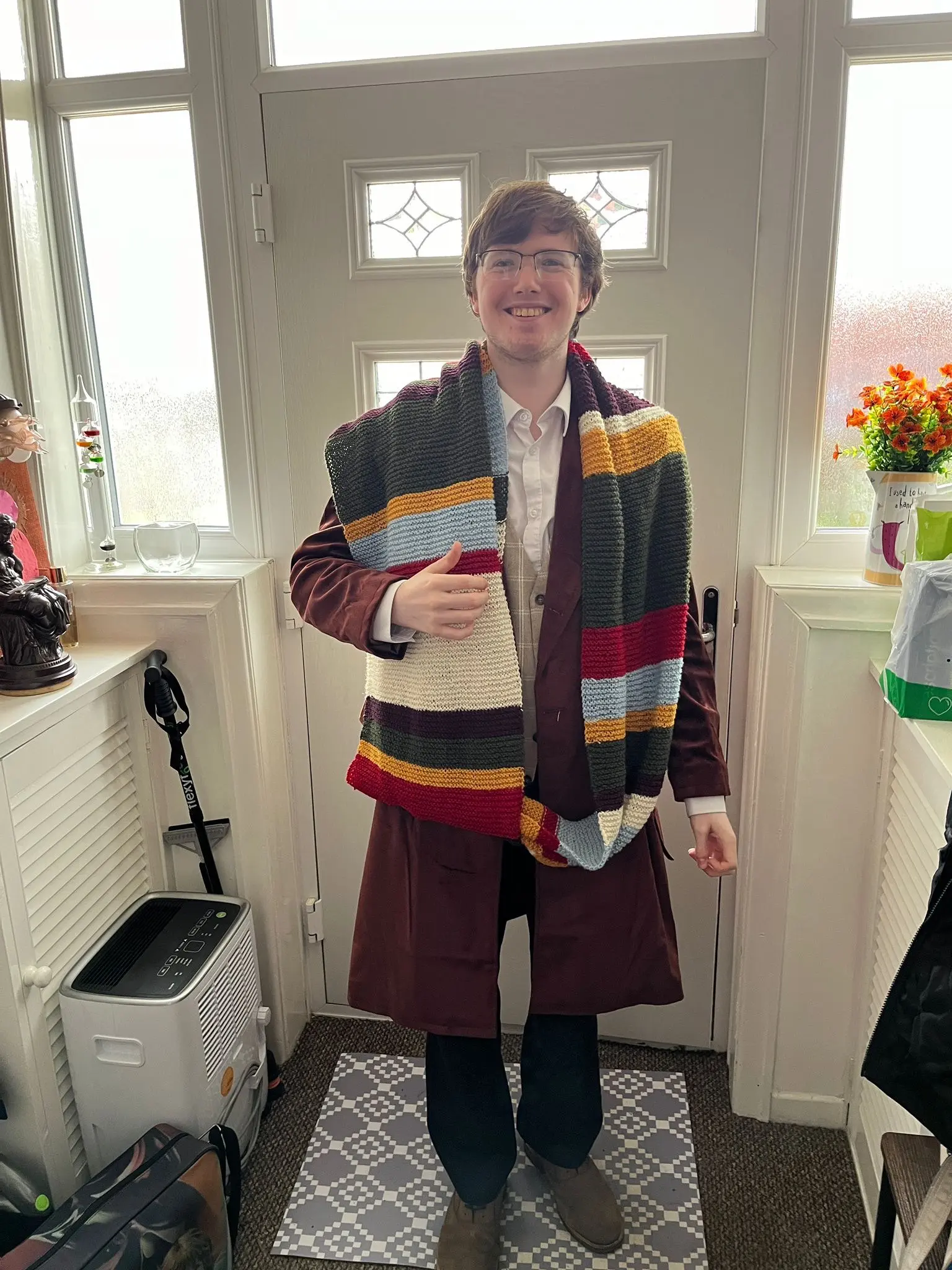
Benjamin Kurt Unsworth is a British Fantasy Award finalist with a degree in Classics and an unhealthy obsession with Doctor Who under belt. He enjoys confusing all and sundry, writing short stories and reviews for various outlets, drinking copious cups of tea, knitting, and buying far too many waistcoats, bow ties, and velvet jackets. His TBR pile threatens to topple over and crush him any day now. His solo collection, Into Wrack and Ruin, is available from Phantasmagoria Magazine, and the collection he co-authored with his father, Uneasy Beginnings, from Black Shuck Books.