
Dead Lover Is Screening With Scratch-and-Sniff Cards. Part of the Experience Is Revealing What Comes Next

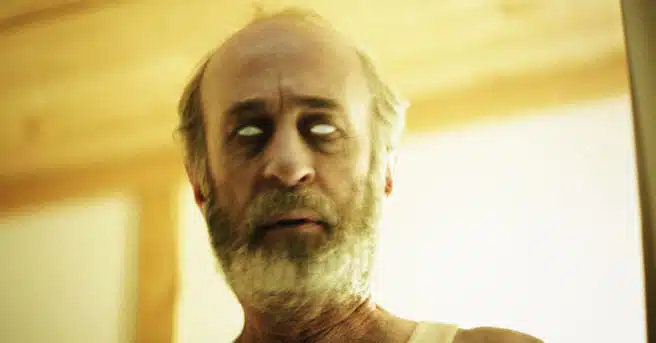
The image was created by us, with AI.
Dead Lover already has the kind of premise that seems built for sensory excess. Grace Glowicki’s romantic horror comedy follows a gravedigger whose relationship with death, desire, smell, and resurrection gives the film an unusually physical quality. Some of its 2026 theatrical engagements have pushed that idea beyond the screen by presenting the movie in “Stink-O-Vision,” handing viewers scratch-and-sniff cards timed to specific moments in the story. At select screenings, a number appears on screen and directs the audience to scratch the matching scented area.
That makes the card more than a promotional extra. Viewers have to do something before they know exactly what they are about to smell. The concealed scent creates a tiny cycle of anticipation, action, and discovery alongside the much larger process of watching the story unfold.
For horror, that interaction is especially well suited to the genre’s fascination with anticipation. What is behind the door, beneath the floor, inside the box, or around the next corner often matters almost as much as what eventually appears. Dead Lover turns that familiar dramatic rhythm into something audiences can perform with their own hands. The scratch-and-sniff card effectively makes “revealing what comes next” part of the viewing experience itself.
Why the Reveal Mechanic Keeps People Engaged
Scratch cards have lasted as a format because they turn a result into a process. The information already exists beneath a concealed surface, but the user cannot see it until performing a small physical action. That gap between knowing something is there and actually uncovering it creates anticipation without requiring complicated instructions.
The same design has carried successfully into digital gaming. You can now play scratch cards online, with the physical coating replaced by an interactive layer that can be cleared with a finger, cursor, or automated reveal. Some digital versions even offer both choices: uncover individual areas manually to preserve suspense or reveal everything at once for a faster result. That distinction is important because it shows that scratching is not merely a practical way to hide information. The act of uncovering is part of the experience.

An online scratch-card game with a beach theme, where players reveal hidden symbols across a grid to uncover matching results and potential prizes.
Screenshot from: Here
Through the reveal, the user controls the suspense
Several mechanisms make it effective.
- First, the user controls the pacing. A reveal can happen immediately or gradually, square by square.
- Second, each movement provides feedback: part of an image, symbol, result, or other hidden information becomes visible.
- Third, the interaction creates a sequence of small unanswered questions. Even when the underlying outcome is determined independently of how someone scratches, the user still experiences the discovery in stages.
That helps explain why playing online scratch cards has become a viable digital format even though a screen does not require anything to be physically scratched away. Designers deliberately preserve the gesture because removing it would remove much of the anticipation. The hidden layer has functional value as an interaction device.
Dead Lover applies essentially the same idea to smell. A numbered patch does not simply announce what odor it contains. The viewer must scratch it, bring it closer, and discover the scent at the moment the film calls for it. In that sense, the card introduces a second suspense track. The audience is waiting not only for the next image or joke but also for the next prompt and whatever unpleasant, strange, or unexpectedly familiar smell it releases.
The result demonstrates why reveal mechanics travel so easily between formats. A small concealed surface can transform passive information into an event. Whether the payoff is visual or sensory, uncovering it gives the audience a role in making the moment happen.
Special Screenings Are Becoming Part of the Attraction
The card also fits a broader shift in how cinemas can make individual screenings feel distinct. A 2025 global survey involving more than 68,000 respondents across 15 markets found substantial interest in cinema experiences that offer something beyond an ordinary presentation. Seventy percent considered premium large-screen experiences valuable, while 44% valued special events.
| Cinema experience valued by viewers | Share of respondents |
| Premium large-screen experiences | 70% |
| Technology-driven experiences | 58% |
| Preview screenings | 46% |
| Special events | 44% |
| Motion-based cinema experiences | 34% |
This explains the appeal of an intentionally low-tech device such as a scented card. It does not require the theater itself to be rebuilt. Instead, a relatively simple object changes how a particular showing works and gives attendees something they cannot reproduce simply by watching the same film normally.
That distinction can make sense for horror in particular. North American theatrical data for 2025 shows that horror generated substantial ticket sales, with several individual releases selling well above 10 million estimated tickets. A genre already associated with collective reactions, practical effects, and strong physical responses has room to experiment with screenings that emphasize those qualities.
The Best Gimmick Is Timed to the Story
The mechanics of Dead Lover’s presentation are strikingly simple. Reports from its New York screenings described a card containing 10 numbered scent areas. When a corresponding number appeared on the screen, viewers scratched that section and smelled it. The same run was reported as drawing nearly sold-out showings, giving some indication that the unusual format itself could become part of the reason to attend.
Glowicki described the audience response in similarly practical terms: “Everyone in New York seemed really into it and really keen to smell all the bad smells along with the movie.”
Synchronization turns scent into part of the screening
That reaction points to an important feature of interactive cinema: synchronization. A scratch-and-sniff card on its own is just a collection of scents. The film supplies timing, context, and expectation. The moment a number appears, the room performs roughly the same action together and waits for the sensory payoff.
There is also something appropriately handmade about the method. Dead Lover was created with the feel of experimental theater, practical effects, stylized performance, and a small ensemble; its four principal performers take on multiple roles. A printed card that has to be manually scratched is consistent with that aesthetic. Instead of hiding the mechanism behind sophisticated technology, the screening makes the mechanism visible and asks the audience to participate.
Horror gains a second countdown
That is where the approach becomes more interesting than smell alone. The card creates a chain of prompts and discoveries. Each numbered cue announces that another unknown sensation is coming, while leaving the viewer to reveal it. Horror has always understood the power of delaying what an audience wants (or fears) to encounter. Here, even the smell has to wait its turn.
Dead Lover shows how little an interactive screening may need to change audience behavior:
- conceal something,
- time the reveal carefully,
- and give viewers the action that uncovers it.
Sometimes the anticipation generated by that small action becomes part of the attraction.
Ginger Nuts of Horror: The Heart and Soul of Horror Reviews
Every feature is designed to help sell your work, build your audience and connect your horror story with readers who are actively looking for their next frightening read. Our horror book reviews and features include backlinks to your website, publisher page or Amazon author page, a full synopsis, relevant author information and a universal purchasing link that directs readers to their local bookseller or preferred retailer.
All editorial coverage is provided completely free of charge. We do not charge authors, publishers, filmmakers or creators for reviews or features. Ginger Nuts of Horror exists to support the horror community and help great books, films and independent voices find the audiences they deserve.
With a large, engaged social following and an 18-year archive of trusted horror coverage, Ginger Nuts of Horror is a horror review website built to support authors, filmmakers and creators. Our coverage spans horror novels, indie horror, gothic fiction, folk horror, psychological horror, supernatural fiction, dark fantasy, horror films and the wider creative world surrounding the genre.
Whether you’re an established horror author, an indie filmmaker, a publisher, or a debut voice in indie horror, we offer opportunities to place your work in front of dedicated horror fans, readers, viewers and genre enthusiasts. A feature on Ginger Nuts of Horror can help improve discoverability, strengthen your online presence and give potential readers a clear route from discovering your work to finding out more or making a purchase.
Although our coverage is free, we do have a Ko-fi page for readers, authors and supporters who would like to help us continue promoting horror books, films and creators. All donations are entirely voluntary and greatly appreciated. Every contribution helps support the time, research and ongoing work involved in running an independent horror review website.
Explore our horror book reviews and horror movie reviews, discover the kind of horror coverage we publish, then get your horror book or film featured today.