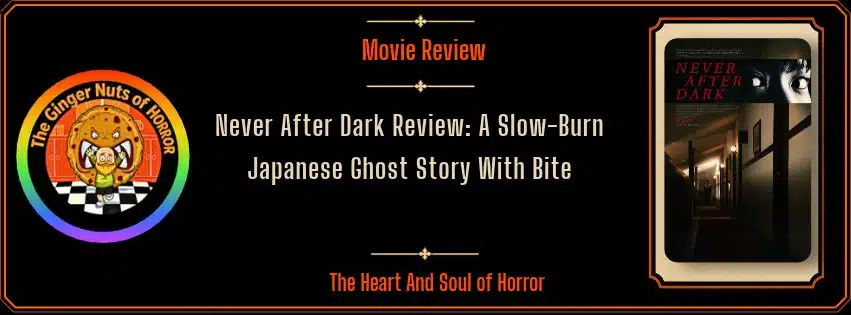
Never After Dark Review: Slow-Burn Japanese Ghost Story
Dave Boyle sends Shōgun’s Moeka Hoshi into a remote inn for a stylish, patient J-horror chiller.

- Director Dave Boyle
- Starring Moeka Hoshi, Tae Kimura, Kento Kaku
- Released 25 September 2026 (US cinemas)
- Runtime 1 hr 44 min
- Distributor Magnolia Pictures (US)
- Subgenre Supernatural horror, J-horror
- Reviewed by Hope Madden
A travelling medium who helps the dead move on arrives at a remote country inn, newly bought at auction by a widow and her son, where odd things keep happening.
Never After Dark is the new Japanese ghost story from writer-director Dave Boyle. A medium who helps the dead move on turns up at a lonely inn where odd things go on. Moeka Hoshi, from TV’s Shōgun, plays Airi, a quiet pro who gets on better with the dead than the living. The phones and the clothes put us back in the early 90s. The film takes its time, which is always the risk with a slow burn. So does the wait pay off? Hope Madden weighs the pace against the light, the framing, the lead and the times Boyle turns nasty. Her Never After Dark review starts with a question every ghost story fan can answer.
Never After Dark is a slow burn that sometimes moves slower than it needs to, but Dave Boyle earns the wait. His light and framing make the inn lovely and spooky, Moeka Hoshi’s prickly, isolated medium carries the tension, and when the violence finally arrives, the affection he has built for these characters is what makes it so unsettling.
A Travelling Medium, an Isolated Inn and a Slow Burn Worth the Wait
Who doesn’t like a good ghost story? And a Japanese ghost story at that!

Writer/director Dave Boyle (Man from Reno) generates spooky tension with Never After Dark, his tale of a traveling psychic hired to help the dead leave this plane. Airi (Moeka Hoshi, TV’s Shōgun), the quietly no-nonsense medium, arrives at an isolated little inn recently purchased on auction by a widow (Tae Kimura) and her son (Kento Kaku). Odd things are happening at the property.
It’s hard to place the period for the film. Landlines, sweater vests and shoulder pads suggest early 90s (a sweet spot for J-horror). The analog vibe suits the film’s dreamy pace. This is a slow burn, sometimes perhaps slower than necessary, but it’s still effective.
Boyle immediately introduces a worn-out genre trope only to expose it, using the gimmick as a tool for the narrative at hand. It works surprisingly well. Images throughout the film feel familiar more than borrowed, and Boyle’s framing and use of light give scenes a lovely but spooky quality.
Hoshi delivers a fascinating central performance: a loner who’s not alone, a polite misanthrope more comfortable with the dead than the living. The balance of the small cast impresses with memorable characters, but the tension grows because of Hoshi. Airi’s petulant defiance of sound advice, her occasionally reckless behavior, and her utter isolation coalesce as the entity in the inn is more fully revealed.
When the violence does come, it’s unsettling. But Boyle has spent more than an hour slowly drawing your interest and almost reluctant affection for these characters, and that’s where the tension really comes from.
Never After Dark delivers on its earliest promise of a stylish supernatural thriller, but Boyle isn’t afraid to get nasty here and there. The combination gives the horror a little substance and the style a nice punch.
The Verdict: Is Never After Dark Worth Watching?
The verdict
A stylish, slow-burning Japanese ghost story that sometimes drags, but Moeka Hoshi’s lead performance and Dave Boyle’s nasty streak make the wait worth it.
Watch it if: you like your J-horror patient, analogue and beautifully lit, with a medium who gets on better with the dead than the living.
Skip it if: you want your scares early and often, because this one spends more than an hour building before it turns nasty.
Ginger Nuts of Horror: The Heart and Soul of Horror Reviews

Hope “Madd at the Movies” Madden, a graduate of The Ohio State University, is a freelance writer and co-founder of maddwolf.com. In addition to 12 years at the award-winning independent weekly newspaper The Other Paper, Hope has written for Columbus Monthly Magazine, The Ohio State University Alumni Magazine, is a published poet and fiction writer. She also currently writes for Columbus Underground, Screen Fervor and the UK Film Review.
Hope’s a member of the Critics Choice Association, the Online Association of Female Film Critics, Columbus Film Critics Association and the Women’s Film Critic Circle. She’s also on the Nightmares Film Festival jury. She co-hosts the weekly movie review podcast The Screening Room and the bi-weekly horror film podcast, Fright Club.
In Columbus, Ohio, you can catch Hope on TV every Friday morning on ABC6/Fox28’s Good Day Columbus.