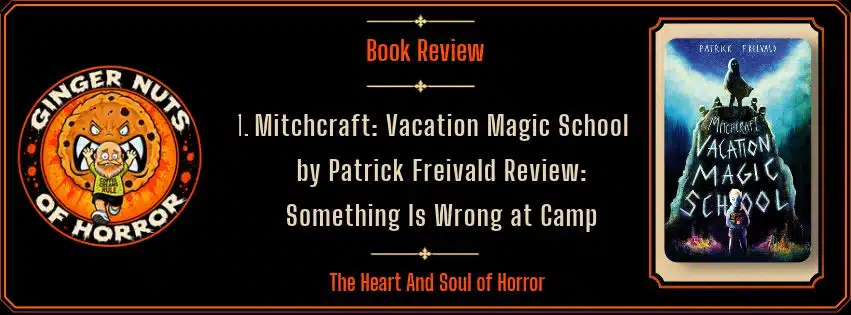
Mitchcraft: Vacation Magic School | Patrick Freivald | Apokrupha Books | 13 October 2026 |

- Author Patrick Freivald
- Publisher Apokrupha Books
- Published 13 October 2026
- Pages 137 (ebook)
- Format Paperback, ebook
- ISBN 9798295675072 (paperback)
- Subgenre Middle grade horror, dark fantasy
- Reviewed by Jim McLeod
Mitch Hayes fails his magic exam and gets one last chance: two weeks at a camp in the woods with the boy who bullies him. Then the rude kids start vanishing, and coming back far too polite.
Mitchcraft: Vacation Magic School by Patrick Freivald is a middle grade horror novel from Apokrupha Books about a boy who knows every spell and cannot cast a single one. In this Mitchcraft: Vacation Magic School review I want to make the case that it belongs on adult horror shelves as well as children’s ones.
Freivald, a four-time Bram Stoker Award nominee, sends seventh grader Mitch Hayes to a magic camp deep in the woods, where rude children go missing and come back sweet. It is short, funny and properly creepy, and the bully, the bratty sister and the sleeping troll all pull their weight.
Mitchcraft: Vacation Magic School is middle grade horror with real teeth. A camp where rude children come back polite and empty, a bully who becomes a friend, and an ending brave enough to deny its hero the easy prize. Short, sharp, and properly creepy.
Mitchcraft Review: The Boy Who Knows Every Spell
Knowing how a thing works and being able to do it are two very different beasts. Every child finds this out. Most of us learn it on a games field, or in a maths test, or at a piano with a clock ticking on the lid. It stings. It keeps on stinging, long after the exam hall has been knocked down and turned into flats.
Patrick Freivald has built a whole book on that sting.
Mitch Hayes is in seventh grade and knows more about magic than anyone in his year. He can tell you which old tongue calls the wind. He has taught himself goblin and pixie from videos online. He cannot, however, push a six-inch stone statue across a classroom. In East Bend, a town where the school motto over the door reads Volo Noscere, I want to know, that is a disaster. Mitch reads the motto on exam day and answers it in his head. Knowing is not his problem. Doing is.
The first stretch of the book is a school story, and a sharp one. Mitch’s exam is a small, painful study in failure. He plants a bean, and it grows an inch, then turns to mush. He calls the ants, and one ant turns up, has a look, and wanders off under the radiator.
He calls the wind, and it ruffles his best friend’s hair. He orders the fan to blow, and it smokes. He tries fire, and has to blow out the coal before the desk catches. In the end he picks up the statue and carries it to the teacher by hand. Somebody at the back laughs, “Now that’s some Mitchcraft!” and the name sticks to him like gum on a shoe.
Freivald plays this dead straight. No last second miracle. No hidden power waiting to burst out. The F turns up in the post a few days later, and his mother reads it at the kitchen table while he eats his granola.
So Mitch is packed off to Vacation Magic School, two weeks in the woods under the eye of a Miss Janice, with Ted Flynn for company.
Is Mitchcraft Scary Enough for Grown-Up Horror Fans?
Yes. And it gets there by the back door.
The camp is grim from the moment the car pulls in. Peeling cabins. A hoop with no net. A light pole with no bulb. Miss Janice switches off the power on the first morning, keeps the WiFi password to herself, and sucks on butterscotch as she stares into each child’s face. Her helper, Hannah, trails behind her with a clipboard and says almost nothing at all.
Then the rude kid goes missing. Bob, the boy who asked about basketballs and told Miss Janice her games were stupid, does not come back to the cabin. His bag sits on his bed, still packed. A day later he is at breakfast with a napkin tucked into his shirt and his hands in his lap, waiting to be told he may eat. Offered eggs, he says yes, please. Asked to wash the dishes, he lights up like it is Christmas morning.
That is the cold heart of the book. Freivald knows the scariest thing you can show a child is not a monster with claws. It is a friend who has been made good. Polite. Quiet. Empty. Any adult in the story would call it an improvement, and that is exactly the point. One by one the troublemakers go, one by one they come back well behaved, and the only people who find this frightening are the other kids.
It works on a fear most of us carried at that age and never quite put down: that the grown-ups would quite like a tidier version of you, and might not notice if the real one went missing.
That fear is earned, because Freivald is brave with his adults. Mitch’s parents love him,but they are not listening. When he comes home late and filthy after Ted’s attack, his mother raises one finger, then two, and he never gets to explain. A third finger would bring his dad. On Family Day the same scene plays out on a bigger stage, with a far higher cost, and the reader has to sit and watch it happen. Children’s fiction often lets the adults off the hook. This one leaves them dangling.
Spoiler warning. The next four paragraphs give away the book’s central twist. Skip to the section on Freivald’s earlier books if you have not read it.
When the empty boys come to search the cabin at night, Mitch hides a marble in the one place they will not look. He pops it in his mouth.
A sweet taste exploded across Mitch’s tongue, like butterscotch combined with an electric thrill, the best butterscotch ever made.
Freivald follows it with one short line on its own: “Miss Janice’s candy wasn’t candy at all.”
Look at how much work that does. For chapters the butterscotch has been a quirk, a bit of sound, the clack of a sweet against a teacher’s teeth. Now it is something else. Which i won’t divulge here
How Mitchcraft Compares to Patrick Freivald’s Earlier Books
Freivald is a four-time Bram Stoker Award nominee, and he has worked both sides of the age line. His Matt Rowley books, which began with Jade Sky and Black Tide, both Stoker finalists, and carried on through Jade Gods and Jade Scars, are loud, violent action horror for adults. Before those came Twice Shy and Special Dead, his Ani Romero books about a teenage girl hiding the fact that she is dead. He also wrote Blood List with his twin brother, Philip.
Mitchcraft takes something from both shelves. It has the dark teen wit of the Ani Romero books and the hard edge of the Rowley novels, cut down for a younger reader but never softened. The violence is brief and real. Ted grinds his shoe into Mitch’s spine. A bully snaps a rod that a dead father left his son. The book does not wallow in any of it, but it does not look away either.
It is hard not to see the author’s day jobs in these pages. His bio in the book describes a high school teacher and a beekeeper. Mitch’s dad keeps eight hives in the garden and chats to them with his fingers. Mitch’s mum is a chemistry teacher with a healthy fear of lab accidents. The principal’s big lesson, after Lucy’s coven blows out the canteen windows, is that control matters more than power. Somebody who has stood at the front of a classroom and watched which kids get seen wrote this book.
Freivald writes plain, clean sentences that a ten year old can follow and an adult can enjoy, and he spends his detail on the senses. Strawberry pie with chocolate sauce. The wriggle of a worm on a tongue. Burnt marshmallow skin peeled off and eaten too hot. Cinnamon in the air as a soul is torn loose. Reading it is like holding a jar of honey up to the kitchen window. Plain glass, golden inside, and only when the light hits it do you see what is stuck at the bottom.
It is short, around 137 pages in the ebook, and it moves. The camp is built as a countdown to Family Day, each breakfast table with one more blank face. If anything slows it, it is a handful of moments where Mitch reels off the rules of magic, druids and Aztecs and Zoroastrians, in a rush. They fit him, since this is a boy who lives in books, but they hold things up for a page. It is a small price.
The real spine is Mitch and Ted. Ted starts as a monster, turns out to be a frightened lad living in a trailer with a gran who does not drive, and ends as a friend who promises to bring two rods to the reservoir. Freivald earns every step.
Lucy, the big sister, deserves a word. She is a brat, the book says so more than once, and her rescue in the dugout is as cruel as it is kind. But she is the one who listens when the marble rolls onto the grass, and she is the one who comes back. Siblings in kids’ books tend to be saints or sneers. Lucy is both at once, which is to say she is real.
As for where it sits, think of Neil Gaiman’s Coraline, another tale where a smiling adult keeps children’s souls and a child must win them back. Think of Goosebumps’ Welcome to Camp Nightmare for the cabins in the woods, or Katherine Arden’s Small Spaces for a kids’ book that is not afraid to scare. For readers who come to Ginger Nuts of Horror for grown-up fare. Freivald does it in a fraction of the pages, with a kinder heart and a troll.
And then there is the title itself. A jibe shouted across a classroom becomes, by the last chapter, the one word that explains how a boy with no magic beat a soul eater. Most magic school books promise their readers that they are secretly special. This one dares to tell them something braver: you might not be, and you can still be the one who saves everybody.
The Verdict: Is Mitchcraft: Vacation Magic School Worth Reading?
The verdict
A short, sharp and genuinely creepy kids’ horror novel that trusts young readers with real fear and a truly brave ending.
Read it if: you want horror for a young reader that does not talk down, or you love Coraline, summer camp scares and bullies who turn out to be human.
Skip it if: you only read adult horror and want gore by the bucket, or you need your magic school hero to discover he is the chosen one.
Jim "The Don" McLeod has been reading horror for over 35 years and reviewing it for more than 16. He's the editor of Ginger Nuts of Horror, Europe's largest independent horror review and culture site, and a British Fantasy Award nominee for his work in the genre. When he's not busy inflicting his opinions on the horror community, he can be found annoying his family or getting thoroughly outwitted by his two dogs, Casper and Molly.

Ginger Nuts of Horror: The Heart and Soul of Horror Reviews


