
The Horror Hiding at the Edge of the Frame
A conversation carries on in the foreground. Someone complains about the house, pours a drink, answers a question. Behind them, a figure stands in a doorway. Nobody turns around.
The discovery can arrive almost casually. That shape wasn’t a coat. It has a face. Suddenly, the scene has two stories: the conversation the characters are having and the presence they haven’t noticed.
Background horror makes an ordinary viewing habit feel unreliable. Watching the person who speaks is no longer enough. The rest of the room demands attention, and even a quiet shot begins to feel crowded.
The Foreground Has an Alibi
Faces, voices and movement give a scene its apparent centre. A character speaking at a kitchen table offers an obvious reason to look there. A motionless figure behind a door has to compete with that attention, particularly when its outline resembles the furniture.
The placement matters more than sheer darkness. Hide everything and there is little to discover. Leave a shoulder, a pale cheek or an oddly upright shape visible, and recognition can happen a beat late. That delay is where the discomfort lives.
Screen attention also matters in online pokies, where an eye-catching symbol may draw the gaze before the rest of the result is read. Payouts depend on the particular game’s rules, which can involve paylines, matching symbols or scatter conditions. A striking image alone cannot establish a win.
Horror uses that gap between noticing an image and understanding its significance to keep a threat quiet in the background. A figure needn’t occupy the literal edge of the screen. It can sit centrally behind the action, disguised by distance or clutter. What makes it peripheral is its position in the scene’s apparent hierarchy.
A House Already Full of People
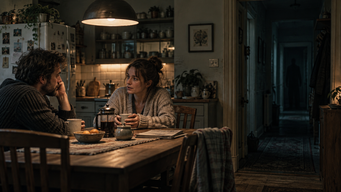
Mike Flanagan’s The Haunting of Hill House (2018) gives this technique an especially unsettling domestic setting. Background ghosts inhabit the house while the Crain family’s immediate troubles occupy the foreground. Their presence often receives no announcement.
The series’ interiors were deliberately designed to accommodate concealed figures. That production choice gives the rooms an unpleasant double function: places where a family lives and spaces that other occupants have never surrendered.
Several details make a background presence harder to dismiss:
- a human outline that separates slightly from surrounding shadows;
- an open doorway that remains visible during a conversation;
- a figure holding still while the foreground activity continues;
- a shot that ends before anyone acknowledges the intrusion.
An unacknowledged ghost leaves an unfinished thought. Did the character miss it entirely? Could it have been standing there during earlier scenes? The family can finish its conversation; the audience has acquired another concern.
The effect depends on the surrounding drama remaining worth watching. If the foreground exists only to distract, the scene becomes a hiding game with actors filling time.
An Ordinary Walker Becomes Suspicious
It Follows (2014) creates a different kind of uncertainty. Its pursuing entity can assume a human appearance, making a distant pedestrian a potential threat rather than harmless background movement.
The film’s widescreen compositions leave room for that uncertainty to develop. An approaching person has time to become a question before becoming an immediate danger. Its widescreen framing recalls John Carpenter’s use of broad compositions, where the surrounding space deserves as much scrutiny as the central character.
Once the premise takes hold, walking itself becomes charged. A person moving steadily towards the foreground demands attention, even before there is enough information to identify them. The viewer starts making provisional judgements about speed, direction and distance.
That response differs from spotting a concealed ghost. A hidden figure rewards recognition; a walker can sustain uncertainty across an entire shot. Cutting closer might settle the question too soon. Keeping the camera back lets suspicion build.
Empty Space Can Do the Work
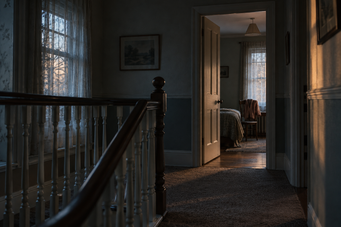
After a film has taught an audience to inspect its backgrounds, an empty patch of room can become troublesome. A doorway seems too exposed. A corridor stays visible too long. Nothing appears, yet the composition invites a search.
The Invisible Man (2020), directed by Leigh Whannell, makes this especially pointed. Cecilia’s fear concerns someone whose presence cannot be checked through an ordinary glance. Apparently vacant space offers little reassurance.
Carefully planned camera movements and effects support that tension. The production required close coordination between cinematography, visual effects and the staging of performers interacting with an unseen presence.
A suspicious empty frame raises several possibilities:
- someone is present but cannot be seen;
- someone has just moved beyond the visible area;
- the camera is withholding an explanation;
- the space is empty, and expectation is doing the frightening work.
That last possibility is valuable. If every lingering doorway produces a monster, the pattern becomes easy to read. An uneventful shot can preserve uncertainty for the next one.
The Rewatch Changes the Room
A second viewing brings knowledge, but knowledge needn’t remove the unease. A previously missed figure can alter the memory of a scene. The room was occupied during a moment that once felt private.
There is a limit, though. Counting hidden faces can distract from grief, dialogue and character. The most effective background scares deepen those elements: a family arguing in a house that has already absorbed other lives, or a frightened woman surrounded by space she cannot trust.
The lingering image is often modest. A person talks. Another listens. Far behind them, somebody else appears to be waiting. The camera allows the conversation to continue, and leaves that waiting figure exactly where it was.