Why Horror Fiction Deserves Serious Academic Study
A strange thing happens when horror enters the classroom. Students who might politely endure a Victorian novel or skim a modernist poem often have strong feelings about a haunted house, a vampire, or a cursed videotape. Some dismiss the genre as pulp. Others defend it with surprising intensity. Either way, horror gets a reaction, and that reaction is exactly why it belongs in serious academic study.
Horror fiction is not only about fear. It is about what a culture cannot quite say in ordinary language. The monster, the ghost, the plague, the possessed child, the abandoned laboratory — these figures carry political anxieties, religious doubts, family tensions, racial fears, gender conflicts, and scientific uncertainty. The genre gives shape to unease.
That makes it valuable in literature classrooms, cultural studies programs, psychology courses, film departments, and history seminars. Horror asks hard questions in a form people remember.
Horror Exposes What Societies Try To Hide
One reason horror fiction deserves study is that it often records social pressure before polite public discourse catches up. Mary Shelley’s Frankenstein is not a story about a creature assembled from dead bodies. It is a novel about ambition, parental abandonment, class exclusion and the terror of making something one refuses to care for. That is a lot of weight for a book still reduced, too often to a Halloween costume.
Bram Stoker’s Dracula reveals Victorian fears about immigration, sexuality, disease, empire and modern technology. The Count is ancient, foreign, aristocratic and contagious. The people fighting him rely on blood transfusion, phonographs, typewriters, train schedules and group documentation. In words the novel stages a conflict, between old-world dread and modern systems of knowledge.
When students struggle with these layers, the problem is rarely that horror is shallow. It is that horror can be too dense to unpack casually. A student who searches write a paper for me after being assigned Dracula may not be avoiding the text because it is unserious, but because the novel demands historical, symbolic, and formal reading all at once.
Academic study helps slow the genre down. It teaches readers to ask why a monster appears at a particular moment, what rules govern fear, and whose anxieties are being dramatized.
The Monster Is Often The Argument
Good horror rarely happens by chance. Horror uses monsters, places and tricks that are made from meaning. The monster is not something to run from. The monster is often the point of the story.
Consider a recurring figures:
- The vampire monster turns closeness into danger and makes desire feel predatory.
- The ghost monster suggests that history is not finished and that the past has moral claims on the living.
- The zombie monster collapses the line between a person and a crowd between a body and work and between life and consumption.
- The haunted house monster turns home space into a record of trauma.
- The mad scientist monster shows anxiety about knowledge without responsibility.
These monster types are flexible. They change with the time. George A. Romero’s zombie monsters in Night of the Living Dead carried the stresses of the civil rights era Cold War fear and media violence. Later zombie monster stories absorbed fears about shopping, disease, climate disaster and failing institutions. The monster lives on because it can be rewritten.
That flexibility makes horror a rich theme for scholars. Horror lets scholars see how fears move from one decade to the next. A vampire monster in 1897 does a cultural job, than a vampire monster in a 1990s TV show or a twenty-first-century romance book. The teeth stay the same. The meaning changes.
Fear Is Also A Serious Aesthetic Experience
Universities have studied tragedy, satire, epic and romance. Horror deserves the attention because fear is one of literature’s major emotional engines. It is not an effect when handled well. It is craft.
A writer builds dread through pacing withheld information, point of view, repetition, silence and setting. Shirley Jackson’s The Haunting of Hill House is frightening not because it explains everything. Because it does not. The house may be evil. Eleanor may be unraveling. The ambiguity is the engine. Jackson turns grammar, rhythm and spatial description into pressure.
Edgar Allan Poe’s stories offer another lesson. In “The Tell-Tale Heart ” the horror comes less from the murder than from the narrator’s voice. The reader is trapped inside a mind trying to prove its sanity while demonstrating the opposite. That is technique, not merely sensation.
The study of horror sharpens attention, to form. Students learn how narrative gaps produce anxiety how unreliable narration distorts evidence and how sound or image can matter much as plot. These are reading skills. They help with fiction, cinema, political rhetoric and even digital media.
Horror Connects Literature With Psychology And History
The academic value of horror does not stop at literary analysis. The genre sits at a busy intersection of disciplines.
Psychology helps explain why people seek frightening stories voluntarily. Research discussed by organizations such as the American Psychological Association has examined fear, arousal, threat simulation, and emotional regulation. Horror can provide a controlled encounter with danger. Readers and viewers feel stress, but within limits. They can close the book. They can leave the theater. That controlled exposure is part of the fascination.
History gives the genre its pressure points. Gothic fiction grew alongside changes in religion, architecture, property law, empire, and Enlightenment rationalism. Twentieth-century horror absorbed world wars, nuclear weapons, psychoanalysis, suburban conformity, and medical experimentation. Contemporary horror often turns toward surveillance, ecological grief, racial violence, gendered danger, and mistrust of institutions.
This is why horror pairs well with archival research. A class reading The Strange Case of Dr Jekyll and Mr Hyde can examine Victorian debates about criminality and degeneration. A seminar on pandemic horror can draw on public health history from sources such as the National Institutes of Health or the Centers for Disease Control and Prevention. A course on Indigenous horror can address land, sovereignty, oral tradition, and colonial violence.
The genre rewards context.
It Gives Marginalized Fears A Language
I have noticed that some of the important horror stories of recent decades come from writers and filmmakers who use horror to make big violence clear. Jordan Peele’s Get Out turned racism into bodily terror. Carmen Maria Machado’s fiction bends the ghost story and the fairy tale toward queer fear, desire and erasure. Stephen Graham Jones uses conventions while engaging Native identity, memory and survival.
When I look at study it can show how these works do more than scare. They reorganize the reader’s attention. Horror makes abstract harm physical. Horror gives exploitation a room, a sound, a face, a ritual.
I see that this matters because some experiences are hard to show through realism. Trauma can feel repetitive and irrational. Oppression can feel atmospheric as if it is built into the walls. Horror understands that feeling. Horror knows that the haunted house is not subtle. It is precise.
How Students Can Study Horror Well
The biggest mistake students make is treating horror as a puzzle with one hidden meaning. A stronger approach is to read the genre as a system of choices: what is shown, what is hidden, who is believed, who is punished, and what the ending refuses to repair.
A practical reading method can help:
- Identify the central fear, then ask who benefits from naming it as monstrous.
- Study the setting closely, especially homes, schools, hospitals, forests, and laboratories.
- Track rules and boundaries, such as doors, bodies, blood, mirrors, and thresholds.
- Connect the work to its historical moment without reducing it to a history lesson.
- Pay attention to pleasure. Horror can be funny, stylish, seductive, and beautiful.
That last point is easy to miss. Horror is not only moral instruction wearing a mask. It has its own pleasures: suspense, atmosphere, transgression, pattern, shock, release. Serious academic study should not drain the genre of energy. It should explain why that energy works.
Taking Fear Seriously
Horror fiction deserves serious academic study because fear is never just fear. It is a record of what people value, repress, misunderstand, and defend. The genre gives scholars a way to study power, identity, belief, technology, memory, and the body without pretending that human beings are purely rational creatures.
A university that ignores horror misses one of culture’s sharpest diagnostic tools. Monsters tell us what a society thinks it can survive. Ghosts remind us what it has failed to bury. The best horror does not distract us from serious questions. It drags those questions into the light, whether we are ready or not.
Keep reading on Ginger Nuts of Horror
 Final Girls Ranked by How Long They’d Last in a Wetherspoons Car Park at 2am
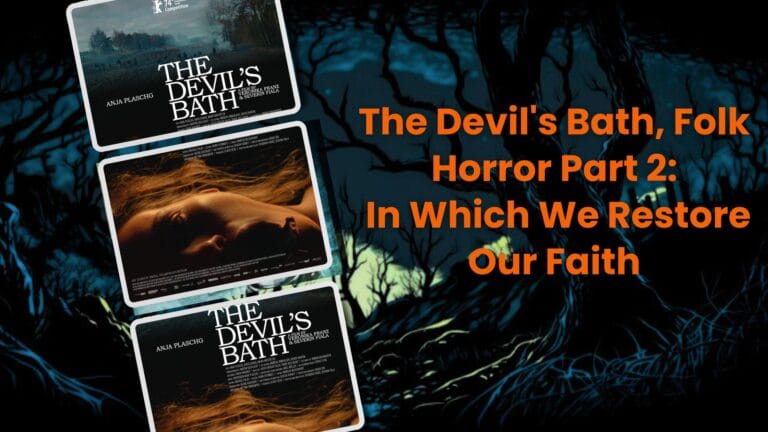 The Devil’s Bath, Folk Horror Part 2: In Which We Restore Our Faith
 The Backrooms is Just a British Backshift With Better Lighting
About Ginger Nuts of Horror
Ginger Nuts of Horror is an independent horror review and culture site based in Edinburgh, Scotland. Edited by British Fantasy Award nominee Jim McLeod, it publishes horror book reviews, film reviews, author interviews, features and cover reveals. Ginger Nuts of Horror won Best Inclusive Film & Book Review Platform at the SME News UK Enterprise Awards 2026.