

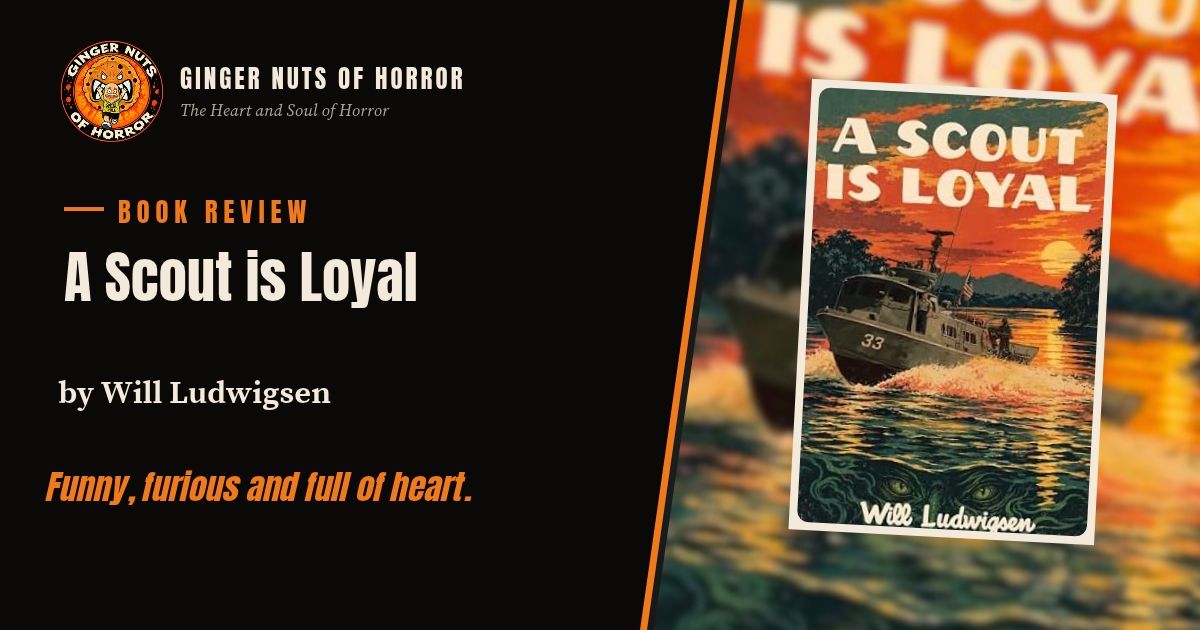
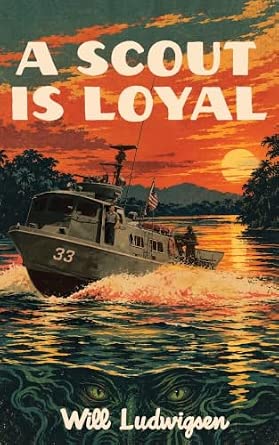
A Scout is Loyal | Will Ludwigsen | Lethe Press | November 2026
- Author Will Ludwigsen
- Publisher Lethe Press
- Published November 2026
- Pages 368
- Format Paperback
- ISBN 9781590218259
- Subgenre Lovecraftian war horror
- Reviewed by Jim McLeod
It is 1968, and Bud Castillo has traded the Scouts of Innsmouth for a Swift Boat in the Mekong Delta, where a conspiracy that reaches into American intelligence wants something ancient and hungry from the river.
Will Ludwigsen’s A Scout is Loyal takes Bud Castillo out of Lovecraft’s Innsmouth and drops him in the rivers of the Mekong Delta. This A Scout is Loyal review looks at whether a small, sad, funny novella can grow into a full war novel and keep its heart. The book is the Lethe Press sequel to A Scout is Brave, a Shirley Jackson Award finalist. It is now 1968, Bud is the radioman on a Swift Boat, and the war starts to look like a fight he has seen before. I found it bigger, angrier and still tender, with a middle that takes its time. It earns its place in our horror book reviews, and here is why.
A Scout is Loyal is funnier and angrier than A Scout is Brave, a Lovecraftian war novel that asks who really deserves a Scout’s loyalty. Its middle takes the long way round, but Bud’s voice, the letters from home and one aching reunion make the trip worth every mile.
A Scout is Loyal Review: Handbooks, Swift Boats and Bad Faith
Every war comes with a manual. Somebody in an office writes down how a young man should behave in a country he could not find on a map, and somebody else hands it to him before he gets on the plane. The manual is always polite. The war never is.
Will Ludwigsen knows this, and he opens his new novel with the joke already loaded:
Serving in Vietnam turned out to be just like the Boy Scouts: halfwits starting fires in the woods, officious leaders enforcing the letter of the law instead of the spirit, and damp socks bloating your feet into white flaccid loaves.
That one sentence is the whole book in small. It is funny. It is bitter. And under the gag about socks there is a real grief, because Bud Castillo is a boy who once believed every word of his Scout Handbook, and he is about to learn what grown men do with rules.
Then the military’s own Pocket Guide to Vietnam is read back to us, line after line, all good manners and respect for local custom. Bud follows it with a confession that sums up the man: he is cursed to be haunted by other people’s handbooks, because he takes them more seriously than the people who wrote them.
Look at how that idea is built. Ghosts and curses are horror words, but Ludwigsen hangs them on something as dull as a pamphlet. The joke is in the clash. The truth is in the last turn of the sentence. Bud’s tragedy has never been that he breaks the rules. It is that he keeps them when nobody else does, and then has to watch.
So how does he end up in a Swift Boat? Not by choice, exactly. Five years after the events of A Scout is Brave, Bud’s family has fled Innsmouth for Long Island. He drifts into college, works shifts at a grocery store, and does something very Bud at a campus protest. A judge offers him a deal, and the Navy takes it from there. Ludwigsen gives a name to the family flaw that drives all this: Castillo Syndrome, a sense of justice so strong it borders on self-harm. It is a lovely bit of invented jargon, and it tells you everything about where this story is going to hurt.
Those early chapters on Long Island are worth a word, because a lesser writer would have rushed them. Bud’s family move in with his mother’s parents, Iska and Sam, who have not spoken to their daughter in fourteen years. Their house is full of clocks that all chime at once, and their peace talks happen over roast beef.
Bud’s father, a man who settles most things with his fists, is the one who finally makes the peace, telling Sam that had he known the rules, he would have asked for her hand as many times as it took. It is a small scene. It is also the book’s first lesson in loyalty: the kind you choose, and keep choosing, after the fight.
Then there is Theresa, the red-haired campus radical who names Bud after a toy soldier and treats his good manners as proof of guilt. She could have been a cheap joke about hippies. Instead she is sharp, brave and a bit ridiculous, the first person Bud meets who shares his urge to fix the world by force of will. The protest that lands them both in a cell is played for laughs right up until a cop raises his baton, and then it is not funny at all. Ludwigsen does this again and again. He gets you laughing, and then he shuts the door.
The Navy, it turns out, has plans for him. At his induction a doctor called Hale sits him down for a game of chess and tells him, more or less, that the real world barely matters in the real world. It should frighten anyone who has read a newspaper. From there Bud bounces through corpsman school, radio school and Swift Boat training, and lands on a crew that calls its boat the Indochine Queen.
Reading Ludwigsen’s prose is like listening to a man tell war stories at a barbecue while he turns the burgers. The jokes keep coming, the tongs never stop moving, and then he says something about a village and the whole garden goes quiet. He is a natural comic writer. His crewmates mostly go by nicknames (Boats, Crank, Spliff), the slang flies thick and fast, and Bud’s asides are often laugh out loud. But the laughs are a delivery system, not a dodge. When the book wants you to stop smiling, you stop.
The chapters that open with letters from Bud’s mother are the quiet engine of the whole thing. They arrive dry and sharp, full of her own wit, and they carry a home front story that hurts in its own way. I will not say more than that. They are the best structural choice in the book.
Is A Scout is Loyal Scary?
Not in the way a jump scare is scary. The fear here is slower and colder. It is the fear of being on the wrong side of something and not knowing it until too late. Ludwigsen sets the dread in the gap between what the officers say and what the boats are sent to do, and he lets it pool there.
The Lovecraftian half is more than a garnish, though. The Deep Ones never left Bud’s life, and the book’s big idea is a good one: that a war run by true believers chasing something old and hungry might have more in common with Innsmouth than anyone in a uniform would admit.
When the monsters come, they come wet and half seen, heard before they are found: claws on steel in the dark. The horror works best when it is close to the bone of the history. Ludwigsen is careful, in his own note at the front, to say his Vietnam is accurate the way Ray Bradbury’s Mars is accurate: true in feeling, not in every fact. That is the right deal to strike with a reader, and he keeps it.
There is also a familiar face from Innsmouth. I will keep the details out of it, but the reunion is the best scene in the book, and it carries an idea that could stand as the novel’s thesis. When Bud asks whose side the worst men in the war are really on, the answer is that they serve no country at all. They serve the war.
Now the half star. A Scout is Brave was a slim book, around 150 pages, and it moved like a short story. This one runs to 368, and the stretch between training and the point where the conspiracy really bites takes its time. Base life, crew banter, slang, a road trip, flag football.
It is all well done and much of it is funny, but if you came for monsters you will be waiting a while. Some readers will love the hang. Others will feel the engine idle. It is a real limit, but a small one, because the payoff is earned by all that time spent with the crew. When the book finally puts them in danger, you care who comes home.
How A Scout is Loyal Compares to A Scout is Brave
Ludwigsen has been writing strange, humane fiction for two decades. His first collection, Cthulhu Fhtagn, Baby! and Other Cosmic Insolence, played Lovecraft for laughs. In Search Of and Others and Acres of Perhaps showed a writer drawn to people who believe the wrong things with total sincerity. A Scout is Brave, which Tony Jones praised for its quiet, confessional voice in his review of A Scout is Brave, was where it all came together: a boy, a friend and a town with something under the reef.
The sequel keeps that voice. Bud still tells the story from many years later, with an old man’s hindsight and a boy’s sense of wrong. What has changed is the scale and the temper. The first book was about a town. This one is about a country, and Ludwigsen is plainly angry at it, in the way you can only be angry at something you love.
On the shelf it sits beside Matt Ruff’s Lovecraft Country and Victor LaValle’s The Ballad of Black Tom, books that turn Lovecraft’s fear of outsiders back on the people who held it. Ruthanna Emrys walked similar water in Winter Tide, where the Innsmouth kin are the ones wronged by the government. On the war side, the black comedy owes something to Catch-22, and the way memory loops back on itself recalls Tim O’Brien. That is good company, and the book holds its own in it.
The theme is right there in the title. A Scout is loyal, the handbook says. Loyal to what, though? To a flag, to a crew, to a friend who is no longer quite human, to a country that sent you somewhere to do things the handbook would never allow? Ludwigsen does not pretend the answer is easy.
He just makes you feel the weight of each choice. In his afterword he says his stories are about people acting on untrue ideas of the world and wondering why it does not work. Vietnam, for him, is the perfect case. But the book is not a sneer. For all its rage at the men who ran the war, it keeps faith with the people inside it, the ones doing small, decent things within reach of their own arms. That is the Scout ideal, stripped of the badges, and it survives the book.
A Scout is loyal, the handbook says. Ludwigsen’s great trick is to make you ask: to whom?
The Verdict: Is A Scout is Loyal Worth Reading?
4.5out of 5
The verdict
A funny, furious and tender war novel that turns Innsmouth into a lens on Vietnam, held back only by a long middle.
Read it if: you loved A Scout is Brave, or you want cosmic horror with politics, black comedy and a real heart.
Skip it if: you want monsters from page one, or crew banter and military slang wear you out.
Content warnings: war violence and civilian deaths, racial slurs, strong language, terminal illness, non-consensual medical experimentation, body horror.

Somewhere under Devil’s Reef, a Deep One is reading this A Scout is Loyal review and wondering why humans needed a handbook in the first place.
Keep reading on Ginger Nuts of Horror
 A Scout is Brave by Will Ludwigsen
 The Ravening Deep by Tim Pratt, Book Review
 Nathan Ballingrud a Horror Author Interview

About Ginger Nuts of Horror
Ginger Nuts of Horror is an independent horror review and culture site based in Edinburgh, Scotland. Edited by British Fantasy Award nominee Jim McLeod, it publishes horror book reviews, film reviews, author interviews, features and cover reveals. Ginger Nuts of Horror won Best Inclusive Film & Book Review Platform at the SME News UK Enterprise Awards 2026.