
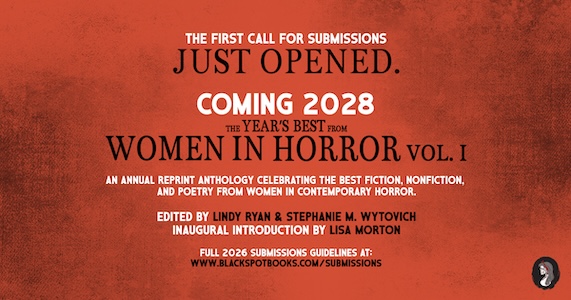
- Editors Lindy Ryan and Stephanie M. Wytovich
- Introduction Lisa Morton
- Publisher Black Spot Books
- Submissions 31 October to 31 December 2026
- Eligible Work first published in 2026
- Length Prose up to 7,500 words, poems up to one page
- Payment One cent per word (USD) plus contributor copies
- Subgenre All forms of horror
An annual reprint anthology gathering the year’s strongest horror fiction, nonfiction and poetry by women and female-identifying writers, with a special eye on work from small presses, magazines and online venues.
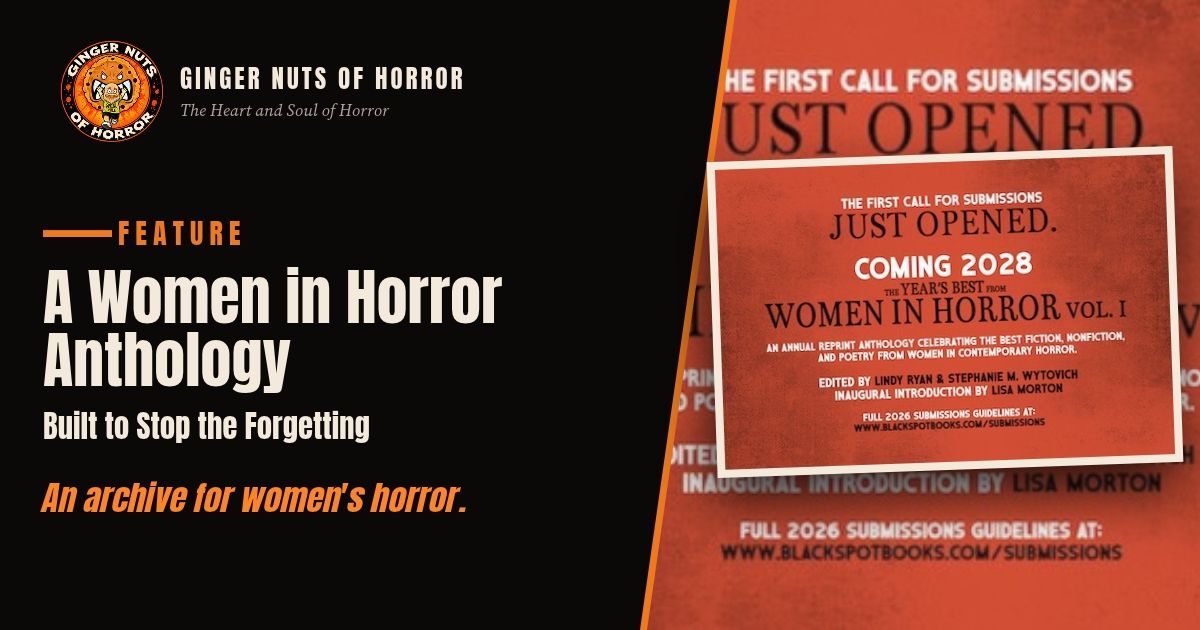
The Year’s Best from Women in Horror is a new women in horror anthology from Black Spot Books, and it has one clear job. It wants to keep the best horror fiction, nonfiction and poetry by women from 2026 on the shelf. Lindy Ryan edits it with Stephanie M. Wytovich. Ryan founded Black Spot Books in 2017, and since then the press has made women’s voices in horror its focus, from the Baba Yaga tales of Into the Forest to the werewolves of Howl. Ginger Nuts of Horror spoke to her about that mission in our Women in Horror Month interview with Lindy Ryan. Submissions are open now, and this call deserves a closer look.
Morton and Klinger had to dig women’s work out of a century of neglect. The Year’s Best from Women in Horror is trying to do that digging in the same year the work appears, before anything has been buried. It is less a trophy cabinet than a filing system.
Somewhere right now, a story that people will still argue about in twenty years sits on a webzine page that may not exist in five. Black Spot Books wants to catch it before it goes. The press has opened The Year’s Best from Women in Horror, Volume 1, to submissions. It will gather the best horror by women from 2026.
That last part matters. This is not a call for new work. Every piece must have appeared between 1 January and 31 December 2026, and the writer must hold the reprint rights. The aim is not discovery in the usual sense. It is rescue.
What Black Spot Books Is Asking For
The rules are simple. The call opened on 31 October and shuts on 31 December 2026. You send work through Submittable. Stories and essays can run to 7,500 words. Poems can run to one page. The work must be by women or female-identifying writers, and writers from any country can send.
Payment is one cent per word in US dollars, plus contributor copies in print and ebook. You can send more than one piece, but each needs its own form. Put two stories on one form and the call warns that some of your work may not be read.
There is a firm line on generative AI. No work written with it or by it will be taken, and sending a piece counts as confirming it is your own. The call says it plainly: the work must be written “by human women.”
The range is wide. Ghost stories, folk horror, Gothic, cosmic and body horror are all named. So are horror comedy, dark fantasy and weird fiction. So is work that sits between the boxes and will not settle in one.
Why a Year’s Best Women in Horror Anthology Matters Now
The history here is not abstract. Lisa Morton and Leslie S. Klinger edited Weird Women, books of dark tales by women writing from 1852 onwards. As they dug, they found how fast that work had dropped out of sight. Carina Bissett told the same story in her Women in Horror Month feature. Women wrote early tales of terror in real numbers. Much of it faded, while work by the men of the time became canon.
Bissett also looks back at the 2008 Bram Stoker Award ballot. It had 34 men and seven women on it, and three of its lists had no women at all. A grassroots push for women horror writers began the next year. Women in Horror Month grew from it.
Things have changed since then. By Bissett’s count, women took seven of eleven awards in 2019. In 2022, there were twice as many women as men on the ballot.
So why a book like this now, when the awards look so different? Because the risk has moved. It is not just that women get overlooked. It is that the places where so much short horror now lives are fragile. The call names them: small presses, small magazines, websites, one-off anthologies. A webzine folds. A small press shuts. A one-off book sells its single run and is gone. The story was read, even praised, and then it has nowhere left to live.
What strikes me most about this call is its timing. Morton and Klinger had to dig women’s work out of a century of neglect. This book is trying to do that digging in the same year the work appears, before anything has been buried. That makes it a different kind of book. It is less a trophy cabinet than a filing system, and I mean that as praise.
The call describes the series this way:
a living canon of women in horror, built year by year
There is a second detail worth noting. Essays are in. A sharp essay or review from 2026 can sit beside the stories it argues about. Bissett’s own essay for Apex Magazine, “Words Wielded by Women,” looks back at women in horror. It was a Bram Stoker Award finalist. Writing like that shapes how a year is remembered. A best-of that keeps the critics keeps the argument as well as the proof.
The Editors Behind the Call
Lindy Ryan founded Black Spot Books in 2017. It became an imprint of Vesuvian Media Group in 2019, and Ryan is still its president. In 2021 the press said it would focus on horror alone. Since then it has built a run of women in horror books.
Into the Forest: Tales of the Baba Yaga came first, in 2022, and it was a Bram Stoker Award finalist. Mother Knows Best: Tales of Homemade Horror followed in 2024, with an introduction by Sadie Hartmann, and was nominated too. So was Howl: An Anthology of Werewolves from Women-in-Horror, which Ryan edited with Wytovich. Two poetry books came along the way. Ryan edited Under Her Skin (2022) with Toni Miller. She edited Under Her Eye (2023) with Lee Murray, and made it with The Pixel Project, a group that works to end violence against women.
Ryan writes as well as edits. Her horror novel Bless Your Heart came out from Minotaur Books in 2024 and was a Stoker finalist for first novel. Publishers Weekly named her a Star Watch Honoree in 2020.
Wytovich brings a poet’s ear, and that counts in a book that takes poems seriously. She has won the Bram Stoker Award twice for her poetry, first for Brothel and then for On the Subject of Blackberries. She is poetry editor at Raw Dog Screaming Press. She also wrote Writing Poetry in the Dark, a guide to the craft. She talked about her work in Carina Bissett’s conversation with Stephanie M. Wytovich.
Lisa Morton writes the introduction. She is a former president of the Horror Writers Association. Through Weird Women, she has done as much as anyone to bring early horror by women back into print. It is hard to think of a better fit for a book about not losing things.
How to Submit Before 31 December
Authors can submit their own work. Editors and publishers are urged to send or suggest pieces from their 2026 lists. The editors will also go out and ask for work. That last point matters. The writers least likely to push their own story are often the ones this book most needs to find. A nudge from an editor can do what modesty would not.
Before you send anything, check three things. Was it first published in 2026? Do you hold the reprint rights? Is it within 7,500 words, or one page for a poem? If the answer is yes to all three, send it, one piece per form.
If you wrote something this year that scared someone, the worst fate waiting for it is not a rejection. It is a dead link.
Submissions open
Submissions for The Year’s Best from Women in Horror, Volume 1, are open until 31 December 2026 through Black Spot Books.
Keep reading on Ginger Nuts of Horror
 Lisa Morton: Women in Horror Month
 Lee Murray: A Literary Powerhouse in New Zealand
 Gwendolyn Kiste – Women in Horror Month
About Ginger Nuts of Horror
Ginger Nuts of Horror is an independent horror review and culture site based in Edinburgh, Scotland. Edited by British Fantasy Award nominee Jim McLeod, it publishes horror book reviews, film reviews, author interviews, features and cover reveals. Ginger Nuts of Horror won Best Inclusive Film & Book Review Platform at the SME News UK Enterprise Awards 2026.