
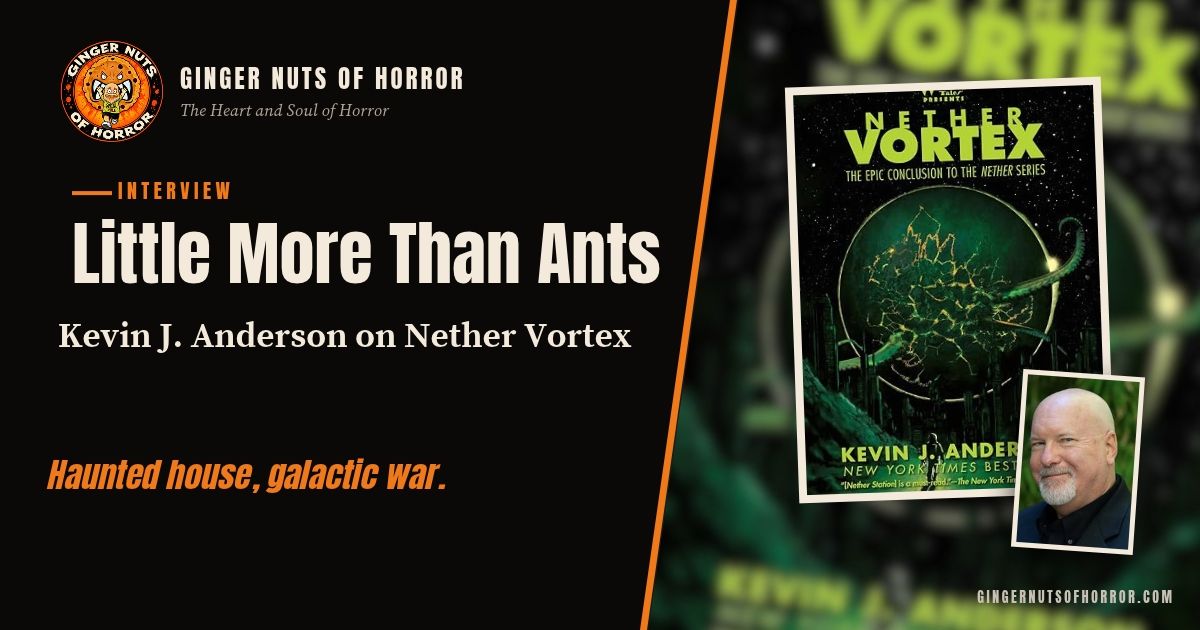
Nether Vortex | Kevin J. Anderson | Blackstone Publishing | 27 October 2026 |
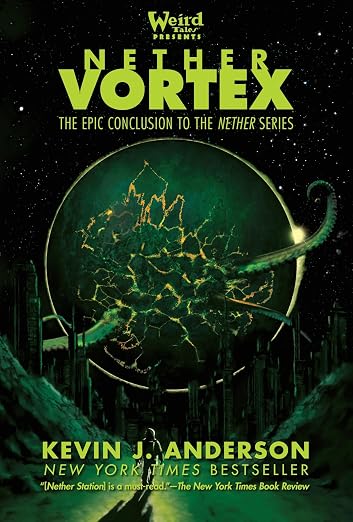
- Author Kevin J. Anderson
- Publisher Blackstone Publishing
- Published 27 October 2026
- Pages 410
- Format Hardback, ebook, audiobook
- ISBN 9798874816872
- Series The Nether Series, Book 2
- Subgenre Cosmic horror, space opera
Five years after Nether Station went dark, its lost crew have become soldiers in an alien war against the soul-eating Agoc, while the woman left behind races home to warn an Earth that would rather not listen.
Somewhere past the Kuiper Belt, Kevin J. Anderson built a wormhole and lined it with temples made for things that were never human. Nether Vortex, the second book in his Nether series and the subject of this Kevin J. Anderson interview, picks up five years after Nether Station, the 2024 novel that sent a privately funded crew to study that wormhole. Anderson has called the first book a haunted house in space.
The sequel blows the walls out: a lone survivor wakes with a warning, a lost crew fights an interstellar war, and Earth keeps its fingers in its ears. It is a long way from the Dune books he writes with Brian Herbert, and a short step back to Resurrection, Inc., his 1988 debut and a Bram Stoker Award nominee.
Lovecraft runs through the new novel, right down to a lost member of the 1930 Miskatonic expedition to Antarctica. For the latest in our run of horror interviews at Ginger Nuts of Horror, I wanted to know what cosmic horror becomes once it leaves the haunted house. So we started where Nether Station left its crew: on the far side of the biggest cliffhanger of his career.
Kevin J. Anderson left Nether Station on a cliffhanger with only the vaguest plan, and found his sequel in the titans themselves. Humanity and every other race fight and die for the Agoc and the star beings, and to both of them they are little more than ants. —
The Kevin J. Anderson Interview: Haunted House to Galactic War
You have said that Nether Station ended on the biggest cliffhanger of your career, and that selling the sequel felt like jumping out of a plane without checking the parachute. When you finally sat down to write Nether Vortex, which loose thread did you pull first, and what did the book turn out to be about that you had not known when you left the crew in that fix?
As a writer, I am always a very careful plotter. I plan things, envision the story arc, and usually the grand finale. When I wrote Nether Station, it was a one-book contract and I didn’t know if Blackstone would let me continue…so I ended it on the biggest jaw-dropper I could come up with. “There, now you can’t just leave it.” But I honestly had only the vaguest idea of where the characters and story would go from that point.
They, and the entire solar system, were in quite a pickle. When I did turn to Nether Vortex and really start to figure out how to solve this mess, I was fascinated by the Miskatonic expedition survivor and what he’d been doing, and I also decided to focus on the titanic superpowerful beings, both the horrific evil Agoc and the omnipotent star beings. I assumed that humanity, and all these other races, were fighting and sacrificing for them, but they were little more than ants.
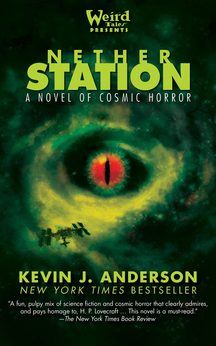
By your own account, Nether Station was smaller and more claustrophobic than your usual space opera, a haunted house in space. Nether Vortex opens onto an interstellar war, an Alliance of embattled races and star beings with power beyond measure. Cosmic horror tends to depend on people being small and alone. How did you keep the dread alive once the canvas went galactic, and did your space opera instincts ever pull against the horror?
I’ve said many times that this two-part story was much akin to Alien and Aliens—with Vortex being the big action-packed latter half. Yes, the scope is much larger, on a space opera scale, but the stakes and the mood is still very cosmic horrific. I particularly love one scene on a devastated library planet where the evil beings have destroyed everything, but the “good guy” star beings are just as cold and horrific.
Karla Arkourian, the former Space Force pilot who ran the first mission as acting commander, wakes from emergency cryosleep on a failing station as the apparent sole survivor, carrying a warning about the Agoc that Earth has spent five years ignoring. What drew you to writing the person who comes back with the truth, and what does a planet that will not listen say about the moment we are living in?
Well, you can point to many instances of people in the modern world being confronted with unpleasant truths and impending disaster, yet they keep whistling past the graveyard. Climate change disaster, AI disasters. We seem to enjoy being oblivious because it is difficult to face the work necessary to solve the problems. Sigh.
When Paul Di Filippo reviewed Nether Station for Locus, he read Benedict Noor as a figure plainly modelled on Elon Musk. In Nether Vortex Benedict is gone, and his sister Margo now runs NOOR Industries. What did you want to do with Margo that you could not do with her brother, and has your view of billionaire-funded spaceflight shifted between the two books?
I saw Benedict as more of an amalgam of Elon Musk and Jeff Bezos, audacious, bullish, and with all the money and power to do whatever he damn well pleases–but he thinks he is doing the right thing. He is opening the stars for humanity, and yes it will make him richer but he doesn’t really care about that. He is a law unto himself, and that hubris causes a lot of problems. However, I don’t think he’s an evil villain. In Vortex, his sister Margo is just as powerful and headstrong, but a little more pragmatic, with a desperate love-hate codependent relationship with him. I love their dynamic.
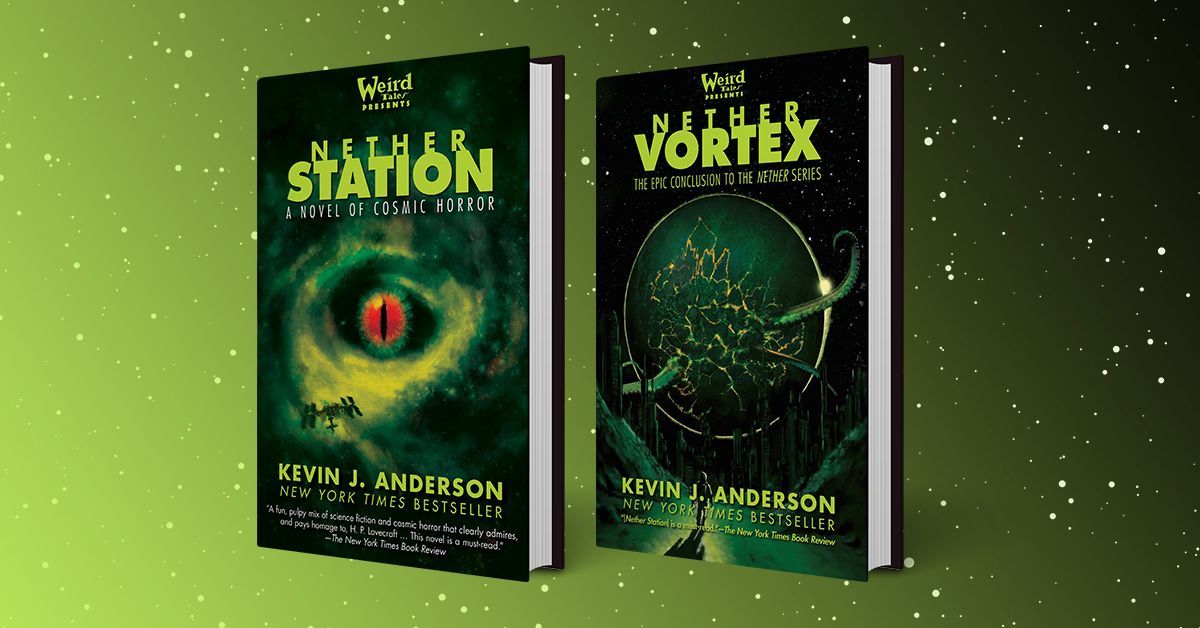
Nether Station named a crater after a Miskatonic expedition, and the sequel goes further, with a lost member of the 1930 Miskatonic University expedition to Antarctica watching over the refugees. You have also built your own threats in the Agoc and the star beings. How did you decide how much of Lovecraft’s Mythos to borrow outright and how much to invent, and what rules did you set yourself for touching At the Mountains of Madness directly?
My Agoc and Star Beings are obviously derivative of Cthulhu mythos but I changed the names so as not to be exactly part of the Lovecraft canon. The Yggroths are like Shoggoths, etc. “At the Mountains of Madness” is one of the creepiest horror stories I’ve ever read, and I wanted to do a real homage to it, except set on the Martian polar ice caps. If you understand the connections, it means more, but I wanted it to be readable as a standalone story, because not everyone is intimately familiar with Lovecraft.
The ship that carries the crew to the Nether in the first book is the Lethe, which shares its name with the river of forgetting in Greek myth. The sequel opens on an Earth that has, in effect, chosen to forget. Was that name a deliberate thread from the start, and how much is the Nether series a story about memory and what we refuse to remember?
Ah, you picked up on something I hadn’t even realized. I picked Lethe for the connection with the long sleep, but I didn’t add more than that. And I’m not really sure Earth has chosen to forget; they just choose not to believe the crazy stories that Karla is telling. At the end of Invasion of the Body Snatchers, WE know that his stories about pod people are true, but he sounds like a nutcase to any normal person.
Your 1988 debut, Resurrection, Inc., was nominated for the Bram Stoker Award for Best First Novel, and the decades since have been filled with Dune, Star Wars and the Saga of Seven Suns. What did horror teach you at the very start that you carried through all that space opera, and why did the Nether series feel like the right moment to come home to it?
Dean Koontz was a mentor of mine, and I studied his techniques of suspense and tension to shape my writing. Those skills are just as legitimate and effective in science fiction, fantasy, and other genres, so I brought them over. I never really left horror, though. A few years ago my novel STAKE is a full-on horror/vampire suspense thriller, and I just published two volumes of my collected horror/dark fantasy stories. I love the genre, but I prefer to blend it into other genres. Honestly, most of my readers come from SF/F and it’s hard to get them to grab a straight horror novel.
Stake turns on the question of whether Simon Helsing is a vampire hunter or simply a killer, with the sceptical Detective Todd Carrow sure he knows the answer. The Nether books leave no room for that kind of doubt: the monsters are real and very old. How has your thinking changed about ambiguity in horror, and when do you think a reader is better served by certainty?
It really depends on the story I want to tell. STAKE depends on the reader not knowing whether Helsing is a heroic vampire killer or a delusional serial killer. The Nether books don’t depend at all on you not knowing; I don’t think I’ve ever written about such blatant, naked evil.
You have spent a good part of your career on horror’s funny side, from Dan Shamble, Zombie P.I. to editing Blood Lite, the anthology of humorous horror for the Horror Writers Association. Cosmic horror has a reputation for having no sense of humour at all. Did you have to switch that part of yourself off for the Nether books, or did it find somewhere to hide?
There is plenty of humor in the Nether books, especially from the character of Glinda and all her sarcasm, and Glinda’s relationship to the other characters, along with Warren the cocky fighter pilot (Tom Cruise) who is a bit full of himself. How can you not have Nether Stastion without wisecracks about the nether regions? But the jokes are like palate cleansers.
There is a lovely irony in your publisher. Weird Tales turned down At the Mountains of Madness in 1931, and the novella finally appeared in a science fiction magazine, Astounding Stories, in 1936. Now Weird Tales Presents is publishing your science fiction answer to it. You have mentioned rereading the Mythos alongside films like Alien and Event Horizon. What can science fiction give cosmic horror that Arkham and its gambrel roofs never could, and where do you see that crossover heading next?
Just today we have announced that Paul W.S. Anderson, director of Event Horizon, will be directing film adaptations of Nether Station and Nether Vortex. A wonderful full circle, since Event Horizon was seminal in inspiring the Nether books. I am perplexed that there aren’t more SF horror films (and novels) because space is so intrinsically dangerous and terrifying. I hope I spark a few more entries into the genre.
Building on Lovecraft now means building on a writer whose bigotry is written into the fiction itself, and horror has spent the last decade arguing about it, with books like Victor LaValle’s The Ballad of Black Tom and Matt Ruff’s Lovecraft Country taking the Mythos back from him. How did you handle that inheritance in the Nether books, and what do you think a writer owes the genre when picking up his toys?
That’s a tough one, because unquestionably Lovecraft was not an admirable man. But his ideas were groundbreaking and very influential to me. His first published story “Dagon” still gives me the literal shudders. “At the Mountains of Madness” is one of the finest horror pieces ever written. You have to separate the work from the creator. I’m not having dinner with the guy, but his writing inspired some of my best work. I took the best from his mythos and made it my own work (and I try to be a better human being!)
Cammie Skoura is an astrophysicist whose mind is more at home with data than with people. Lovecraft’s narrators tend to fall back on the unnamable; a scientist wants to measure. When you were writing scenes through Cammie’s eyes, how did you build sentences that let the reader feel the measurements failing, and what did her way of seeing let you do that a more conventional narrator would not?
I have known and mentored several neurodivergent individuals and I get along with them quite well. We can relate as fellow nerds. I know so many hardcore science fiction/fantasy/horror fans who are on the spectrum (many may not even know it), that I understand how they think, what interests them. Frankly, in a situation like I set up in Nether Station, a person like Cammie fits in better.
She studies wormhole physics and is used to dealing with incomprehensible subjects, so Lovecraft’s “unnameable, unknowable” stuff is just another problem for her. In Nether Vortex, she is thrown into an even vaster galactic war and surrounded by bizarre alien races. And she realizes that sometimes she can understand alien thinking more than she understands humans. After all, this story demands something other than swooning romance and soap-opera relationships.
Nether Vortex runs on several fronts at once: Karla and Margo dealing with an Earth in denial, the crew of the Neil Armstrong caught up in a war on the far side of the galaxy, and Cammie facing something older still. On top of that, the story jumps five years and has to welcome readers who may not have read Nether Station. What was the hardest technical problem in balancing those strands, and how did you solve it without letting the tension leak away between chapters?
I have always been comfortable with writing big stories with multiple plotlines and point-of-view characters, so that part was easy. In fact, my Dan Shamble, Zombie P.I. series is very unusual in that it only has one POV.
It was more difficult to write a book that readers unfamiliar with Nether Station could enjoy. As an author, it’s hard to face that – of course they should read it in order! Who would watch Empire Strikes Back without seeing Star Wars first? But in this case, my model was Aliens, which picked up after the events of Alien, but is absolutely a standalone masterpiece.
You dictate your books, and you have talked about keeping a recorder and a pair of hiking boots close at hand. You also said you hoped Nether Station would make readers look up at the Colorado night sky and wonder whether it is out to get us. After two books spent staring into the Nether, does the sky look any different to you when you are out on the trail with the recorder running?
It’s probably also a function of getting older, when you feel less immortal and more vulnerable. I am facing more and more of my friends passing away, people my own age, and I am a little less naive about the universe. I can look at it with suspicion instead of starry-eyed sense of wonder.
Also, while writing Nether Vortex I had a serious accident while hiking and dictating; I slipped and fell off a mountain pass and broke my ankle, then had to hobble a mile back to my car. I usually hike alone, and that suddenly drove home the idea that I may not be invulnerable after all. (I had never broken a bone in my life…and that’s not an experience I want to go through again.) On the other hand, that sense of unease certainly helped add to the mood of the novel.
Cosmic horror says that nothing we make matters to the universe, and you have spent more than 180 books arguing, in effect, that stories matter a great deal. Can a writer who believes in stories that much ever truly write the void, or is every cosmic horror novel secretly an act of defiance against it?
Ha, well the stories and experiences matter very much to the people FACING the void and the fear, and that is my audience. We write stories to help humans face unthinkable scenarios and prepare for them (while also being entertained).
Get the book
Nether Vortex by Kevin J. Anderson, the second book in the Nether series, is out now from Blackstone Publishing in hardback and ebook.
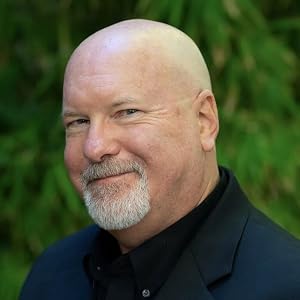
If this Kevin J. Anderson interview proves anything, it is that no book called Nether Station escapes a joke about the nether regions, and that any omnipotent being on your side deserves a very long second look.
Keep reading on Ginger Nuts of Horror
 Inside the Gulp: Alan Baxter on Australian Cosmic Horror, Swallowing Towns & The Rise
 Crawlspace by Adam Christopher Review: SF Horror That Delivers Mechanical Dread
 Cosmic Horror 2026: Ronald Malfi’s The Hive Novel & the Shadows Over Innsmouth Anthology
About Ginger Nuts of Horror
Ginger Nuts of Horror is an independent horror review and culture site based in Edinburgh, Scotland. Edited by British Fantasy Award nominee Jim McLeod, it publishes horror book reviews, film reviews, author interviews, features and cover reveals. Ginger Nuts of Horror won Best Inclusive Film & Book Review Platform at the SME News UK Enterprise Awards 2026.