
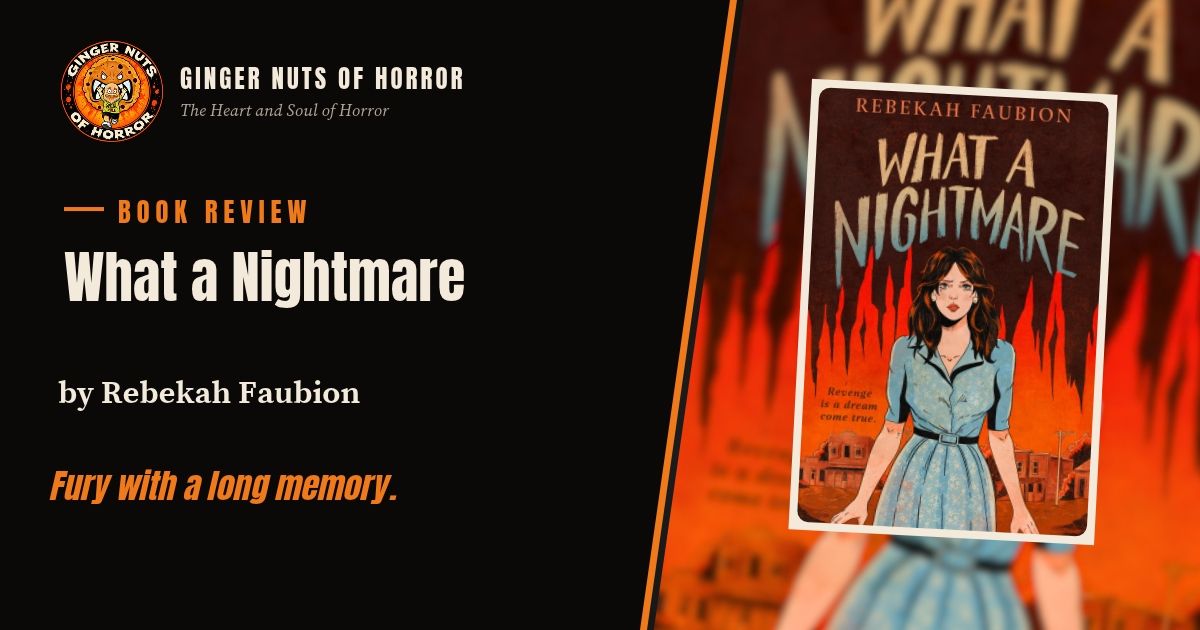
What a Nightmare | Rebekah Faubion | Berkley | 13 October 2026
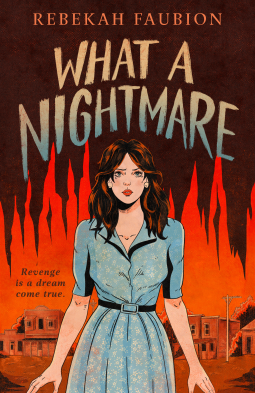
- Author Rebekah Faubion
- Publisher Berkley
- Published 13 October 2026
- Pages 368
- Format Paperback, ebook, audiobook
- ISBN 9798217192144
- Subgenre Supernatural small-town horror
- Reviewed by Jim McLeod
A woman who has spent years shrinking herself finds her nightmares can kill. Called home to Texas by her ailing father, she has to open the box where she locked her past away.
Rebekah Faubion’s What a Nightmare is her first horror novel for adults, a furious homecoming story set in a small Texas town. This What a Nightmare review looks at how she builds a Carrie for grown women, where the power is old news and the real question is what it costs to use. Faubion came to it from rom-coms and a YA thriller, and both show here: in the warmth of its one love story and in the speed of its scares. It sits well beside the queer Southern horror that has crossed our desk this year, and it pushes that shelf somewhere angrier. Here is why it earns its place.
What a Nightmare takes the Carrie blueprint, moves it to a sweltering Texas town and asks what revenge costs the woman who takes it. The narration sometimes explains images that already land, but Faubion’s first adult horror novel is angry, sharp and very hard to shake.
What a Nightmare Review: Rage Kept Under the Lid
Every small town has a word for the girl who will not sit still. Loud. Trouble. Too much. The word sticks long after the girl has learned to whisper, and it waits for her at the city limits like a dog that never stopped looking for its owner.
Haven Powers learned to whisper. When we meet her she goes by Haven Smith, works a front desk in Chicago and keeps her life small on purpose. Few friends. No roots. A smile for every customer. She has good reason. Something in her is dangerous, and she keeps it shut away in a box in her mind, the way her mother taught her. Then a predatory boss pushes too far, Haven has a nightmare about him, and in the morning he is dead.
That is the hook, and Faubion lands it fast. But the real book starts when the phone rings and her father is ill. Haven has to go home to Friendship, Texas, a town whose name is a joke it does not know it is telling.
The Powers family runs Friendship. Earl, the father, has money, a pulpit’s worth of certainty and a grip on almost everyone around him. Olympia, the mother, is a former beauty queen who sets the standard every other woman in town is measured against. Then the three brothers: Buck the heir, Sterling the spare, Lucky the youngest. Haven is the girl in the middle of all that, the one who got away, and the one the family has never forgiven for it.
The comparison everyone reaches for is Carrie, and Faubion invites it. A girl with a dangerous gift. A town that turns cruelty into custom. A mother who treats faith like a leash. For the first stretch the echo is loud, and it works.
Then the book turns. Carrie White was a teenager who found her power and burned the world down within a few pages of learning what it could do. Haven is a grown woman. She has known about her gift for years. She has built a whole life around not using it. So the question is never “what can she do?” It is “what will it cost her to stop holding back?”
That shift makes this a different animal. It also brings in the other ghost on the shelf, Freddy Krueger, since death arrives through dreams. Yet Faubion flips the A Nightmare on Elm Street model. Here the dreamer is the threat, and the dream is the weapon. It is a neat inversion, and she is smart enough not to make a meal of it.
The box is the book’s best idea. Early on it looks like a stock device: a place in Haven’s head where she shoves anything too big to feel. Slowly it becomes something else. Olympia gave her daughter that box. Women in this family are taught to keep the lid down, while the men are handed permission to be as loud and angry as they like. Rage, in Friendship, is a family heirloom. It just gets passed down in two very different wrappers.
And here is the twist of the knife: the more Haven refuses to look at her past, the stronger her power grows. Repression is the fuel. That turns a familiar metaphor into a working machine, and it is the reason the slower early chapters pay off later.
Is What a Nightmare Scary?
Yes, though maybe not where you expect. The nightmare sequences are bloody and strange, and Faubion clearly had fun with them. But the deepest dread sits at the dinner table.
Faubion’s best formal trick arrives once Haven learns to walk through other people’s minds. Each mind has its own shape. I am paraphrasing here rather than quoting, since I have not checked the exact wording against the text, but the shapes are easy to hold onto. Earl’s mind is an orchard he has tended for decades, every tree a story in which he is the hero. A man called Keller has a mind padded like bubble wrap, soft on every side, so nothing he has done can ever bump into him. Buck’s mind runs on the language of the hunt.
Look at what that does. In a single image, the orchard tells you how a man like Earl survives his own conscience: he has spent a lifetime pruning it. The bubble wrap tells you that some people are not ignorant of the harm they cause; they have simply wrapped themselves against it. No speech needed. No villain monologue. Just a room you can walk around in.
That is horror doing its proper job, making the abstract solid enough to touch.
It also sets up the book’s sharpest moral turn. Haven does not only go into the minds of the men who hurt her. She goes into her brother Sterling’s mind too, without asking, to shake the family loose. Sterling is not a monster. He is a man coping badly with a father who wants him to be someone else. The novel knows this, and it does not let Haven off. That is braver than it sounds. A lot of revenge horror wants you cheering at every kill. Faubion lets you cheer, then quietly hands you the bill.
Reading Faubion’s prose is like standing at a screen door in a Texas August: it swings open with no effort, and the heat comes straight in with it. The sentences are clean and quick. The town is all church car parks, gossip on porches and air that sits on your skin like a damp towel. You can smell the fried food and the hairspray. You can feel the sweat.
The family is where she does her best work. Olympia could easily have been a cartoon, the cruel church mother from a hundred other books. Instead she is a woman who was crushed by the same system she now enforces, and the book refuses to choose between those two facts. She is a victim. She is also the warden. Both are true, and both make her worse to be around.
The brothers each get a lane and then, slowly, step out of it. Buck stays close to power and pays for it in ways he cannot name. Sterling drinks and spirals. Lucky, the baby, is the only one still asking whether the family story is true. It is a smart choice to let the siblings change. In most family horror the relatives are furniture. Here they are people who might, given time, get better or worse.
Then there is Winter Reyes, a woman who knew Haven back when she was the loud girl. Their thread is kept deliberately light. Faubion has said in interviews that she held the romance back so it would not soften the brutality, and you can see why. Haven’s life is falling apart; this is no time for a slow dance. Still, Winter matters more than her page count. She left Friendship too, but she can walk back in without giving herself up. She is proof that there is a third road between the family’s rules and a fake name in a strange city. The book is queer at its root, not as decoration.
There is one real problem, and it is worth naming plainly. Faubion does not always trust her own images. She builds something as good as Earl’s orchard, lets it land, and then adds another paragraph explaining what it means. The picture was already doing the work. The extra words just slow things down.
That habit adds up. The middle stretch of the book moves at the pace of a long Texas afternoon, and part of the drag comes from the narration circling back to tell you what you have just seen. Many readers have also felt that the final act settles the family’s account more neatly than it settles Haven’s own; I will not say more than that here. None of this sinks the book. It does stop it short of perfect.
Books Like What a Nightmare
This is Faubion’s first adult horror novel, but she is not new to the dark. She started out with the sapphic rom-coms The Lovers and The Sun and the Moon, then turned to fear with Lost Girls of Hollow Lake, a YA speculative thriller from Delacorte. You can trace the line. The rom-com books gave her an ear for warmth and banter, which is why the Winter scenes glow even when they are brief. Lost Girls gave her practice at ensemble casts and buried secrets. What a Nightmare fuses the two and adds a grown-up appetite for consequence.
On the wider shelf, it belongs beside Gillian Flynn’s Sharp Objects, another story of a damaged woman sent home to a Southern town and a mother who poisons with a smile. It shares ground with Rachel Harrison’s Black Sheep, where a daughter returns to a fiercely religious family, and with Jessica Johns’s Bad Cree, which also lets dreams bleed into the waking world.
Fans of Yah Yah Scholfield’s sapphic Southern Gothic debut, which we covered in our review of On Sundays She Picked Flowers by Yah Yah Scholfield, will find a louder, angrier cousin here. It also makes a strong case for the argument Elizabeth Broadbent made on these pages in Why We Need More Queer Female Southern Gothic: that the South needs stories where a woman can be something other than a saint or a ruin.
What sets it apart is the moral bookkeeping. The current wave of female rage horror often stops at the payoff, the scene where the bad man gets what he deserves. Faubion keeps going. She asks what happens to a woman after she discovers that hurting people feels good. She separates violence that stops harm from violence that punishes, and violence that simply scratches an itch. Being hurt, the book argues, does not make you harmless.
That is a hard thought to sit with. It might be the most useful one horror can offer right now.
Friendship taught Haven to keep the lid on. The book’s best trick is making you wonder who should be more afraid of what is in the box: the town, or her.
The Verdict: Is What a Nightmare Worth Reading?
4.5out of 5
The verdict
A furious, clever revenge story that asks what rage costs, held back only by a habit of explaining its own best images.
Read it if: you want Carrie’s fury with a grown woman’s memory, and family horror where the dinner table scares more than the dreams.
Skip it if: you need a fast plot from page one, or you want the love story at the centre rather than the edges.
Content warnings: religious trauma, homophobia, child abuse including child sexual abuse, sexual assault, intimate partner violence, disordered eating, addiction, serious illness of a parent, gore.

Keep reading on Ginger Nuts of Horror
 Hex House Review: Amy Jane Stewart’s Dark Fairy Tale of Feminine Revenge
 Beyond the Final Girl: 16 New Horror Books by Women Who Refuse to Look Away
 Trad Wife by Sarah Langan: A Feminist Horror Novel for 2026
About Ginger Nuts of Horror
Ginger Nuts of Horror is an independent horror review and culture site based in Edinburgh, Scotland. Edited by British Fantasy Award nominee Jim McLeod, it publishes horror book reviews, film reviews, author interviews, features and cover reveals. Ginger Nuts of Horror won Best Inclusive Film & Book Review Platform at the SME News UK Enterprise Awards 2026.


