

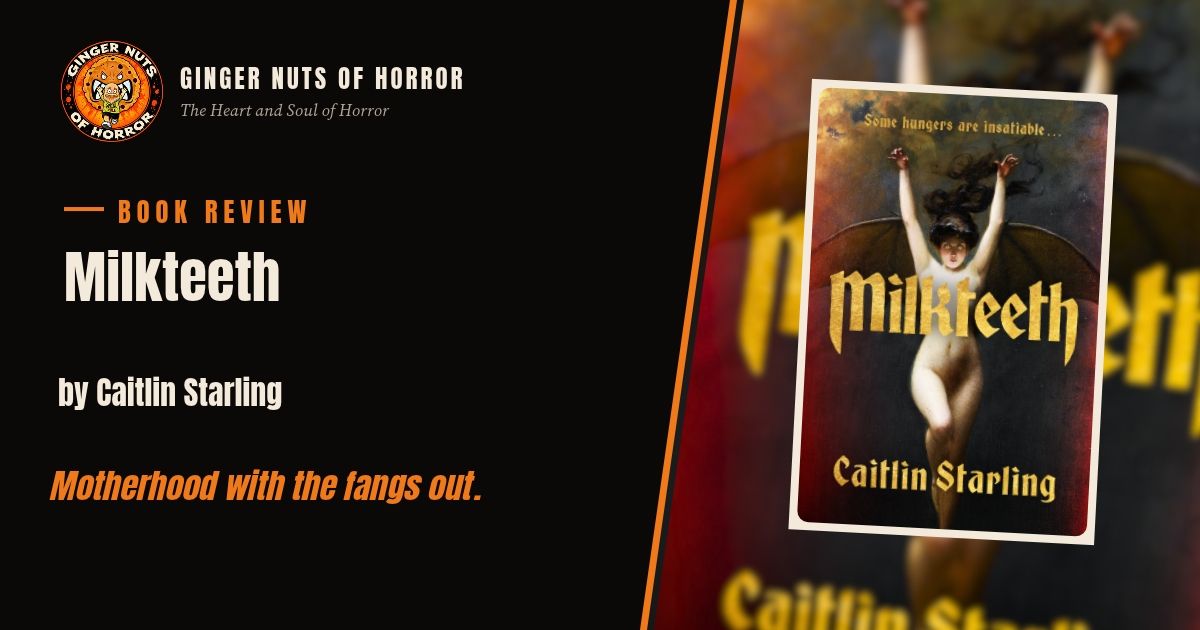
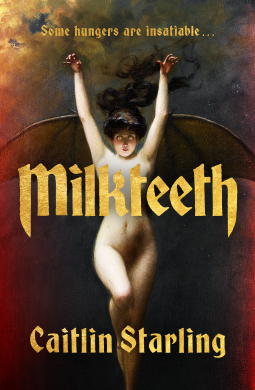
- Author Caitlin Starling
- Publisher Michael Joseph
- Published 22 October 2026
- Pages 336
- Format Hardback, ebook, audio download
- ISBN 9780241844182
- Subgenre Vampire horror, body horror
- Reviewed by Jim McLeod
Beatrice nurses newly made vampires in a hidden warren of old offices beneath a skyscraper. When she takes in a third fledgling, half lost to the ghoul, her hunger grows and her body starts to change.
Caitlin Starling’s Milkteeth asks a question vampire fiction has dodged for two hundred years: who feeds the newly dead? This Milkteeth review looks at a novel that answers with a broodmother, a nursery hidden under a skyscraper and a body that will not stop changing. It is out in hardback from Michael Joseph in the UK and from St. Martin’s Press in the US. Plenty of vampire novels cross the desk at our horror book reviews, and very few bring lore that is truly new. This one does. It also has a slow patch worth naming, so let us start at the beginning.
Milkteeth hands the oldest monster in horror the night feed, and the result is the freshest vampire lore in years. Beatrice is appalling and magnificent in equal measure. Only a middle stretch that loops through the same feeding rounds keeps Caitlin Starling’s strangest book from the very top shelf.
Milkteeth Review: Motherhood With the Fangs Left In
Every vampire story skips the nursery. Someone is bitten. Someone rises. A few pages later they are out on the town in a good coat, and nobody ever asks who fed them in between, or who sat up with them while they screamed.
Caitlin Starling asks. Then she makes you watch the answer.
In Milkteeth, turning is not the work of one night. It takes years. A new vampire comes back weak and helpless, more infant than predator, and human blood is poison to it. Only another vampire can feed it, and hardly any vampire can do that and survive. The few who can are called broodmothers. They are rare, prized, and kept well out of sight.
Beatrice is one of them. She lives in a buried warren of abandoned offices under her patron’s skyscraper. She is not allowed out. Her prey comes down to her in the freight lift. Her patron, Manon, runs the local coven from far above and relies on her completely, while making it plain that the work is beneath her. Beatrice tells us all of this herself, in the first person, to someone she calls “love”. Starling makes you wait to learn who that is, and the wait is part of the design.
She has two fledglings when we meet her. Gorgeous was once a heartthrob and is now a living corpse who behaves like a moody teenager and pines for the lover who made him. Fortunata is the offspring of Beatrice’s own mistress, strange and ambitious and hard to read. Then Beatrice takes on a third. Lu comes from a turning that went wrong, a fledgling stuck halfway between vampire and ghoul. To save her, Beatrice has to feed more and give more. Her hunger swells. Her body begins to change. She starts to crave flesh, which no vampire is supposed to want.
So she goes looking for answers. Early on she slips into a human support group for nursing mothers. Think about that image for a moment: a monster sitting among exhausted women, there for the same reason they are, because nobody else will tell her how her own body works. It is a joke and a wound at the same time, and it sets the tone for everything that follows. The woman running the group is Dr Bajracharya, an OB-GYN, and Beatrice decides this is the person who might explain what is happening to her.
You can guess this will go badly. You will not guess how.
She keeps hold of old folklore too. Her vampires are compelled to count, a superstition from old Eastern European folklore, and she lets it sit among the dull bookkeeping of Beatrice’s days as if it were simply another chore. It is a neat touch. Nothing here is lore for the sake of lore; every rule bends back towards the body and what it costs to keep another body alive.
Beatrice herself is not likeable, and Starling never asks you to like her. She is proud, possessive and fierce about her brood in ways that most of us would call toxic. She does not want rescuing. She wants to be good at her job and left alone to do it. That refusal to soften her is the bravest choice in the book.
The brood is just as sharply drawn. Each fledgling wants something different from her, and none of them say thank you. Gorgeous wants his maker back. Fortunata wants power, and she has the family name to reach for it. Lu just wants to eat, and what she wants to eat is the problem. Beatrice loves all three in the only way she knows, which is fiercely and badly. Some of the best scenes are small ones: a squabble in a corridor, a sulk, a feed that goes wrong. They read like any crowded house at the end of a long day. Then you remember what is on the menu.
Gorgeous, in particular, sneaks up on you. He starts as comic relief, all vanity and heartbreak. By the end he is carrying some of the most tender ideas in the book, about the gap between being wanted and being loved.
Is Milkteeth Scary?
Yes, though not in the way most vampire novels are. There are no figures at the window and no stake through the heart at midnight. The fear here is bodily. It lives in feeding scenes, in blood and worse, and in the slow, careful account of a body growing into something its owner does not recognise. Starling has worked in narrative design and has been paid to invent body parts, and you can tell. The changes to Beatrice are precise, plausible and deeply wrong.
The second source of dread is the doctor.
Starling is careful with Bajracharya. She is not a villain from the first page. She is curious and clever, and hungry in her own way, and a monster who turns up at her group is the find of a lifetime. You understand her. That is what makes her so frightening. The humans in Milkteeth are rarely better than the vampires, and the book is quietly furious about what people with power will do to a body that cannot complain.
Spoiler warning: the next paragraph touches on where Beatrice’s bond with Dr Bajracharya goes in the second half of the book.
What begins as an appointment turns into obsession on both sides. There is no romance in the usual sense, but there is a pull between the two women that reads as sapphic, and it curdles into control of the most literal vampire kind, and in time into an operating table neither of them should be near. It plays like Frankenstein run in both directions. Each woman wants to own the marvel she has found in the other, and neither can stop.
End of spoilers.
Now the snag. The middle of the book circles. Feed, rest, worry, feed again. Some of that is clearly deliberate. Anyone who has lived through the first months with a newborn knows that time stops being a line and becomes a loop, and Starling wants you inside that loop with Beatrice. It is a smart choice, and it still costs her. For a run of chapters the plot holds its breath while the routine repeats, and much of the action only arrives in the final act. Readers who come for pace will feel the drag. The slow build has its own rewards, but a tighter middle would have pushed this to the full five stars.
How Milkteeth Fits Caitlin Starling’s Run of Hungry Books
Look back across her novels and the same obsessions keep surfacing. The Luminous Dead (2019) put one woman in a sealed suit deep in a cave while another watched her every move from the surface. The Death of Jane Lawrence (2021) began with a marriage of convenience to the local doctor. Last to Leave the Room (2023) sent a scientist in a sinking city up against her own double. The Starving Saints (2025) locked its women inside a besieged castle that turned to feasting on itself. The Graceview Patient (2025) trapped a woman with a rare illness in a hospital where she could not trust her own mind.
Bodies under study. Medicine that helps and harms in the same breath. Hunger. Milkteeth gathers all of it into one place and gives it a mother’s face.
It also lands in the middle of a real revival. Vampire fiction has been clawing its way back from the romance shelf for a while now, and our review of Keith Rosson’s Coffin Moon and our feature on how Brian Lumley and Keith Rosson reforged modern vampire mythology both trace that turn back towards the monster. Starling goes somewhere neither of them goes. Anne Rice gave us Claudia, the child vampire frozen forever. Let the Right One In gave us the ancient thing in a child’s body. S. T. Gibson’s A Dowry of Blood looked at the vampire household as a trap. Milkteeth takes the nursery none of them bothered to show and builds an entire biology inside it.
Underneath the gore sits an argument about work. Broodmothers stand in for every carer who is relied on and then shut away: valued for what their bodies produce, ignored when they ask what it is doing to them. Beatrice cannot find a single book about her own anatomy, and that blank page will be familiar to a lot of women who have tried to get straight answers about theirs. Starling never preaches about any of it. She simply lets the basement speak.
None of this makes Milkteeth a lecture. It is a horror novel first. It wants you queasy. It wants you to flinch at the word milk. Most of the time, it gets its way.
Every vampire has a mother. Starling has finally written her, and she is starving.
The Verdict: Is Milkteeth Worth Reading?
4.5out of 5
The verdict
The freshest vampire lore in years, held back only by a looping middle before the final act bites.
Read it if: you want vampire lore you have never met before, and body horror with something sharp to say about motherhood and care.
Skip it if: you need a fast plot, or graphic feeding, gore and bodily change are hard limits for you.
Content warnings: graphic gore, blood drinking, cannibalism, body horror and bodily transformation, medical procedures and surgery, toxic and controlling relationships, mind control, exhaustion and distress linked to new parenthood and breastfeeding.

Keep reading on Ginger Nuts of Horror
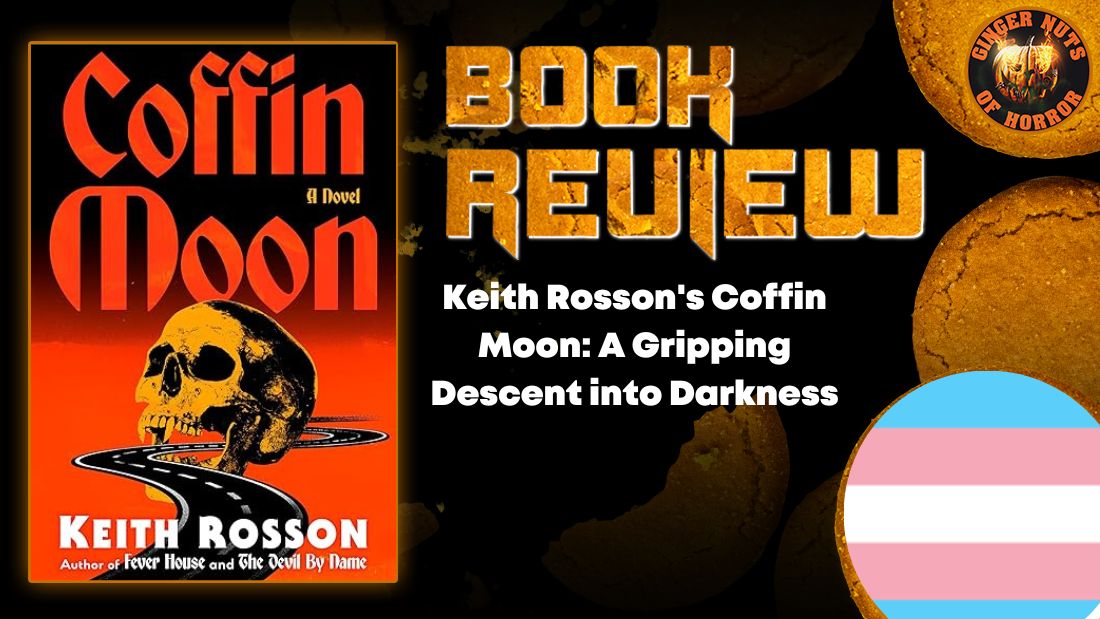 Keith Rosson’s Coffin Moon: A Gripping Descent into Darkness
 Reign of Terror: How Brian Lumley and Keith Rosson Reforged Modern Vampire Mythology
 The Gathering by C. J. Tudor

About Ginger Nuts of Horror
Ginger Nuts of Horror is an independent horror review and culture site based in Edinburgh, Scotland. Edited by British Fantasy Award nominee Jim McLeod, it publishes horror book reviews, film reviews, author interviews, features and cover reveals. Ginger Nuts of Horror won Best Inclusive Film & Book Review Platform at the SME News UK Enterprise Awards 2026.


