Eliza Jabore’s debut horror novel Backstabbers arrives in June 2026 with a cool premise: three women hiking Washington State’s Bones Hollow Trail, listening to a true crime podcast about the serial killer who used to hunt there, walking directly into his old territory. It sounds like dark comedy.
It is dark comedy. It is also a survivalist horror novel with real teeth, a study of female friendship under catastrophic pressure, and a pointed satire of our obsession with violent crime as entertainment.
Backstabbers takes the well-worn survivalist slasher and rewires it from the inside. Eliza Jabore builds a horror that runs simultaneously through dark forest and the nervous system of a fractured friendship, never letting either threat outrun the other. Sharp, funny, and at times quietly devastating.
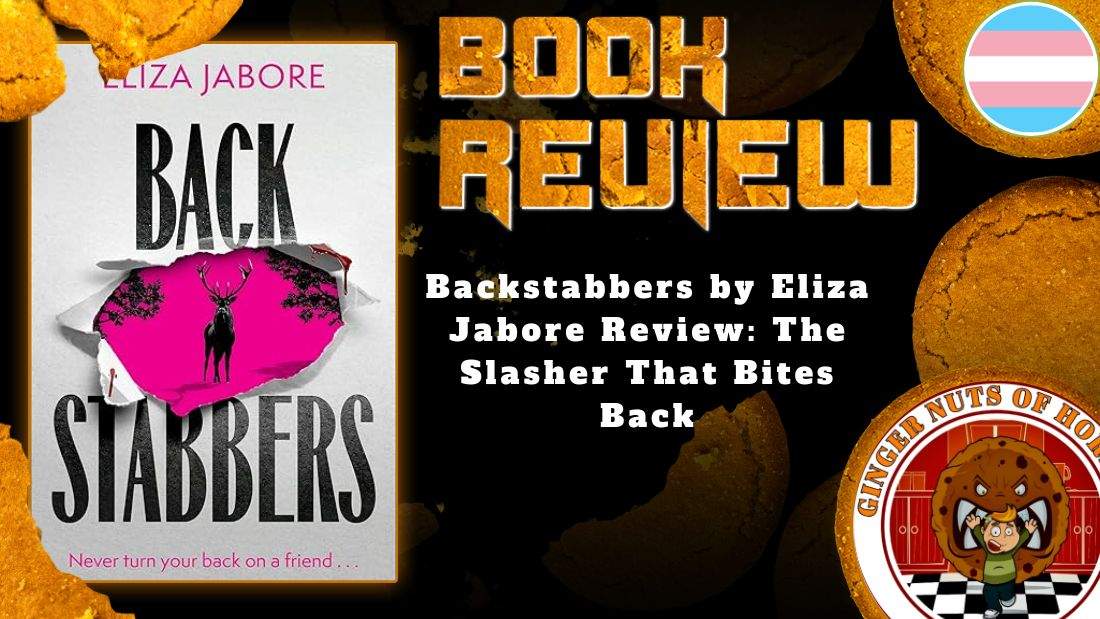
Backstabbers by Eliza Jabore Review: The Slasher That Bites Back
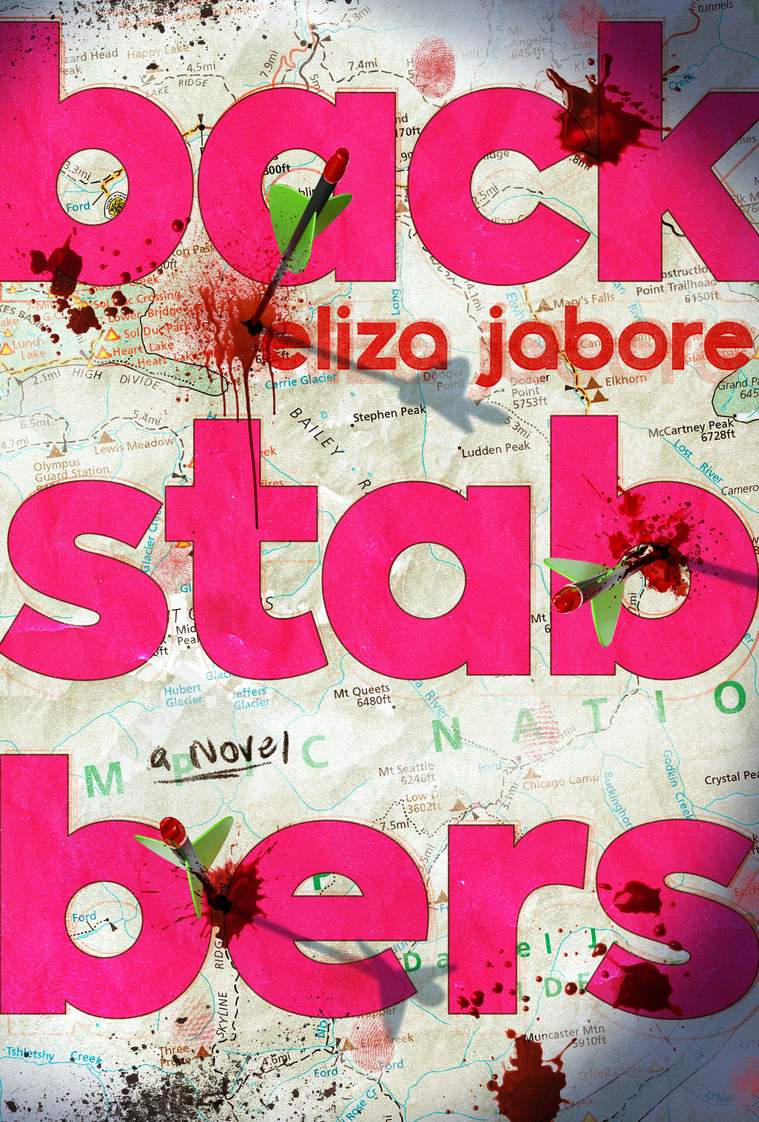
Jade, Stef, and Zoe walk into a forest with a true crime podcast in their earbuds, and Eliza Jabore’s Backstabbers makes that one detail do more work than most novels manage in three hundred pages.
There is something specifically contemporary about that image. Not just the hiking, not just the lurking threat in the trees, but the fact that these women are willingly narrating their own fear to themselves, piping a serial killer’s history directly into their heads as they walk across the precise ground where he hunted.
That detail is the book’s first and best joke, delivered absolutely straight, and it sets the tone for everything that follows. Backstabbers is a slasher in the old, clean sense of the word, but it is also a satirical piece of work about why we love true crime, and about what that love costs us when the podcast stops and the reality begins.
What Jabore builds on Bones Hollow Trail is a particular kind of dread. The setting earns its place from the first pages. Washington State’s wilderness comes across not as a backdrop but as an antagonist: cougars, black bears, storms that materialise without warning. The landscape is indifferent to the women in it, and that indifference is scarier than any malevolent force would be. Nature does not care about your podcast. Nature does not care about your ankle.
Because the pacing works like tightening rope. Each chapter adds a small new tension. By the time Stef’s injury forces the group toward the cabin in the trees, the one that looks exactly like every cabin in every horror film you have ever seen, the atmosphere has been wound so tight that the arrival of the reclusive man inside it lands as both terrible and almost, horrifically, like relief. Someone is there. That is the book’s darkest trick: it makes you understand, briefly, why they go in.
The dread Jabore builds is a slow, social, compounding kind. It comes from watching a friendship that clearly has history and fault lines being stress-tested by physical danger, by fear, by the question of who will protect whom when things collapse. The horror here is not only external. It runs along the nerve ends of familiarity. And that makes it land harder than a simple threat in the trees ever could.
Backstabbers is fast, propulsive, genuinely funny in places, and then abruptly, completely serious. Jabore shifts registers without warning, which sounds like a technical failure until you realise she is doing it on purpose, that the sudden lurches in tone mirror the way real fear works: how a group of friends can be laughing one second and then the laughter stops and something has changed and nobody can quite say when.
The prose does not reach for the gothic or the literary in ways that slow the narrative drive. What it does instead is observe people with a very precise and slightly cold eye, the way you might if you were describing human behaviour to someone who had never encountered it before and needed to understand it functionally rather than emotionally. That quality in the narration is what gives the horror its edge. Jabore writes like someone taking careful notes on a situation that has already started to go wrong.
Dialogue does the heavy structural lifting throughout. The conversations between Jade, Stef, and Zoe function on two levels simultaneously: surface conversation and subterranean pressure. What gets said is almost always less interesting than what is being carefully not said, and Jabore trusts the reader to hear both registers at once. This is genuinely skilled writing, because that double-layered dialogue is difficult to sustain without making it feel arch or contrived, and here it never does.
The chapter construction favours brevity and velocity. Short, purposeful sections that refuse to let momentum settle into comfort. Point-of-view stays close to the central characters without becoming claustrophobic, giving the reader enough perspective to see the larger picture while remaining inside the fear. The decision to ground the horror in completely realistic threats first, in injury and weather and geography, before introducing the human danger, is structurally smart. By the time the cabin appears, the reader has already accepted the world as hostile. The man inside it is simply one more thing in a list.
Horror is a genre that has always been strongest when it uses impossible or extreme situations to say something true about the ordinary. Backstabbers does exactly that, with economy, with wit, and with a willingness to push its central friendship to places that are genuinely uncomfortable. That discomfort is the point. That discomfort is the work.
The true crime podcast, woven into the fabric of the hike, functions as an ongoing ironic counterpoint: a voice talking confidently about violence as entertainment, as narrative, as solved problem, while an unsolved problem assembles itself around the three women in real time. It is one of the book’s cleverest structural moves.
Strip the plot away and Backstabbers is asking one clean question: what do we actually know about the people we love?
Female friendship in horror tends to be coded as either unbreakable solidarity or inevitable betrayal. Jabore refuses to settle for either. The friendship between Jade, Stef, and Zoe feels lived-in and complicated before the first threat appears, and that prior complexity is what the crisis reveals rather than creates. The horror does not produce the tensions in these women; it only removes the social structures that kept those tensions managed. This is a more interesting and more troubling idea than the standard slasher dynamic, because it locates the danger inside something warm.
The true crime satire angle is sharp. We are living through a period when violent death has been turned into content, packaged into episodic listening experiences complete with ad breaks and subscriber bonuses. The podcast that Jade, Stef, and Zoe consume throughout their hike represents that entire cultural phenomenon, the comfortable distance we place between ourselves and violence by giving it narrative structure, a beginning, an end, a solved case. Backstabbers systematically destroys that distance. When the serial killer’s old ground becomes the ground you are actually standing on, the podcast stops being a product and becomes something much more uncomfortable.
There is also something precise being said about survival as it applies specifically to women: how survival sometimes requires choices that do not feel survivable, how trusting someone with your life is a different proposition entirely from liking them, and how physical vulnerability strips away the layers of performance that make relationships function. Stef’s ankle injury is not just a plot mechanism. It changes the social geometry of the group immediately and permanently. Suddenly some of the women can move and some cannot, and what happens next in that power shift is the book’s most quietly devastating material.
Backstabbers is Eliza Jabore’s debut novel. That fact is worth sitting with, because debut novels rarely carry this quality of structural confidence. The pacing discipline, the dialogue control, the tonal range: none of these are traits that appear by accident in a first book. Jabore clearly comes to fiction having absorbed how slasher narratives work at both the mechanical and the philosophical level, and she has built something that handles those conventions from a position of understanding rather than imitation.
Stephen Graham Jones has spent the better part of a decade teaching the literary establishment what the slasher always was: not a formula, but a vernacular for discussing survival, identity, and who gets to live and why. In his wake, a generation of writers has picked up the form and found genuinely different things inside it.
Backstabbers sits in this current moment of slasher literary fiction, but it brings something to the table that distinguishes it from much of the current field: the true crime satire angle gives it a cultural specificity that is very precisely of now. Books like Paul Tremblay’s survivalist horror and Tasha Coryell’s Love Letters to a Serial Killer share some of its tonal territory, but Jabore’s fusion of wilderness survivalism, female ensemble horror, and media critique operates as its own distinct configuration.
The wilderness setting aligns it somewhat with the isolated-threat tradition, but where most isolation horror strips its characters of context, Jabore keeps the cultural noise turned up. The podcast never fully stops. The world never fully disappears. The horror is that it does not need to.
The book also participates in a broader wave of horror writing that examines how women relate to each other under conditions of extremity. Laurie Elizabeth Flynn’s work, and Leah Rowan’s Marion, occupy adjacent territory, but Backstabbers is less interested in the domestic as a horror space than it is in the natural world, and specifically in how the natural world refuses the social scripts women use to manage their relationships with each other.
Horror is a genre that has always been strongest when it uses impossible or extreme situations to say something true about the ordinary. Backstabbers does exactly that, with economy, with wit, and with a willingness to push its central friendship to places that are genuinely uncomfortable. That discomfort is the point. That discomfort is the work.
The forest always ends. The friendship is the thing that stays.
Backstabbers by Eliza Jabore
A deliciously tense, edge-of-your-seat reading experience that will have you turning the pages well into the night’ LAURIE ELIZABETH FLYNN
Never turn your back on a friend.
Jade, Stef and Zoe are hiking Washington’s Bones Hollow Trail, braving cougars, snakes and the storms that roll in without warning. The friends’ paranoia isn’t helped by listening to a true crime podcast about the serial killer whose hunting ground they’re hiking through.
Then when Stef twists her ankle – badly – there’s no one to hear them scream for help. The only sign of life for miles is a cabin that looks straight out of a horror movie, with an owner who’s a little too eager to invite them in.
The friends must soon find a way to survive as things spiral out of control. After all, who can you trust when your back’s against the wall? But unfortunately for them, the only thing more twisted than this nightmare is their friendship…
‘Filmic, fresh and frightening with shocks galore’ ALLIE REYNOLDS
‘Full of twists and unexpected turns’ TASHA CORYELL
‘Don’t you dare turn your back on Backstabbers, a deliciously sinister sojourn into true crime country’ CLAY McLEOD CHAPMAN
‘This book has everything you need for a rip roaring adventure and jaw dropping twists…Read it if you dare!’ 5* NETGALLEY REVIEW