Hawkins gives his wolf a name, a dead mate and a theology, then points him at the end of the world.
Blacktail by Scott Hawkins Review: A Wolf, a Sleeping God and the End of Human Exceptionalism
Scott Hawkins spent eleven years away from fiction. He has come back with a novel that never once looks at the world through human eyes. Blacktail is a half-breed wolf of the north woods, faithful to a god he cannot see and in love with Renren, a house dog kept chained in a garden by people who barely look at her. When they kill her, and the pups she is carrying, an ancient cat witch called the Old Kitty Mother makes him an offer. Better than one dead family. She will give him all of us.
To collect, he has to travel south and wake the Forest God, who sleeps because the God of Reason took the world while nobody was watching. This Blacktail review looks at how Hawkins builds a whole theology out of what animals can actually sense, why Car is a god and the Hunt is a sacred language, and how a book this angry stays this precise. It is eco-horror with the allegory stripped out, folk horror where the monsters drive to work, and proof that the long gap taught him to cut. Tor Nightfire publish it in the UK.
Hawkins gives his wolf a name, a dead mate, and a theology, then points him at the end of the world — and every page earns that ambition. Blacktail is furious, mythic, and utterly precise: literary eco-horror at its most ferociously original.
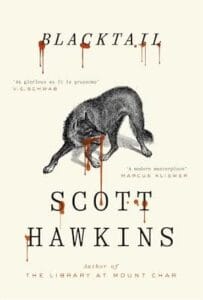
Blacktail | Scott Hawkins | Tor Nightfire (UK) / Crown (US) | 3 September 2026 (UK) |
Scott Hawkins gives his wolf a name, a dead mate, and a theology, and then he points him at the end of the world.
That’s the deal. That’s the whole engine running underneath this book’s bones. Blacktail, half-breed wolf of the north woods, is faithful to a god he cannot see and in love with a creature he should not be. When the men who own his mate kill her, something breaks open in the cosmos. Not just in Blacktail. In the book itself.
What starts as a story about grief and the absolute clarity that grief sometimes becomes, the kind that collapses the distance between sorrow and violence, expands into something vast and strange and deeply unsettling. By the time the ancient feline witch finds Blacktail in his rage and makes her offer, the rules of the book have already changed under your feet, and you haven’t noticed yet.
This is the right kind of horror. Not the kind that makes you flinch and then forget. The kind that settles somewhere between the ribcage and the conscience, making you uneasy long after the last page. Hawkins builds his dread the way a wolf circles a kill: patient, deliberate, always approaching from an angle you weren’t watching. The pacing in the first third is almost deceptively quiet. Blacktail’s north woods exist in a state of perpetual encroachment, the forest smaller every season, the men louder and closer.
The horror is environmental before it is supernatural. It is the horror of a world being erased, and Hawkins gives you enough time inside Blacktail’s senses, the smell of turned earth and diesel, the sound of chainsaws bleeding through tree-line, that you feel the encroachment as a physical threat. Then the killing happens, and the book shifts into something else entirely. The feline witch arrives. The Forest God’s name enters the narrative. And you realise you were never reading a small story about one wolf’s grief. You were reading something that was always going to be about the price of asking too much of ancient things.
The book doesn’t build to its horror so much as reveal that you’ve been inside it all along. The tension of the early chapters comes from recognising that Blacktail’s north woods are already a horror story, one written in slow decades of deforestation and displacement, before a single act of violence occurs. When the violence does arrive, it lands with the force of something that was always inevitable. Hawkins has engineered this, carefully, and the architecture holds.
What Hawkins does with point of view is the book’s most audacious structural decision. Every scene is rooted in animal perception, which means human beings are, for possibly the first time in literary horror, genuinely and irreversibly the monsters. Not metaphorically monstrous. Monstrous in the flat, factual sense that a wolf experiences them: larger than they should be, loud in all the wrong ways, indifferent to everything that matters.
The prose adjusts itself to this perception without ever calling attention to the adjustment. Hawkins never translates the animal experience into human emotional language; he trusts you to make the leap yourself, and that trust is what makes the horror land. When Blacktail invades the house of the men who killed his mate, the scene isn’t constructed around dread the way a human-perspective horror scene would be. There’s no hesitation. No second-guessing. The ruthless straightforwardness of it is more disturbing than any amount of atmospheric hand-wringing could produce. Grief in a wolf, it turns out, does not negotiate.
The structural choice to use multiple animal narrators, not just Blacktail, gives the book a breadth that a single point of view couldn’t achieve. Each additional perspective functions as a different frequency of the same alarm, different creatures registering the same catastrophe in different registers.
The chapter construction is tight without feeling compressed; Hawkins understands that 288 pages is an argument as much as a length, that a book about the erasure of the natural world should not itself be overlong. He cuts before you need him to. The prose, even in the passages of the highest violence, stays clean. There’s no showboating. No sentence that exists to demonstrate what the author can do rather than to serve the story. After a decade away from fiction, Hawkins writes as though he’s been saving every word.
The themes at work here are not subtle, and Hawkins is not trying to make them subtle. Blacktail is a book about environmental destruction told from the perspective of the destroyed. It is about what we have taken from the natural world, not in the abstract, but in the specific, granular sense of taken: territory, life, quiet. Every human character in the book is seen through animal eyes, and the effect is a defamiliarisation that should embarrass us. We are the invasive species here. We are the thing spreading wrong.
Hawkins has said that much of this book was sparked by events he witnessed as a pet owner and through his work with a dog rescue. That personal origin matters. The grief in these pages has the texture of something observed rather than invented. The mate Blacktail loses is not a symbol; she is a dog, specific and particular, and the loss of her is rendered with an emotional precision that abstract environmentalism rarely achieves. This isn’t guilt-lit. This is fury-lit. There is something both refreshing and genuinely disturbing about a horror novel that locates the monster with this much conviction.
The journey that follows, Blacktail moving deeper into the world of man, drawn by the feline witch’s bargain, gathering around him companions animal, mortal, and stranger still, is where the book earns its mythic weight. Hawkins has always been interested in the architecture of the divine: what gods want from the creatures below them and what those creatures pay for proximity to power. Here, he inverts the question.
Blacktail does not seek the Forest God for salvation. He seeks him because the witch has shown him that the alternative is watching everything he is vanish into subdivisions and silence. The Forest God’s sleep is not a metaphor. Or it is, but one with teeth: the divine withdrawing when the world stops deserving its attention.
The question of whether waking the Forest God is wisdom or catastrophe, whether ending the plague of men solves anything or merely replaces one damage with another, drives the book’s latter half with the kind of theological urgency you don’t usually find in novels that also contain this much blood. This is a book that thinks hard about what it asks for. The ending does not let the reader off the hook.
Coming to Blacktail from The Library at Mount Char is a strange and rewarding experience. That first novel, published in 2015, is a book about humans warped past recognition by their proximity to godlike power: Carolyn and her siblings, raised by the centuries-old Father in his terrible library, given dominion over domains of knowledge ranging from war to language to death.
It is brutal and strange and refuses to resolve neatly, and its reception was as divided as you might expect for a novel that operates according to its own logic. The Wall Street Journal called it “wholly original” and “the work of the newest major talent in fantasy.” V.E. Schwab, writing for NPR, described it as “utterly resistant to categorisation.” Both assessments are accurate.
The decade between that book and Blacktail is evident in the prose. Hawkins writes with more restraint now, more confidence in the white space. The Library at Mount Char occasionally overwhelms with its own invention; Blacktail knows when to go quiet. The recurring obsessions are the same: the cost of proximity to the divine, the violence underneath mythology, the small creature navigating cosmic indifference. But where The Library at Mount Char asked what happens when humans are given the tools of gods, Blacktail asks what the non-human world makes of us. The answer is not comfortable.
What the gap between the books has given Hawkins, beyond technical refinement, is a clearer sense of what he cares about. The Library at Mount Char is a book discovering its own convictions in real time. Blacktail arrives already knowing exactly what it wants to say, and that certainty, disciplined rather than didactic, gives the whole novel a quality of purpose that makes even its most extravagant sequences feel earned.
Within horror fiction, Blacktail occupies a position that is genuinely difficult to triangulate. The comparisons to Watership Down are inevitable and not wrong, but they require qualification. Richard Adams’ rabbits belong to a book ultimately about community and survival. Blacktail’s wolf belongs to one about annihilation, or at least about the conditions that might justify it. The bones of the journey narrative are similar. The emotional and moral register is not.
What Blacktail does that few horror novels manage is earn its cosmic scale without abandoning the intimate. The moment of grief at its core, a wolf in the ruins of what he loved, keeps everything else honest. The Forest God, the witch, the burning confrontation with something like angels at the world’s edge, none of it would matter without that. Hawkins knows this, and builds accordingly.
He is working in a tradition of eco-horror that views human exceptionalism not as a philosophical position but as a species-level pathology, and the genre is having a significant moment. Recent horror has increasingly turned its attention to questions of environmental culpability and the rage of the non-human world. Blacktail is the novel that tradition has been waiting for: the one that dispenses with allegory and simply hands the microphone to the wolf.
The comparisons to writers like Paul Tremblay are apt in the sense that both operate in a literary horror register where the prose earns every scare and the emotional architecture holds up to scrutiny. But Blacktail’s closest kin might be the strain of dark fantasy that treats mythology not as decoration but as argument. This is not a book about horror using animals as vehicles. It is a book about what animals already know, and what we have refused to learn from them.
What wakes the gods is not prayer. It is the specific, accumulated weight of everything we refused to protect.
There is exactly one decent human being in these pages. Blacktail’s moral system has no slot for that, and Hawkins will not build him one to make us feel better. That single choice is braver than most of what passes for edgy in horror this year.
Horror keeps circling round to blame. What we have broken, and whether something out in the dark will hold us to account. Blacktail answers in the affirmative. The answer is a wolf.
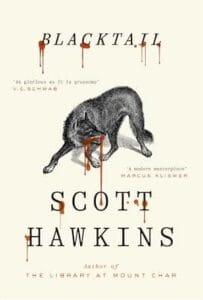
Blacktail by Scott Hawkins
What wakes the gods is not prayer. It is the specific, accumulated weight of everything we refused to protect.
‘A modern masterpiece. Blacktail will consume you’ – Marcus Kliewer, bestselling author of We Used to Live Here
‘Blacktail is as glorious as it is gruesome’ – V. E. Schwab, Sunday Times bestselling author of Bury Our Bones in the Midnight Soil
A wolf embarks on a primal hunt for revenge. Blacktail is a dark work of animal fiction from Scott Hawkins, the critically acclaimed author of The Library at Mount Char.
Blacktail is a half-breed wolf, born to hunt. When he finds love beyond a garden wall, he dares to imagine a peaceful life – until men butcher his mate and unborn pups in a surgical act of cruelty. His grief ignites a rampage of torn throats and shattered bone, a slaughter so absolute it draws the gaze of an ancient feline witch. She sends him south to wake the sleeping Forest God and end the age of reason.
Fuelled by a rage that frightens Hell itself, Blacktail wages war against men and the beasts who dare defend them. From a gore-soaked wilderness to a burning confrontation with Heaven, Blacktail is a feral odyssey of vengeance.
The Forest God sleeps. But what will be the price of waking him?
* * *
‘Touching, horrifying, and entertaining . . . You should all get excited for this book’
– Mark Lawrence, Sunday Times bestselling author of The Book That Wouldn’t Burn
‘Blacktail is one to savor; one to delight in the eccentricities of; one to sit with long after it ends’
– Olivie Blake, New York Times bestselling author of Girl Dinner
‘Beautiful, brutal fantasy, red in tooth and claw’
– Chuck Wendig, Sunday Times bestselling author of The Staircase in the Woods
Ginger Nuts of Horror: The Heart and Soul of Horror Reviews
Every feature is built to sell your work. We include backlinks to your website or Amazon author page, a full synopsis, and a universal purchasing link that sends readers straight to their local store. Add a large, engaged social following and an 18-year archive of trusted horror coverage, and you have a platform genuinely built to grow your readership.
Whether you’re an established author, an indie filmmaker, or a debut voice in indie horror, there’s a way for us to help you reach more fans. Explore our horror book reviews and horror movie reviews, then get your horror book or film featured today.