Folk horror didn’t die. It got a job at Tesco.
Dan Coxon’s Come Sing for the Harrowing, reissued by CLASH Books in April 2026, is one of the most formally inventive folk horror collections to emerge from British weird fiction in years.
Eighteen stories remake the subgenre from the inside, placing ancient forces inside care homes, tourist caves, Brixton supermarkets, and medieval theme parks. Originally published in 2024 by the now-defunct Weird Little Worlds, the collection gains a new cover, additional stories, and a foreword from Brian Evenson in this edition. Dan Coxon has built his reputation across both fiction and editorial work, and this collection shows him at his most ambitious and controlled.
Come Sing for the Harrowing is Dan Coxon at his most formally audacious: eighteen stories that pick folk horror’s bones clean and reassemble them into something stranger, funnier, and more disturbing than the subgenre thought it could be. Ancient forces here make their claims in care homes and tourist caves and Brixton Tescos; the prose is clean, controlled, and quietly devastating. This is the uncanny as it actually lives.
Dan Coxon’s Come Sing for the Harrowing: Folk Horror Reimagined
Dan Coxon has a problem with old gods. Not a theological one, more a literary one. Folk horror keeps serving them up on a wooden platter, hungry and eternal, and somewhere between Robert Holdstock and the tenth pagan sacrifice of a young man in sackcloth, the subgenre started eating itself alive.
Dan Coxon knows this. He says so publicly, calling folk horror in danger of burning out Wicker Man-style, and then he did the only sensible thing: picked the genre up, turned it sideways, and dropped it into a call centre, a Brixton Tesco, a cave system in the Cheddar Gorge, a medieval tourist attraction that is just a little too authentic. Come Sing for the Harrowing is the result. Eighteen stories of folk horror as you have never quite encountered it, built on the ruins of the genre’s own expectations, and considerably more unsettling for that.
The book itself has a history before it has a proper readership. Originally published in 2024 by Weird Little Worlds, a small US press that folded almost immediately after release, Come Sing for the Harrowing spent roughly a year as a ghost book, flickering in and out of availability, all but invisible.
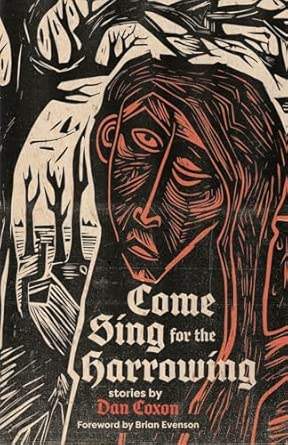
CLASH Books picked it up for this 2026 edition, added new stories, commissioned a new linocut-style cover from artist Matthew Revert, and secured a foreword from Brian Evenson, who has been quietly championing Coxon’s work since he bought a copy of the micro-collection Green Fingers back in 2021 and sent a message saying how much he’d enjoyed it. That small origin story feels appropriate for this particular book. It started as an act of genuine appreciation, not an industry favour. What followed was the right introduction.
Reading Come Sing for the Harrowing is like crossing a moor in thin fog. The path is clear enough underfoot. You can see what’s around you. But the periphery keeps shifting, the sounds are wrong, the distances are wrong, and something out in the grey is absolutely stationary and absolutely watching.
Coxon builds this atmosphere through restraint. He is one of those writers who understands that the word uncanny doesn’t mean frightening exactly; it means the familiar made strange, comfort curdling into something else entirely. His best stories place ordinary people in situations a few degrees off from comprehensible and let the wrongness accumulate, without ever explaining it.
The title story opens the collection and earns its place there. A young man called Jack takes a summer job at a medieval theme park called Historytown, forking hay in a fake stable. From the first scene, where a man named Big Mike smells of pig fat and onions and measures Jack for a sackcloth tunic in a basement, the horror isn’t announced so much as installed.
What happens to Jack is not quite a surprise, but it doesn’t need to be. Coxon paces it like a ceremony. The Darkness Below might be the collection’s best single piece: the story of a father who takes his family to Gough’s Cave in the Cheddar Gorge, loses his teenage son briefly in the dark, and becomes increasingly, quietly convinced that the boy who came back out is not his son.
Told in the register of a confession transcript, it’s a masterclass in Capgras-delusion territory, at the exact intersection of psychological and folk horror that Coxon navigates best. The father isn’t unreliable in the usual sense. He knows exactly what he saw. The horror is that we cannot be certain he’s wrong.
Our Sister of Blackthorn unfolds through podcast transcripts, a true crime podcaster investigating a childhood friend’s disappearance from a crumbling urban estate. The formal choice amplifies the horror rather than diluting it; the bureaucratic calm of interview questions makes the darkness beneath them feel colder. Long Gone (Slight Return) is stranger still: a fragmented oral history of a rock band built from cut-up interview transcripts, original grunge-adjacent lyrics, and an imagined gig poster.
The disappearing musician at its centre feels lifted from a Joel Lane novel, which is meant as very high praise. Vile Jelly takes place in the margins of King Lear, following servants attending Gloucester after his blinding, and it is exactly as unnerving as that sounds. Grains of Sand gives us an ancient Egyptian mummy working security at a Brixton Tesco, recognising in a customer the reincarnated soul of his lost love. It sounds absurd. Coxon makes it work, and that tells you something important about the control he has over the register throughout.
The pacing architecture of the collection is thoughtful. The first third is heavier on classic folk horror territory: islands with wrong rules (The Wives of Tromisle), hilltop churches with unwholesome histories (Bring Them All Into the Light), village girls haunted by dead boys (Bumblethatch). Then the book broadens its register, moving through urban horror, psychological horror, Lovecraftian surrealism, and even a moment of resigned dark comedy. No two consecutive stories deploy the same mode of dread.
The collection’s variety is itself an argument: that the uncanny isn’t confined to any particular geography or idiom, that it travels, that it adapts. By the final story, Beyond the Beach, the Trees, set in a tropical resort where a sweating man encounters someone wearing a dead friend’s face, the horror of the familiar out of place has followed us across continents.
His sentences are clean and direct, uninterested in ornament. He spends a paragraph making a character feel entirely real and familiar, then produces one detail, the wrong smell or the wrong stillness or the too-precise memory, that makes everything before it retroactively strange.
This is the Aickman inheritance, and Coxon wears it knowingly, though where Aickman was often austere to the point of coldness, Coxon is warmer. There is grief in these stories. Obsession and family damage, and the specific loneliness of people who have made choices they can’t quite explain.
His formal experiments are not gimmicks but tools, chosen because the story demands them. The cut-up and weave of Long Gone (Slight Return) doesn’t feel like a workshop exercise; it feels like the only possible way to tell a story about a musician who became something other than himself, fragmenting and reassembling as the evidence accumulates.
The podcast-transcript structure of Our Sister of Blackthorn earns its horror by making it clinical, the way the most frightening things in real life are often recorded in a flat, professional register that has no idea what it’s documenting. Clockwork, in which a woman compelled to dig up pieces of a Victorian automaton from her late abusive father’s garden reassembles something she cannot identify, is the collection’s best example of how Coxon handles repetition and obsession: a psychological horror story in which nothing supernatural might be happening at all, and which is more disturbing for that ambiguity.
Even the moments of dark absurdity, and there are several, feel precisely calibrated. He knows when to pull the camera away before something becomes explicit, a technique he shares with Aickman and which the best weird fiction has always relied on. What you don’t see is invariably worse than what you do. The Darkness Below ends before the father finishes his testimony. In Flickering Light, a story about a film editor reflecting on working with a director who loved and exploited women, ends in a way that refuses to resolve. These open endings are not failures of nerve. They are the structure of dread itself: the thing that persists because it was never quite named.
The themes Coxon returns to across these eighteen stories are obsession and inheritance, the way things are passed down whether we want them or not. Clockwork makes this literal: a daughter compelled to reassemble her dead father’s automaton, her hands carrying out a task her mind hasn’t authorised. Bring Them All Into the Light does it spiritually: a father seized by a devotion to a hilltop that looks, from the outside, indistinguishable from breakdown. Bumblethatch does it communally: a village girl narrating a dead boy’s return, the past refusing the tidy ending everyone agreed it should have.
This is the central anxiety of the collection: that we are not as free from the past, from the land, from old obligations, as we’d like to believe. Folk horror has always traded on this idea, the sense that beneath modernity’s concrete and Wi-Fi, something ancient is still making claims.
What Dan Coxon does differently is locate those claims inside contemporary life, in parking lots and care homes and tropical resorts and tourist caves. The old forces, in these stories, have adapted. They’re here, in the familiar and the everyday, and they have been waiting. The horror of Gorphwysfa, a Welsh word meaning “resting place,” which follows a man moved into a care home and a thing that begins leaving scratches on him, is recognisable to anyone who has ever watched a parent diminish in an institution. The dread isn’t added on top. It’s already in the situation.
Religion runs through the collection as a quiet current, not in the sense of Christian theology but in the older sense: the compulsion to offer, to sacrifice, to answer a calling, to build on a hilltop because something insists. Coxon has noted in interviews that he finds religious and spiritual ecstasy interesting precisely because it sits next to the uncanny, that sense that the mundane world is stranger and more wonderful than it appears.
Several stories in this collection could be read as accounts of people encountering genuine transcendence; it’s just that the transcendence in question is indifferent to human welfare. Ancient gods don’t necessarily mean ill. They just don’t mean well, either.
Horror, Coxon has argued, is enjoying a renaissance because it examines what should be safe spaces, the home, the family, the familiar street, and finds them threatening. Come Sing for the Harrowing is animated by exactly this understanding. Every safe space in these pages is, at some level, a trap.
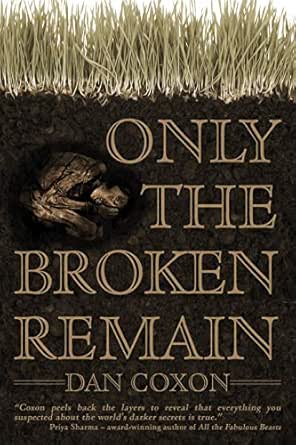
Only the Broken Remain, Coxon’s 2021 debut collection from Black Shuck Books, established the territory: folk horror, urban uncanny, weird fiction, stories that refused easy categorisation. Shortlisted for two British Fantasy Awards (Best Collection and Best Newcomer), it gathered pieces from twenty years of publication and showed a writer already capable of remarkable range, with the folk horror pull of landscape and community running alongside psychological horror and something that defied genre labelling.
The themes that animate Come Sing for the Harrowing were seeded there. The anxiety about families and what they transmit, the preference for atmosphere over event, the refusal to explain what might be better left unexplained. Green Fingers (2020), his micro-collection from Black Shuck Shadows, extended this, with folk horror woven through domestic and pastoral settings in miniature.
What Come Sing for the Harrowing shows is increased confidence in formal experiment and a willingness to be funny, or at least wry. Only the Broken Remain was excellent but rarely played for dark comedy. Come Sing for the Harrowing allows itself some register-shifting moments, Grains of Sand in particular, and they work because they don’t undercut the horror so much as use it to sharpen what follows.
There is also, in this collection, a more visible interest in what the uncanny looks like in post-austerity Britain, in the specific textures of 21st-century life: the gig economy, the struggling institution, the tourist experience that has been packaged and managed until it hits something real. The folk horror concern with what lies beneath modernity is here brought directly into contact with modernity’s most specific anxieties.
Come Sing for the Harrowing has taken the atmospheric inheritance of Aickman and M.R. James and pressed it against contemporary concerns, asking what the uncanny looks like in a Britain of managed decline, social fracture, and nostalgic anxiety. The folk horror revival Coxon helped curate with This Dreaming Isle back in 2018 has, by 2026, matured into something more interrogative and self-aware.
The late Joel Lane’s urban horror, which found bleakness and the supernatural in Midlands decline, provides a useful comparison for stories like Our Sister of Blackthorn and London Deep. Adam Nevill occupies some of this territory in longer form; Coxon’s short fiction is considerably less interested in physical threat. What Come Sing for the Harrowing does that none of these comparisons quite capture is the refusal to settle: the genre-mixing, the formal experiment, the dark comedy, the willingness to put an ancient mummy at a Tesco checkout and treat it with complete seriousness.
This book is, among other things, an argument that folk horror’s claim on the contemporary imagination depends not on its fidelity to ritual and landscape, but on its willingness to find the ritual and landscape wherever ordinary people actually are.
It’s treating the familiar as the site of maximum threat, locating the uncanny not in remote moorlands but in leisure centres and care homes and tourist caves and hotel resorts. Coxon has been part of that shift since at least 2018, and Come Sing for the Harrowing captures it at its most accomplished. The old haunts have not been abandoned. They’ve simply moved closer.
When this collection first vanished into the void with the collapse of Weird Little Worlds, it was a genuine loss for British horror. Its return, properly packaged and properly championed, feels less like publication and more like excavation: something that was buried has been brought back out, and unlike the father in The Darkness Below, we can be certain it is exactly what it always was.
From British and World Fantasy award-winning writer and editor Dan Coxon, Come Sing for the Harrowing is an uncanny folk horror collection for fans of John Langan and Robert Aickman.
A young man working at a tourist attraction is singled out for unholy transformation, a gang of burglars are ambushed with something unworldly when they attempt to rob a local farm, and a daughter seeks revenge on her abusive father after his death. Invoking the sense of natural surreal found in Midsommar, these stories are always a little to the left of what’s expected.
Weaving macabre contingencies into realities, Dan Coxon crafts unsettling and eerie worlds through hauntingly literary prose. Including a featured story from Ellen Datlow’s “Best of Horror” round-up and a foreword from Brian Evenson, Come Sing for the Harrowing will haunt your dreams and gnaw at you during the daylight.