
- Dean Cade Author Interview: Queer Horror, True Crime, and the Summer 1973 Trilogy
- Cruising by Dean Cade, Review: The Summer of 1973 Never Felt so Terrifying
Cruising by Dean Cade opens in Houston’s Heights neighbourhood in July 1973, a few weeks before the worst serial murder case in American history becomes public knowledge. The Summer 1973 horror trilogy launches with a book that fuses true crime and LGBTQ+ coming-of-age fiction into something genuinely new: a story about a closeted gay teenager whose tentative awakening runs parallel to encroaching predatory danger.
Published by Slashic Horror Press, Cruising places queer horror at its centre rather than its margins, and uses meticulous historical research to give the Houston Mass Murders’ forgotten victims the interior lives the historical record could never supply.
Cruising holds the horror and the tenderness in the same hand and never lets either win. Dean Cade’s debut is a meticulously researched, quietly devastating portrait of a community’s most vulnerable boys, their desires, their dangers, and the predator circling at the edge of their summer. This is true crime horror at its most human.
Cruising by Dean Cade, Review: The Summer of 1973 Never Felt so Terrifying
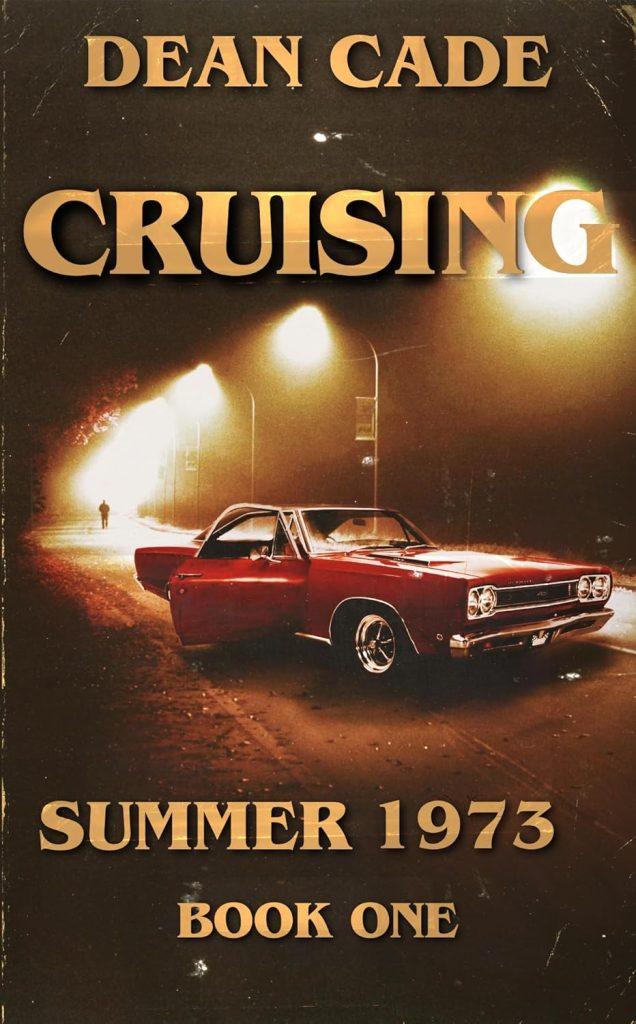
Lane knows the dark red Plymouth GTX is bad news long before he can articulate why.
It just keeps turning up, idling with its engine at a low, oily rumble, its windows tinted to the edge of legality, its driver a shadow wearing a shape. This is the engine at the centre of Dean Cade’s debut novel, Cruising, the first book in the Summer 1973 trilogy, and if you have spent any time with true crime history, you know exactly what that car represents. What Cade understands, and what makes this book so quietly devastating, is that dread does not need to announce itself. It just needs to be present, circling.
Cruising is set in Houston’s Heights neighbourhood in July 1973, a working-class district of bungalow houses, bayou water, and decaying Fifties infrastructure. It is a summer novel, sun-drenched and seemingly golden on the surface, with something awful moving underneath. Lane, eighteen years old, works the pumps at a Mobil station, shares a small apartment with his charismatic roommate Kyle, and spends his weekends the way teenagers everywhere spent their weekends in 1973, cruising Shepherd Drive in muscle cars, shooting pool at the Bohemian, smoking weed to Deep Purple records. The horror arrives not as a crash but as an accumulation, a slow tightening around the edges of the picture.
Cade’s pacing is more patient than readers weaned on modern horror fiction might expect. The terror builds through what the book withholds rather than what it shows. A tattered, missing poster on a telephone pole. The heavy rumble of a car engine getting closer and then, mercifully, fading. The way Old Man Wallace tenses when he spots the GTX parked across the street. These are not shocks; they are stones dropping into standing water, rippling outward.
By the time Lane and his new friend James stumble onto something they should not have seen on a remote beach at High Island, the dread has been layered so carefully that the revelation lands with the weight of inevitability rather than surprise.
Reading Cruising feels like pressing your palm to sunlit glass. The warmth is there, the nostalgia for an era rendered with tremendous atmospheric fidelity, the transistor radios, the Budweiser cans, the record needle settling into Deep Purple’s Machine Head. But the glass itself is what you feel. Something cold is on the other side of it. The reader knows something Lane does not, and Cade uses that dramatic irony without mercy and without exploitation.
What Cade does better than almost anything else in this book is close third-person interiority. We are inside Lane’s head constantly, and that head is a busy, conflicted, tender place. Lane is working class, closeted, uncertain about his future, and still adolescent enough to be wrong about the things he thinks he understands.
His voice is vernacular and specific, rooted in Houston 1973 without feeling like a museum exhibit. When he notices something he should not, a lingering glance at Kyle’s chest, the way James’s blue eyes catch the firelight, the prose does not editorialise. It simply records, with precision and without judgment, and the cumulative effect is a character portrait of real emotional generosity.
The dialogue is another strong suit. Cade writes to teenagers the way they actually spoke, oblique and full of self-protection, circling around what they mean. Lane and Kyle’s banter has the easy rhythms of young men who have known each other long enough to stop performing, yet the performance is always there, Lane performing straightness he does not feel, Kyle performing certainty he may not have. The subtext in their exchanges is dense without being laboured.
Structurally, the novel opens inside the horror before rewinding to Lane’s ordinary Saturday evening, a choice that works because Cade trusts his readers. The prologue’s dark red GTX, a body in plastic sheeting in the boot, the Rolling Stones’ “Sympathy for the Devil” clicking off into silence, is not a spoiler. It is a tuning fork. It sets the note the rest of the book must resolve. Every scene of cruising and pool halls and beach bonfires carries that note in its undertone.
Cade’s prose works like good cinematography: it moves between the granular and the wide. A paragraph about the Mobil station’s oil-stained sink will anchor you in the physical world, then a sudden pull back to the darkening Houston skyline above the bungalow rooftops reminds you of the scale of what is at stake. It is writing that knows when to be claustrophobic and when to open up, and those shifts do a great deal of the tonal heavy lifting.
This is, at its core, a novel about invisibility. The boys who disappeared from the Heights in 1970 and 1971 were invisible in two senses: invisible because they were working-class kids from a neighbourhood the rest of Houston had stopped paying attention to, and invisible because many of them were queer at a time when queerness was something you took a great deal of care to hide.
The police, as Cade’s research documents and his fiction implies, were not rushing to investigate runaways from a decaying district. The systemic neglect that made the Houston Mass Murders possible for three years is encoded in the world of the novel, present in every dismissive conversation about missing kids, in every neighbour who chose not to notice the odd hours kept by the house on Lamar Drive.
Lane’s closetedness sits at the intersection of all of this. Being gay in 1973 Houston is not simply a personal predicament; it is a specific vulnerability. The killers targeted boys from the margins, boys who could be dismissed as runaways, boys whose disappearance might not trigger an urgent response. Lane understands, on some level he cannot fully articulate, that his difference makes him legible to a certain kind of predator in a way his straight peers are not. This understanding shapes his wariness without him ever consciously naming it, and it is one of the most quietly sophisticated aspects of the novel’s construction.
It is about what happens when a community’s most vulnerable members are left to fend for themselves. Cade is careful not to make this polemical; he lets the historical record do the arguing. He is writing fiction drawn from documented fact, names on missing posters that appeared in real Houston newspapers, burial sites that real investigators excavated, and in doing so he keeps the moral weight of the story grounded in something that actually happened. Lane’s awakening love story with James runs parallel to the escalating danger, and that structural choice is purposeful: it argues that desire and beauty and the tentative beginnings of self-acceptance are precisely what predators seek to extinguish.
There is also a thread about place and class running through the book that deserves attention. The Heights is rendered with the kind of specificity that comes from deep research and genuine affection. Cade spent years in the Houston Public Library’s archives, reading 1973 editions of the Houston Post and Chronicle on microfiche, consulting with people who knew the neighbourhood and the case.
The result is a location that feels three-dimensional, decaying but not without dignity, a working-class community with its own pride and its own code, slowly being hollowed out by forces it cannot name. Old Man Wallace’s lament about the neighbourhood, once full of people who tried, now full of families that have given up, is one of the book’s most emotionally complex passages.
Cade has spoken about Clive Barker as a formative influence, specifically Barker’s willingness to write gay characters into the foreground of horror without apology or qualification. That influence is present here not in terms of Barker’s more extravagant style, but in the philosophical commitment: queer lives matter enough to be the subject, not the subtext. Cade has also mentioned that he burned down an earlier approach to this material during the 2020 pandemic and rebuilt the book from a different foundation, a decision that clearly paid off.
What is perhaps most striking about this debut is how disciplined it is. The material is inherently sensational: a real serial killer, twenty-nine victims, three years of murders in a single neighbourhood, and Cade refuses to be sensational with it. He keeps the violence at the periphery, present in its effects rather than its details, and centres the human texture of the lives lived in proximity to it. That restraint is a craft choice with a moral dimension, and it distinguishes Cruising from the bulk of true crime-adjacent fiction.
Cruising holds the horror and the tenderness in the same hand and never lets either win. Dean Cade’s debut is a meticulously researched, quietly devastating portrait of a community’s most vulnerable boys, their desires, their dangers, and the predator circling at the edge of their summer. This is true crime horror at its most human.
True crime fiction has been a growth area in horror for several years, driven partly by the podcast-and-docuseries explosion that has made real-world criminal cases part of mainstream cultural consumption. But most fiction that draws on true crime still operates at a remove, using real cases as backdrop, inspiration, or loose structural template while moving the events safely into the fictional register. Cruising does something riskier: it keeps the real names, the real places, the real chronology, and populates the documented historical frame with fictional characters whose lives and deaths illuminate what the historical record cannot reach.
The closest comparison in terms of intent, though not in terms of style or setting, is Jack Olsen’s non-fiction account The Man With the Candy (1974), one of the two out-of-print books Cade consulted in the Houston Public Library. Where Olsen documented the case, Cade fictionalises its human texture, the interior lives of the boys who were victims, the community that surrounded them, the fear that moved through a neighbourhood without being named. The fictional mode allows Cade to do what journalism cannot: to speculate on interiority, to ask what it felt like to be Lane, to be young and gay and working-class in July 1973, to sense a danger you cannot fully see.
In the broader LGBTQ+ horror space, Cruising sits alongside work by writers like Eric LaRocca in its commitment to queer experience as the organising principle of the narrative, but its closest structural relatives might be found in historical literary horror: the way Paul Tremblay uses quiet accumulation rather than explosive revelation to build dread in works like A Head Full of Ghosts. Cade’s book is more restrained than either, more purely a period realist novel with horror operating at its margins, but the genre kinship is real.
What Cruising does that no comparable work quite manages is to hold the horror and the tenderness in the same hand with equal steadiness. Lane’s tentative connection with James, the halting acknowledgement between two young men that they are drawn to each other, plays out against a backdrop of documented atrocity without either element diminishing the other. The love story does not soften the horror. The horror does not negate the love story. They exist together in the way that beauty and catastrophe coexist in real human experience, which is to say, simultaneously and without resolution.
Cruising arrives in a horror landscape where the genre is doing some of its most serious work in decades, using monster and predator not just as sources of visceral fear but as lenses for examining social violence, historical injustice, and the specific vulnerabilities of those the mainstream has chosen to overlook. This book belongs in that conversation. It earns its place not through scale or spectacle but through precision, care, and an unwillingness to look away from what it actually means to be a lost boy.
The twenty-nine victims of the Houston Mass Murders were once considered the worst serial murder case in American history, and then, as these things go, they were largely forgotten. Cade is not willing to let that forgetting stand.
Cruising (Summer 1973 Book 1) by Dean Cade
In Cruising, Lane meets James, someone different like him. Together, they stumble into one of the most horrific crimes in the annals of American history.
Summer in the blue-collar neighborhood of the Heights is a time of partying, muscle cars, and rock music. Working as a gas jockey, Lane spends his time off with his roommate, Kyle, cruising the strip, hanging out in dives, and going on double dates at the drive-in. Lane knows he is different than other guys—gay in a time when it is not cool.
The Heights has a secret too, hinted at by the telltale signs of missing posters, an abandoned car, runaways, and an eerie, dark red ’68 Plymouth GTX that prowls the streets.
A chance encounter with James grows into something more for Lane. Dreams become vivid with omens of impending chaos as he crosses boundaries and sees a way to escape his dead-end life on the back of James’s BSA Lightning motorcycle. Ignoring the warning signs, he is unaware that a serial killer and his teenage accomplices are stalking them and intend for them to be the next victims.