A handmade Italian folk horror fable of scapegoating and female defiance.
Mattia De Pascali’s The Forbidden Lands (original title Le Terre Incolte) premiered to a packed house in Galatina before earning an Honorable Mention at the Washington Underground Film Festival and a Best Horror nomination at Los Angeles Fantasy Fest. Now available on Prime Video in the US and UK, this Italian folk horror draws on the legacy of Lucio Fulci and the ethnography of Ernesto De Martino to tell a story about witch hunts, false prophets, and three women who decide to stop waiting for someone else to save them. It is independent cinema in the truest sense, handmade, stubborn, and alive.
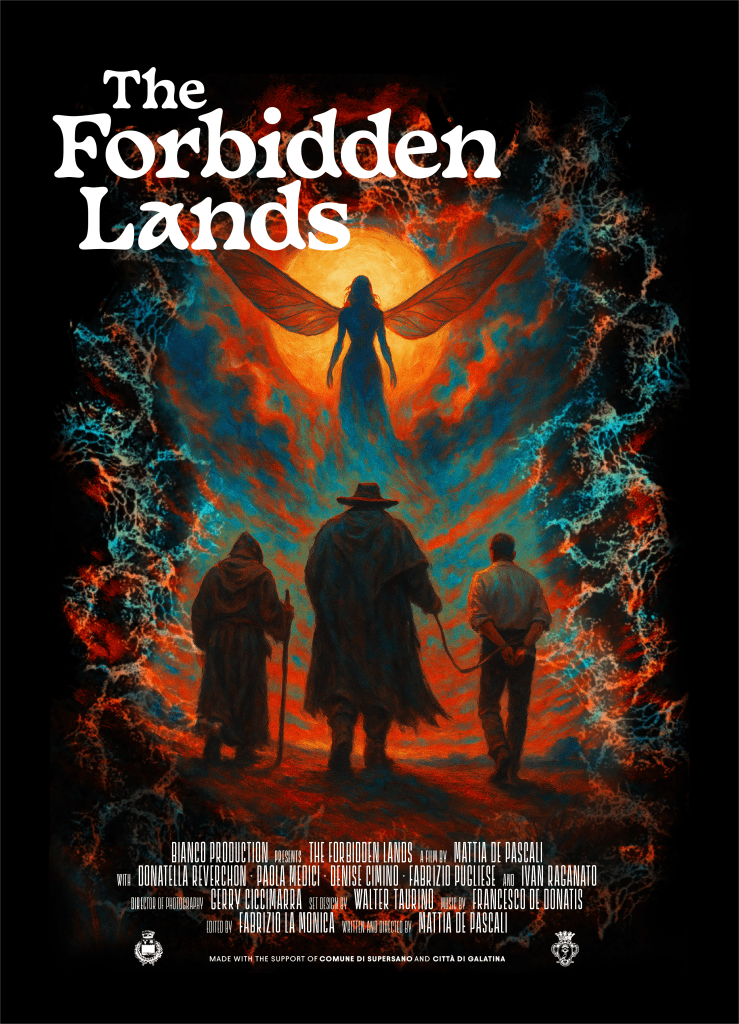
Mattia De Pascali’s The Forbidden Lands is the kind of folk horror that understands folklore is not decoration, it is a system people live and die by. Shot on location in the sun baked Salento, this dark fable follows three women who refuse their assigned roles and pursue the truth past the edge of the known world. A handmade, idea-dense film that channels Fulci’s moral fury and marries it to a fierce female solidarity. De Pascali has made something genuinely independent, and it will outlast the noise.
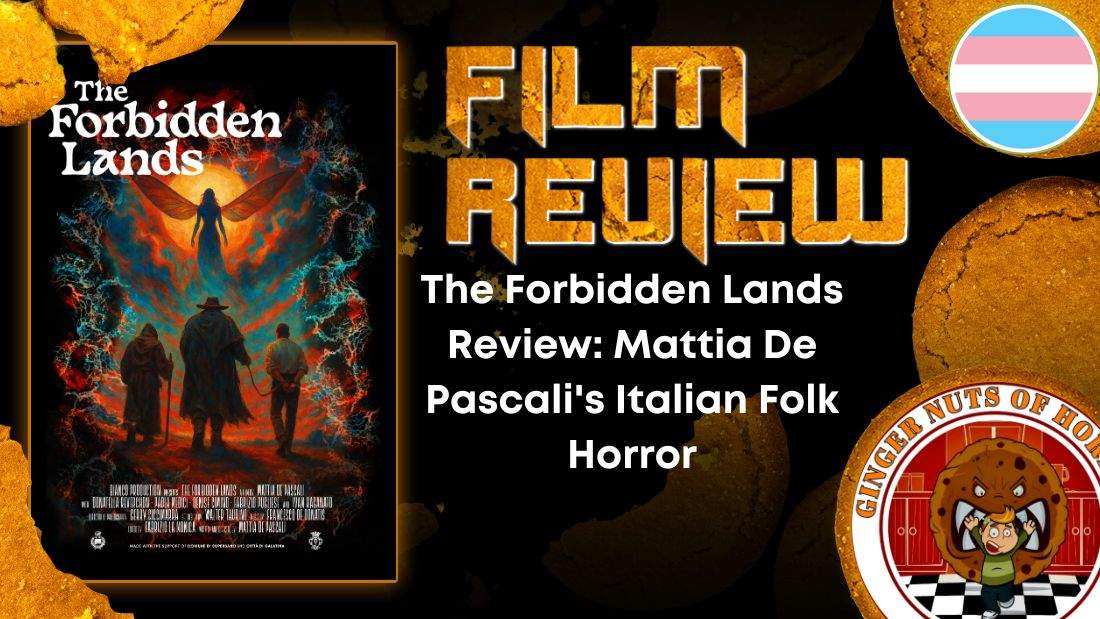
The Forbidden Lands Review: Mattia De Pascali’s Italian Folk Horror
Nobody tells you the priest is dead until a child trips over what is left of him in a limestone cave, and by then the village has already decided who to blame.
That is the kind of film Mattia De Pascali has made with The Forbidden Lands, a folk horror fable shot entirely in the Salento region of Apulia, where the soil is red and the dialect thickens the air like humidity. It premiered to a full house of five hundred at Galatina’s Teatro Cavallino Bianco on the third of October last year, and watching it now on streaming, months after its festival run earned an Honorable Mention at the Washington Underground Film Festival and a Best Horror nomination at Los Angeles Fantasy Fest, what strikes me first is how little it behaves like a film that needs your permission. It simply begins and expects you to keep up.
The film occupies a tonal register that hovers somewhere between a grim fairy tale and a sun baked crime scene photograph. De Pascali does not build dread through slow burn so much as he lets dread pool in the corners of scenes while other things are happening. There is always something unsettling in the periphery, a figure standing too still, a sound that does not belong to the person speaking.
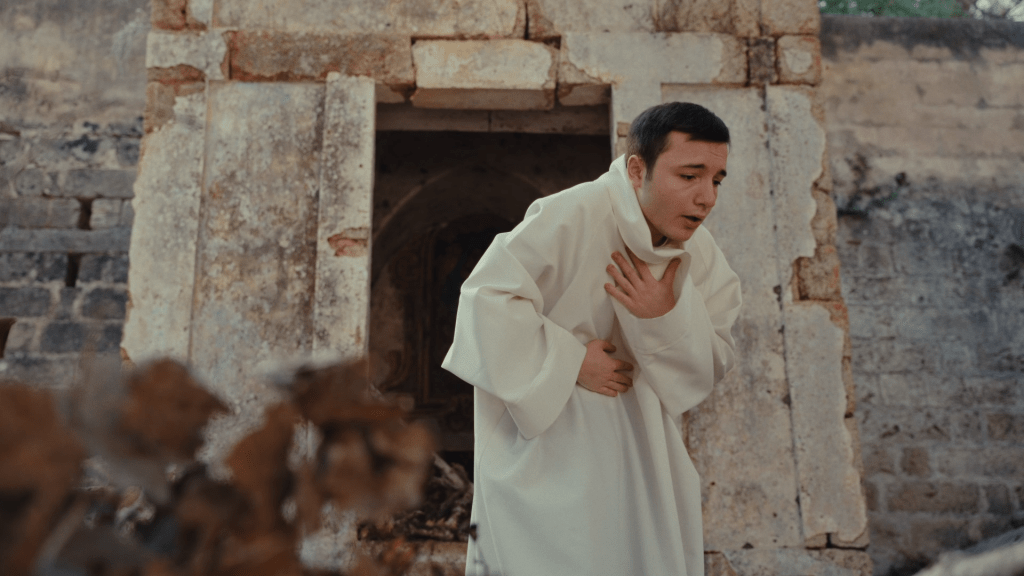
The atmosphere is thick with what I can only describe as rural claustrophobia. Everyone knows everyone, and that knowing is itself a kind of surveillance. When Tore, the boy played with wiry conviction by Keoma Vetrano, goes hunting with his grandfather (Nik Manzi, gruff and grounded) and stumbles upon the mutilated remains of Don Oronzo, the local priest, the horror is not just in the carnage. It is in how fast the village converts fear into accusation. A woman living on the margins, the one they call the Witch, played by Donatella Reverchon with a face that holds grief and defiance in equal measure, becomes the answer before anyone has asked a real question.
What the film does to the nervous system is peculiar. It does not pummel you. It nudges you off balance repeatedly, sometimes with a cut, sometimes with a line of dialogue that lands slightly wrong, suggesting a world where the rules are not quite the ones you walked in with. The pacing is episodic, almost picaresque, which in a lesser film might feel baggy. Here it feels like a deliberate strategy, a way of populating the village with enough faces and petty grievances that when the two strangers arrive, their strangeness registers against a fully realised backdrop of ordinary human weakness.
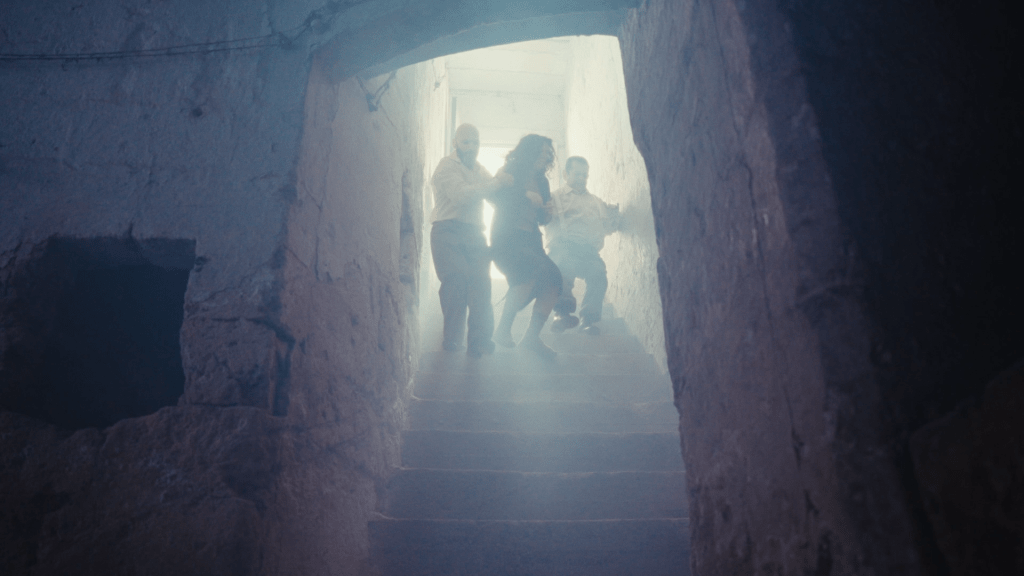
De Pascali shoots the Salento landscape the way someone photographs a relative they love but do not entirely trust. Gerry Ciccimarra’s cinematography catches the white stone and red earth without glamorising either. The camera moves economically, favouring compositions that let actors occupy space rather than chasing them through it. There is a shot early on, a wide of the hunting party dwarfed by scrubland, that tells you everything about how small these people are against what they are about to provoke.
The editing, handled by Fabrizio La Monica who also plays the Knight on screen, deserves particular attention. Scenes are allowed to breathe, but the transitions between them carry a snap. A quiet domestic moment will cut to something deeply wrong without warning, and the effect is less jump scare than cognitive lurch. You are still processing the last image when the new one has already started rearranging your assumptions.
Sound design is where the film earns a lot of its horror credentials. Francesco de Donatis’s score is not wallpaper. It functions almost as a second narrator, sometimes mournful, sometimes mocking. There are stretches where the music drops out entirely and what remains is wind, footsteps on gravel, the distant barking of a dog. These silences feel riskier than any orchestral swell.
The performances operate on a spectrum from naturalistic to deliberately stylised. Fabrizio Pugliese as the Hermit understands that the scariest people are the ones who believe their own lies. His face is a study in serene self regard, the kind of piety that curdles into entitlement the moment no one is looking. Fabrizio La Monica’s Knight is all physical threat and minimal speech, a block of muscle in service to someone else’s pathology.
Denise Cimino, as Selvaggia, brings genuine physicality to a role that could have been a sketch, she moves like someone who has spent years navigating land that wants to trip her. Paola Medici’s Rosa provides the emotional anchor, a woman propelled by love for a missing brother into a situation her community would rather she accepted with folded hands. And Reverchon’s Witch, the performance around which the film’s moral argument pivots, is remarkable for what it refuses to do. She does not plead. She does not explain. She watches, and her watching becomes a form of accusation.
What the film does to the nervous system is peculiar. It does not pummel you. It nudges you off balance repeatedly, sometimes with a cut, sometimes with a line of dialogue that lands slightly wrong, suggesting a world where the rules are not quite the ones you walked in with
The film’s central preoccupation is with the scapegoat mechanism, and it handles this theme with more precision than its genre trappings might suggest. A community confronted with something it cannot explain does not seek understanding. It seeks a target. The Witch, an impoverished woman living outside the village’s social contract, serves that purpose perfectly. She is guilty of being strange, of being alone, of being female in a way that offers no comfort to male authority.
This is not abstract sociology. The film explicitly channels a tradition of Italian cinema that examines the violence of rural ignorance, most directly Lucio Fulci’s Non si sevizia un paperino, where the witch Maciara is similarly a scapegoat for crimes she did not commit. De Pascali has acknowledged the debt, but his treatment differs in one crucial respect. In Fulci’s film, the scapegoat is destroyed. In De Pascali’s, she is freed, and she becomes instrumental to the resolution. That is a significant revision, a suggestion that the people a community casts out may be the only ones capable of saving it.
The arrival of the two strangers claiming divine authority introduces a second thematic layer: the critique of delegated salvation. The villagers are not merely superstitious. They are eager to hand over responsibility to anyone who speaks with enough confidence. The Hermit and his Knight are transparently predatory, yet nearly everyone believes them, because believing is easier than acting. The film’s satirical edge, noted by several Italian critics, cuts against both religious hypocrisy and the broader human tendency to outsource moral courage.
There is also, woven through the film’s second half, a thread of female solidarity that feels earned rather than programmed. Selvaggia, Rosa, and the Witch form an unlikely trio, each with distinct motivations, and their pursuit of the cannibalistic strangers into the forbidden lands becomes something stranger than a rescue mission. It becomes a journey toward knowledge, toward the discovery of what the forbidden lands actually contain. The film suggests, without ever quite stating, that the real forbidden territory is not geographical. It is the space where women refuse to accept the roles assigned to them.
The historical and cultural resonances are specific. The film engages with the ethnographic work of Ernesto De Martino, particularly Sud e magia, which explored the tension between magic and rationality in Southern Italian culture. De Pascali sets his story in a deliberately indeterminate time, somewhere in a reinvented twentieth century, which allows the rural setting to feel simultaneously archaic and contemporary. The Salento he presents is not the postcard version of pizzica and luminarie. It is a landscape of rough stone and suspicion, and the fantastical elements do not contradict its reality. They reveal it.
The cannibalism here is not gratuitous. It is integrated into a moral fable. The shift from the claustrophobic interiors of Beyond the Omega to the open landscapes of the Salento countryside represents a literal and figurative opening out. De Pascali has said he wanted to break from the realist representation of his home region, to treat the Salento as a space for fantasy rather than social documentary. The Forbidden Lands delivers on that ambition.
Across all three films, certain preoccupations recur. Power and its abuses. The fragility of social contracts. The body as a site of violence and transformation. A darkly comic sensibility that surfaces even in grim contexts. De Pascali’s protagonists tend to be people who refuse to play their assigned roles, whether that is Malcolm in McBetter, Aristodemo in Beyond the Omega, or the trio of women in The Forbidden Lands. He is interested in what happens when someone says no to the story they have been given.
The cast carries forward a sense of continuity too. Donatella Reverchon has been with De Pascali since McBetter, where she played Patricia, and she performed in his theatrical production La casa dell’oblio. Nik Manzi and Andrea Cananiello return as well, creating the sense of a repertory company operating at the edge of the Italian film industry. This loyalty to performers, in a sector where casting is often transactional, speaks to De Pascali’s broader ethos. He builds a world on screen by building one behind it.
The Forbidden Lands is folk horror made by someone who understands that folklore is not quaint. It is a system of beliefs that people live and die by. The film belongs to the tradition that includes Il demonio (Brunello Rondi, 1963), Non si sevizia un paperino (Lucio Fulci, 1972), and Arcana (Giulio Questi, 1972), three Italian films that used the figure of the witch to examine the violence of patriarchal rural societies. De Pascali extends this tradition by giving the witch not just a tragic arc but an active role in the resolution.
Where The Forbidden Lands departs from its precursors is in its embrace of fantasy. The final section enters territory that owes more to dark fairy tale than to horror’s realistic wing. The forbidden lands themselves, when we finally see what they contain, push the film into a register that some viewers will find jarring. I found it exhilarating. The film earns the shift by building toward it methodically, and the practical effects work, credited to SFX make-up artist Chiara Calò, grounds the fantastical elements in physical texture.
In the broader landscape of contemporary folk horror, The Forbidden Lands does not try to compete with the polished dread of an Ari Aster or the austere formalism of a Robert Eggers. It operates in a different register entirely, one that is closer to the scrappy, idea-dense tradition of Italian genre cinema. It has more in common with the Fulci of the early seventies than with anything coming out of A24.
The film’s natural neighbours are works like A Classic Horror Story or Paolo Strippoli‘s La valle dei sorrisi, recent Italian horror films that attempt to engage with folk traditions while operating within international genre frameworks. What sets De Pascali apart is his refusal to smooth down the edges. His film feels handmade, and it is all the more persuasive for it.
The film arrives at a moment when Italian horror is in a tentative period of rediscovery. After decades of decline from the genre’s golden age, a new generation of independent filmmakers is finding ways to produce horror that speaks to Italian cultural specificities while reaching international audiences.
De Pascali‘s path, self produced, regionally rooted, distributed through streaming after a grassroots festival run, represents one viable model. It is not the only model, but it is one that preserves artistic control while building an audience incrementally. The fact that The Forbidden Lands secured distribution on Prime Video in both the US and UK, after festival screenings across three continents, suggests that this approach can work.
There is something quietly radical about a film that treats the rural South of Italy not as a problem to be documented but as a stage for the imagination. De Pascali has said he finds the bizarre more stimulating than the ordinary. The Forbidden Lands applies that principle to a landscape too often framed by poverty and criminality, and in doing so, it reclaims a space for wonder, even if the wonder comes with teeth.
A film about a community that turns on its own margins, saved by the very women it tried to bury, is not just a horror story. It is a wager on what stories can still do.