I know writers who use subtext and they’re all cowards.
This isn’t using subtext. This is about being subtext. Matthew Holness — yes, the same Matthew Holness who gave us Garth Marenghi’s Darkplace, crafted something genuinely devastating with Possum. It’s a film that takes the monster-as-metaphor trope and pushes it past cleverness into something more uncomfortable: lived experience. Sean Harris’s Philip carries a puppet with spider-legs and his own face, but the real horror is what that puppet represents to a man who never escaped childhood. Holness evolved his original short story into something deeper, asking not “what does the monster mean?” but “what does it feel like to be the kind of person who needs one?”
Warning: this is a film about child sexual abuse and its after-effects. I will be talking about that. Also the pictures will not be comfortable for arachnophobes. Also self-harm.
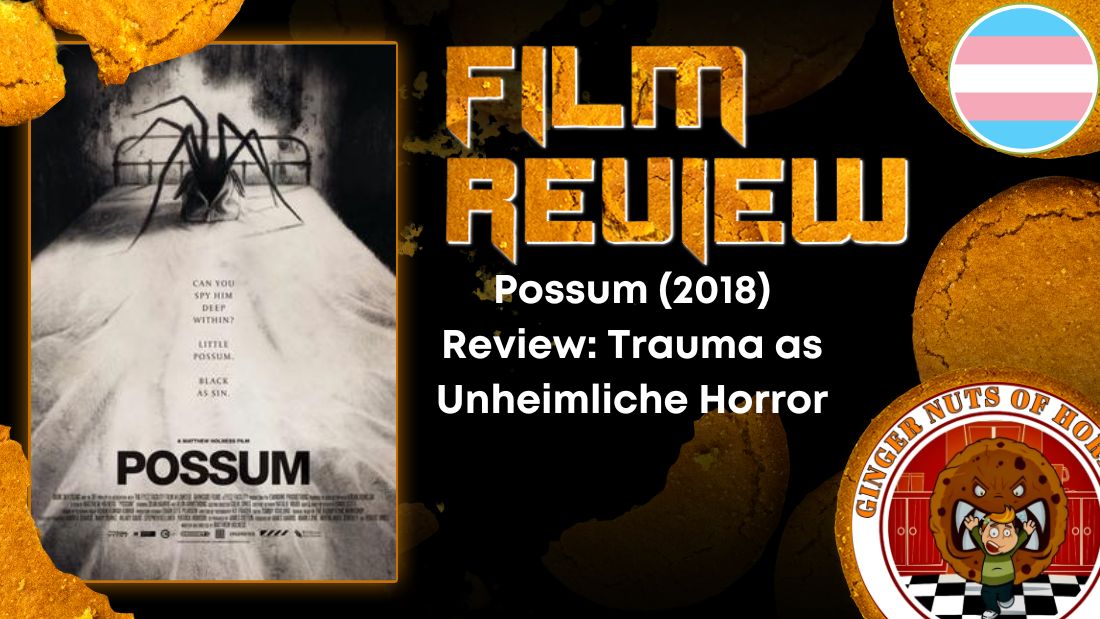
Possum (2018) Review: Trauma as Unheimliche Horror
Well look at that: Possum is on Shudder! So how about this: we’re going to talk about the movie – and also the short story it’s based on. It’s a good story, also by Matthew Holness . . . and it’s also curiously different. And yes, it’s the same Matthew Holness who wrote the cult comedy Garth Marenghi’s Darkplace. Join me!
Let’s talk for a minute about metaphors in horror.
Because Possum is one of the most Adventures Of A Metaphor horror movies ever made.
It’s also subtle. Which is quite a remarkable combination.
We’re moving past the ‘elevated horror’ trend, at least as an industry hot property.
Fair warning, I can’t be bothered to debate whether that was a snobby term for that particular kind of movie: it was the term that stuck, so we might as well use it because at least everyone knows what it was referring to. The point is that Possum was definitely like that.
Partly because it had amazing direction, acting, sound design, props and everything else. It’s brilliantly atmospheric and genuinely heart-wrenching.
But it also has that quality much attributed to elevated horror: monster-as-metaphor was definitely the style.
The thing is, though, that’s pretty much how all horror works.
Why else is it such fun to write essays about? Horror is a deliciously discussable genre.
A horror film in which the threat doesn’t touch on some deep-rooted discomfort isn’t going to horrify you. Would Val Lewton’s Cat People have worked if we didn’t know what it was like to abandon our tight self-control and risk intimacy? Would Ridley Scott’s Alien have worked if we weren’t afraid of what happens when our safe categories – dominant species or prey, male or female, my body or your body – start to break down? Would John Carpenter’s Halloween have worked if we weren’t afraid our homes might not actually be our castles? Would It have worked if we weren’t afraid that the adult world that rules us all runs on not on caring responsibility but abuse and enabling?
A monster that works as a metaphor is just a monster that touches a nerve. It’s nothing uncommon.
So in a way, saying that the monster of Possum (a truly horrendous puppet) represents childhood trauma isn’t saying anything unusual. That’s not what makes it stand out.
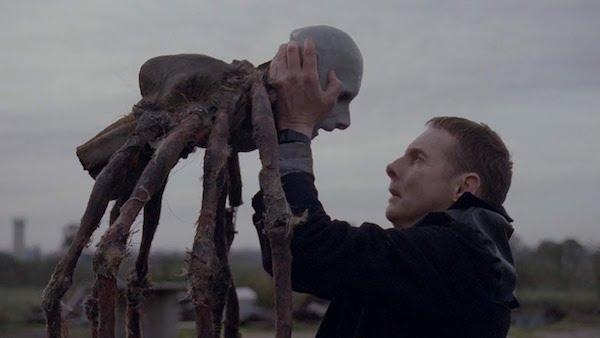
What is unusual – what was unusual in a fair amount of elevated horror, actually – was that it played around with using subtext as something very close to text . . . and what was more unusual still is that it worked.
I know writers who use subtext and they’re all cowards.
Yes, that’s by the same Matthew Holness that wrote this emotional beating of a film. Garth Marenghi’s Darkplace was a hilarious parody of the kind of sub-Stephen-King rockstar horror writer of the 80s who churned out absolute trash convinced he was a genius, and Holness’s Garth was very proud of the fact that he was bold enough to be clangingly heavy-handed.
Which makes Holness fascinating. Because then he turned around and did exactly that, and made a masterpiece.
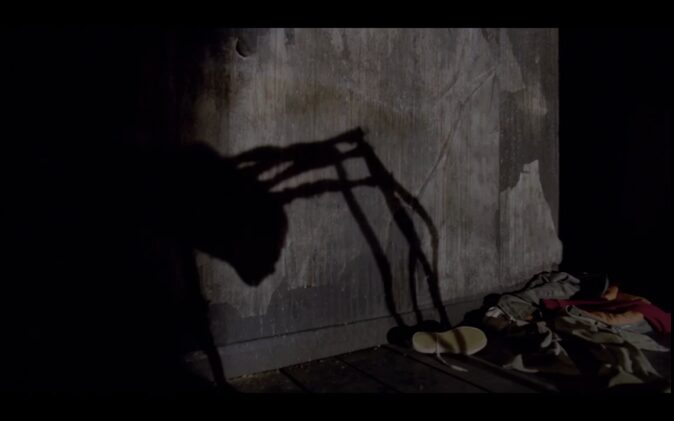
How the bloody mayhem do you pull that off?
Mother, Father, what’s afoot?
Only Possum, black as soot.
Mother, Father, where to tread?
Far from Possum, and his head.
Here’s a bag, now what’s inside?
Does he seek or does he hide?
Can you spy him, deep within?
Little Possum, black as sin.
If I ever put together a list of modern classics in horror, Possum is absolutely going to be on it. (Along with, let’s see, The Babadook, The Devil’s Bath, The Witch, Mad God, Skinamarink, Frewaka, and nothing by Ari Aster.)
It’s a tough watch. Beautiful, but really tough. If you have a kid you’d better be willing to hug them afterwards – not because we see anything too extreme happen to a kid during the film itself, but because we spend the film with an adult man, Philip (Sean Harris), to whom the worst thing that can happen to a child have already happened.
They happened decades ago. Deep down in the dark where it matters, they never stopped happening.
Possum makes you live with the man that grew up in that pain.
The story is, on the face of it, both simple and ambiguous.
Philip is a children’s puppeteer. Or he was. Something happened; he did something that went too far. He’s gone back to his home town after falling into disgrace – back to the house he grew up in.
On the train back, he notices something: a boy sitting with his friends, quietly drawing pictures while his mates laugh and joke around him. That’s nice. Philip’s an artist too – a puppeteer, but also a very fine draftsman if you can bear the terrors he puts on the page. And Philip, like the boy, knows what it is to be thinking your own thoughts in a crowd. The boy looks clean, healthy, safe. Cared-for. If Philip’s parents had lived, that’s who he might have been.
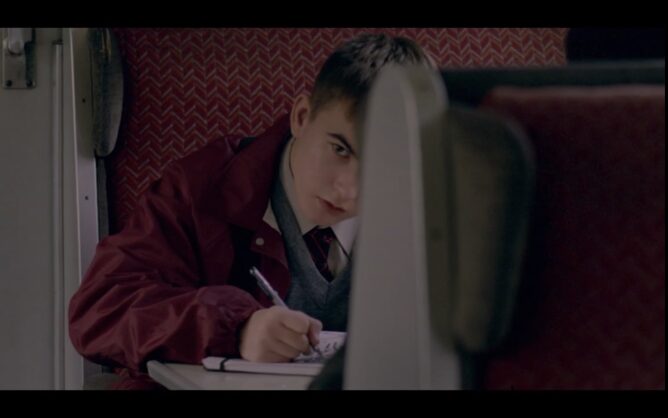
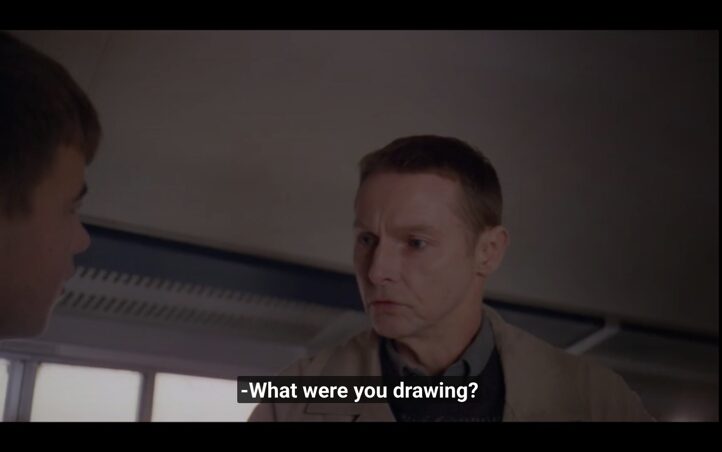
Philip makes a brief, awkward attempt to say hello, but of course the boy is nervous of him. What boy wouldn’t be? A middle-aged weirdo just accosted him out of nowhere.
You get the impression that Philip doesn’t really know he’s middle-aged: he carries himself like a scolded child, and addresses the lad like they’re primary-schoolers on a playground. Maybe a desperately lonely boy might be grateful for any such attention, but this boy’s okay and he can see how far from normal it is. He backs away.
Philip goes back to his old home. The house is in a state of decay. At first it seems empty; there’s just one closed room in it he won’t go into. But for the rest, it’s a depressing husk of a place. You can smell the damp and the old cigarettes. You wouldn’t want to be there either.
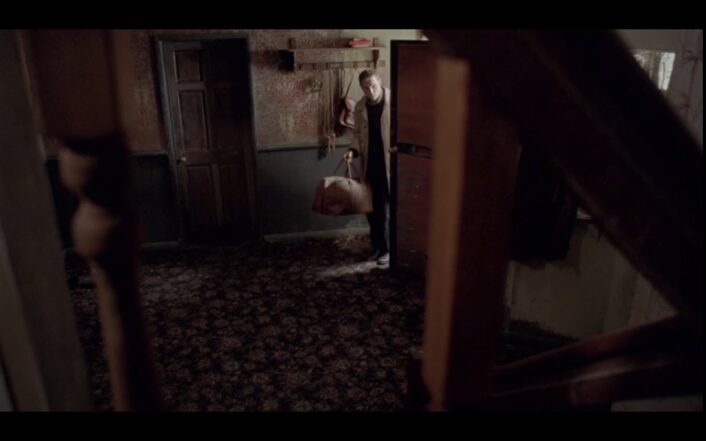
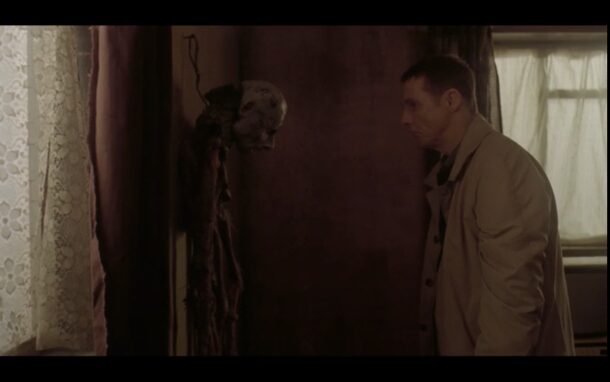
Philip makes the first of many attempts to dispose of something. ‘It’s a puppet,’ he says. It has long spider-legs. It has a face just like his own.
Wherever he disposes of it, it always comes back.
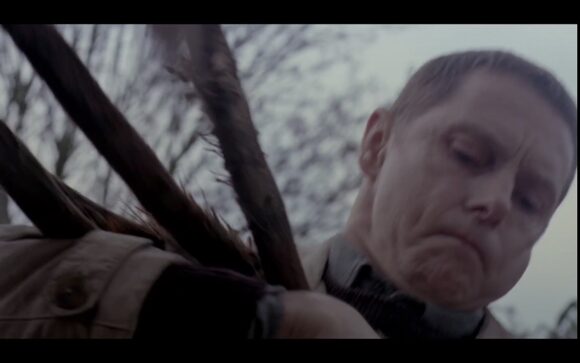
That’s the story, really: Philip keeps trying to get rid of the puppet, and the puppet keeps coming back. Of course it does. You can’t get rid of trauma.
For a while the house is empty and silent. Then, without explanation, Philip’s Uncle Maurice is there.
The house is rotting. And so is the utter goblin of a man that is Uncle Maurice (Alun Armstrong), the abusive bastard that got custody of him after Philip’s parents died. Maurice is still living there, apparently.
Where was he before? Was he just out? Was he hiding?
It’s possible. He’s still a sadist. He still takes a chuckling glee in tormenting Philip. And if you’re picking up on the sexual implications, you can see he’s laughing about it in their first scene together.
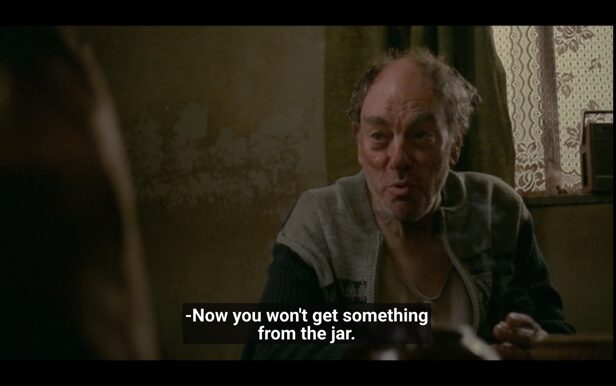
There’s a jar of sweets on the shelf. Philip takes a swig of tea, and then, tasting something off, spits it out.
‘Now you won’t get something from the jar,’ Maurice crows. No sweets for boys who spit it out.
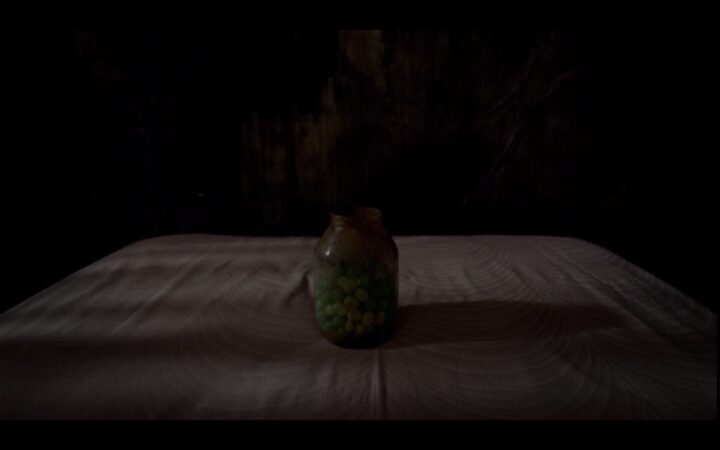
Yeah. Horrible things have happened to Philip. I won’t go into further detail, but this is not going to be the last time we have to picture them. There are reasons the Possum puppet looks the way it does.
Is any of this real?
Is Philip talking to Maurice? Or is he hallucinating Maurice, dreaming Maurice, experiencing a flashback of Maurice so vivid that showing it isn’t real would be failing to convey how it feels?
You could talk about that for a good while if you were so inclined. But here’s the thing: it’s not really the point.
I always imagined it as something akin to George Romero’s Martin, something that’s a psychological horror film that’s about tortured, fractured psyches and claustrophobic family relationships that are kind of toxic.
Now that’s a very interesting comparison, because as well as all those things – and both Martin and Possum are all those things – they’re both films about uncertainty.
In Martin, our eponymous young man goes to stay with his elderly cousin Cuda (Lincoln Maazel) in a run-down 1977 Pittsburgh. The neighbourhood is in bleak decay; Cuda is an Old World Catholic entirely convinced that Martin carries the family curse. Martin, according to Cuda, is a Nosferatu, a vampire, and Cuda will tolerate his presence as long as his victims include ‘nobody in the town.’
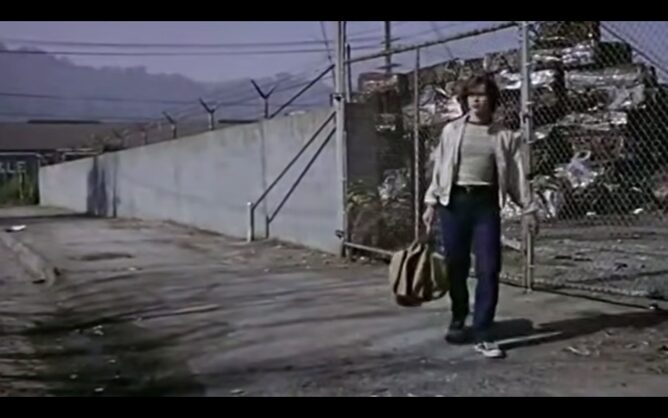
Martin is living in a Hammer Horror house in the middle of American urban decay. But is he actually a vampire? He’s a murderer, we know that much, and also a necrophiliac. The first thing we see him do is sedate, murder and drink the blood of a woman on the train home. Technically? You can’t argue that he’s not.
But is he, you know, a vampire vampire? Or is he just a deeply disturbed young man, warped by his bizarre family’s beliefs into thinking he’s a vampire and only doing ‘the sexy stuff’ with women he’s killed as long as he lacks the social skills to get into a normal relationship? Is he haunted by ancient memories or hazy fantasies? Does he need to kill, or does he just think he does?
Is he a Monster? Or is he a monster?
And either way, why are we feeling so sad for him when we know in full colour that he’s a serial killer?
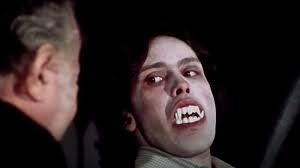
Romero directed the film very carefully. You could believe he’s a capital-V Vampire if you want to. But you absolutely don’t have to accept that. I can’t find the interview that’s knocking around in my memory where he said he personally believed Martin wasn’t, but I think he said it – and even if he didn’t, he certainly directed a film where there’s no evidence that Martin’s anything other than a traumatised, mal-socialised isolate who does bad things.
And is also utterly pathetic. Martin longs for human connection. He’s attracted to women and wants to be with them; he just has no idea how it’s done when they’re awake. He’s so lonely he calls a radio chat show; his main confidante (as well as a clever device to let the audience hear his inner world) is a disc jockey who cheerfully refers to him as ‘the Count.’
But Martin isn’t a Count. He’s a peasant, a village idiot. He has no power. Outside the murders he commits – a big ‘outside’, granted – he’s an abused boy under the thumb of a crazy guardian.
You feel for Martin. You want him to get out of his trap, and the trap is himself. The tragedy for Martin, if not his victims, is that his cousin isn’t about to let him do that. Cuda knows what Martin is and that’s the last word on the matter. Maybe in another life Martin could have been somebody else, but before the first frame touches the screen it’s already too late.
All of which we can see in Philip.
I talked about this in a different essay (https://gnofhorror.com/the-advent-calendar-a-christmas-horror-review/), but Philip in Possum is an ambiguous character. There are several ways to see him:
Once upon a time there was a little boy called Philip. His parents died and he was left in the hands of a monster. That monster, his Uncle Maurice, abused him emotionally, physically and sexually until there was nothing left of Philip but shame, fear and pain. One day Maurice kidnapped another boy – a boy like Philip might have been if his parents had lived, artistic and healthy and loved. Philip, tormented by his past but still seeing a light, defeated Maurice and let the boy go.
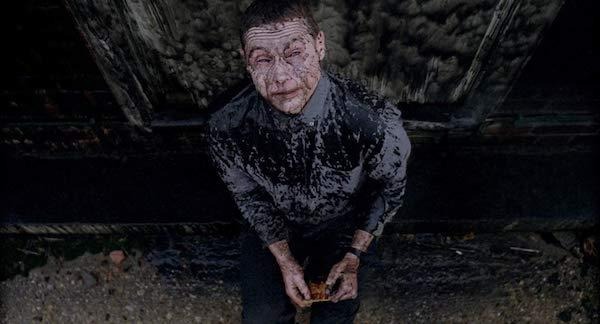
Or:
Once upon a time there was a little boy called Philip. His parents died and he was left in the hands of a monster. That monster, his Uncle Maurice, abused him emotionally, physically and sexually until there was nothing left of Philip but shame, denial and re-enactment.
Even after Uncle Maurice died, the damage he did was so present that he might as well have been a real man living in Philip’s old house, talking to him and tormenting him as cruelly as if he were really there. Philip, possessed by his past, kidnapped a boy, becoming to that boy what Maurice had been to him. By the time he came to his senses and let him go, it was too late: the chain of pain would never be broken.
Or:
Once upon a time there was a little boy called Philip. His parents died and he was left in the hands of a monster. Once he grew up and his life fell apart, his past, his uncle, the kidnapping of a boy who was everything that was stolen from him, were imagined by him as ways to communicate what it felt like to be the man he’d been turned into.
Any could be equally true.
I hate to admit it, but the film really does lend itself to the interpretation that Philip has become a kidnapper. Maurice does not feel entirely real: he talks about Possum and its refusal to vanish with an insider’s knowledge that’s hard to argue comes entirely from outside of Philip’s own head. Even if part of his abuse of Philip in childhood was encouraging terrors and nightmares – entirely believable – he knows a bit more than he should for a fully real person.
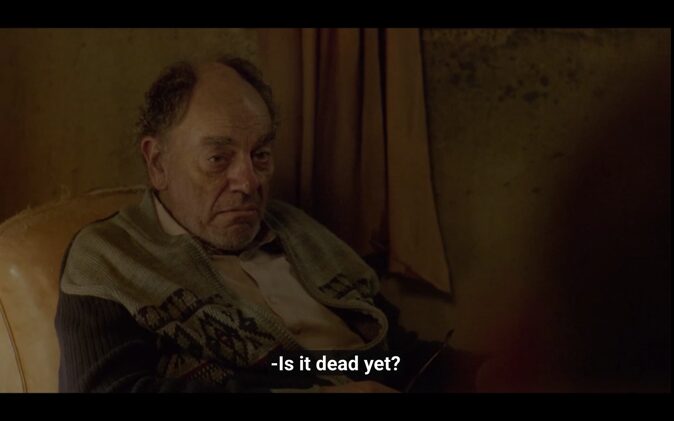
But what it did was make me want to believe Philip innocent. The kind of man I’d very firmly tell to back away if I saw him near any child of mine – but Sean Harris’s performance made me see the anguished boy I never want any child of mine to be. It’s a hard watch as a parent, because he’s a man you’d have to keep away from your children, but the child he was – the child you ache to comfort – is written in every line of him.
You’d have to keep him away from any child you loved. But you hurt for him, because he is the child that nobody loved. And for a child to be unloved is an abomination.
Which, I’d argue, is really the point of the film. Is Philip innocent or guilty? That’s not the important question: he’s fictional, so it’s moot anyway. But the pain of abuse is real. The need to show compassion for traumatised people (even if you protect your children first) is real.
The film is full of harrowing little moments in which Philip is both creepy and heartbreaking.
For instance: Philip hovers around his old primary school. First he just stands outside the gate, staring until a teacher does the only thing a teacher could do: he comes out and asks the lurking weirdo what he’s doing – and when Philip can only say, ‘Used to by my school,’ tells him to move on.
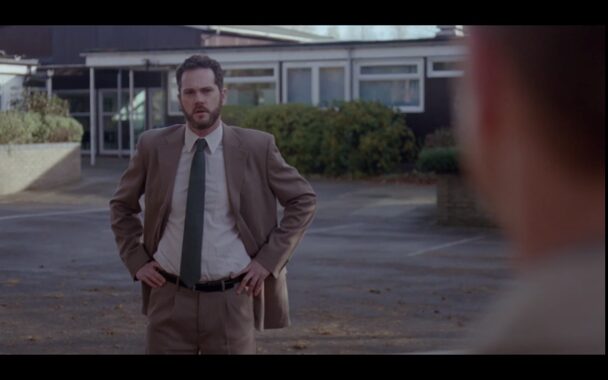
‘Yes sir,’ says Philip. ‘Sorry sir.’ He sounds about seven years old. A seven-year-old with no fight in him at all, used to teachers telling him to pull himself together.
Then, close to the end of the film, Philip goes back. He makes it all the way inside and asks to see a member of staff. He always talks and moves like something like a frightened child, and here in the school he seems to have completely regressed.
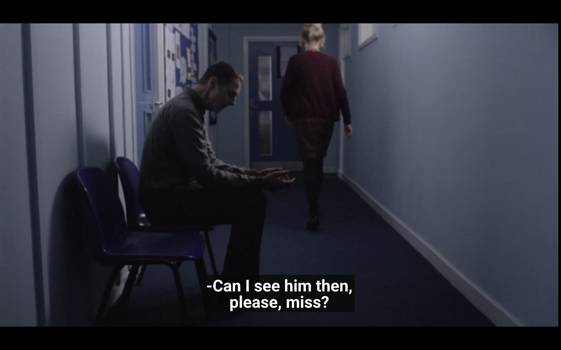
Philip: Can I see him then please, Miss? Will I – will I see him then, Mr Grant? He’s my form teacher, he knows all about it. He knows what’s happened. Said he’d come with me.
Teacher: Come where?
Philip: Police station, Miss.
Once a teacher might have tried to help Philip. But he wasn’t quite able to, and now look.
Harris’ performance is shockingly painful because we see everything he was: a boy who was frightened of school because he was frightened of everything, and probably was not considered one of the clever, talented or charming ones. We know he was bullied by other children; he talks about it elsewhere. School wasn’t a success for him.
But we also see a boy who loved school because it was a place of order where there was a limit to what the adults could do to you, and he didn’t have that anywhere else.
Or there’s a couplet in the Possum poem that stands out stark – the final lines, in fact, which are perfect in their logical illogic:
Children, run! He’ll eat and smother
Any child without a mother.
Possum may come for a child unprotected, yes. But it also captures the humiliation Philip feels at being, as Maurice brutally mocks him, a ‘poor orphan boy.’ I said earlier a child going unloved is an abomination; Philip feels that, and it’s made him feel like he’s an abomination. The lack of a mother isn’t just a vulnerability: it’s a deformity, a curse, an invitation to all the horrors to come in.
Philip is made of agony. Is Maurice real? Is the kidnapped boy real, even? That’s not the question. This isn’t a world of logic; logic is for safe little boys.
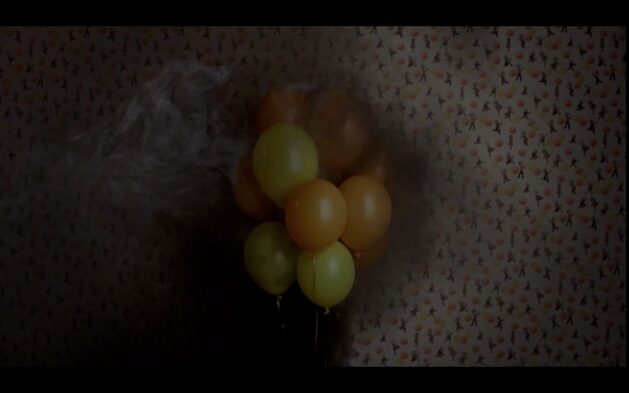
Say hello to black balloon.
The film shows us surreal images from very early on; I’m not even going to call them visual metaphors. They’re images that make us feel the way the story should feel. And what we feel is heartbreaking pity.
It seems very likely that Sean Harris made a major contribution to this; as Holness said in interview:
Sean’s a method actor . . . Sean does not break character . . . Sean wasn’t really interested in the horror side of it so much as he was getting to the truth of this character and expressing what he’d gone through for the audience.
That all makes it onto screen. The horror was definitely safe in Holness’ hands because Possum itself is a ghastly object, but ultimately it’s a film more horrified than horrific, drenched in compassion.
Which is an intriguing evolution. Because the original character of the short story is a very different beast.
The story is anthologised in The New Uncanny: Tales of Unease, aka Comma Modern Horror Book 2, published in 2008 with a star-studded roster of contributors. It won the Shirley Jackson Award for Best Anthology. I’d recommend it.
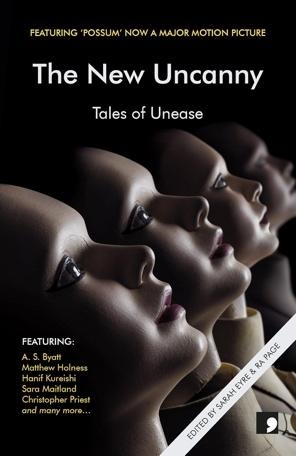
I’m going to call him the Narrator, not Philip, because in the short story he doesn’t have a name. There isn’t a Maurice either; there’s a character called Christie who occupies the same narrative position.
The story is similar in essentials but different in tone. Both film and script are by Holness, who evidently felt free to adapt what he found interesting rather than being bound to pure transcription, so it’s probably best to see them as companion pieces rather than as two versions of the same thing.
Holness went a lot more full hog when it came to the horror in the original story. It’s less a tale of staggering misery than traumatised frenzy. We begin hearing the Narrator operate the carefully-engineered puppet, and . . .
Forcing my hand through the hole in its rear, around which in recent years I had positioned a small number of razor blades, I felt for the concealed wooden handle. Locating it, and ignoring the pain along my forearm, I swerved the head slowly left and right.
He is not fucking around.
This Possum is a creature of rusty nails; a tongue stuck with dead flies; diseased dog eyes preserved in formaldehyde; self-harm mechanisms. The Narrator keeps it to frighten children.
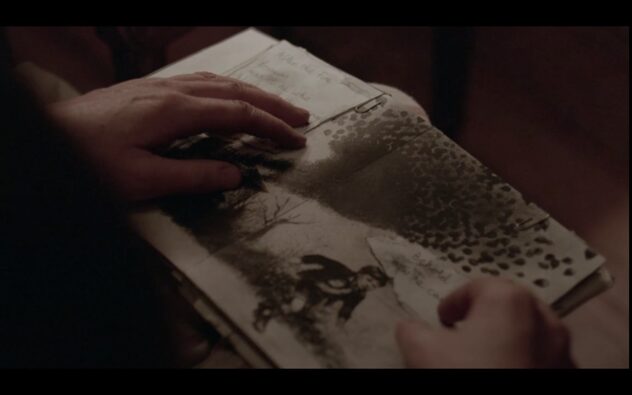
You know how we don’t know quite what Philip did to disgrace himself? The Narrator does puppet shows where Possum invades at the end to eat the heroes. He also uses it frighten passing children, shooting out its mechanical legs and making sure they catch a glimpse of its staring eye. He hides like a monster, thinking of startled victims as ‘my approaching billy goats.’
Why is he doing this?
The more we see of him, the more we see how little of anything else there’s been in his life. Christie, the Maurice figure, used to frighten children in his puppet show too. And Christie used to abuse him, concealing his face within a bag. A horror within a bag is what he understands.
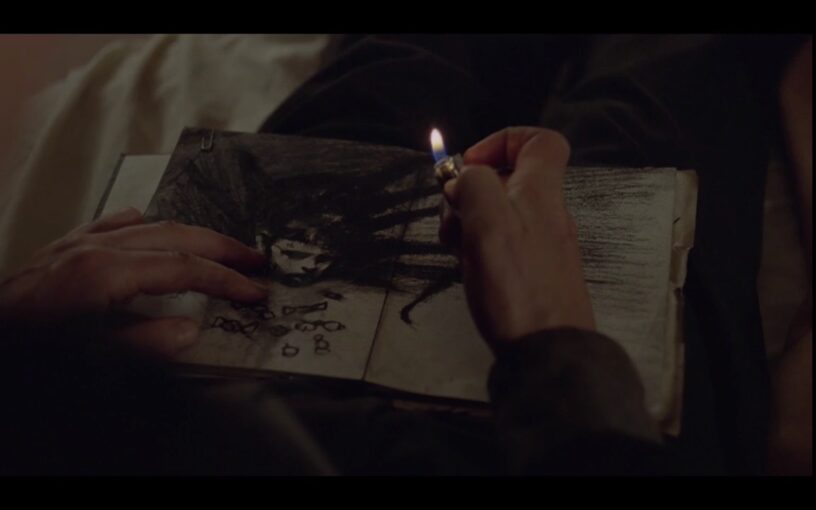
Except the Narrator and Christie – insofar as Christie is real now, which is hard to tell – are engaged in a kind of war of cruelty with each other. ‘Parlour games’, the narrator calls it. They range from verbal jabs to passing back and forth a dead fox, the Narrator leaving it on the stairs for Christie to trip over and Christie serving it on the Narrator’s plate.
Why is the narrator setting razor-traps within Possum? Well, late in the story when remembering a man who preyed upon him, he thinks of ‘the diseased hands [the predator] had hated’. One way a child might try to protect himself from sexual abuse is to try being repulsive so the abuser won’t want him. The short story extends this to the point of self-mutilation. Better cut to bits than . . . that.
But by the end, Christie has left the Narrator a Christmas present. At the top of the tree is the mask the Narrator’s abuser wore. At the bottom, a twitching, rustling parcel of . . . something. Something Possum-like that won’t die. The Narrator reaches for it eagerly.
Christie, in a sense, is even more unreal than Maurice. That’s one of the tricks of written fiction: whether something is literally there or just thought about can be fully concealed, because we can’t see anything. So it doesn’t matter. That’s not what the story is about.
Says Holness of writing the story:
[Comma Press] asked all the writers to read Freud’s theory of the uncanny, pick a fear that appealed and write a story for a modern audience.
I picked two. I like the idea of combining the fear of doubles and the fear of dummies. To avoid the slight horrid cliché of the creepy ventriloquist dummy, what if you had someone who made one and it was literally a double, that was a version of themselves, and then what kind of person would do that? That’s what the story was about.
https://screenmayhem.com/matthew-holness-interview-possum-horror-and-a-bit-of-dark-place/
What kind of person would do that? That’s where Holness started.
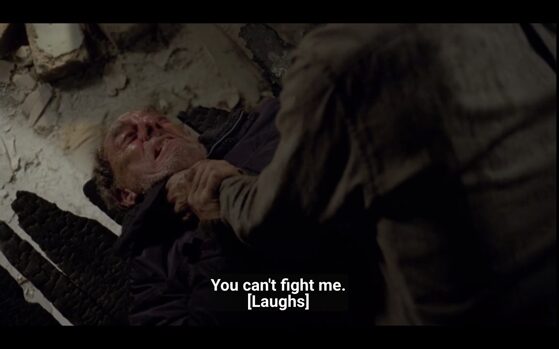
But then it got onto the screen. It involved actors. You had to have two different men visible – well, in theory he could have had Harris play both parts, but it would have been a great shame to lose Armstrong. And what he got was two truly spectacular actors who, in collaboration with him, moved the question into a different one: What does it feel like to be the kind of person who would do that?
Which is why reality doesn’t matter.
It’s perfectly possible that the boy was never kidnapped at all; if Maurice is a figment of Philip’s imagination, the kidnapping might have been as well. Maurice might be there, he might not. Anything might have happened, or none of it.
It’s about how it would feel if it was true, not about whether it is. Because the feelings are true either way.
The short story never intended to be clear on what was and wasn’t real. It’s a deliberately challenging read: you have to let it confuse you and remember the things it tells you and construct what reality you can towards the end. Then you have to let it sink deeply back into the psyche it’s about, which is a psyche that – by publisher brief, no less – could not be clear on what is and isn’t real. The whole point about Freud’s uncanny is that it operates on a level where that’s not the question.
Freud’s essay on the uncanny is available here if you want to read it: https://web.english.upenn.edu/~cavitch/pdf-library/Freud_Uncanny.pdf. Inevitably he talks a lot about castration anxiety because he was constitutionally incapable of allowing that anything wasn’t about willies, but it’s worth noting that he also stresses the exact word in German: Unheimliche, literally ‘unhomely’. He actually stresses that other languages don’t have this exact word:
ENGLIGH: (from the dictionaries of Lucas, Bellows, Flugel and Muret-Sanders): uncomfortable, uneasy, gloomy, dismal, uncanny, ghastly, (of a house) haunted, (of a person) a repulsive fellow.
But in German it’s something else. Something that’s dislocated from everything that feels familiar, safe, protective. Everything that should be home.
What else has happened to Philip?
Holness began by playing around with the idea of someone who could create a double of themselves, maybe more than one, and why they’d do that. Then he made a bigger piece, involving everything you can put into a film . . . and he came to the substrate of the idea.
Unhomeliness. The horror of a reality where there is no home.
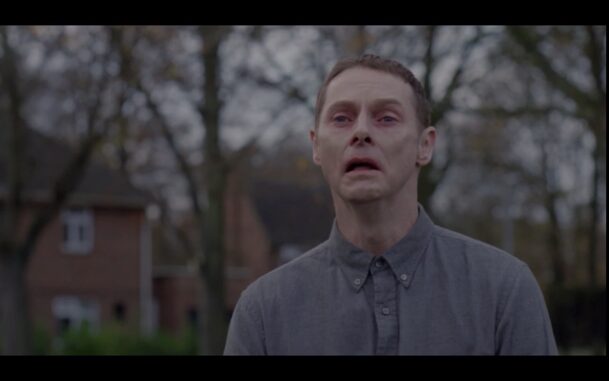
‘A broken toy,’ Christie calls the dismembered Possum at one point in the short story. But what is Philip now? Maurice toyed with him, and now he’s broken.
Bag is open, growing wider.
What’s inside it, man or spider?
In Possum, it’s not a question with an answer. The question is the answer: this is what happens when trauma creates a permanent state of uncertainty about who you are. If Philip could only answer it, he might have a chance of healing.
This isn’t using subtext. This is about being subtext.
Philip isn’t carrying around a metaphor for his trauma because the film thinks it’s clever. He’s carrying around a metaphor for his trauma because he can’t think about anything else. His personality was shaped around it, so it comes out in his art, his face, his body, his voice, his life. Now he’s two things: a person we’d pity and a person who might be dangerous. When both are true at once, reality becomes too big to grasp.
Matthew Holness wrote a story of the uncanny. And it became a story of the Unheimliche.
The origin of the word ‘uncanny’ comes from an old word meaning ‘knowing’. We still have its meaning preserved in ‘canny’: a clever, shrewd person who knows a thing or two. It’s the same root as the word ‘cunning.’
And that’s a state of fear all right: the unknowable. It’s a state of fear Philip is in, and the place both story and film create in us: what is real and what isn’t? We don’t know. It is, to use another phrase that grew from the same root, beyond our ken.
In English we’re afraid of things we can’t get our heads around, and Philip’s head is both on his neck and on the spider-legs of a terrible puppet. Some things are too dire for our minds to take them in.
But what’s so terrible about this horror? It’s Unheimliche.
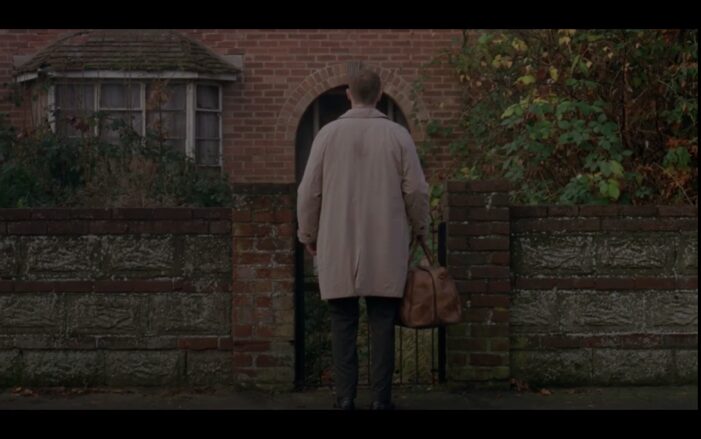
Philip is a child without a mother. An adult without love. A man who can go home because psychologically he never left – and who can’t go home because a home is not what that house was.
Boy did Holness understand the assignment.
He decided to tackle doubles and dummies, and wanted to do something a bit more interesting than a ventriloquist’s doll. So he created a tragedy in which the puppet may be uncanny – it’s a creepy fucking thing, that’s for sure – but the reality that’s truly broken is in the flesh-and-blood man that carries him.
Why are we afraid of doubles and dummies?
Freud himself, when defining the uncanny, wrote that he must ‘plead guilty to exceptional obtuseness in this regard . . . It has been a long time since he [ie Freud] experienced or became acquainted with anything that conveyed the impression of the uncanny.’ Despite his famous association with the subject, it wasn’t something he felt particularly strongly. He was elaborating on the writings of psychologist Ernst Jentsch, who he quotes as giving an example:
E. Jentsch singles out, as an excellent case, ‘doubt as to whether an apparently animate object really is alive and, conversely, whether a lifeless object might perhaps be animate.’
Little Possum, black as sin, is definitely the latter. That’s the bread-and-butter of creepy doll movies. But it’s rare indeed to see a film that takes on the complementary side: the ‘apparently animate’ that isn’t quite alive.
Oh, Philip’s alive, technically. Maurice might not be, that’s for sure, but Philip is. But you couldn’t call it living.
The work of art Freud dwells upon is E.T.A. Hoffman’s classic story ‘The Sand-Man,’ which you really must read if you haven’t. Being Freud, he gets distracted by something: the narrator, Nathaniel, is afraid of a mythical Sand-Man who will attack his eyes. Why are people so afraid of getting their eyes damaged, Freud rather unnecessarily ponders? He just about admits that it is, as a literal injury, an upsetting thought . . . but he can’t help himself. He argues himself back into claiming it’s castration anxiety in the end.
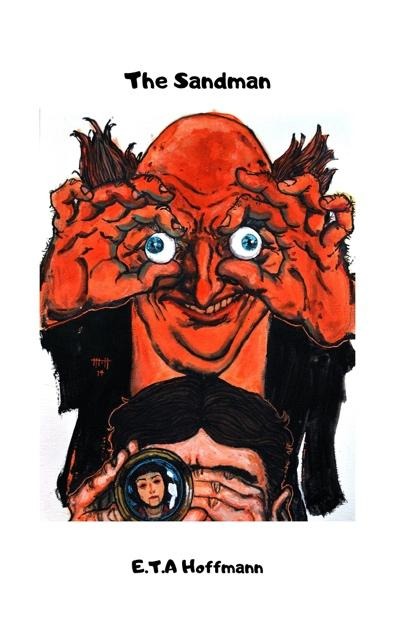
Why was Freud so obsessed with castration? Most people, men included, are likely to put the idea in the same category as the loss of your eyes: something you definitely don’t want to happen, but awful enough in itself without having to build a belief system around it.
Here’s an interesting thing about Freud: as the boy of the family he was enormously favoured. Notoriously, when his mother’s ‘golden Sigi’ complained that his sister’s piano playing distracted him from his homework, that sister was forbidden to play.
No cis boy wants to be castrated. It’d hurt, for starters. More than that, he doesn’t want his sex taken away. Again, what cis person would? But imagine the insecurity of the over-indulged, the precious protections showered upon you, carrying with them the message that you aren’t strong enough to do without them. Are you clever enough to study without your sister’s silence? You’ll never have to put it to the test. So what could be worse than castration – than no longer being able to show that you’re a boy? Look at what happens to people who aren’t.
Freud brought castration anxiety into his essay on the uncanny, I think, because he couldn’t see past the literal image to what it really meant for him: a loss of identity. And in particular, a loss of identity as the special one. If you weren’t the golden boy, who would you be?
Well, Philip could tell him.
Freud would call Philip a castrated man. He’s certainly a violated one. But above all, he’s a man who grew up without the cherishing, and the consequent sense of security and strength, that a child should have. He was not golden. And now look what’s left of him.
‘Anyone who possesses something precious, but fragile, is afraid of the envy of others,’ Freud wrote in his essay on the uncanny. Isn’t that what the kidnapped boy of Possum is? He’s a child, precious and fragile – and he’s a cared-for child, which is fragile in a way that burned Philip’s life to the ground. The boy’s disappearance and reappearance in the story is only partly plot. It’s also about that quality of goldenness that Philip has every reason to envy.
Everything around Philip is a mirror, in the end. Maurice is the past he can’t escape. The boy is the child he couldn’t be. And Possum? Well, Possum has power. The power to frighten and hurt, that’s all. But by now, that’s about the only kind of power Philip might be able to imagine. It’s the only power he ever knew.
Why, Freud asks, are we afraid of dummies and doubles? Because they raise questions of what is and isn’t a person.
But what happens to reality – to the reality you have to live in, even if you live there alone – when in the years that formed you, you were treated as if you weren’t a person?
Little boy, don’t lose your way.
Possum wants to come and play.

Ginger Nuts of Horror: The Heart and Soul of Horror Reviews

Looking to get your horror book or film in front of the genre’s most dedicated audience? Ginger Nuts of Horror is one of Europe’s largest independent horror review websites, with over 30 contributors publishing horror book reviews and horror movie reviews almost every single day.
We offer far more than reviews. Authors, filmmakers and publishers can promote their work through in-depth horror book reviews, horror film reviews, comic and video game coverage, news features, and our popular author and director interviews like Five Minutes With. Our guest feature series, The Horror of My Life, Childhood Fears, The ? That Made Me and more, let creators tell their story while promoting their latest release.
Every feature is built to sell your work. We include backlinks to your website or Amazon author page, a full synopsis, and a universal purchasing link that sends readers straight to their local store. Add a large, engaged social following and an 18-year archive of trusted horror coverage, and you have a platform genuinely built to grow your readership.
Whether you’re an established author, an indie filmmaker, or a debut voice in indie horror, there’s a way for us to help you reach more fans. Explore our horror book reviews and horror movie reviews, then get your horror book or film featured today.

Jim "The Don" McLeod has been reading horror for over 35 years and reviewing it for more than 16. He's the editor of Ginger Nuts of Horror, Europe's largest independent horror review and culture site, and a British Fantasy Award nominee for his work in the genre. When he's not busy inflicting his opinions on the horror community, he can be found annoying his family or getting thoroughly outwitted by his two dogs, Casper and Molly.