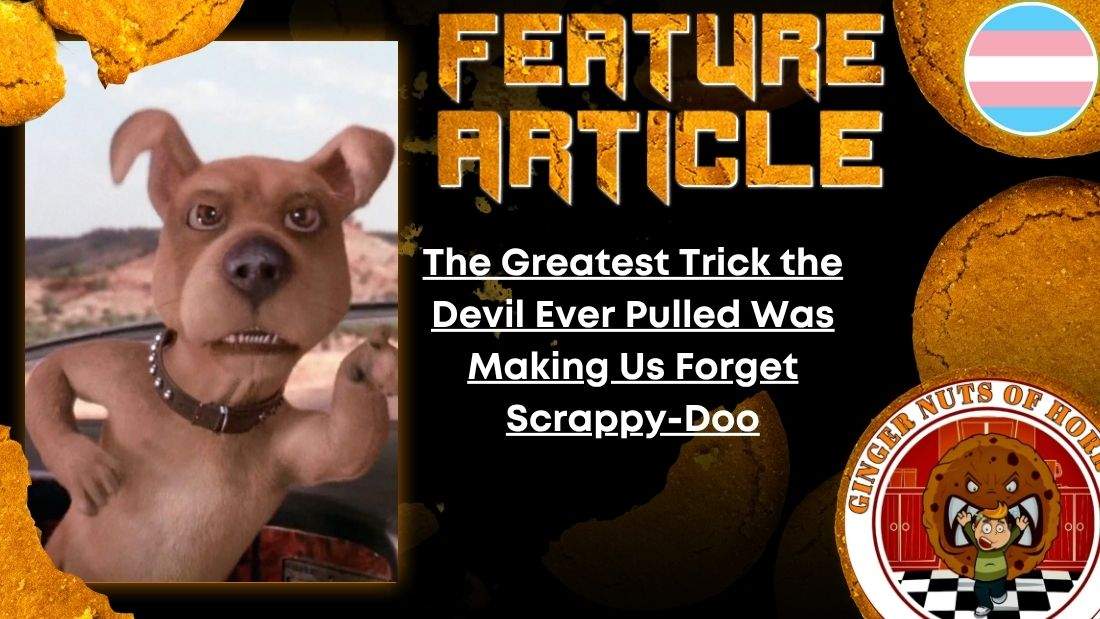
The Scooby-Doo 2002 movie contains a narrative deception so audacious that it weaponises three decades of collective audience loathing and transforms a cartoon punchline into the most psychologically credible villain origin story Hollywood has ever smuggled past a studio notes meeting.
The Greatest Trick the Devil Ever Pulled Was Making Us Forget Scrappy-Doo
For decades, film scholars and caffeinated listicle writers have debated the Mount Rushmore of plot twists. The canon is practically scripture: Marion Crane’s shower curtain ripped aside to reveal a wigged Norman Bates; Malcolm Crowe’s wedding ring landing with a silent, sickening clink; Verbal Kint’s limp dissolving into the stride of a man who just conned the entire LAPD.
These are not merely surprises, they are cultural earthquakes, moments that rewire the audience’s understanding of narrative itself. Yet for all the doctoral theses dedicated to their genius, I am here to tell you that every single one of them has been lapped by a twist so audacious, so philosophically deranged, that it transcends mere cinema and enters the realm of modern mythology.
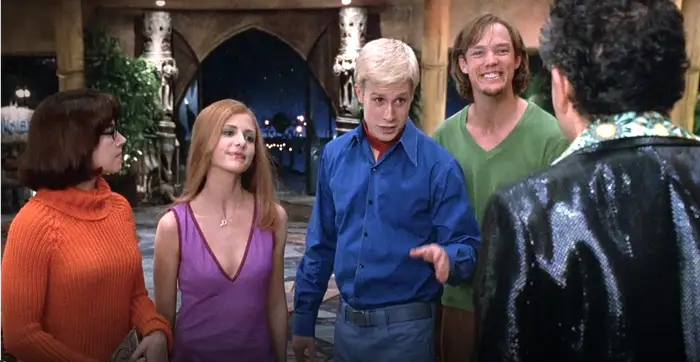
To find this unicorn, you must journey not into the arthouse or the prestige horror canon, but into the garish, sugar-rush fever dream of a critically derided box-office hit that most adults remember only as a hazy stoner rental. I am speaking, of course, of the 2002 live-action Scooby-Doo. Yes, that one. The one with the flatulence contest. The one where Fred’s ascot absorbs more charisma than the entire cast of The Fast and the Furious.
Tell someone the greatest plot twist in cinema history hides inside the 2002 Scooby-Doo movie and watch their face cycle through the five stages of grief in about four seconds. Denial, anger, bargaining, depression. Acceptance rarely arrives at all. This reaction is the direct consequence of a cultural verdict delivered two decades ago and never seriously revisited.
The argument that follows is sincere, detailed, and built on the conviction that the genre’s greatest pleasures sometimes hide in the places criticism has been too embarrassed to look. The Scrappy-Doo plot twist is not a guilty pleasure. It is a genuinely brilliant piece of narrative architecture, and the case for it begins now.
The live-action Scooby-Doo arrived in summer 2002, trailing the faintly sulphuric odour of a cash grab, and critics found soft tissue everywhere: the flatulence gags, the Nu-Metal soundtrack, the script that seemed assembled by committee during a gas leak. The film grossed over a quarter of a billion dollars and was immediately filed under guilty pleasure.
The Mount Rushmore of plot twists, Norman Bates’ mother being a skeleton with a wig, Bruce Willis being dead the whole time, and Keyser Söze straightening his limp are taught in film school, dissected in video essays, and worshipped in film forums. And they are all, I must tell you with a straight face and a thesaurus, absolute amateur hour compared to the masterstroke of narrative deception that James Gunn smuggled into this movie. I am, of course, talking about the revelation that the film’s masked antagonist is not a grizzled lighthouse keeper or a land developer in a rubber costume, but a digitally shrunken megalomaniac: Scrappy-Doo.
To understand why this is the greatest plot twist in the history of projected light, we must first humble ourselves before the sacred texts of horror cinema. M. Night Shyamalan‘s The Sixth Sense gave us a ghost who didn’t know he was dead. Clever. It works precisely once, and only if you’re not paying attention to the colour red or the fact that nobody offers Bruce Willis a snack.
Alfred Hitchcock’s Psycho killed its protagonist in the shower halfway through. Shocking, yes, but ultimately it’s a straightforward bait-and-switch about mortality. The Usual Suspects reveals that a weedy con man fabricated a legend from a corkboard. Amusing, but fundamentally, it’s just a guy lying.
The Scooby-Doo twist operates on a plane of existence so far beyond these mere mortal machinations that it practically vibrates. This isn’t a twist about perception, death, or identity. It’s a twist about vindication. For twenty-three years, the global population was united in a single, unwavering belief: Scrappy-Doo was an insufferable cartoon tumour, a neon-green blight on an otherwise perfect canine detective quartet.
Screenwriter James Gunn looked at this universally despised, yapping punchline and asked the question no one else dared to: what if we were right? What if being a tiny, hyperactive nephew who talks about his “puppy power” actually breaks a person? What if our collective loathing curdled him into a demon-harvesting tyrant?
Compare this to Fight Club’s Tyler Durden reveal. The Narrator’s split personality is a psychological allegory for late-capitalist masculine ennui. Deep, but fundamentally, it’s one guy who’s bad at sleeping. Scrappy-Doo’s turn, however, is a searing metacommentary on the fickle nature of fame. He wasn’t framed; he wasn’t possessed. He masterminded a full-scale spiritual extraction operation on Spooky Island, harvesting souls into gelatinous protoplasm blobs, because Mystery Incorporated kicked him out for being an egotistical nuisance, and he never forgave them for it.
This is the most aggressive “notice me, senpai” gesture ever captured on celluloid. Norman Bates killed because of a domineering mother. Scrappy’s motive is darker: he got too big for his ascot.
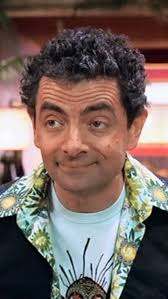
The structural genius of the twist is that it weaponises our own dismissal. The movie presents a classic whodunit. Rowan Atkinson is prancing around. There are luchador-masked demons punching Scooby in the upside-down head. In the classic Scooby-Doo formula, the villain is the guy you medium-suspect.
Here, the guy you medium-suspect turns out to be a robot suit, with Scrappy-Doo piloting it from within. Mondavarious isn’t torn apart; he’s found alive and imprisoned, a hostage inside his own mechanical double. You sit there, slack-jawed, thinking, “Well, if it’s not the eccentric park owner, who could possibly be the, oh no.”
The film dares to reveal that Scrappy has been absorbing people’s essences not merely to conquer the world, but to transform himself into the monstrous Scrappy Rex and enslave it with a demon army. His great tragedy is that he never escaped the shadow of his uncle. This is Shakespearean. This is Richard III barking at the moon, demanding a kingdom.
Other twists leave you with a sense of awe. The Scrappy Twist leaves you with a distinct physiological sensation: the immediate, desperate need to find the nearest human being and lock eyes in a shared, silent scream of “Was that real?” But unlike The Brood, this climax features a flatulence contest as the resolution. It’s high art and low humour fused into a single, radioactive moment.
Critics will say a twist is only great if it recontextualises the entire film. Watch Scooby-Doo again. Every time Scrappy isn’t on screen, you’ll realise he was pulling the strings, shrinking his ego down to a pea-sized vengeance machine. The foreshadowing is unnerving. “Scrappy’s always been a little… ambitious,” the gang muses. Yes! He was ambitious! He was working on his villain monologue while you were all high-fiving over a man in a miner’s helmet ghost costume!
In the pantheon of twists, The Empire Strikes Back gave us a sad dad. The Crying Game gave us a surprise gender reveal. But only James Gunn‘s Scooby-Doo gave us a creature driven to apocalyptic villainy by the simple, heartbreaking truth that he was, and always would be, the Scrappy-Doo of the group.
He is the modern Prometheus, if Prometheus had bad hips and was voiced by Scott Innes doing a Joe Pesci impression. And for that, it is not just the greatest plot twist of all time. It is the only one that truly asks, with a straight face, “Puppy power. What is it good for?” The answer, it turns out, is absolute evil.