
The witch trial never ended. Georgia Summers proves it.
Georgia Summers’ Trollheim: Tale of Sýstir arrives in 2026 as one of the most assured pieces of Nordic folk horror fiction in recent memory. The No.1 Sunday Times bestselling author of The City of Stardust and The Bookshop Below takes Scandinavian mythology, specifically the figure of the Huldra, the forest creature whose name means “hidden,” and builds from it a dark, folklore-rooted story of persecution, belonging, and the cost of being the thing society cannot name. For readers who want their horror literary, patient, and grounded in genuine mythological tradition, Trollheim delivers with rare authority.
When your name means “hidden,” surviving means never letting anyone see your back.
Burn the thing you cannot name. It is a lesson humanity has rehearsed with depressing regularity, from the medieval witch trials of Scandinavia to every era of persecution that followed in their long shadow. The creature who does not fit, the woman whose knowledge frightens, the child born different: these are the figures folk tradition warns you about, fears, and eventually hunts. What Georgia Summers does in her third novel is take that particular, well-worn terror and flip it inside out, so that the monster becomes the one worth following into the dark.
And the dark, in Trollheim: Tale of Sýstir, is worth following into.
Georgia Summers takes Nordic folklore at its darkest and most honest, and builds from it a book about what it costs to exist in a world that has already decided you are dangerous. Trollheim: Tale of Sýstir is patient, precise, and quietly devastating, the work of a writer finding exactly how close to the bone she can write. It stays with you the way old stories do: not gently.
Georgia Summers’ Trollheim: Nordic Folk Horror Done Right
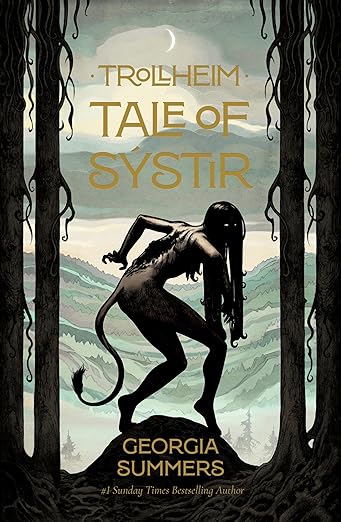
The horror here is not the kind that reaches out and grabs you by the throat. It is subtler, more patient, and ultimately more unsettling for it. Summers works in the folk horror register: the dread of community turning on its own, of the old stories proving true, of the forest holding something older and less forgiving than anything a village can produce. When Sýstir and her sister Ada watch their mother dragged to a burning stake, accused of witchcraft, the horror is entirely human in origin. That is where the book announces itself, quietly and firmly, as something with genuine teeth beneath its lyrical surface.
The atmosphere Summers builds in Trollheim operates like fog: it comes in low, it obscures edges, and by the time you realise how thoroughly disoriented you are, you have already accepted the world on its own terms. The Dark Forest, the realm the book comes to inhabit, is not a place of cheap darkness. It is layered, full of competing needs and old allegiances, populated by mythical beings who carry their own histories of displacement. There is a loneliness to Trollheim that accumulates across the story’s time jumps, a persistent note underneath everything else, like bass resonating through a cathedral floor you can feel in your chest before you hear it.
The pacing is deliberate. Summers builds character before she builds crisis, which is a choice that rewards patience. Sýstir’s coming-of-age does not rush toward confrontation; it breathes, it digresses, it stops to let grief sit. The rogue troll Agagkantor, who takes Sýstir in after she escapes the chaos of her mother’s burning, is given enough space to become genuinely complicated. His secret, which the synopsis flags without revealing, works as a slow structural pressure, a tension that builds beneath the surface of what appears to be sanctuary.
Summers writes in a close third person anchored tightly to Sýstir’s perspective, and this is the right choice. It keeps the reader inside a consciousness that is simultaneously trying to understand itself and trying to survive, two pressures that create an almost constant, low-level friction in the reading experience. We see Trollheim through the eyes of someone for whom it is both revelation and exile, both sanctuary and proof that she has lost everything she knew.
The time jumps are handled with a structural confidence that less assured writers miss. Rather than feeling like narrative shortcuts, they operate as the story’s equivalent of a camera pulling back, letting us see how Sýstir’s situation has shifted, how she has adapted or failed to adapt. They give the book its broader weight, preventing it from collapsing entirely into a single, anguished moment.
The dialogue has a period quality without falling into the trap of archaic stiffness. Characters in Trollheim sound like beings with long memories and complicated motivations, not like people performing ancientness for the reader’s benefit. Agagkantor, in particular, gets lines that carry the weight of someone who has seen too much and chosen, deliberately, to obscure what he knows.
The chapter construction follows a logic of accumulation rather than escalation. Each section deposits something that the later sections draw on. This is a book that trusts its reader to carry information forward, and that trust is repaid by the way the revelations about Agagkantor’s secret and about Ada’s disappearance land when they finally arrive. Nothing feels arbitrary.
And Fulgir. The wildcat companion deserves a mention on craft grounds because Summers uses the animal precisely where a less careful writer would use an expository character: as the constant in an inconstant world, as the thing that grounds Sýstir in her body when her mind is elsewhere. It is the kind of quiet structural intelligence that doesn’t announce itself but makes the difference.
Trollheim is, at its marrow, a book about what it costs to be the thing society cannot name. Sýstir is Huldra: a creature from Scandinavian folklore whose very name derives from the Old Norse huldr, meaning “covered” or “secret.” The Huldra are beautiful, dangerous, associated with the deep forest, marked by features they must keep hidden from human eyes. They are nature’s kept things, the wild and uncategorisable. That the book’s protagonist carries this etymology in her identity is not incidental. Everything about her situation, the hiding, the constant threat of discovery, the relief and terror of finally existing in a place where hiding is unnecessary, flows from what her name means at its root.
The witch trial backdrop is not decorative. It places the story inside a specific historical horror: the European persecution of women, particularly women who operated outside the boundaries of acceptable knowledge and behaviour. Sýstir’s mother dies in a framework that has nothing to do with what she actually is and everything to do with what the community needs to believe about her. This resonates with particular clarity right now, when questions of who gets to exist openly, who gets to be visible, who gets to live without concealment, are far from settled.
The Dark Forest as a sanctuary is the book’s most interesting conceptual move. Trollheim is not paradise. It is a place for those with nowhere else to go, a haven built on the collective condition of being unwanted elsewhere. This found family, assembled from displacement and necessity rather than choice, is the book’s emotional core. Agagkantor is not Sýstir’s family by blood or convention; he is her family because he made a choice in a moment when she had nothing, and the book is honest about how complicated that kind of origin makes a relationship.
The missing sister Ada is the wound the book doesn’t quite close. Her absence runs through the story as a kind of negative space, a shape defined by what is not there. The grief of surviving when someone you love did not is one of the harder things to write honestly, and Summers manages it without turning it into pure sentiment.
The animal companion, the forbidden nature, the burning, the secret the guardian carries: these are the book’s recurring pressures. Together they construct a portrait of what it means to live in perpetual negotiation between what you are and what the world will permit you to be.
It is worth placing Trollheim within the full arc of what Georgia Summers has been building across her three books, because the trajectory is genuinely interesting.
The City of Stardust, her debut, announced a writer with an appetite for scale: family curses, soul-stealing gods, scholars and cabal intrigues, and a heroine who crosses the world in search of answers about her mother’s absence. The book wore its influences openly, Gaiman’s otherworlds, Taylor’s dark fairy-tale logic, and the prose carried the particular brightness of a writer discovering what she could do. It became a No. 1 Sunday Times bestseller, a kind of success that can make a second book difficult.
The Bookshop Below was the proof that Summers was not going to simply repeat herself. Cassandra Fairfax, disgraced bookseller, navigating a hidden world of ink magic and deadly bargains beneath London’s streets: a more contained canvas than The City of Stardust, but more interior, more focused on character psychology. The world-building tightened. The moral ambiguity deepened. Where the debut was a book about inherited destiny, the second was about the choices you make when the system you trusted expels you.
Trollheim is a further step inward, and in a direction no one could have predicted from the first two books. It is the most stripped-back of the three, the most rooted in a specific mythological tradition, the closest to the original grain of folklore. What connects all three is a set of preoccupations that Summers is clearly working through from different angles: outsider women navigating worlds that require concealment; the inheritance of trauma and secrets; the question of what counts as family when the one you were born into has been destroyed or corrupted; and finding community in spaces that exist outside the official world.
The difference is that Trollheim goes further back, to the source material itself, and finds the darkness that those older stories were always carrying. The prose is leaner here than in either previous book. It has shed some of the decorative quality of The City of Stardust, revealing something harder underneath.
Georgia Summers takes Nordic folklore at its darkest and most honest, and builds from it a book about what it costs to exist in a world that has already decided you are dangerous. Trollheim: Tale of Sýstir is patient, precise, and quietly devastating, the work of a writer finding exactly how close to the bone she can write. It stays with you the way old stories do: not gently.
Folk horror is having a significant moment, and Trollheim sits squarely within it, though it brings its own particular quality to the conversation. The sub-genre’s distinguishing feature, that the horror emerges from the community against the outsider, from the landscape itself, from the old stories proving literal and terrible, is fully present here. But Summers adds something the best folk horror fiction does: she insists that the outsider’s interiority matters as much as the threat.
Katherine Arden’s The Bear and the Nightingale is the obvious formal comparison, and it is not wrong. Both books draw on specific Slavic and Nordic mythological traditions, both use a young woman protagonist navigating a world of supernatural beings, and both understand that the human community can be more dangerous than the monsters it fears. But Arden’s Vasya is fighting to preserve something, while Sýstir is trying to build something from almost nothing. The register is different. More concentrated.
Genevieve Gornichec’s The Witch’s Heart occupies adjacent territory: Norse mythology reimagined from the perspective of a being tradition usually treats as marginal or monstrous. These are the books that Trollheim belongs with, the ones that ask what the story looks like from inside the creature, and find it considerably more complicated than the tales let on.
What Trollheim offers that those comparable books do not is its particular focus on the moment of arrival in sanctuary, on the construction of found family under conditions of grief and trauma, and on the secrets that even refuge-givers carry. It occupies its corner of the genre with a quiet authority, neither shouting about its mythological credentials nor disappearing into them.
Horror as a genre is increasingly interested in what the monster knows, what it feels, and what it understands about the humans who fear it. Trollheim is a precise, carefully crafted contribution to that project.
What Summers understands, that the old witch-trial logic never really went away but simply found new targets, is what gives this book its lasting weight. The burning is always somewhere on the horizon.
Trollheim by Georgia Summers
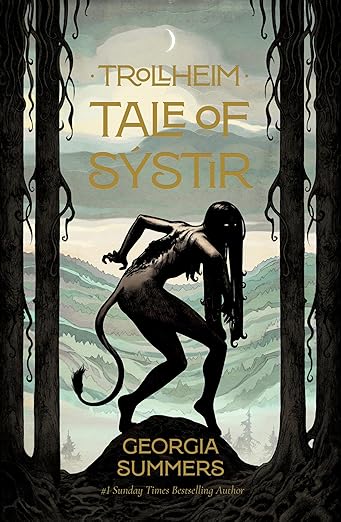
When their mother is burned at the stake, Sýstir and Ada have two options: run or die. For fans of The Bear and the Nightingale and The Ten Thousand Doors of January, this lyrical tale of magical realism rooted in Nordic folklore is written by a no.1 Sunday Times bestselling author.
Sýstir’s world is small and quiet but shrouded in secrets. Outside of her family’s cottage lurks the constant threat of being discovered for what she truly is: unwanted, dangerous, Huldra. When their mother is accused of witchcraft and dragged to the stake, she and her sister must run for their lives. Yet only Sýstir escapes.
Taken in by the rogue troll Agagkantor, Sýstir finds herself in the Dark Forest, otherwise known as Trollheim. Here, she discovers a magical realm for mythical beings and a sanctuary for those with nowhere left to turn.
For Sýstir, it’s a chance to forge a new family and live life as her true self. But questions remain about her missing sister, and Agagkantor carries a secret of his own – one that could unravel Sýstir’s past and destroy the Dark Forest entirely…