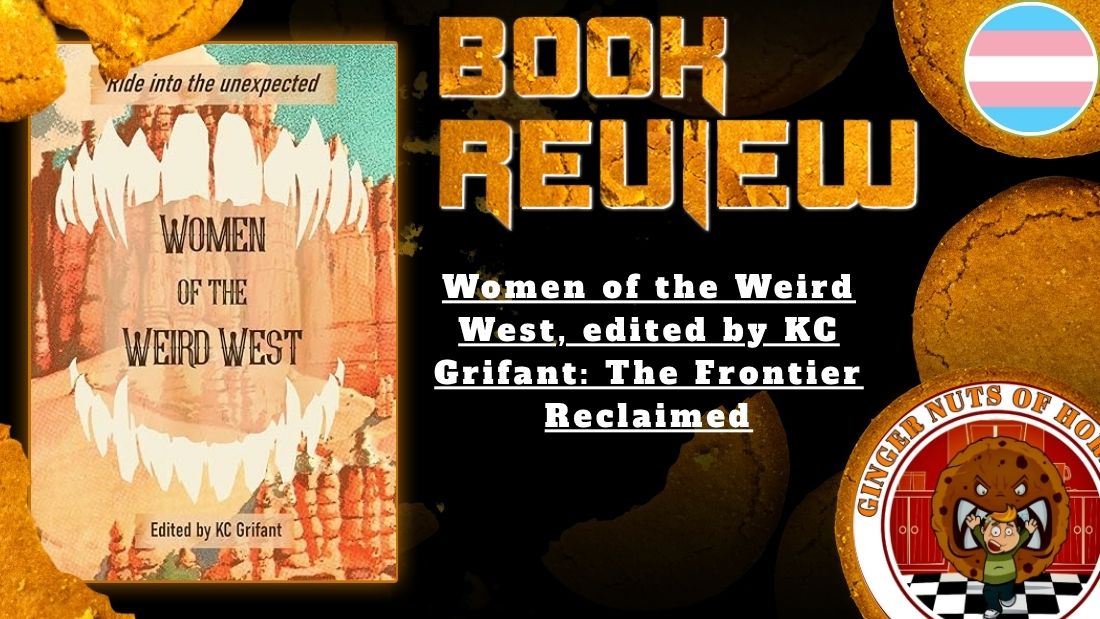
A dead woman sings the song about her own death in a graveyard she dug by hand. That image opens Women of the Weird West, the new weird-western horror anthology edited by KC Grifant for Brigids Gate Press, and it sets the terms for everything that follows. Across 25 stories and poems, this book hands the frontier to the women the old westerns cut from the picture. Frontier folklore bites back, vampires lay siege to a Texas mission, and an Arctic river monster waits in the silence. It’s women in horror at full strength, and proof the weird west revival has real teeth.
These stories work like a séance, calling up every woman the old westerns cropped out of frame and handing her the gun, the grief, and the last word. KC Grifant refuses to pick a lane, and the frontier she builds is bigger, stranger, and far more alive for it.
Women of the Weird West | KC Grifant | Brigids Gate Press | June 2026 |
A woman stands in a prairie graveyard she dug by hand, six feet down, no pine box, a miner’s lantern set beside each body so the dead won’t lose their way in the dark. She is singing the folk song about her own death. That is the first thing this book does to you, and it does not loosen its grip after.
The woman is Clementine, or what’s left of her, in Cynthia Pelayo’s opening story. She is not the prostitute-with-a-heart-of-gold and she is not the obedient farm wife. She is something the old westerns never had room for. Across twenty-five stories and poems, KC Grifant has gathered a whole frontier of women like her, and the cumulative effect is a book that feels less like an anthology and more like a séance.
KC Grifant has arranged the collection so that the dread never settles into a single register. You finish a quiet, grief-soaked prose poem and turn the page into a vampire siege. You leave a Chinese funeral parlour crawling with faceless yaoguai and land on a smoothie bar on a planet called Alpha V, where the gunfight is settled by a haiku. The book refuses to let you brace for the next thing.
That refusal is the point. The old western promised a kind of safety, the lone gunslinger who always rides off into the sunset. These stories strip that promise away early and never give it back.
The dread here is patient. In Mathilda Zeller’s “Bountiful Harvest,” a woman named Jenny watches a tizheruk, a long eel-like monster of Inupiaq lore, cut through the Kobuk River, and she knows what it means. Death follows the sighting. The horror is not the creature. The horror is the long, silent walk to the stream when her toddler wanders too close to the water. Zeller writes that drowning and death are silent things, and the line sits in your chest like a swallowed stone.
Other stories go loud. V. Castro’s “Soldaderas” drops you inside a mission outside San Antonio where ten women, named for the female soldiers of the Mexican Revolution, hold a wall against a horde of vampire demons led by a general who bleeds the land itself. Two bandoliers, a machete on the belt, a bruja’s blessed metal spikes driven into the dirt. The tension there is the pressure of running low on ammunition as a solar eclipse approaches.
So the book builds its dread in two ways. Through patience and through siege. By the end, you can’t predict which kind of fear is coming, and that uncertainty is its own slow torture.
Pelayo opens “My Darling, Clementine” by threading the actual lyrics of the folk song through the prose, so the reading rhythm keeps stuttering back to that tune you half-remember. The effect is hypnotic. You start to hum it against your will. The voice is first person, present and patient, a dead woman explaining her own land to you while preachers roll past on clacking carts.
Then turn to Angela Liu’s “How To Kill A Yaoguai.” Here, the voice is dry, hungry, funny in a way horror rarely lets itself be. The narrator watches a roach crawl under the pantry and imagines frying it up with chilli paste for a bit more crunch. That joke lands one paragraph before the demons start mimicking a dead aunt’s voice and telling the sisters to slice themselves open. Liu knows exactly how to use a laugh to widen the wound underneath it.
The point-of-view choices throughout the book are deliberate and varied. Some stories sit tight in one head. Tiffany Morris’s “Twin Pistons” stays so close to a knife-throwing girl named Clara, given a glowing machine heart by her blacksmith father after a lightning strike, that you feel the artificial heart aching and breaking in her chest as she walks away from home. Other pieces pull the camera back into legend, the way Jendia Gammon does in “The Stinger of Hellbinder Gulch,” where the canyon itself becomes a character that throws sound around to trick you into thinking danger is far off when it’s right behind you.
“How To Kill A Yaoguai” — Angela Liu
Two sisters run the town’s best saloon and its only monster-extermination service, and Liu makes both feel equally routine. That deadpan is the trick. A roach becomes a breakfast garnish one beat before faceless, eyeless demons start purring a dead aunt’s cruelty back at the women. Funny, then awful, then tender. The hunger in it stayed with me.
“Bountiful Harvest” — Mathilda Zeller
Jenny sees a tizheruk knife through the Kobuk River and knows death is coming, but the fear here isn’t the eel. It’s her toddler slipping toward the water while she’s slowed by the baby on her back. Zeller writes that drowning is silent, then makes you feel that silence. Gold-rush greed and Inupiaq lore, braided tight. Quietly devastating work.
“Soldaderas” — V. Castro
Ten women hold a mission outside San Antonio against vampire demons led by a general who bleeds the land. Bandoliers crossed, machetes blessed by a bruja, ammunition running low with an eclipse approaching. Castro grounds the siege in real revolutionary history, so the monsters feel like inheritance rather than invention. The fight is exhausting, furious, and never once asks for rescue.
And then there are the poems. Grifant doesn’t quarantine them. Anna Madden’s “Pink Stems, Silver Irises, Soiled Doves, Red Lanterns” runs a carriage drawn by púca, Celtic fae wearing the shape of sleek black horses with golden eyes, through a red-light district papered with scenes of Paris. Lisa Timpf’s “Showdown On Alpha V” tells a whole standoff in tight haiku stanzas. Dropping verse between prose stories changes your breathing. It makes you slow down and read each word like it might bite.
“Pink Stems, Silver Irises, Soiled Doves, Red Lanterns” — Anna Madden
Madden runs a carriage drawn by púca, Celtic fae wearing the shape of black horses with golden eyes, straight through a frontier red-light district papered with scenes of Paris. Champagne, morphine, men who crave what they’ll never name to their wives. The lushness is a trap. Beneath the finery sits a predator’s patience, and Madden lets you feel the teeth.
“Showdown On Alpha V” — Lisa Timpf
A barroom standoff told entirely in haiku, set on a planet with talking horses and six-legged dogies that yodel in the fields. Timpf compresses the whole western showdown into clipped, sly stanzas, then lets her gunslinger resolve it by walking to the transfer booth instead. Small, dry, and clever. Proof the form can carry a full story in a handful of breaths.
What unites the craft is restraint about gore. There’s blood here, plenty of it. But the writer’s trust suggestion. The scariest images are the small ones. A maggot in the eye socket. Purple drool curving into a smile. A husband who comes home violent after the whiskey. The book earns one genuinely visceral gut-punch precisely because it doesn’t reach for that gear on every page.
Underneath the monsters, this is a book about who gets remembered.
The dedication says it plainly. To those whose stories were lost throughout history. Grifant has talked about the gap she found when she dug into the real records of the West, the female sharpshooters and warriors and lawmakers, the Indigenous and Asian and Black and Hispanic and queer people who lived that period and then vanished from the movies in favour of yet another Wyatt Earp. This anthology is an act of return. It hands the camera to the people, the genre cropped out of frame.
That mission could have stayed abstract. It doesn’t, because the writers ground it in folklore that belongs to specific people. The tizheruk is not a generic lake monster; it carries the weight of the Kobuk River Valley and the diseases white men brought there. The yaoguai is rooted in Chinese tradition. The soldaderas carry the memory of the Mexican Revolution into a war against vampires. K.M. Chavez’s “Valley Of The Shadow” walks a fifteen-year-old named Xiomara Buenaflor through a New Mexico desert she knows down to the mesquite, between the Giusewa Pueblo and the pink Nafiat mountains the settlers renamed the Sandias. The land remembers its older names, even when the maps forget.
The bond between siblings. The betrayal of spouses. The solace of community. The fierceness of mothers and sisters and daughters. India dies in her partner Tish’s arms in Nicole Givens Kurtz’s “Turquoise Waters,” refusing to be left behind. Two sisters running a saloon and a monster-killing business in the same breath. These are the relationships the lone gunslinger story never had time for.
There’s a real-world charge running under all of it. The Old West was, as Grifant puts it, a flashpoint of America’s identity, a place of adventure and independence and also genocide and suppression. Reading these stories now, with the country still arguing over whose history counts, the speculative lens does something a straight history can’t. It lets the buried thing climb up out of the ground and speak.
Curation is its own craft, and the running order proves Grifant has it. She opens on Pelayo’s slow prairie ghost, closes on Chavez’s desert resurrection, and paces the loud and the quiet so the book breathes. There’s also a sensitivity and authenticity read credited to Shane Hawk, which tells you the care here goes past good intentions into actual practice.
What sets this collection apart from the broader pile is its refusal to pick a lane within the weird west. Plenty of anthologies stay in the 1800s Southwest. This one treats the weird west as an aesthetic and a feeling rather than a fixed place and date, so it can hold a vampire siege near San Antonio, a machine-hearted girl, a smoothie bar in deep space, and an Arctic river monster without any of them feeling like a cheat. That elasticity is where the genre is heading. The frontier was always a story about edges and crossings, and these writers push it to the edges of folklore, science fiction, and poetry at once.
The collection makes a quiet case that the weird west was never really about cowboys. It was about the strange new ground where cultures collided and the supernatural leaked through the cracks. Give that ground to the people who actually walked it, and the genre gets bigger, stranger, and far more alive.
When the genre’s full history gets written, the cowboy won’t be the one telling it. She will be standing in the graveyard she dug herself, singing.
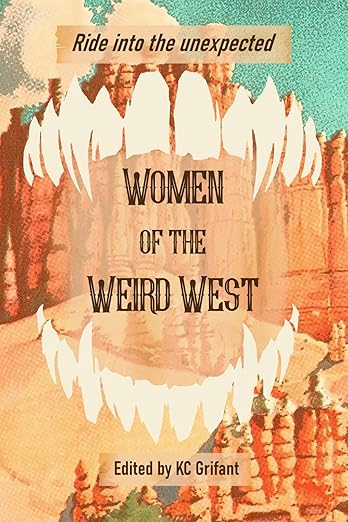
Women of the Weird West edited by KC Grifant
Saddle up. The Old West is weirder than you think.
In this bold reimagining of the Old West, dive into haunted canyons, frontier towns hiding cosmic horrors, vast deserts, and far-flung worlds where women take center stage.
Women of the Weird West features 25 original speculative poems and short stories set in landscapes both familiar and strange. Gunslingers, outlaws, dreamers, and survivors face overwhelming forces both human and supernatural.
Subversive and genre-bending, this anthology captures the wonder, violence, and resilience at the heart of the Old West while featuring women all too often left off the page.
Edited by KC Grifant and with a foreword by Kasey Lansdale, the book features short stories and poems by: Eugen Bacon, Jennifer Brody, V. Castro, K.M. Chavez, Deborah Daughetee, Sarah Faxon, Jendia Gammon, Anastasia Jill, R.J. Joseph, Nicole Givens Kurtz, Angela Liu, Christine Lucas, Anna Madden, Tiffany Morris, Donna J.W. Munro, SJ Myles, Nico Martinez Nocito, Cynthia Pelayo, Grace Quon, Stephanie Rabig, Rebecca Rowland, Tammy Salyer, Lisa Timpf, Angelica Urquizo and Mathilda Zeller.
Perfect for readers who enjoy supernatural westerns, dark fantasy, cosmic horror, historical reimaginings and speculative fiction.