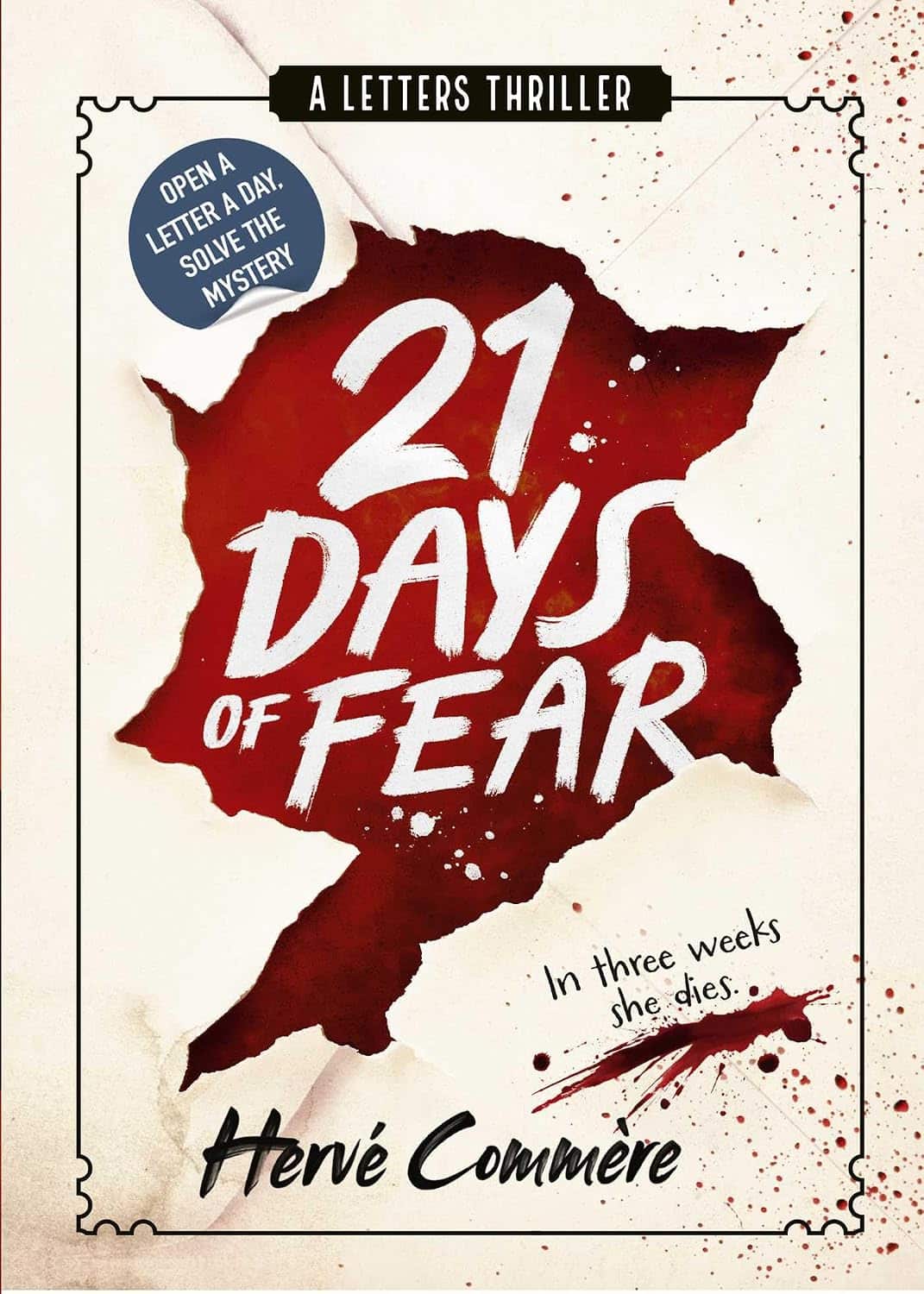
Twenty-one sealed letters, a missing sister and a countdown you tear open with your own hands.
- Author Hervé Commère
- Publisher Simon & Schuster Children’s UK
- Published 24 September 2026
- Pages 422
- Format Hardback
- ISBN 9781398564022
- Subgenre YA thriller, epistolary horror
- Reviewed by Jim McLeod
Ten years after his little sister vanished during a game of hide and seek, Luca starts a new life in London. Then the letters begin. She is alive, they tell him, but not for long.
21 Days of Fear Review: An Advent Calendar of Dread
21 Days of Fear by Hervé Commère is a YA thriller that comes to you as twenty-one sealed letters, and my 21 Days of Fear review argues that the format is the whole point. Translated from the French and published in the UK by Simon & Schuster, it follows Luca, a young man starting over in London whose little sister vanished ten years ago. Then the letters arrive. They say she is alive, and they give him a deadline. Built as an advent calendar thriller, with one chapter to tear open each day, it turns the oldest ritual of waiting into a countdown of dread. Here is why it earns every one of its five stars.
Commère has taken the one promise every child breaks, one door a day and no peeking, and built a thriller inside it. Read straight through, it is a sharp, twisting YA mystery. Read a letter a day, it becomes something rarer: a book that makes the waiting part of the fear.
A Countdown You Open With Your Own Hands
Every advent calendar comes with one rule. One door a day, and no peeking. It is the first deal most of us ever strike with a calendar, and most of us break it before the first week is out, thumb on a cardboard flap, telling ourselves that one early chocolate does not count.
Hervé Commère has built a whole thriller out of that broken deal.
The book first came out in France in March as 21 jours en enfer, part of a line from the publisher Auzou called Un jour, une lettre. One day, one letter. It now reaches the UK in hardback from Simon & Schuster, and the object is the first thing you notice. There are twenty-one chapters.
Each one is sealed shut. The last page of each chapter folds over the rest and closes along a perforated edge, so you tear it open by hand, or run a ruler down the seam if you are the careful sort. Nothing gets ripped out. The book survives, which means it can be passed on, or given as a gift, or read again by someone with more willpower than you.
Twenty-one is a slightly odd number for an advent book, and I like it all the more for that. Start on the fourth of December and the last letter falls on Christmas Eve. That is the dream, anyway.
The story is simple to set up. Ten years ago, Luca was playing hide and seek with his little sister, Telma, in the garden. One day he went looking for her and she was not there. She was gone. The police, the searches and the appeals turned up nothing, and the family came apart in the slow, quiet way that families do. His mother sank into depression. His father could not bring himself to speak of it. Luca was left with the guilt of the boy who was counting when she vanished.
Now he is a young man, starting again in London with a job lined up and a bed in a youth hostel. The day he arrives, a letter is waiting on his pillow. His sister is alive, it says. In twenty-one days she will be dead, unless he does exactly as he is told.
So he does. Each day brings a new letter, and each letter asks a little more of him.
How the Sealed Letters Turn Waiting Into Fear
Plenty of books have used letters. Dracula is a stack of letters and diary pages. Carrie is built from reports and news clippings. Holly Jackson’s A Good Girl’s Guide to Murder drops logs and transcripts into the story. Here, though, the letter is the page itself, and you have to break it open to read it.
That small act matters more than it first seems. Tearing a seal is a tiny bit of violence. You do it once a day, on command, because a book told you to. Luca does the same thing. He opens each letter because a stranger told him to, and then he does what it says. The format quietly makes you his partner. You are both taking orders from someone you cannot see.
Advent has always been about waiting. The word comes from the Latin for arrival, and the weeks before Christmas are built around the slow thrill of expecting someone. Commère takes that thrill and poisons it. The thing you are waiting for is no longer a chocolate or a gift. It is the next instruction.
This is where the book gets clever. The UK publisher’s own page cheerfully tells you that you can tear through all twenty-one at once if you cannot stand the wait. Almost nobody will manage one a day. I do not think that is a flaw. I think it is the trap. Permission to cheat is its own test, and the book sets it knowing you will fail, just as the letters set tasks for Luca knowing he will obey.
Read straight through, 21 Days of Fear is a sharp, twisting YA mystery, with each chapter ending on a turn that makes the next one hard to leave alone. Read a day at a time, it becomes something rarer. The gap between letters starts to count as part of the text. A full day with nothing but the last line in your head is a long time. The reader who binges gets the story. The reader who waits gets the fear.
The finest thing about the book is how tightly the form and the story lock together, and the French edition’s back cover shows it best. That copy is written in the voice of whoever sends the letters, and it speaks straight to him. I am paraphrasing from the French here. It reminds him of the game in the garden.
It tells him ten years have passed, half his life, without knowing why, or who, or how. It tells him his sister is alive, and will be dead in twenty-one days, unless he does exactly what he is told. Then it signs off with a small question: “prêt à reprendre la partie ?” Ready to pick the game back up? The translation is mine.
Look at what that line does. It uses tu, the French word for you that is kept for family, friends and children. It is close, almost fond. And it turns the whole ordeal into the same game of hide and seek, picked up where it stopped. Someone hides. Someone counts. The countdown is the count. Luca was the seeker who failed, and now he gets another turn, with the rules written by someone else.
And what is an advent calendar, if not a hide and seek toy? It is a board of small doors with things hidden behind them, opened one at a time by someone who is not allowed to look ahead. The form of the book is the plot of the book. I can think of very few novels where the thing in your hands and the story inside it tell you the same thing so closely.
The prose, in English, is plain and quick. It has to be. Each chapter needs to be read in one sitting, carry a new letter and a new push, and land on a hook. Commère spent years writing crime fiction in France before he turned to books for teens, and you can feel a noir writer’s thrift in it. Nothing lingers. His style works like the timed light in a French stairwell. It clicks on, it lights just enough of the stairs to get you to the next landing, and then it cuts out and leaves you standing in the dark until you find the next switch. The next switch is tomorrow’s letter.
Now and then a line sits a little stiffly in English, the kind of phrasing that tells you it was first written in another tongue. It is a minor thing. It even suits a story about a French lad trying to find his feet in London, where every sentence around him is a touch foreign too.
The other snag some will hit is Luca himself. He believes the letters fast. A cooler head would ask whether someone was playing on his grief, and in a world of faked videos and scam calls, that is not a daft question. But grief does not think like a detective. A boy who has spent ten years as the one who lost her would want to believe far more than he would want to check. His belief is the bruise the letters press on. It is not always easy to watch, and that is rather the point.
The story also crosses the Channel more than once, using the short hop between England and France so that Luca can chase parts of the mystery back home. It gives the book room to breathe, and a sense of a young man pulled between the life he fled and the one he was trying to start.
Commère ran a bar before he was a novelist, and his first book, J’attraperai ta mort, came out in 2009. Since then he has won French crime prizes for Les Ronds dans l’eau, Imagine le reste, and Ce qu’il nous faut, c’est un mort. The one that feels closest to this book is Sauf, from 2018, in which a man finds a photo album of his own childhood, an album that should have burned in the fire that killed his parents.
That is the Commère engine. A thing from the past that should not exist turns up in the present and asks to be explained. In Sauf it was an album. Here it is a sister. L’Échange was his first novel for teens, and 21 Days of Fear feels like the moment he worked out how to make the object itself do the frightening.
On the shelf, it sits beside Holly Jackson’s book and Karen M. McManus’s One of Us Is Lying, the smart YA mysteries that trust teens with dark material. Its real family is odder than that. Think of the Ahlbergs’ The Jolly Postman, with its letters tucked into real envelopes, or Nick Bantock’s Griffin and Sabine, where you slide each letter out with your fingers.
Think of the old Fighting Fantasy gamebooks, where your own hands move the story on. On the horror side, think of Jigsaw’s tapes in Saw, a voice that knows your sins and sets you tasks with a clock running. Our review of The Advent Calendar, Patrick Ridremont’s French-language horror film, makes a good companion piece. Both take the cosy daily ritual of the calendar and give it rules with teeth.
Is 21 Days of Fear Scary?
Yes, and more than the YA label might suggest. The publisher pitches it at readers aged fourteen and up, and that feels right. The fear is mostly dread rather than shock: the slow pull of the noose, the sense that every choice Luca makes is watched and counted. But the book does not flinch when it turns violent, and a few scenes are rough.
Readers who cannot face harm to animals should know that one scene will be hard going. At times it reads closer to adult noir than to much of the YA shelf, and that is part of its bite. If it leaves you wanting more dark fiction for younger readers, The Ultimate YA Horror Reading List is a good place to keep going.
It would also make a fine family read for older teens. Open a letter after tea each night, read it aloud, and argue about who is sending them. Just check the age guide first.
The ending comes fast and leaves a few threads loose. After twenty days of slow burn, the last letter lands like a door slammed rather than eased shut, and some readers will wish for one more envelope. I would call that a small price, and a fitting one. Real countdowns do not come with an epilogue.
So buy it in November. Put it on a high shelf. Start on the fourth of December and see how long you last. You will not make it to Christmas Eve. Luca never gets the choice.
The Verdict: Is 21 Days of Fear Worth Reading?
The verdict
A thriller where the book in your hands is part of the plot, turning the advent calendar’s small daily ritual into a countdown of real dread.
Read it if: you love puzzle box stories, books built from letters, or a December read with teeth for yourself or an older teen.
Skip it if: you need a hero who questions everything, or harm to animals is a hard line for you.
Ginger Nuts of Horror: The Heart and Soul of Horror Reviews

Jim "The Don" McLeod has been reading horror for over 35 years and reviewing it for more than 16. He's the editor of Ginger Nuts of Horror, Europe's largest independent horror review and culture site, and a British Fantasy Award nominee for his work in the genre. When he's not busy inflicting his opinions on the horror community, he can be found annoying his family or getting thoroughly outwitted by his two dogs, Casper and Molly.