- Summer Coven: Kat Hillis and Rosiee Thor Defang the Vampire
Hand the vampire a mortgage, and the fear has to go somewhere else.
The vampire used to be the thing under the bed. Kat Hillis and Rosiee Thor gave him a bed and breakfast instead. Summer Coven, out from Berkley on 25 August, is the second Dead & Breakfast book, a cozy paranormal mystery in which two married vampires, Arthur and Salvatore, solve murders rather than commit them. This time the bodies come with witchcraft attached: a pet psychic poisoned by a potion she never saw coming, and the Celestine Coven, a group of witches who sell their charms for a price.
Arthur takes his first case as a proper private detective while quietly hunting for a missing mother on the side. I sat down with Hillis and Thor to work out what it costs, and what it frees, to hand horror’s oldest predator a mortgage and a set of house rules. We talked about mysteries that play fair even when written at speed, the sadness buried inside immortality, and the town of Trident Falls, idyllic but not especially keen on the undead living openly in town. Mostly we talked about where a culture’s dread goes once it has fallen in love with the monster.
Hillis and Thor take horror’s oldest predator, hand him a mortgage and a bed and breakfast, and dare you to still be scared. Summer Coven proves the monster was never the thing to fear. The pitchfork mob was. Fall in love with the vampire and the dread simply moves next door.
Summer Coven: Kat Hillis and Rosiee Thor Defang the Vampire
The mayor of Trident Falls turned up dead in a flower bed with two puncture wounds in his neck, and the obvious suspects were the couple who least wanted the attention: two married vampires running a bed and breakfast. That was Dead & Breakfast, the 2025 cozy mystery in which Kat Hillis and Rosiee Thor took horror’s oldest predator, handed him sunscreen and a mortgage, and made him clear his own name.
Summer Coven, out from Berkley on August 25, brings Arthur and Salvatore back for a second case, this one built on a poisoned pet psychic and the Celestine Coven, a group of witches who sell their charms for a price. The series works a strange and productive seam. It borrows horror’s entire bestiary, then tears up horror’s contract with fear. Hillis writes the fast first draft; Thor revises overnight from the other side of the country, returning each chapter by morning with a fresh layer of puns attached. We wanted to know what it costs, and what it frees, to make the monster cozy. So we started there, with the witches.
The first book ran on one clean inversion: vampires as the ones solving the murder instead of committing it. Summer Coven widens the world to witchcraft, with a pet psychic poisoned by a potion she somehow didn’t see coming, and a Celestine Coven that treats magic as a commodity, charms sold for a price. When you brought witches into Trident Falls, what did magic let you do to the mystery that vampirism couldn’t?
We always knew we wanted to expand the paranormal lore in the second book. Bringing in witches let us widen the world Arthur and Sal inhabit, making them question a lot of their assumptions about other paranormal people and learn to work within other cultural hierarchies and practices. It’s also just plain fun to write such a versatile type of magic and think about how witches would live in the open in a modern society. We had a blast brainstorming what was essentially a magical multilevel marketing company and all the ways that could go wrong for Arthur and Sal.
A pet psychic who fails to foresee her own poisoning is both a good joke and a genuine threat to a fair-play mystery, because foresight is exactly the kind of power that dissolves suspense. How did you decide how much the magic in this book is allowed to know, so that the coven’s charms raise the stakes rather than quietly solving the case for you?
The fun of bringing in a coven that’s so focused on branding and selling products is that it raises questions for Arthur and Sal—they know magic is real, but are the witches they’re investigating really all that magical? When we were working out the world building of witch magic, it was always with an eye to what that magic could and couldn’t do. The witches of the Celestine Coven come in many varieties, with different types–or amounts–of magic under their command. We think it’s safe to say without spoiling anything that this gave us a lot of flexibility when it came to the mystery and how much power the coven truly has to influence events.
Arthur narrates as the buttoned-up half of the partnership while Sal supplies the whimsy, and here Arthur takes his first case as an actual private detective. Putting the straight-laced one behind the eyes of a genre that traditionally runs on cynicism and solitude is a deliberate friction. How does Arthur’s voice shift when he has to play noir, and what did the PI structure give you that the amateur-sleuth setup of the first book couldn’t?
Arthur’s side hustle as a PI for the paranormal community let us complicate his life. The sudden murder throws his other investigation into turmoil, and he’s forced to balance a lot more than running a bed and breakfast and his personal life. We think the best mysteries come with a side of personal growth, and it was so fun to explore Arthur’s relationship to his work/life balance in this book. Additionally, we got to throw him into a situation where he’s not the only investigator on the scene, and writing his run-in with a fellow sleuth was one of our favorite scenes to write.
Underneath the murder sits a quieter, sadder case: Arthur looking for Brody’s missing mother. A missing parent is a different emotional register from a poisoned stranger, more grief than puzzle. What were you trying to work out by running those two investigations alongside each other, and how did you keep the missing-mom thread from souring the comedy around it?
We’ve always believed that comedy and melancholy go hand-in-hand. For example, while we take great delight in many aspects of vampire mythology, at its core, immortal undead beings who must feed on humans and are barred from practicing their own religion and forced to follow supernatural rules others aren’t subject to, is quite sad in and of itself. Setting these two mysteries side-by-side felt like a natural way to explore some of the side characters of Trident Falls more deeply, but it was also a natural contrast for us to explore.
Thor, you’ve described Arthur and Sal as a way of putting hope into the world, two immortal husbands whose marriage is a settled fact the plot never threatens. Most genre fiction treats a couple as something to be tested toward a breakup or a reunion. What happens to a story’s engine when the central relationship is load-bearing and safe, and you have to manufacture tension everywhere except there?
Dead bodies help a lot with tension! The stakes can’t get much higher when murder is in the mix. That being said, while Arthur and Sal’s relationship is solid, they still have their disagreements. Arthur and Sal have different ways of expressing themselves (Arthur through acts of service and solving problems, and Sal through the majesty of his glitter pens) and their communication doesn’t always go to plan. Sometimes they misunderstand each other or keep things from each other, which can cause all kinds of conflict.
It was important to us to show that even when a romance plot is resolved, that doesn’t mean the relationship doesn’t continue to grow. A story revolving around a married couple can be just as dynamic as one following the first steps of new love. We also love creating tension within the rest of the cast. Arthur has a great deal of interpersonal tension with Theo, Trident Falls’s resident werewolf barista. In many ways, their slow-burn friendship takes the place of the more common slow-burn romances that can develop over the course of a mystery series, as do the other relationships they form with other townies.
Trident Falls is idyllic but, as the first book put it, not especially paranormal-friendly, a town where the undead have to mind their manners. That setup turns small-town nosiness and suspicion into the real menace, more than any monster. How consciously are you using the cozy small-town frame to write about being tolerated rather than accepted, and does Summer Coven let the town in on more of the secret than the first book did?
Our choice to examine small-town prejudice was very deliberate, but it was also important for us to show that there’s still a thriving paranormal community despite the pressures against it. Arthur and Sal find allies and friends who love them, fangs and all. Summer Coven is an expansion on that. With the mayor out of the way after his death in the first book, Trident Falls is on the precipice of a leadership change–something we hope to explore in the future–but not all change comes from the top down. In Summer Coven, we wanted to show that Arthur and Sal are no longer isolated, and their community is continuing to grow.
You came to this from opposite directions. Thor, you write from frustration, by your own account: Tarnished Are the Stars out of the American healthcare system, Fire Becomes Her out of wealth inequality and voter disenfranchisement. The Dead & Breakfast books look, on the surface, like the opposite of that, comfort where there used to be grievance. Is there a frustration buried under the cozy, and if so, what is it?
Frustration has definitely played a role in my writing in the past, and it’s a place I find a lot of inspiration. I write my way through troubling times and often find answers to questions I’m asking myself through fiction, but this book was not born from a place of frustration at all. Dead & Breakfast was all joy to start.
Sure, there are frustrating things we explore in this book–like homophobia–but I don’t think we ever approached it from that direction quite so overtly. Instead, we let humor lead the way, and it’s been such a fun writing process. I like to think I’m entering my clown era with these books, and I hope to continue finding inspiration in the lighter things alongside the heavy.
Hillis, you have a solo novel coming, Necromancy and the Art of Hero Killing, and you’ve called yourself a jock whose sport is writing, someone steeped in tabletop RPGs and game design. What has co-writing the Dead & Breakfast books with Thor taught you about plot mechanics that you’re now carrying into a book you have to build entirely alone?
Because of publishing timelines, I actually wrote Necromancy and the Art of Hero Killing before Dead & Breakfast, though working with Rosiee as their mentee absolutely set me up to be able to write everything since. They taught me how to think of plot and structure, how to take apart a book and revise it into a story that fits my vision.
The series began almost as a complaint. Thor, you were interning at what’s now Hillis’s literary agency, reading cozy mysteries in the slush pile and wishing they were funnier and had more vampires; the punny title arrived that day, years before the book did. What did you come to understand about cozy mystery as a form by the end that the intern rolling their eyes at the slush pile hadn’t yet figured out?
I definitely wasn’t as familiar with the cozy genre back then as I am now. Reading slush was a true crash course in so many things I didn’t understand about publishing, and expanding my horizons when it came to genre was perhaps the most important. I got to read a lot of books outside my usual taste, and I learned to love new genres I might never have picked up without that job.
Cozy mystery was absolutely one of my favorites to discover through that job. Coming from a background in young adult, where immediately establishing the stakes and conflict is key, I don’t think I fully appreciated back then that cozy books (across genre) have more freedom with things like pacing and exploration of setting. I know now that though the progression of the mystery itself is the driving engine of the book, a lived-in setting and quirky side characters are sometimes even more important to readers of the genre, which makes for such a fun writing process!
Your vampires owe something to a long line of monsters we’re asked to love instead of fear, from Anne Rice’s Lestat to the suburban undead of What We Do in the Shadows. Setting your own series aside, what’s one book that made you feel for a monster in a way you didn’t expect, and what did it actually do on the page to earn that feeling?
We both really loved What the Woods Took by Courtney Gould, which places troubled teens in a wilderness survival program plagued by monstrous entities threatening to destroy them. The monsters Gould creates are truly terrifying, but by the end of the book we found ourselves just a little sympathetic to their plight. Gould clearly put a lot of thought into the motivations of the monsters, and we think that’s the key to make any character someone you can identify with or even root for. Some other fictional monster books we’ve enjoyed are Someone You Can Build a Nest In by John Wiswell and But Not Too Bold by Hache Pueyo.
Your division of labour is well documented: Hillis drafts fast, Thor revises overnight. But a fair-play mystery lives or dies on clues planted early and paid off late, which is exactly the architecture a fast first draft tends to skip past. In Summer Coven specifically, who is responsible for the clue the reader should have caught, and how do you build fairness into a book one of you is deliberately writing without stopping to make good?
The short answer is we’re both responsible. We do most of this work in the planning stage. We have in-depth phone calls each week while we’re in the initial drafting stage to chart out which clues need to be established as we go, so we’re always on the same page. When Kat sits down to write, we both know what’s going into the chapter: who our sleuths talk to, what they learn, and what misdirection gets thrown in their paths.
Same with revision—if Rosiee notices something missing, they add it. We do all the subsequent revision passes together and work hard to make sure everything lines up. Of course, some details come through more spontaneously, but we’re in pretty much constant contact while drafting to ensure we don’t step on each other’s toes or go too far off-script without discussing it first.
Horror assembles dread one sentence at a time. What you’re doing is closer to the inverse, building reassurance, the sense that the reader is safe to laugh even with a corpse in the begonias. That’s a real sentence-level craft, and an easy one to overshoot into tweeness. How do you tune a single line so the comedy lands without announcing to the reader that the danger was never real?
With a mystery, especially a cozy one, the danger as it pertains to the sleuths usually happens at the end. The murders occur off the page, out of sight, which makes the mystery element possible, and through the course of solving it, the sleuth gets closer and closer to backing a murderer into a corner. Balancing humor with that isn’t much different than balancing it with anything else—it’s a matter of perspective.
Having a sidekick like Salvatore really helps. He provides a lot of comedic relief for the narrative, just as he brings levity to his life with Arthur. As much as Sal revels in absurdity, Arthur brings a logical framework that contrasts Sal’s antics. Most of the comedy comes from their dynamic and allowing them to play off one another.
Here’s a tension at the center of the whole series. Your detectives cannot die, yet they solve murders, a form that depends entirely on one death mattering enormously. When the people doing the investigating are immortal, what does a single human death weigh? Do Arthur and Sal stand over the bodies they find and grieve them differently than a mortal sleuth would?
For Arthur, death weighs the same to him now as it did when he was mortal, because he’s not that many decades into being a vampire. Sal views it about the same as when he was mortal, too, but because he was born unserious. As their connections to the community deepen, the mortality of their friends takes a sharper angle as well. Though they might not be worried about dying from old age, that doesn’t mean their friends are safe. And, of course, while Arthur and Sal can’t be killed by conventional means, that doesn’t mean they can’t still experience threats to their existence, like prison or consequences both mundane and paranormal.
The monster was invented to hold a culture’s fear, the vampire most of all: contagion, appetite, the dread of the dead coming back. You’ve spent a series taking that figure and turning him into a husband, a host, a man fretting over his begonias. If the monster no longer carries our fear, the fear doesn’t vanish; it has to go somewhere. Where do you think it goes, and what does a culture do with its dread once it has fallen in love with the thing that used to carry it?
Fear is such a subjective thing. One person–or culture’s–fear is not the same as another’s. Fear also has a strong relationship to hate, something we explore by shifting the focus of fear. In the Dead & Breakfast series, Arthur and Sal are the feared monsters, but they are also afraid of the “normal” population and the prejudice they face..
Vampires also often represent fear of sexuality and queerness in other media, so by writing from the perspective of the vampire in these books, we can explore what life has always been for those of us on the so-called wrong side of the normal/abnormal divide. The dread is carried by the angry mob with pitchforks and torches who show up to run the monsters out of town for the crime of being different, and really who is the one to fear then–the one running away or the one chasing them out?
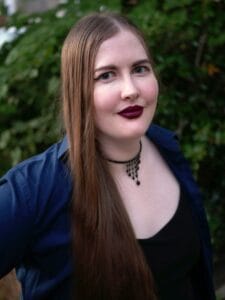
Kat Hillis is an author of queer speculative fiction full of silly jokes and twisty plots. A southerner now living in Alabama, she’s a lifelong fan of vampires, murder, and puns. When she’s not writing or reading, she’s gaming, drawing, or making handcrafted soaps.
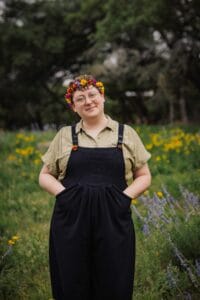
Rosiee Thor began their career as a storyteller by demanding to tell their mother bedtime stories instead of the other way around. Now, they write stories for all ages, including young adult novels Tarnished Are The Stars and Fire Becomes Her, the picture book The Meaning of Pride, and tie-in novels for franchises like Life is Strange and Firefly. They live in Oregon with two cats, a dog, and an abundance of plants.
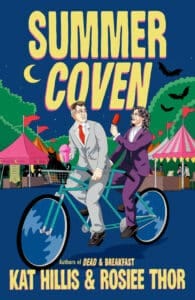
Summer Coven (A Dead & Breakfast Mystery Book 2) by Kat Hillis , Rosiee Thor
Everyone’s favorite vampire odd couple is back for another bloody good time in this new supernatural mystery from the authors of Dead & Breakfast.
Arthur Miller (no relation to the playwright) and his beloved, Salvatore Conte, are settling into their (para)normal lives in Trident Falls. Finally, everything seems to be going swimmingly…business is booming at the inn and Arthur is hard at work on his first case as a private detective: finding their friend Brody’s missing mom.
But when a pet psychic is felled by a poisoned potion she (somehow) didn’t see coming, Arthur’s investigation takes an enchanting turn – and not in a good way. It turns out the psychic was a member of the Celestine Coven, a powerful group of witches who sell their charms for a price. Did the pet psychic find herself on the wrong side of the coven? Or did she trigger someone’s pet peeves with her predictions? It will require all of Arthur’s wit and Sal’s whimsy to solve this murder, find their missing person, and avoid becoming part of the witches’ wicked brew.
Ginger Nuts of Horror: The Heart and Soul of Horror Reviews
Every feature is built to sell your work. We include backlinks to your website or Amazon author page, a full synopsis, and a universal purchasing link that sends readers straight to their local store. Add a large, engaged social following and an 18-year archive of trusted horror coverage, and you have a platform genuinely built to grow your readership.
Whether you’re an established author, an indie filmmaker, or a debut voice in indie horror, there’s a way for us to help you reach more fans. Explore our horror book reviews and horror movie reviews, then get your horror book or film featured today.


Jim "The Don" McLeod has been reading horror for over 35 years and reviewing it for more than 16. He's the editor of Ginger Nuts of Horror, Europe's largest independent horror review and culture site, and a British Fantasy Award nominee for his work in the genre. When he's not busy inflicting his opinions on the horror community, he can be found annoying his family or getting thoroughly outwitted by his two dogs, Casper and Molly.