- American Nightmare by Kelly McWilliams: Historical Horror of 1919 and the NAACP Spy Who Passed for White
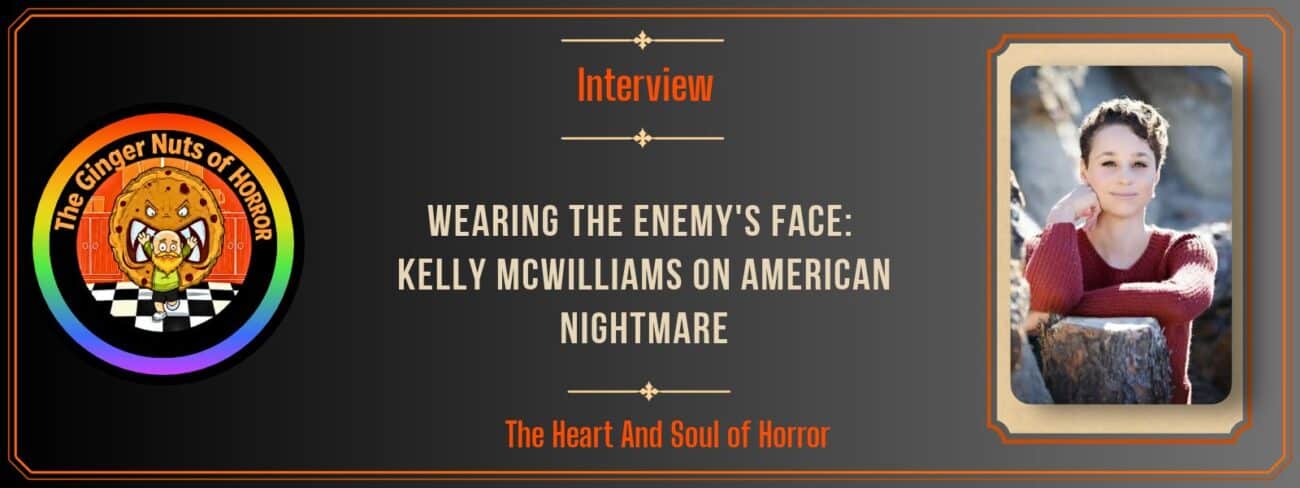
- Wearing the Enemy’s Face: Kelly McWilliams on American Nightmare
American Nightmare has no monster to kill, because racism never needed one.
Kelly McWilliams on American Nightmare and Black Horror | Interview |
Clark Wendell White is thirteen when the Atlanta mob comes down his street in 1906, and something in the crowd looks back at him. He names the thing the Nightmare, and it never leaves. Kelly McWilliams has built a career on people caught on the wrong side of the colour line: the white-passing plantation heiress of Mirror Girls, the grieving museum-keeper of Your Plantation Prom Is Not Okay, a run of girls whose worlds are trying to erase them.
American Nightmare, her adult debut, hands that preoccupation to a grown man and takes away his exits. Clark passes as white to spy for the NAACP, collecting the names of lynchers across the Red Summer of 1919, wearing the enemy’s face in order to hunt the enemy. There is no curse to lift here, no reflection to win back, no monster a reader can put a blade through. McWilliams makes the horror out of documentation and daily self-erasure, then refuses to let anyone kill it.
Kelly McWilliams built her reputation writing girls caught on the wrong side of America’s colour line, in Mirror Girls and Your Plantation Prom Is Not Okay. American Nightmare, her adult debut, hands that same fracture to a grown man and takes away every one of his exits. Clark Wendell White passes as white to spy for the NAACP, hunting the names of lynchers through the Red Summer of 1919, all while a nameless entity he calls the Nightmare feeds on him from the inside.
There is no curse to lift, no monster with rules a reader can learn, and McWilliams wanted it that way. In this interview for Ginger Nuts of Horror, she talks about writing Walter F. White’s real, partly erased history into fiction, why the Atlanta Race Riot of 1906 and her own family’s memory of the Rodney King riots sit at the book’s foundation, and why Black horror functions for her as joy rather than spectacle. She also discusses John le Carré’s influence on the novel’s patient first act, the invented Klansman Sam Cahill, and the ghost who judges rather than haunts. It is a rare, unguarded conversation about what Black horror is for.
The Nightmare has no rules, no origin, no weakness a clever character could exploit, because racial hate has none either. Kelly McWilliams refuses to let American Nightmare grant catharsis, insisting instead that this history needs no monster, only the courage to keep watching for it in daylight.
Wearing the Enemy’s Face: Kelly McWilliams on American Nightmare
I wanted to begin where the book begins, with the decision to make history supernatural at all.

This is a wonderful question—and the answer is so simple as to be almost embarrassing.
I couldn’t bear to write this material straight. That’s the truth. I knew it when I took my first crack at the prologue…when, in fact, I tried to write the Atlanta Riot without the supernatural element first. Only, as a mixed-race American writer, there’s a rubble of trauma to dig through before you can write about any race massacre. Clark White and his father stand guard over their house while the mob rushes by. The thirteen years old Clark carries a gun and is ready to shoot, kill if he needs to. The real Walter F. White survived this riot and refers to it as his origin story in multiple interviews.
Rodney King is my riot—my origin story. My family lived in LA when it happened. My mother packed me and my brother into a car and just drove, sure the riot was going to chase us, because it reminded her of her first race riot—and here, I think you can begin to glimpse the spiral stair that Clark perceives when he first dreams up the Nightmare. Racial violence is the thread that ties American history—and all of us—together.
It’s a bright red thread and it’s terrifying, and every American bears responsibility for understanding at least one stitch. During Rodney King, as a child, all I wanted to do was protect my mother from pain. But I couldn’t. Studying the Atlanta, Chicago, and Tulsa massacres for this novel, I recognized the reflection of other cities far in the future. I thought about how my daughter’s childhood is likewise stamped by the summer of 2020. And this way, clearly, lies despair!
But luckily—and this is what I most want to tell you—horror, as a genre tool, is a transcendent escape hatch. Casting my mind to the supernatural element allowed my imagination to play. And I love the Black horror renaissance because I know just how hard it is to do this work for years and years (thank you, so much, for mentioning of my other work)—and I also know how badly this material needs to be written, examined, reckoned with.
And it’s no great surprise to me that we 90s Blerds devoured our Star Trek and Stephen King and H.P. Lovecraft (oh, my Lord) and then promptly used the spyglass we’d been given by these genre delights to examine what matters most to us: our experience, our history. I was always going to write the Atlanta Race Riot, and I was always going to write my version of Walter F. White’s story.
I think some subjects are written in our stars. But when I combine real historical experience with the Nightmare—with a mysterious spiral stair, lit by torches and a chaos of stars—well, suddenly, I’m writing from joy. Not the happy-go-lucky kind. But joy, nonetheless. Black horror—it’s Black joy. Without its alchemy, I couldn’t have written this novel.
And I really think this is missed in the discourse, but—in Black horror the supernatural almost never exists to make history scarier. History is already maximally scary!
No. For us writers, the supernatural might just be what makes history legible. Survivable.
Walter F. White walked into towns that had just committed murder and took down the names, his fair skin doing the work of a disguise. That history is already horror, and it needs no ghost, yet you fasten a supernatural presence onto Clark as a boy in 1906 and let it feed for the rest of his life. What does the Nightmare let you reach that the documented record White actually compiled cannot?
I read Walter F. White’s interviews, articles, auto-biography, and some extremely excellent biographies (I recommend A.J. Baime’s White Lies). This man was an incredible American spy, perhaps one of the greatest ever to live. So, I shouldn’t have been surprised that there was a glaring hole at the center of his story—and it has something to do with the way he mythologized the Atlanta Race Riot.
Even in his own mind, he had to make it a legendary origin story—and tell it that way—and I sense some of his human vulnerability there. That moment allowed him to say: Look. I have suffered along with the Black community. I have decided to fight for them. Allow me to fight for them, to be one with them! These were the words he was essentially screaming his whole life…and W.E.B Du Bois himself challenged Walter’s Blackness.
So there is a way in which the Nightmare feeds on Clark/Walter for his whole life, yes…but in another sense, doesn’t Clark feed on it, too? It becomes his way of saying—and of understanding—that no, I’m not white. Why? Because there’s a spiritual difference between myself and the people capable of the 41 lynchings and eight race massacres that Walter (the real man) would go on to investigate.
The novel runs on two boys from the same Atlanta street in 1906, Clark and Sam Cahill, both later turned away by the segregated army for opposite reasons, both washing up in New York in the same trade of telling who can pass. You set their chapters against each other and then decline to have anyone point out the symmetry. How hard was it to hold that line, to trust the reader to see the rhyme without a character ever naming it?
It was very, very hard! Because who’s more excited about symmetry that us lit-fic types? And if you saw my drafts…listen, I wasn’t born with this much restraint!
Truly, I feel incredibly seen by the question—and you’ve correctly noted that this was a delicate foil. It broke several times and in several places whenever I made a mistake with Sam’s motivations. He really had to fly straight as an arrow, in a shadow dimension to Clark, and the scariest thing about Sam is just how much he really shares with our hero. (At one point, Sam Cahill even had his own ghost. But then, due to his dishonorable actions in the manuscript, the ghost was revoked from him. Look closely at the scene where he goes to his father’s grave and you might see the ghost of his ghost!)
But the symmetry does serve two crucial purposes. First, it sets up a challenge for the reader to identify what radicalized this man, Sam, and track his changes to Clark’s. Clark is also radicalized. The difference is he’s on the right side. And that brings us to the second purpose—the Klan began to reorganize, in American history, at precisely the moment the NAACP came into being. And vice versa.
These forces are tied together. No one is shouting it, but the Klan—which has morphed now into various new forms—is a dangerous and warlike enemy even now. The NAACP are, then and now—our champions. That’s what I really wanted to draw attention to. Sometimes the past is told as the Klan’s story (and I blame Birth of a Nation for a lot of this). But we saw them coming. And we stood on our porches—and fought back.
Most novels of this period keep the Klan in the South and let the North stand as the place you escape to. You grow a Klan chapter in New York City instead, in the same streets where Clark is being trained, so the thing he fled is already there when he arrives, hiring and holding meetings. What did closing that northern escape route open up for the book?
The cruelty of this historical truth is so real. And its political truth has to do with real estate. New York was technically an integrated place (though not necessarily so in practice!), and developers were panicked that Queens and Brooklyn, in particular, would become “devalued” because Black migrants from the South wanted to live there. So, they imported an old deterrent, quite on purpose. In the language of my metaphor, they called the Nightmare. They invited it!
I’ve always been emotionally consumed by the story of Black migration after enslavement because my own family has struggled to find a place to settle and live since my parents married in the 80s, in the contested state of Maryland. You want to believe somewhere is safe. You’ll go West—to California! Shoot, that didn’t work out (remember, Rodney King? We left shortly after), what about Massachusetts, that’s super northern…oh, they have their racism, too?
The same problem wearing a slightly different mask? Are you kidding me right now! Sadly, the geography of racism isn’t comforting….and my version of the story takes place at a prosperous intersection. Imagine you’re moving from Mississippi to Chicago in 1919. To do so, you must have all the hope in the world…but no northern city was completely safe. There was a short window of doubt. But in the end, it is not, as some say, a southern problem. It’s an American one. It’s us.
At the start of the book, because it’s still only 1918 and the NAACP didn’t know, entirely, how the migration would turn out, or how bloody the transition would be—bringing the Nightmare to New York just as Clark breathlessly arrived also raised the stakes. He’s the white-passing spy who can see racialized evil at glance, smell it, even. It is now his job to protect New York from the evil he knows like the back of his own hand. And of course, his sister is trying to move out of the South. She gets to Chicago just months before the summer murder that set the city aflame.
The first half accumulates rather than races, because passing is not an action sequence; it is a slow daily act of self-erasure, and a faster book would be lying about the cost. That is a real risk to take with a readership trained to expect acceleration. What convinced you the tempo of the grind was worth defending over the tempo of the chase?
John le Carré.
He convinced me!
The slow first act…yes, this was risky, especially since my advertised thriller spends some fifty pages as a tense office drama after the prologue! But even more than a thriller, I conceived of American Nightmare as a spy novel. And the spy that always resonated with me most is The Spy Who Came in From the Cold, for precisely the reasons you just articulated. Passing for white, or for anyone you’re not, is death by a thousand cuts. To remain invisible to your own organization is death by a thousand cuts.
To be invisible to your own people, too. This is the heart of the pain I set out to capture, and Mr. le Carré, when I re-encountered him during revisions, gave me such a critical piece of permission. The main character in that book slowly falls apart (or appears to!) for about a hundred pages before he gets a move on!
But of course, this is the Tiktok era… I gave myself a slightly tighter window to get Clark on the road, out of respect for our very exhausting present moment.
I also enjoy a bit of tension-and-release. Clark is kept penned up at the NAACP for a long time before his spymistress trusts him enough to send him on his first investigation. (And even then, it’s really out of necessity that she sends him at all.) When that cage finally bursts open? I hope somewhere, some reader is shouting, “Let’s. Fucking. Go!”
The Nightmare has no rules, no origin you can look up, no weakness a clever character could exploit. Horror usually rewards the opposite, a monster with mechanics the reader gets to learn. What was the discipline of keeping it illegible, and how did you know when you had withheld enough and not too much?
I feel very lucky that you saw Mirror Girls, because here’s a secret about my artistic development. I’ve never been totally satisfied with the ending of my second YA novel. In that book, I had a clear curse that needed breaking, and my main character broke it, and the magic responds, just as you say, with rules and mechanics that the reader has learned. I LOVE Mirror Girls, and I thrust it upon all the young folk who are unfortunate enough to cross my path, but in terms of my thinking about what fiction can do, I hadn’t yet had my breakthrough.
The Nightmare is my breakthrough because it has no rules, and thus, feels much more true to me. In fact, its meaning is slippery. It shifts, changes. So does racial hate, mob violence. It’s so alive that it evolves…and yet, let’s be real here: it’s not alive, is it? Racial hate is more like a very well-oiled machine. Except no, it’s not even a machine—that, too, is a distancing technique. Racism is just…us.
The heart of men. And there are so many wonderful nonfiction books that explain it, that break it down into its component sociological parts—but phenomenologically? In terms of on the ground experience? It feels like a monstrous supernatural evil and yet we must never forget that it’s human at its core, so human in fact that we are each susceptible to some version of it. It scares me even to write that down, but it’s true.
So, every time I tried to turn the Nightmare into a monster with guiding rules—a Stranger Things style creature we can defeat—I reminded myself that while these types of stories can be so useful, I wasn’t interested in telling it that way this time. It was an important craft challenge to me that was, I think, also a moral challenge. Tell it again, but don’t end it like Mirror Girls. Not because the curse in Mirror Girls was such a mistake. But because Clark was ready—or could become ready—to see the problem plain as any day.
And when I was able to resist making a clear-rules monster out of the Nightmare, when it felt solid enough that I could release it like a miasma and just let it work, the Nightmare itself kept me on track. Whenever I overstepped its capability, something in the story would break—a helpful but messy way of letting me know I’d done something wrong.
As foggy as the Nightmare sometimes is, it’s also the form of this very strange novel, as much as a haiku or sonnet is a form. It does have rules, but they’re not plot rules. As a supernatural element, where it really lives is at the level of the theme…though it does impact Clark enough to become his motivation, his opponent, and his traumatic nemesis, too.
There is a second presence besides the Nightmare: the ghost of Clark’s dead friend Davey, who works less as something to fear than as an accusation. Giving a grieving man a ghost that indicts him rather than menaces him is an unusual move. What did Davey need to be for Clark, and why did the book require a ghost that judges?
Ah, yes, welcome to Davey, my favorite character in the book. I’ve been a white-presenting woman all my life. Things have happened in my presence to my own brother that would never happen to me. To friends. And I try always to fight for the people in my life, to be a listening ear, but at the end of the day I am often in my therapist’s office talking about survivor’s guilt.
Clark White is able to become this incredible investigator because he leverages his incredible privilege. When you are as pale as myself and Walter F. White and various other ambiguous figures, you can heroically leverage your position to do good, if you find yourself at the right place and the right time. (For me, that’s my desk, writing these books.) But more often, being white presenting is like Soviet Russia: It leverages you. How many times is Clark mistaken for white when he’s not even trying? And is there not some guilt in the eternal safety he enjoys?
Well, he and Davey are real friends. And Davey died as a result of a racist act that specifically put Clark on one side of the line and Davey on the other, and of course everyone on Davey’s side of the line died, terribly, as sacrifices to World War I. Davey’s grievance is utterly real. And some deaths will always be racialized deaths. Think of the ghost in Beloved. There is a righteous anger here that must be expressed. And God Bless Clark, because he could take it—and hear it. He’s not absolved.
The reader must judge him, too. But I hope they both judge him and love him, as Davey did. That’s actually my hope with the story of Walter F. White, too. Because of his white presentation and some choices he made late in life (i.e., his second wife was a white woman), his story has been essentially erased from history. Well, let’s bring it back! And where judgment is called for, we can judge. But there are parts of this man so worth loving.
In Mirror Girls the cost of passing is literal: Magnolia’s reflection vanishes, a curse that can in principle be broken. American Nightmare removes that consolation entirely, with no reflection to recover and no mechanism to defeat. Was surrendering the breakable curse a condition of writing passing for adults, or something you arrived at inside this particular story?
See earlier answer on Mirror Girls, but: THANK YOU for your excellent readership. I wanted to grow after Mirror Girls. I always want to get one step closer to the truth. Surrendering the curse was scary, but worth it. As a writer of Black horror, I had to get smarter and grow to pull this off—and this story was the perfect opportunity. Because Clark isn’t trying to solve the mystery of one murder or lynching, like my mirror girls.
He’s trying to solve all of them. He’s trying to tackle the whole national phenomenon. And so, the supernatural he perceives is also different, because the problem is different. And I felt a huge responsibility to at least represent that problem as faithfully as I could.
Your work has been described as horror, history and girlhood, and until now your narrators have been girls and young women: Agnes, the twins, Harriet, the debutantes of Greystone. Clark, and Cahill beside him, are grown men. What did you have to build differently to live inside a man’s interior, and did anything about your earlier narrators refuse to come with you?
I’m smiling so hard right now! Writing my first two male points of view was challenging, especially because the subject is war. My prior novels have followed in the vein of the traditional passing novel—they are in some ways domestic tales. And I’m lucky to have mixed race and light presenting readers who have reached out to me over the years to say that they were so grateful to see representation that felt like a mirror.
And it just got me thinking about the body of white passing representation, and how persistent the tragic mulatto story is in fiction. BUT there are great examples from history, I always want to say, in which white presenting people took a highly active role. I think of the Crafts, who escaped from slavery so heroically, and then went on the lecture circuit to talk about it. And I always think of Walter F. White.
So, I guess, the silly-simple answer is I wanted to tell his story to my people. I wanted them to have it. I wanted them to know that we had a Robin Hood as well as a Clare Kendry. I wanted them to know we fought war, not just the yellow wallpaper…and I don’t mean that to disparage the perils of the wallpaper. Every one of my stories begged to be told, and this one was the same. Did I, however, hum Be A Man, from Mulan, when I sat down to write Clark and Sam? I admit, yes, I did.
Your Plantation Prom Is Not Okay ran hot: contemporary, angry, a teenager weaponising social media against the romance of the antebellum South. American Nightmare runs cold, converting rage into dread and denying the reader any win. What did writing Harriet’s anger teach you that you then had to unlearn, or deliberately withhold, to write Clark’s containment?
OOOOH she ran so hot! Listen, coming off writing through BLM in 2020? I was HOT. I needed to scream into some wood pulp and I absolutely did. By then, I’d written two social justice-y books and I was bone tired of fighting. I get crazy emails sometimes. Crazy messages. My mother, also a working novelist and the author of GHOST BOYS, does, too. And it just felt like nothing was changing in the external world despite the great representational renaissance we were seeing in children’s books, and still are, though I think it’s grown a little muted.
I also deeply feared—because Prom didn’t sell very well—that my work didn’t matter. That’s not true. I learned just this year that the Whitney Plantation Museum store, one of only a handful of slavery museums that tells the history of enslavement from the perspective of the enslaved, actually carries that book, which is a bigger win than any Nielsen number, to me. But Clark does represent a change in my tactics, at least for now.
Clark wasn’t always so contained. But I eventually began to feel that that was the best way to represent his masculinity: with quiet on the voice front. It’s a little John Wayne, but I’m a person who writes from character first. If you want to know, the person I specifically pictured, after some discussion from my editor, is Brick, played by Paul Newman in Cat on a Hot Tin Roof. That’s Clark. He couldn’t express himself the way Harriet does, but I like to think she might read American Nightmare, one day?
American Nightmare sits near Ring Shout, The Reformatory and Victor LaValle’s work, with The Nickel Boys and The Trees close by, but it declines what several of them offer. P. Djèlí Clark hands you Ku Kluxes you can kill; Percival Everett hands you the pleasure of vengeance. You give the reader no monster to put a blade through. Where do you place yourself in that company, and why refuse the catharsis some of your neighbours grant?
These are the best neighbors. Thank you for putting us together on the same street! But yes, I did put a different marking on my door, I think, and it has to do with where I’m situated in the body of white-passing literature. Charles Chesnutt, Nella Larsen, Jean Toomer—these were my main interlocutors as I wrote.
Everett and Due and LaValle, all of them helped open the floodgates to the Black horror renaissance. But my entry into it is a white-passing story. There is so much internalized pain in erasure (hello, Mr. Everett!) and in self-erasure. Clark is bound by his white presentation, almost gothically confined by it. He achieved as much catharsis, I think, as he possibly could.
You describe your subject as white passing, American history and the uncanny, and the uncanny is doing work here that a straight documentary account of 1919 could not. Setting your own novel aside, which work of horror first showed you the genre could carry the weight of real historical atrocity, and what does the uncanny let a writer reach that realism leaves on the table?
The first would be Song of Solomon and Beloved. They showed me. But because the field used to be so much smaller, these were masterpieces, not invitations, yes? I heard the cage burst open on Black horror when I saw Get Out in theaters. I just knew we were about to have the most fun—and I mean right now you and me, horror fans! Not only could that movie carry the weight of historical atrocity…but also it carried it hella far! Straight into the heart of popular culture. And then the follow up, Us, with those dopplegangers…. My fate was sealed by Jordan Peele. God bless him.
The most frightening machinery in this book is not the ghost, it is the documentation: names taken down, evidence compiled, a bill that will not pass. Your prose sits plain on the surface with the pressure held underneath. How do you build dread at sentence level when the horror is administrative, a matter of records and rooms rather than blood?
Did you ever play the game Papers, Please? You take on the role of an immigration officer in a Soviet-inspired dystopia. In the game, the power you hold over others raises challenging moral questions—but those questions are always threatening to get lost in your day-to-day need to work effectively and ever faster among changing bureaucratic rules, and ultimately keep feeding your family. That game scared me more than any zombie horror I’ve ever played or seen. Because we call it paper, but on those slips of paper are human lives, institutionalized. We are all of us institutionalized in some way, and that is to be at the mercy of something very large and very cold.
I felt very restrained as a prose artist. I love a gorgeous sentence, maybe too much, but the problem is, when the cold horrors are in the room with us, it’s ghastly to stylize them. I can tilt my words and phrases, tint them so they are a little scarier, but I couldn’t show off. And I thought that was good and right because neither could Walter. The mission demanded he put aside anything that wasn’t essential. I have tried to honor his mission and his work.
At one point, I even had a list of acceptable imagery for Clark/Walter to think in. Dust, mud, iron, steel…it was quite restricted and contained. And I was actually writing No One Leaves the Manor (which is quite lush) at the same time. For Manor, I could use all the imagery gothic fiction has to offer, but Nightmare, down to the word, we had to stay close to Clark’s claustrophobic experience of 1919.
Cahill is assembled from small, human parts: a broken nose, a mother who broke it, a private humiliation that a robe in his size converts into public power. He frightens precisely because the explanation is so meagre, and the book never excuses him. Where was the line, technically, between giving a Klansman a genuine interior and letting that interior become a defence, and how did you keep landing on the right side of it?
Once, I tried to write a ghost for Cahill. It seemed only fair he’d get one if Clark did. But somehow, that was the line. When I gave him his father’s haunting ghost, it went too far. So I stuck with the mother, which was plenty enough, and made him small, petty. As small as any incel on a Reddit forum, is what I told myself. I couldn’t make him a great supervillain. He, too, got the story he deserved.
You have now spent more than one book living close to characters who pass, who spend themselves daily to survive as someone else. Mirror Girls did it through Magnolia; this book does it through four hundred pages of a grown man deleting himself. After that much proximity, what has sustained company with passing clarified, or cost, in you, the writer holding the pen rather than the face?
Writing about white passing and white presenting issues has healed me. I tried therapy at some point. It helped! But what we discovered there was that I process my own experiences through writing. And writing is uniquely great for processing the situations you can’t change, no matter how hard you might wish to.
People mistake me for white in Seattle all the time, and that’s painful. But deep down, I know: I’m not this body. I’m Kelly McWilliams. I wrote all these books out of love. If someone wants to know me, I’ve left a bloody good trail! I will and can wear my Lightly Melanated, Hella Black t-shirt….but I don’t have to proclaim the meaning of my name. I have made it mean something. Sure, in corners people can ask, is she white or is she Black?
But Lord knows, I’ve answered it at length—and in print! And that process has been so healing that now, I think of passing not as like, my source of material and my cross to bear…but as the material I’m an expert in. And that’s so liberating. And writing this here, for you, has been so liberating. So if my thanks haven’t come through, I’d love to give them, here.
The book reframes the American nightmare as something other than a supernatural event: a recruitment strategy, always hiring, wearing whatever face the day needs, still, by the novel’s own logic, taking applications. A horror that kills its monster is therefore a kind of lie. When a reader closes American Nightmare still carrying the dread you refused to discharge, and the thing is left standing out on the street in daylight, what do you want them to do with it?
Yes. And this where the Nightmare, because it has no on-page rules, is really scary. Because the Nightmare creeps. It oozes and transforms. It escapes confinement like Squeeze! We SHOULD be looking for it everywhere, all the time. We need to read the news. We need to watch what’s happening right now, in this also very red summer. We must stay awake and stay on our toes. There is no time for a victory lap. History is happening now.
American Nightmare by Kelly McWilliams
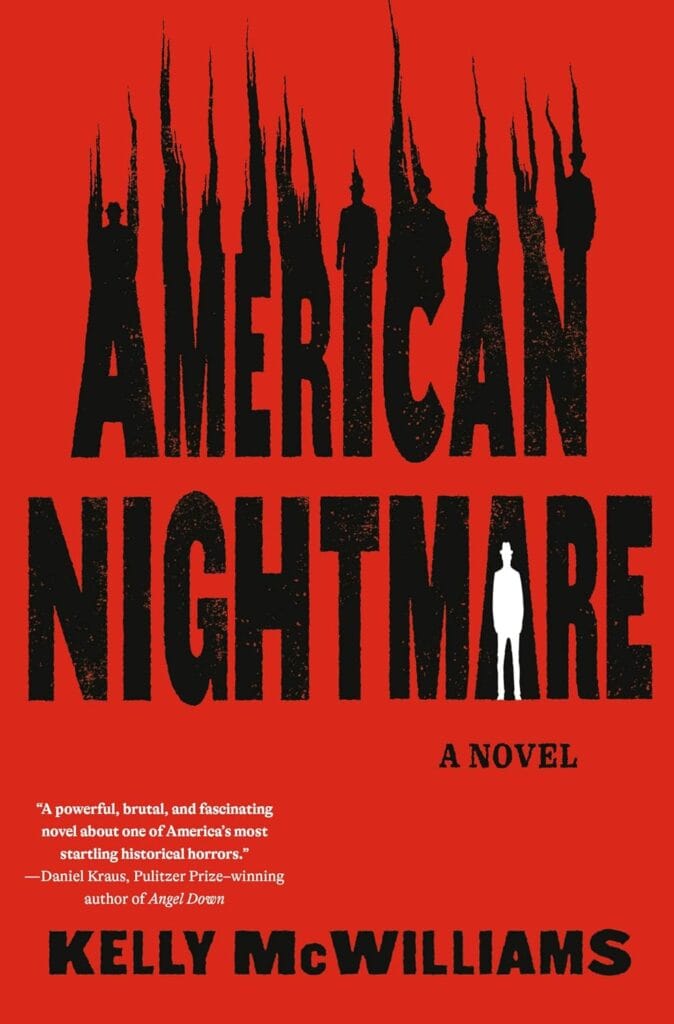
“With its unflinching excavation of our dark past, American Nightmare is a page turner with a message.”—Tayari Jones, New York Times bestselling author of Kin
In this haunting historical novel, a light-skinned Black man goes undercover to investigate lynchings in the South, only to be confronted by the very evil that has pursued him since childhood…
Clark Wendell White first encountered the Nightmare as a child during the Atlanta Race Riot of 1906, when he and his father stood guard over their family home. In the eyes of the mob surging through his neighborhood, Clark sensed this malevolent presence. It was then that the Nightmare took shape, burrowing deep into his mind and feeding on his fear.
Years later, the same evil presence drives Clark to the NAACP’s headquarters in New York City, where he answers an ad seeking light-skinned Black men for dangerous undercover work. As a spy for the NAACP, Clark investigates lynchings, impersonating the very Nightmare that once tormented him.
As Clark descends deeper into this double life, another force rises: a new chapter of the Ku Klux Klan, finding a foothold in the storied streets of New York City. Among its eager recruits is Sam Cahill—the one man who can see past his disguise. Now Clark must outwit both the living and the dead, as he confronts a past that refuses to stay buried and a future where the act of passing exacts a soul-deep price.
Inspired by the life of civil rights activist Walter White, who passed as a white man to expose the brutality of lynchings from the South to the Midwest, American Nightmare is a gripping historical thriller that reveals the most terrifying monsters aren’t those that go bump in the night but those that walk among us.

Jim "The Don" McLeod has been reading horror for over 35 years and reviewing it for more than 16. He's the editor of Ginger Nuts of Horror, Europe's largest independent horror review and culture site, and a British Fantasy Award nominee for his work in the genre. When he's not busy inflicting his opinions on the horror community, he can be found annoying his family or getting thoroughly outwitted by his two dogs, Casper and Molly.
Ginger Nuts of Horror: The Heart and Soul of Horror Reviews
Every feature is designed to help sell your work, build your audience and connect your horror story with readers who are actively looking for their next frightening read. Our horror book reviews and features include backlinks to your website, publisher page or Amazon author page, a full synopsis, relevant author information and a universal purchasing link that directs readers to their local bookseller or preferred retailer.
All editorial coverage is provided completely free of charge. We do not charge authors, publishers, filmmakers or creators for reviews or features. Ginger Nuts of Horror exists to support the horror community and help great books, films and independent voices find the audiences they deserve.
With a large, engaged social following and an 18-year archive of trusted horror coverage, Ginger Nuts of Horror is a horror review website built to support authors, filmmakers and creators. Our coverage spans horror novels, indie horror, gothic fiction, folk horror, psychological horror, supernatural fiction, dark fantasy, horror films and the wider creative world surrounding the genre.
Whether you’re an established horror author, an indie filmmaker, a publisher, or a debut voice in indie horror, we offer opportunities to place your work in front of dedicated horror fans, readers, viewers and genre enthusiasts. A feature on Ginger Nuts of Horror can help improve discoverability, strengthen your online presence and give potential readers a clear route from discovering your work to finding out more or making a purchase.
Although our coverage is free, we do have a Ko-fi page for readers, authors and supporters who would like to help us continue promoting horror books, films and creators. All donations are entirely voluntary and greatly appreciated. Every contribution helps support the time, research and ongoing work involved in running an independent horror review website.
Explore our horror book reviews and horror movie reviews, discover the kind of horror coverage we publish, then get your horror book or film featured today.