- Bodies of Work by Clay McLeod Chapman Review: Supernatural Revenge Horror Delivers Ghosts, Art, and Unease
- Wake Up and Open Your Eyes by Clay McLeod Chapman: A Masterclass in Horror Writing
- What Kind of Mother by Clay McLeod Chapman
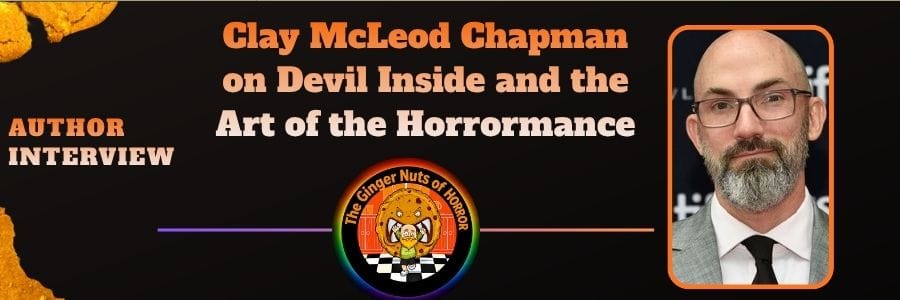
- Clay McLeod Chapman on Devil Inside and the Art of the Horrormance
- Devil Inside by Clay McLeod Chapman: The Horrormance That Makes Love Look Like an Infestation
A dead man, a demon, and the happily ever after that damns everyone else.
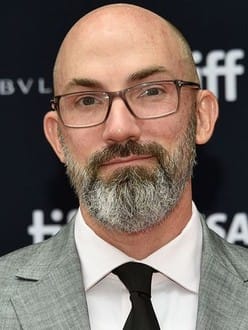
Clay McLeod Chapman has spent half a decade writing horror that behaves like a diagnosis, from the haunted drug of Ghost Eaters to the possession epidemic of Wake Up and Open Your Eyes. His new book, Devil Inside, is the strangest turn yet: a horrormance, published by Harlequin, about a bike messenger back from the dead and the demon who wants to move in. We sat down to talk about what happens when you write a love story where the happily ever after is the most frightening thing on the page.
Across the conversation, Chapman digs into the horrormance as a genre nobody quite knows how to shelve, the dual point of view that traps you inside two unreliable heads, and the single rule he set himself before he started. We get into demonic possession as a form of consent, the Satanic Panic roots of Whisper Down the Lane, the book by Susan Barker that still hasn’t left him, and why he keeps chasing hope through some of the bleakest material in modern horror. If you came for Rachel Harrison and Grady Hendrix, stay for the murder.
Jordan wakes from the accident tasting ash, watching the faces of everyone he loves liquefy before his eyes, and the only thing that feels real is the demon who just rolled out of his bed. This is the premise of Clay McLeod Chapman’s Devil Inside, a book that sits somewhere between a possession narrative and a romcom from hell, and it represents a sharp left turn even for an author who has made a career out of swerving.
Over the past half decade, Chapman has built a bibliography The Remaking, Whisper Down the Lane, Ghost Eaters, What Kind of Mother, Wake Up and Open Your Eyes that treats horror as a diagnostic tool for American anxiety, whether that means the viral spread of paranoia, the ghost logic of addiction, or the monstrous weight of parental grief.
Devil Inside arrives this August as his most formally unclassifiable work yet: a horrormance that insists love and possession might be the same verb. The book is already generating the kind of charged, polarised responses that mark something genuinely alive. So let’s start where the book starts: with a body that comes back wrong, and a question about what it means to be inside something that isn’t yours.
Chapman set himself one rule: give a dead man and a demon their happily ever after. The closer that ending came, the more horrifying the book turned, because their union is paid for by everyone else. Devil Inside asks whether being possessed and being loved are the same thing.
Clay McLeod Chapman on Devil Inside and the Art of the Horrormance
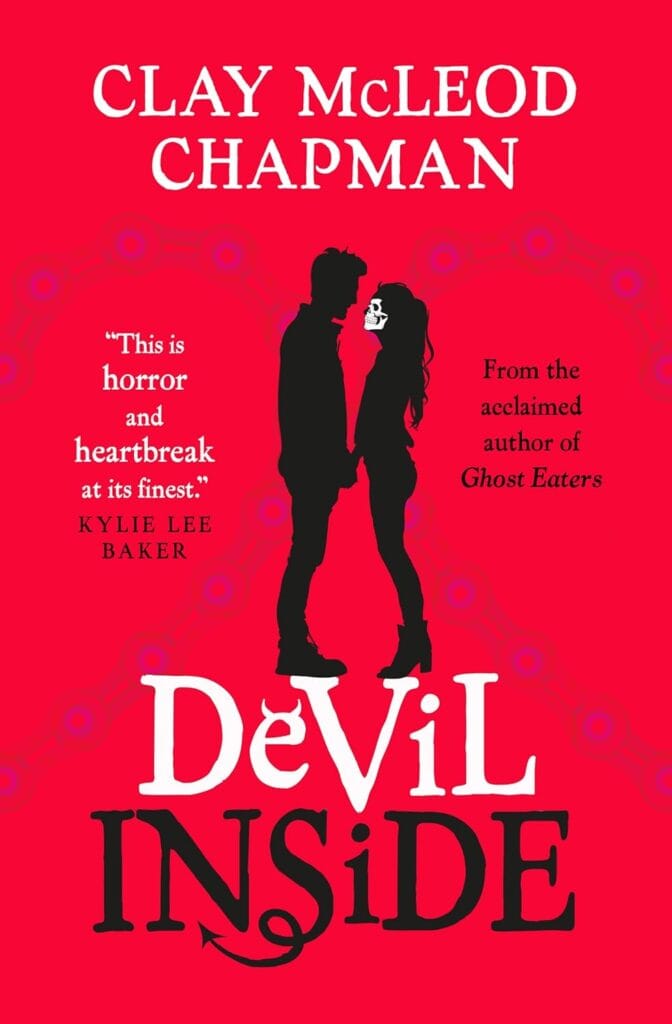
You’ve called Devil Inside a “horrormance,” which is a word that carries a lot of weight for readers who think they know what both horror and romance are supposed to do. When you were writing Jordan and Lilith’s relationship, were you more concerned with subverting the expectations of romance readers or horror readers? Or were you trying to locate something both genres share that you hadn’t seen articulated before?
Funny enough, Devil Inside all came about because of an earlier work of mine… What Kind of Mother. There’s a slight courtship taking place between our main characters, so when my editor-to-be, Emma Cole, read that novel, she reached out to ask if I’ve ever been interested in writing a love story head on. I’ll admit that I’m a sucker for love stories, so having the opportunity to write one—for Harlequin, no less—felt like a wonderful opportunity.
There have been so many love stories embedded within the heart of horror, and vice versa… whether it’s called horrormance or not.
The discovery for me in writing Devil Inside and navigating the relationship between Jordan and Lilith, was how dark their love became. When writing this book, one of the biggest rules—possibly the only rule—that I had to follow was that our central characters had to have a HEA (Happily Ever After). The closer I got to their happy ending, the more horrifying the book became. A Happily Ever After for them definitely didn’t make a Happily Ever After for anyone else in the story.
The novel alternates between Jordan’s and Lilith’s points of view, and there are moments where it’s genuinely unclear whose perception is more reliable, the guy whose reality is literally melting or the demon who’s been around long enough to know better. That structural choice feels like it’s doing something specific. What did the dual POV allow you to explore that a single perspective couldn’t?
Given that there’s a courtship at the center of this story, one of the first choices I made was to volley the narrative between these two. If it had centered only around one of them, I feel as if the reader would be missing the flipside to the narrative coin. These two are destined for one another: A human with no soul to speak of and a demon desperate for a vessel. I wanted to chart the course of these two becoming one, so I felt it was necessary to show them as separate selves first before fate merges them together.
There’s a line that keeps coming back to me from an early review: “Love is possession. We invite them in. Let them take over.” That’s the thesis statement of the book, I think. But possession in horror is usually a violation, something done to you. Here, it’s something you choose, something you might even want. Were you trying to write a book about how love and invasion might be the same thing, or were you more interested in the gap between those two ideas?
I was definitely wanting to take part in this discussion between possession and obsession, and where the line gets drawn, that a lot of horror seems to be having right now. Look at Obsession!
I started with a basic question: What are the connections between demonic possession and love? Is possession in of itself a form of love? What is possession in the context of consent, and how is it given? Or taken? Possession throughout horror has been such an invasive notion. It’s an assault. The host loses their autonomy. I thought there was something to explore here. Is there a form of demonic possession that is either consensual, or at least offered? In Devil Inside, that is something that Jordan and Lilith discover… but it takes some navigating, and there’s a toll. An awful one.
Jordan is a bike messenger, which is a very specific, very physical job, someone who moves through the city, who carries things from one place to another. Lilith is a demon who wears different faces. How much of the book’s exploration of identity and selfhood came out of that occupational choice, and how much of it came out of the supernatural mechanics you were building?
I wanted to create a certain kinetic energy between these two. Both are restless spirits, in their own way. Neither can really sit still. Jordan has a need for speed and Lilith desires to drift from body-to-body. That sense of restlessness is something that they have in common, albeit with different mechanics in place, but I felt like it would help bring them together… while also creating an energy to the text itself. I wanted the prose to flow.
The book has been described as “too much horror and not enough romance” by some readers, and as a “nightmare you’ll fall in love with” by others. That’s a fascinating split. Were you aware, while writing, that you were making a book that might frustrate people who came for one thing and got another? Or did that tension feel like the point?
You know… I feel like I’ve made a career out of not giving people what they want. It’s terrible, because I’d probably be a lot further along with my livelihood if I simply executed what I set out to do, but it’s rarely the case, and I feel like it tends to get me in trouble now and then. Case in point.
This book will always have a certain tension point, a fault line of genre, at its center… I guess it boils down to where you might find it on the shelves. Will it go to romance? Or horror? The challenge I’ve found thus far is convincing horror readers to take a chance on romance, and convincing the romance readers to take a chance on something horrific… and now I’m wondering if either will be happy!
I definitely didn’t set out to frustrate readers… but I seem to do it more often than not. But there’s bound to be a middleground, a venn diagram, where these two meet, and the story within blossoms. I think what I ended up doing is writing a horror novel within the structure of a romance.
One thing I haven’t seen anyone ask you yet: the book’s title. Devil Inside, it’s a phrase that’s been used before, obviously. But in your novel, the devil isn’t just inside Jordan in the possession sense. Lilith is inside the city, inside his head, inside the very fabric of his perception. What does the title mean to you now that the book is finished, and did it mean something different when you started?
It was the inevitable choice. I don’t think there was any other option… It had to be Devil Inside. It’s all about obsession, when another individual consumes you, when you let them in.
I feel like I needed to earn that title.
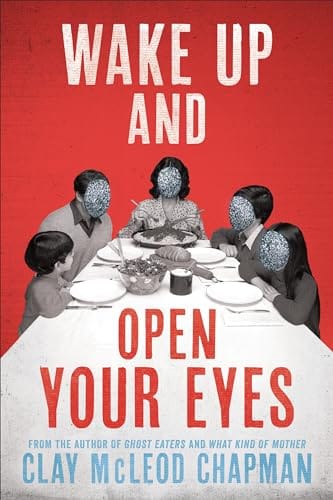
Let’s talk about the run of books that brought you here. Ghost Eaters is about a haunted drug, What Kind of Mother is about parental grief and the return to a haunted hometown, Wake Up and Open Your Eyes is about a possession epidemic spread through media. Each of those books is doing something different formally, but they’re all, in some sense, about what gets inside us—whether it’s a substance, a story, a grief, or a signal. When did you realise that was your subject, or did it take you a few books to see the pattern?
Oh, wow… Can I be completely honest with you and confess I’ve never really thought of it that way? I love it, though. I can run with that. A mission statement! I have an artistic mission now!
Seriously, though… It’s a lovely idea: We’re being consumed by some external presence. We’re surrendering ourselves, either to our grief or our addictions.
I’ve been lucky—extremely lucky—to be able to tell the stories I’ve wanted to tell. I’ve had a few opportunities to bring my sense of storytelling to different corners of the medium, but I’ve always aimed for the story to dictate what it wants to be and where it wants to go. Not always, but most of the time the story has been the guiding light. That a certain thematic connective tissue is starting to tether them altogether just shows where my own personal obsessions lie.
Whisper Down the Lane is the book that feels most directly drawn from your own life—you’ve spoken about growing up during the Satanic Panic, about the McMartin trial as a backdrop to your childhood. Looking back at that book now, after several more novels, what did writing it teach you about how to handle material that isn’t just research but memory?
Whisper Down the Lane was a pivotal moment for me and my writing, truth told. I don’t know if it registers for anyone other than myself, but that’s one of the first books where I began to put my own skin in the game. I started asking myself: What am I frightened of? Not just as a reader, but as a human being?
That’s the leading question I ask at the beginning of any book: What am I afraid of right now? With Whisper, and beyond, I realized I’m afraid of being a parent. The sins of the father being handed down to their sons. The notion that we are damaging our children, having been damaged ourselves. That continues to ring true through a few stories of mine.
You’ve written across so many forms, novels, comics, plays, screenplays, podcasts. But there was a moment, probably around The Remaking, where the novels started arriving with a different kind of density and confidence. Was there a specific decision or external event that changed how you approached the novel form, or was it more gradual?
It was certainly external. It was all Quirk Books! They took a chance on me, offering me a platform to tell stories. I’d been dying to write more novels… but seven-ish books in and nearly fifteen years into my so-called publishing career, and I couldn’t get people to read my stuff.
Quirk changed that. They were looking for their next Grady, and they asked me if I’d want to write straight-up horror novels, and I essentially said, Sign me up! I had written horror adjacent material up to that point, but never out-in-out horror. Over time, and through the working relationship with my editors there, I was able to discover my voice and what stories I wanted to tell within the genre. I couldn’t have done it without them. I definitely wouldn’t be here now.
The phrase “elevated horror” gets thrown around a lot, and you’ve been grouped with writers who are trying to do something more than just scare people. But you’ve also spoken about horror as a buffet, as something with many flavours, and you don’t seem precious about the “elevated” label. Where do you land on that debate? Is there a version of horror that you think is doing more interesting cultural work right now, or is that question itself a trap?
I find myself feeling quite happy that horror as a genre offers so many different flavors to so many different types of readers. I want to believe that horror in of itself is an inclusive space that embraces its variety, and one particular niche doesn’t negate the value of another. The number of diverse voices is hopefully continuing to grow, and the readership for those voices is expanding. It doesn’t have to be just one thing.
As far as ‘elevated horror’ goes, I think that’s the banner that has grabbed the attention of folks outside the genre, who wish to consider a greater value than scaring the audience. Storytellers can use horror to say something, explore something, even change some things… whether in the reader or in the writer themselves.
I want to ask you about a book by someone else that genuinely got under your skin recently. Not a book you admired or respected, but one that actually unsettled you in a way that made you think differently about what horror can do.
The first book that popped into my mind was Old Soul by Susan Barker. I read it last year and it still hasn’t left me. Truly, truly an amazing novel. I can say I admire and respect it—AND it got under my skin. The prose itself slithers in a way that makes my intestines twist. I loved it.
Let me ask you about a technical problem you had to solve in Devil Inside. You’re writing a book where reality is unstable, where perception is unreliable, where the protagonist can’t trust what he sees. How do you build suspense and dread at the sentence level when your narrator’s senses are themselves compromised? How do you scare a reader when the ground is already shifting?
The jury’s out if it worked… but I do think that’s the joy in first person narrative. You as the reader have to take the narrative itself at face value, making a decision at some point over whether or not you trust the narrator themselves. That’s one of the most joyful moments for me as a reader: Putting the book down long enough to ask myself… Do I trust this narrator?
There’s always a moment for me in writing where the myopia of the narrator’s perspective opens up the story to the very negative space around the narrator. What’s happening right behind them? What are they not seeing? What are they not saying? Given that we’re essentially trapped in their POV should make for a very stressful/dreadful reading experience. I want to suffocate the reader. Third person would punch a hole in the jar’s lid, where I want to tighten it.
You’ve been at this for over two decades now, the Pumpkin Pie Show, the plays, the comics, the novels. What’s something you know now about writing horror that you wish someone had told you at the beginning, and what’s something you’re still trying to figure out?
Oh, man… There’s so much I have yet to learn. I feel like class is in session every day. Or, at least, I hope it is. I don’t have the confidence of my literary heroes—or, I guess I should say, I don’t have the confidence that I think my heroes all have. Who knows? Maybe they don’t, either.
I want to write a hopeful story. I think readers need a sense of hope… More now than ever, maybe. I find it interesting that folks are coming to horror for their hope, but they are, and they’re finding it with a lot of our stellar storytellers: Tananarive Due. Nat Cassidy. It’s there, that sense of hope, and it’s giving readers a little buoyancy that helps them get through the day.
Me? Not so much. I wish I had a little more hope in my heart to offer readers… I’m trying.
This might sound like an odd question, but I’ve been thinking about the endings of your books. They don’t offer easy resolutions. They tend to leave the reader suspended in the consequences. Devil Inside has a relationship at its centre, and relationships in fiction usually demand some kind of emotional resolution, a commitment, a rupture, a clarification. But your book seems less interested in answering whether Jordan and Lilith end up together than in asking what “together” could possibly mean when one of you is dead and the other is a demon. Was the ending always going to resist that kind of closure, or did you have to fight your own instincts to get there?
Like I said before, I knew the two of them had to have their HEA… or their version of it, at least. Not to get too spoilery, but their union would be at the detriment of those around them. We’re watching one character discover his darkness and the other finding a home.
Rather than offering closure, I think the ending ruptures itself and rips right open. Jordan and Lilith’s adventures have just begun. For better or for worse. Probably worse. A lot, lot worse.
On a side note, after watching and enjoying the video content you put out across various social media platforms, I have to ask, have you ever considered switching to decaf? I’m out of breath watching you zoom around; heaven knows what you must feel like.
Ha! Yeah… It’s a little too much. I’m running the risk of burning out. We’re told by our publishers to find our readers, and well, I think I’ve found the best way to reach out and connect with folks is by making a complete fool out of myself. I have very little shame, but it’s catching up to me. We’ll see how long it lasts, or how long I last. Any bets what busts first?
Here’s the last thing I want to ask you, and I’m asking it because I think your work has been building toward this question for a while. You write about possession, about addiction, about the stories that take us over, about the things we let inside us that we can’t get out. And you write about love as a kind of possession too.
So here it is: do you believe that we are what we let inside us, that ourselves are constituted by the things we invite in, whether we choose them or not? Or do you believe there’s a core self that survives all of that, that remains intact no matter what gets in? Because your books seem to argue the first position, but the way you write your characters, their desperation, their longing, their refusal to stop trying, suggests you might actually believe the second. I don’t know which one is harder to live with. I’m asking which one you think is true.
First off, I just want to say thanks for looking at my work from this macro-viewpoint. It’s immensely gratifying to hear, and an honor to even be asked a question like this. Truly. Thank you.
I feel like I might revert back to that need for hope. A better writer might posit the former, but lead the reader to the latter. Humans are vulnerable things. We hurt so much… and we hurt each other. But there’s got to be something better than us, greater than us, to live for… right? To endure all this? If we succumb to our baser instincts, or let the devil in, what good are we?
I want to believe there’s hope in horror. In my horror. I just need to find it in myself, first, so I can then find it in my own horror.
Devil Inside by Clay McLeod Chapman
A man who’s back from the dead meets a woman who’s from somewhere even worse in the new horrormance from the acclaimed author of Ghost Eaters, about love, possession, and just a little murder.
Perfect for fans of Rachel Harrison and Grady Hendrix.
After a traumatic accident that almost cost Jordan his life, he’s finally starting to feel normal again. Well, maybe not normal. Everything tastes like ash, and when he looks at the people around him, their faces start to melt. At least he’s not dead, right? His friends are doing their best to get him back on his feet, maybe find someone to talk to, perhaps even find someone to take his mind off his last failed relationship.
Then he meets Lilith. The two share an instant connection but after a wild and passionate night together, she ghosts him. Jordan searches the city for Lilith, desperate to see her again. But when a woman claiming to be Lilith shows up, wearing a different face but knowing intimate details about Jordan, he worries he’s losing his grip on reality. As he grows closer to this mysterious woman, he discovers that happily ever afters sometimes come at a cost. How far will Lilith take him, and how much darkness will he embrace to find love?
Ginger Nuts of Horror: The Heart and Soul of Horror Reviews
Every feature is built to sell your work. We include backlinks to your website or Amazon author page, a full synopsis, and a universal purchasing link that sends readers straight to their local store. Add a large, engaged social following and an 18-year archive of trusted horror coverage, and you have a platform genuinely built to grow your readership.
Whether you’re an established author, an indie filmmaker, or a debut voice in indie horror, there’s a way for us to help you reach more fans. Explore our horror book reviews and horror movie reviews, then get your horror book or film featured today.


Jim "The Don" McLeod has been reading horror for over 35 years and reviewing it for more than 16. He's the editor of Ginger Nuts of Horror, Europe's largest independent horror review and culture site, and a British Fantasy Award nominee for his work in the genre. When he's not busy inflicting his opinions on the horror community, he can be found annoying his family or getting thoroughly outwitted by his two dogs, Casper and Molly.