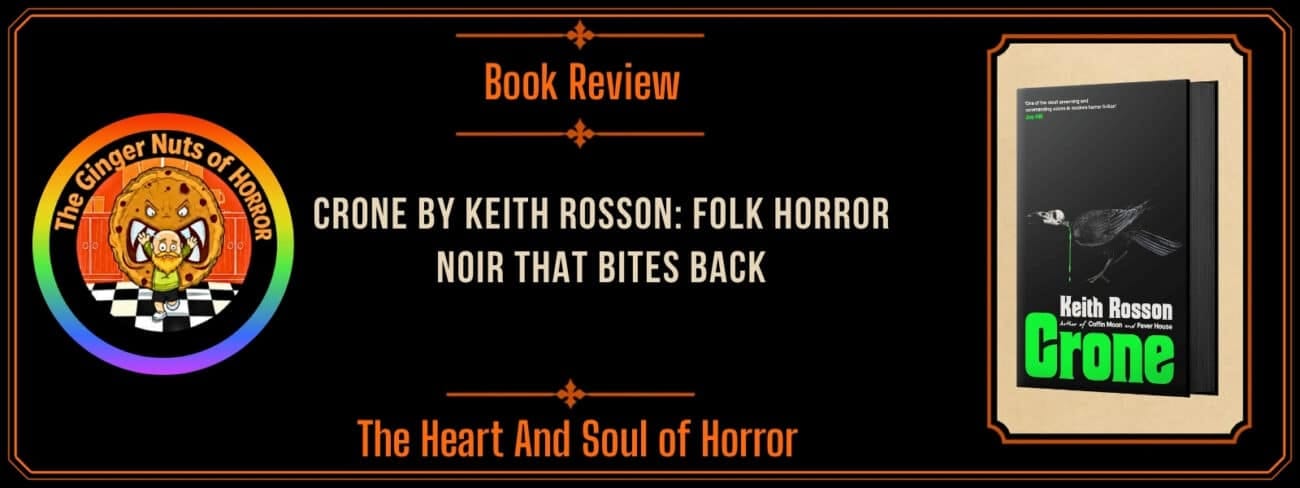
A grief-soaked welding of crime noir and folk horror, and the finest thing Rosson has written.
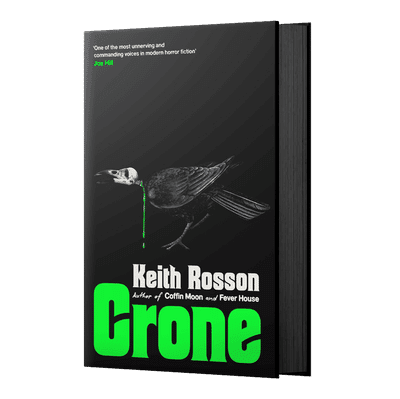
- Author Keith Rosson
- Publisher Black Crow Books
- Published 22 September 2026
- Pages 336
- Format Hardback
- ISBN 9781805530183
- Subgenre Folk horror, crime noir
- Reviewed by Jim McLeod
A former detective, still grieving the daughter who vanished thirteen years ago, is ordered by the biker gang he owes to find a killer, while something old and clawed waits in the Salt Point woods.
Crone | Keith Rosson | Black Crow Books | September 2026 |
Crone by Keith Rosson is out now from Black Crow Books, and this Crone review is the easiest five stars I have handed out in a while. Rosson has spent his career mixing crime with horror, and here he takes it to a wet, rotten stretch of coast: a former detective working off a debt to a biker gang, a daughter gone for thirteen years, a street drug called wire, and something in the woods that nobody will name out loud. It is folk horror noir built from grief rather than gore. Below, I look at how Keith Rosson makes his two genres lock together, and why I think this is his best book.
Rosson welds crime noir to folk horror and never lets either half go slack. Crone is grief written as rot, a witch story that earns both its darkness and its mercy, and the finest thing he has written. It asks a little patience early on, and repays it in full.
Crone Review: Grief, Wire and a Witch Who Keeps Accounts
The missing-girl story runs on one cruel piece of machinery. The reader works it out long before the searcher does, that the girl is already bones in the ground, and the rest of the book is just a father limping toward a grief the pages have been holding for him all along. Rosson knows you know this. He builds his new novel on the wreckage of that expectation, and what he does with the pieces is the most quietly radical thing folk horror has managed in a good while.
Here is the shape of it. Eli Lamp was a detective once, and a decent one, with the closing rate to prove it. Then his daughter Hannah got into the wrong van thirteen years ago and never came home, and Eli took his old life apart with his own hands looking for her.
Now he is a wirehead who somehow clawed his way clean, an errand boy for a coastal biker gang called the Crooked Wheel, delivering paper sacks of bribe money to a bought sheriff and keeping his lost daughter’s bedroom in a rundown trailer exactly as she left it. When the son of the gang’s boss turns up murdered in a scene that refuses to make sense, Eli is handed a deal: find the killer, and your debt dies with them.
That is the noir engine, and Rosson runs it hard. What idles underneath is something older and stranger.
Is Crone Folk Horror or Crime Noir?
Rosson has never been shy about welding genres at the seam, but this is the cleanest join he has managed. The crime plot is thick with the specific, sour texture of rural rot: the Salt Point Sheriff’s Office where every deputy finds an envelope of cash in his locker every fortnight, the Dew Drop Inn where a florid drunk claiming to be a sacked college coach sells Deputy Adam Kingston a sure thing that will unmake him, the Crooked Wheel compound with its three stereos playing three different songs and its prospects vetting visitors down the barrel of an AR-15.
It reads like the best country noir, like Donald Ray Pollock’s godless Ohio or Daniel Woodrell’s Ozarks transplanted to a wetter, colder coast. And then the folk horror comes up through the floor of it like damp, and the book gets bigger.
Take Kingston, who could have been a stock crooked cop and is instead the most human person in the book. His fall begins in the back room of a bar with a red-faced drunk who claims to be a sacked college coach and swears he has a sure thing, a game already fixed, the point guard going down in the third quarter. Kingston knows it is a con. He also cannot stop himself, because the gambling itch has been his one true religion since boyhood, and so he pushes his last fifty-six dollars across the table like an offering.
Everything that follows, the raid on his own evidence room, the humiliating drive out to the Crooked Wheel to beg the man who raised him for a loan, the boot party on the garage floor that ends with his car sitting on four flat tyres, flows from that one weak minute. Rosson understands that the best noir is not about bad men but about ordinary men choosing wrong, again and again, in ways they can see coming and cannot prevent. You ache for Kingston even as he damns himself. That is hard to do, and Rosson makes it look like nothing.
The heart of the Crone is a fictional drug. Wire. On the surface it could stand in for any street poison, but Rosson makes it a genuinely new and horrible thing, crystalline filaments that users push up under their fingernails and toenails, and the withdrawal is rendered with a body-horror precision that would make Cronenberg wince. Watch what he does with Avery, Hannah’s old friend, holed up in a motel with stolen money and a dope-sick dread.
She stands in the shower and watches the water run from red to pink to clear off her ruined feet, too frightened to wash them properly because she is afraid a toe will come loose and clog the drain. Her spine, wanting the drug, feels bent as a coat hanger. That is addiction written as literal decomposition, the self coming apart in the plughole, and it lands harder than any overdose scene because it is so small and so domestic.
That precision is everywhere in the prose, which is lean and battered and capable of sudden, unshowy lyricism. Reading it is like watching a mechanic who has stripped ten thousand engines: nothing wasted, every movement sure, and then out of nowhere a line so clean it stops you. Kingston, the crooked deputy, looks at Eli Lamp and sees a ghostly mirroring of himself, what he might become if his own life veered a degree or two off centre, and the recognition scares him and enrages him in equal measure. That is a whole doomed character in a single sentence.
But the writing does its most daring work in the crone’s chapters, and this is where I want to slow down. Isabelle has no ordinary voice. She speaks into Hannah’s mind, and Rosson renders that telepathy on the page as lowercase, unpunctuated, drifting:
they wont hurt you its okay its howie and the sad woman theyre just passing through
No capital letters to mark where a human sentence would start. No commas to tell you where to breathe.
The effect is uncanny in the truest sense, because the words seem to arrive already inside you, unmediated, the way a smell or a memory does. When Isabelle says lay them all groundward is what i say, the archaic syntax and the missing punctuation do more to convince you she is centuries old and barely human than any amount of description could. It is a small formal choice, a matter of dropped capitals and absent commas, and it carries the entire supernatural weight of the novel. That is control.
How Crone Compares to Coffin Moon and Fever House
For readers coming to Rosson fresh, this is a fine door to enter by, though the back catalogue rewards the walk. He has been circling this territory for years, from the reincarnation-haunted Smoke City to the cryptid melancholy of Road Seven, through the apocalyptic dread of Fever House and its sequel The Devil by Name, to last year’s Coffin Moon, which took the most exhausted monster in the genre and made the vampire ache again.
The Shirley Jackson Award his collection Folk Songs for Trauma Surgeons won was not a fluke. Across all of it runs the same conviction, that horror only matters when it is bolted to real grief, and Crone is the fullest expression of it he has produced. His people bleed before they are ever frightened.
Where the book sits in the wider genre is interesting, because the crone is a deliberate inversion. The witch in the woods is usually the predator, the thing that eats children, the punishment waiting for the girl who strays from the path. Rosson takes that figure and turns her ninety degrees. Isabelle is what the abused girl gets instead of justice, since justice was never coming.
She is terrible, and she is a mercy, and the novel refuses to let you resolve her into one or the other. Set her beside the vengeful folk magic of Stephen Graham Jones or the domestic dread of Catriona Ward and you can see Rosson working the same rich seam, the horror that comes not from the monster but from everything ordinary that made the monster necessary.
Which is the theme, in the end. Cycles. The crone tells Hannah, of her own gift and its cost, that it happened to my mama too, and that quiet line ropes the whole book together: Avery bruised by a charming man who tosses wire into her lap, Hannah broken by boys who laughed, Isabelle carrying her mother’s curse, Kingston raised and then discarded by a surrogate father who taught him to shoot and then had him beaten bloody on a garage floor.
Violence handed down like an heirloom. What Crone asks, and does not flinch from answering, is what a girl is owed when every institution built to protect her, the father, the law, the town, has quietly agreed to look the other way.
The answer it gives is monstrous. It is also, somehow, tender. That Rosson holds both of those in the same cold hand, for the length of a whole novel, without ever letting the noir go slack or the folk horror tip into whimsy, is the achievement here. If the book asks a little patience while its two halves circle each other before they lock, that patience is repaid with interest and then some.
Some witches curse you. This one keeps the girls the world threw away, and settles their accounts in full, and God help you if your name is in her book.
The Verdict: Is Crone Worth Reading?
The verdict
Rosson’s most complete novel, a crime story and a witch story locked so tight you stop looking for the join.
Read it if: you like your folk horror caked in the mud of real lives, and Coffin Moon or Fever House left you wanting more Rosson.
Skip it if: you need the supernatural front and centre from the first page, or graphic addiction and violence are a hard no.
Ginger Nuts of Horror: The Heart and Soul of Horror Reviews

Jim "The Don" McLeod has been reading horror for over 35 years and reviewing it for more than 16. He's the editor of Ginger Nuts of Horror, Europe's largest independent horror review and culture site, and a British Fantasy Award nominee for his work in the genre. When he's not busy inflicting his opinions on the horror community, he can be found annoying his family or getting thoroughly outwitted by his two dogs, Casper and Molly.