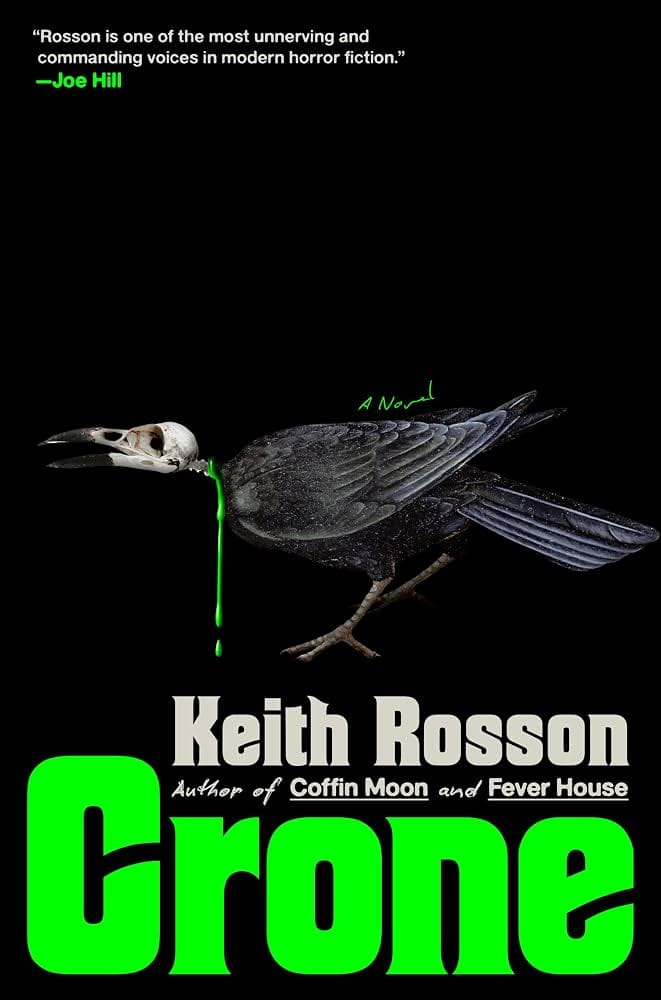
- Author Keith Rosson
- Publisher Black Crow Books
- Published 22 September 2026
- Pages 336
- Format Hardback
- ISBN 9781805530183
- Subgenre Folk horror, crime noir
Ten years after his daughter vanished, former detective Eli Lamp is working off a debt to a drug gang. Ordered to find a killer, he digs into the past, while something bent-backed waits in the woods.
Keith Rosson’s Crone, a folk horror crime novel from Random House and Black Crow Books, puts a bent-backed thing in the woods at the heart of a father’s search for his lost daughter. It also joins one of the oldest lines in the genre. The crone in horror runs from the Grimms’ gingerbread witch and Baba Yaga’s hut on chicken legs to Häxan, the hagsploitation films and modern work such as Relic and She Will.
Witches in horror have always carried our fears about age, women and forbidden knowledge. This feature traces how the old woman became a monster, and why the best stories now ask whether we feared the wrong thing.
The vampire needs a curse. The risen corpse needs a spell. The masked killer needs a grudge. The ageing body needs nothing at all. The crone whispers something far more personal: keep living and you are heading this way too.
She is already waiting when we walk into the story.
Sometimes she lives in a cottage deep in the forest. Sometimes she stands by an oven. Sometimes her house stands on chicken legs. She has a bent back, weak eyes, hands like claws, or a face that turns out to be far less human than we hoped. She knows things the young ones do not. She remembers what the rest have let slip. She lives at the edge of polite society, and she has no wish to come back.
Horror has given her plenty of names: witch, hag, wise woman, granny, widow, crone. The details change. The warning rarely does. Do not go into the woods. Do not knock on her door. Do not take what she offers. And whatever you do, do not make her angry.
Keith Rosson’s Crone, out on 22 September 2026 from Random House in the US and Black Crow Books in the UK, adds one more figure to this very old parade. It is a novel of grief, crime and folk horror, with something in the woods that nobody wants to call a witch. The publisher’s copy pictures it as “bent-backed and black-eyed, clawed and vengeful”. Rosson’s story follows Eli Lamp, a former detective and recovering addict whose daughter went missing ten years ago. A new murder pulls him towards secrets buried far deeper than his own loss.
Rosson is not just calling up a stock monster, though. He is calling up her whole history.
Before the Witch, There Was the Insult
The word crone has a nasty streak in it, and its past holds no respect at all. It came into English in the late fourteenth century as a harsh name for a feeble, withered old woman. Trace it back and it runs through the Anglo-French carogne, a word for carrion and carcass that could also mean an old ewe.
The insult came first. The wisdom came much later. Only in the last century did feminist and neopagan writers start to claim the word back for female age, knowledge, freedom and power.
That matters, because horror did not dream up its fear of old women on its own. Long before cinema had latex good enough to build a truly foul witch, our culture had the words to make an ageing woman grotesque just for going on living. Youth could stand for beauty and promise. Age could be made to stand for rot. A man grows old and becomes an elder. A woman grows old and becomes a crone, and horror knew just what to do with the gap.
Baba Yaga and the Old Woman in the Woods
Fairy tales knew the power of the old woman long before horror films did. In the Grimms’ Hansel and Gretel, the kind old woman who takes the starving children in turns out to be a witch. She built her house of bread and cake to lure children inside. She plans to fatten Hansel, cook him and eat him. Her age is part of the threat. She hobbles out on crutches, and her red eyes cannot see far, but she has a nose as keen as a beast’s and knows when people draw near.
She looks weak. She is nothing of the kind. That tension is the secret of the crone’s long life. The old woman who scares us is so often the one her world has written off. By the usual tests of strength she seems frail, yet she holds a different kind of power: knowledge, magic, memory, cunning and patience. She does not need to be stronger than you when she knows the rules of a world you barely grasp.
No figure in folklore holds that knot tighter than Baba Yaga. In Slavic tales she lives apart from ordinary life, often deep in the forest in her hut on chicken legs. Depending on the tale, she might threaten, trap, test, help or try to eat whoever finds her. Calling her an evil witch misses what makes her last. She can be monster, gatekeeper, trickster, teacher and the push that changes a life, sometimes all at once.
You do not simply beat Baba Yaga. You live through meeting her. That gap points to something horror keeps finding out about the crone: she is at her most unsettling when she will not sit still as the villain. The forest was hers long before the hero turned up.
When Folklore Became Flesh
Behind every fictional witch stands a brutal real history. Europe’s witch hunts were not fairy tales. Historians think somewhere between thirty and sixty thousand people were put to death in the main years of the hunts. Most were women. The popular picture of witches burned at the stake does not hold up either. In England and the American colonies, those found guilty were mostly hanged. In Scotland they were mostly strangled and then burned. In 2022 the Scottish Government made a formal apology to all those accused and killed under the old Witchcraft Act.
Nor were the accused just real versions of the bent old women in children’s books. That matters. The picture of the witch packed fears about women, faith, sex, poverty, disorder, illness and defiance into one monster you could spot on sight. The truth was far more tangled, but stories are good machines. They simplify.
The old woman was especially useful. She might be widowed, poor or alone. She might know about plants or childbirth. She might speak too freely. She might just be disliked by the folk next door. Real villages could turn life on the margins into suspicion, and stories turned suspicion into claws.
Here is the cruel twist. Some traditions also trusted old women with the very things a village needed to know. In the Appalachian folk ways sometimes called granny magic, older women were the healers and the midwives. They kept the lore their mothers handed down, often in remote hill country where doctors were few and far off.
So the same figure can tell two opposite stories. There is the old woman who knows which plant will cure you, and the old woman who knows which plant will kill you. Shift the teller’s sympathy a few inches and the healer becomes the witch.
Häxan, Hagsploitation and the Witch on Screen
Then came cinema, and it found that the old woman could be made into a show. Benjamin Christensen’s Häxan, made in 1922, sits near the start of the screen’s long love affair with witches. It is part history lesson, part horror film and part fake documentary. It acts out demon rites, torture and the witch trials in scenes that still shock a century on.
Häxan has also grown a new layer with age. A BFI piece marking its hundredth year argued that its horror now lies less in its witches and devils than in the long abuse of women it shows. That shift matters. The witch can frighten us, but so can the people hunting her. Cinema would spend decades swinging between those two ideas.
At one end sits the grotesque unmasking. Nicolas Roeg’s 1990 film of Roald Dahl’s The Witches gives us one of the great nightmare images of children’s horror, when Anjelica Huston’s Grand High Witch peels off her lovely face to show the monstrous one beneath. It works because it makes an ancient fear literal. Beauty is the mask. Age and horror are sold as the ugly truth under it.
Horror did not even need magic to turn older women into a show. Robert Aldrich’s What Ever Happened to Baby Jane? (1962) set off a cycle later mocked as hagsploitation or psycho-biddy. The kinder name was Grande Dame Guignol. In these films, old stars and old bodies were there to shock us, to win our pity and to be played for camp. The cycle ran on into the 1970s.
The labels give the game away. A male monster can be ancient and mighty. An ageing woman, it seems, can become a genre.
The modern witch film keeps picking at the same knot. In The VVitch, Robert Eggers made the woods a place of temptation. The Dutch folk horror of Heresy sends a shunned woman into a forest where something old takes an interest in her.
Why Ageing Is Horror’s Oldest Body Horror
The crone lasts because ageing is one of the few changes waiting for nearly all of us, and horror has always understood change. Bodies bleed, split, rot and turn on their owners. Teeth loosen. Hair falls out. Skin shifts. Memory slips. Strength drains away. The line between us and the monster gets hard to hold when the monster’s great crime is having a body further down the same road as ours.
This is where some recent horror has done something far more interesting with the old woman. Instead of treating age as proof of rot, it asks why ageing scares us at all.
Natalie Erika James’s Relic (2020) opens with Edna, an old woman who goes missing from her home and then just as suddenly comes back. Her daughter and granddaughter have to face the changes in Edna, in the house and in their own grip on what is going on. The ghost story and the story of memory, illness and inheritance become one and the same. The terror is watching someone slip out of reach while they are still in the room. The old woman is frightening, but she is frightened too, and that one shift in viewpoint changes everything.
Charlotte Colbert’s She Will goes further. Alice Krige plays Veronica, an ageing actress getting over a double mastectomy in a trade fixed on female youth. She travels to a healing retreat in Scotland, on land where women were once burned as witches. The film ties ageing, bodily change, old persecution and female anger tightly together. The witch is no longer just the thing we should fear. Witchcraft becomes a language through which a woman can face what was done to her.
Recent horror keeps coming back to this doubt. Looking back on 2022, the BFI’s Sight and Sound noted a crop of witches on screen, among them those of Kate Dolan’s You Are Not My Mother and Lynne Davison’s Mandrake. These are women who might be supernatural threats, might just be neglected and shunned, or might be some uneasy mix of both. The crone survives. What changes is where the camera stands.
Fear Her, Pity Her, Become Her
Perhaps that is why the scary old woman stays so much richer than most of horror’s stock figures. She holds opposites together. She stands for death and for survival. She is weak and she endures. She is lonely and she is free. She is decay, and she is knowledge. She can be the person the world threw away, or the one who walked away from the world first.
The vampire needs a curse. The risen corpse needs a spell. The masked killer needs a grudge. The ageing body needs nothing at all. The crone whispers something far more personal: keep living and you are heading this way too.
For women the figure has an extra sting. Pop culture has spent generations treating youth as a kind of cash and female ageing as a vanishing act. The crone does not vanish. She becomes impossible to ignore, and perhaps that is her real crime. She is still here.
There is a fair objection, and it deserves an answer. Claim the crone back too eagerly and you risk sanding her down into a greeting card wise woman, all herbal tea and gentle advice. That version is kinder, but it has no teeth, and the old tales never pretended she was safe. The better modern stories do not pick between the healer and the thing with claws. They keep both, and make us sit with the discomfort.
Keith Rosson’s Crone and the Thing in the Woods
Which brings us back to Crone. Rosson’s novel arrives carrying all of that baggage in a single word.
The book’s own blurb names the word witch only to tell us that nobody in the story will say it out loud. Eli’s search opens on familiar noir ground: a broken former detective, a drug gang called the Crooked Wheel, a vicious murder, a missing daughter and the chance to wipe out a debt. Then the borders start to shift. The hunt stretches back across decades, old grief comes up for air and something waits in the woods. At last the old shape turns up again: bent back, black eyes, claws, vengeance.
That shape could have walked out of a tale told hundreds of years ago. The world around her, though, could only belong to now. Rosson has form here. In Coffin Moon he dragged the vampire back into the grime of 1970s Portland. He made it a story about grief as much as blood. Our review of Crone found him doing the same to the witch, in a book that will not let her settle as either terror or mercy.
That is what makes the crone such a strong monster to inherit. A writer does not have to build her from nothing. She arrives with centuries of fear on her back. The bent body, the woods, the solitude and the forbidden knowledge already sit somewhere in our shared memory.
The real question is what a writer does with them, because modern horror cannot call up the crone in innocence. We know too much now. We know that stories about monstrous old women sit beside the history of real women punished for being difficult, poor, strange, knowing, free or simply unwanted. We know the ageing body has been held up again and again as something to flinch from. And we know that folklore’s old women were rarely as simple as the monsters pop culture squeezed them into.
We know Baba Yaga might eat you. We also know she might show you the way.
That doubt is where the figure still lives. It is there in the cottage and there in the forest. It is there in the woman everyone dismissed until they no longer could, and in the creeping sense that age has not left her powerless at all.
Maybe that was always the secret buried under the crone. Horror tells us to fear the old woman because she is near the end of her life. The better stories understand something far more unsettling.
She has lived long enough to know exactly where the bodies are buried.
Get the book
Crone by Keith Rosson is out now in hardback from Black Crow Books, published on 22 September 2026.



Jim "The Don" McLeod has been reading horror for over 35 years and reviewing it for more than 16. He's the editor of Ginger Nuts of Horror, Europe's largest independent horror review and culture site, and a British Fantasy Award nominee for his work in the genre. When he's not busy inflicting his opinions on the horror community, he can be found annoying his family or getting thoroughly outwitted by his two dogs, Casper and Molly.
Ginger Nuts of Horror: The Heart and Soul of Horror Reviews
Every feature is designed to help sell your work, build your audience and connect your horror story with readers who are actively looking for their next frightening read. Our horror book reviews and features include backlinks to your website, publisher page or Amazon author page, a full synopsis, relevant author information and a universal purchasing link that directs readers to their local bookseller or preferred retailer.
All editorial coverage is provided completely free of charge. We do not charge authors, publishers, filmmakers or creators for reviews or features. Ginger Nuts of Horror exists to support the horror community and help great books, films and independent voices find the audiences they deserve.
With a large, engaged social following and an 18-year archive of trusted horror coverage, Ginger Nuts of Horror is a horror review website built to support authors, filmmakers and creators. Our coverage spans horror novels, indie horror, gothic fiction, folk horror, psychological horror, supernatural fiction, dark fantasy, horror films and the wider creative world surrounding the genre.
Whether you’re an established horror author, an indie filmmaker, a publisher, or a debut voice in indie horror, we offer opportunities to place your work in front of dedicated horror fans, readers, viewers and genre enthusiasts. A feature on Ginger Nuts of Horror can help improve discoverability, strengthen your online presence and give potential readers a clear route from discovering your work to finding out more or making a purchase.
Although our coverage is free, we do have a Ko-fi page for readers, authors and supporters who would like to help us continue promoting horror books, films and creators. All donations are entirely voluntary and greatly appreciated. Every contribution helps support the time, research and ongoing work involved in running an independent horror review website.
Explore our horror book reviews and horror movie reviews, discover the kind of horror coverage we publish, then get your horror book or film featured today.