The Thrill Factor: Why Our Brains Crave Fear, Suspense, and Risk
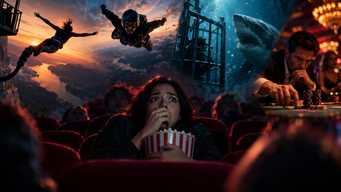
Picture yourself sitting in a dark movie theater. The soundtrack grows quieter, the main character approaches a mysterious door, and you instinctively grip your seat. Your heart races as you anticipate something terrifying. When the inevitable jump scare arrives, you scream, laugh, and somehow feel entertained.
A similar emotional reaction can occur while riding a roller coaster, exploring a haunted house, or participating in extreme sports. Despite knowing these experiences might be frightening, millions of people actively seek them out.
But why do humans enjoy sensations that their survival instincts ordinarily tell them to avoid?
The answer lies in the fascinating relationship between brain chemistry, evolutionary psychology, and our perception of danger. From horror cinema to recreational fear and calculated risks, these experiences allow people to explore powerful emotions, confront uncertainty, and sometimes discover a surprising sense of enjoyment within fear itself.
The Neurobiology of the “High”
A person playing at the fastest payout casinos in Canada, someone experiencing bungee jumping in New Zealand, an adventurer skydiving in the USA, or a thrill-seeker enjoying shark cage diving in South Africa may all experience a similar sense of anticipation, excitement, and heightened awareness. Although these activities involve different types of risk, they can activate overlapping brain systems associated with reward, fear, and uncertainty.
Interestingly, watching a terrifying horror movie can produce some of these same physiological reactions without requiring physical danger.
Whether someone is watching a suspense thriller or participating in high-stakes decision-making, the brain continuously evaluates uncertainty and possible outcomes.
Adrenaline, Cortisol, and the Fight-or-Flight Response
When the brain detects a possible threat, networks involving the amygdala help initiate defensive responses.
The sympathetic nervous system releases adrenaline, also called epinephrine, producing an adrenaline surge that increases heart rate, redirects energy, and heightens alertness.
Cortisol also participates in the body’s stress response, helping maintain energy availability during demanding situations.
This fight-or-flight response evolved to help humans react quickly to danger. However, horror movie fans can experience similar physical sensations while watching fictional threats unfold.
Dopamine, Endorphins, and the Reward System
The brain’s dopaminergic pathways are involved in motivation, anticipation, and reward learning.
Unpredictable outcomes can engage these systems, potentially contributing to the excitement associated with gambling, extreme sports, and suspenseful entertainment.
Although commonly called a dopamine rush, the experience is more complex than a simple release of pleasure chemicals.
Endorphins, which help regulate pain and stress, may also contribute to positive feelings during or after certain intense experiences. However, their role varies depending on the activity.
Why Fear Can Feel Like Excitement
A racing heartbeat, rapid breathing, and heightened attention can accompany both fear and excitement.
This overlap helps explain misattribution of arousal, where people interpret similar physical sensations differently depending on context.
Related ideas from excitation transfer theory suggest that lingering physiological arousal can intensify subsequent emotional experiences.
A frightening movie scene followed by laughter illustrates how quickly our interpretation of intense emotions can change.
The Safety Frame: Why Controlled Fear Feels Good
The difference between enjoyable fear and genuine terror often comes down to perceived safety.
Imagine hearing someone unexpectedly breaking into your home. Your fear would represent a response to a potentially serious threat.
Now compare that situation with watching a fictional intruder in a horror movie.
Although both situations might trigger amygdala activation and physical arousal, the second experience takes place within a protective psychological framework.
Researchers describe this phenomenon as recreational fear, where people voluntarily engage with frightening situations while maintaining sufficient control and security.
A haunted house visitor knows that the actors are performers. Similarly, audiences understand that the monsters appearing on a cinema screen cannot physically reach them.
This awareness allows fear to become entertaining rather than overwhelming.
Psychological reversal theory describes a paratelic state, in which people are focused on enjoying the present experience and may interpret heightened arousal as pleasurable.
Importantly, enjoyment often depends on the intensity of fear. Research on recreational horror suggests that moderate levels of fear can be more enjoyable than experiences that feel either boring or overwhelming.
Successfully completing an escape room, finishing a frightening film, or overcoming anxiety before a supervised adventure can also create feelings of mastery.
These experiences may support confidence and emotional catharsis, although they do not automatically produce lasting psychological resilience.
The attraction lies in experiencing controlled danger while retaining the ability to stop or withdraw.
The Evolutionary Psychology of Fear and Social Bonding
Fear has served an essential survival function throughout human evolution. Recognizing threats, responding to uncertainty, and learning from dangerous situations helped our ancestors navigate unpredictable environments.
Some evolutionary psychologists suggest that frightening stories and imaginary threats may provide opportunities to mentally rehearse challenging circumstances.
One related hypothesis, Threat Simulation Theory (TST), proposes that dreams can simulate threatening events and potentially exercise threat-recognition mechanisms.
Although the theory primarily concerns dreaming, similar ideas have been explored in discussions of horror cinema and suspense fiction.
Watching a character escape a dangerous situation may encourage audiences to imagine possible responses, but evidence that horror viewing directly improves real-world survival skills remains limited.
Another fascinating aspect of horror is its social appeal.
Consider a group of friends watching a supernatural movie together. During frightening moments, they might scream, laugh, grab one another’s hands, or exchange nervous glances.
These shared high-arousal emotions can create memorable social experiences.
Research into physiological responses during group-based haunted-house experiences suggests that social context can influence how people experience threatening situations.
Similarly, escape rooms, roller coasters, and supervised extreme sports often encourage cooperation, shared attention, and collective celebration.
Experiencing uncertainty together may strengthen feelings of companionship, particularly when participants already trust one another.
Even true crime podcasts and suspense fiction can encourage conversations about danger, human behavior, and moral decisions.
Morbid curiosity also plays a role. People are naturally interested in disturbing or threatening subjects because such information can feel emotionally compelling or potentially useful.
For horror movie fans, confronting fictional darkness becomes a way to explore difficult emotions without necessarily experiencing the events themselves.
Why Some People Love Fear More Than Others
Not everyone finds frightening entertainment enjoyable.
Psychologist Marvin Zuckerman studied these differences through his Sensation Seeking Scale, which measures preferences for novel, intense, and stimulating experiences.
People with high sensation-seeking tendencies may gravitate toward skydiving, roller coasters, and terrifying films. Others may prefer quiet reading, familiar activities, or gentler entertainment.
These preferences reflect combinations of personality, experience, environment, and biology.
Research also suggests that genetic influences and differences in dopamine-related brain functioning contribute to sensation-seeking behavior.
However, no single dopamine receptor or gene determines whether someone becomes an adrenaline junkie.
Ultimately, the same frightening scene that exhilarates one person may feel exhausting or unpleasant to another.
Conclusion: Why We Keep Coming Back for More
Fear is not simply an emotion humans are programmed to avoid. Under controlled conditions, it can become a source of excitement, curiosity, social connection, and personal accomplishment.
From horror cinema to adventurous experiences, recreational fear allows people to encounter uncertainty while maintaining a sense of security.
The appeal comes not from danger alone, but from how our brains interpret and respond to it.
So the next time a terrifying movie makes your heart race, ask yourself: Are you enjoying the fear, or the feeling of overcoming it?
Jim "The Don" McLeod has been reading horror for over 35 years and reviewing it for more than 16. He's the editor of Ginger Nuts of Horror, Europe's largest independent horror review and culture site, and a British Fantasy Award nominee for his work in the genre. When he's not busy inflicting his opinions on the horror community, he can be found annoying his family or getting thoroughly outwitted by his two dogs, Casper and Molly.