Morwood plants something small and wrong in the walls. Then she watches it fester.
The mermaid carving is wedged inside the bones of the house like a splinter, and once you see it, you cannot unsee it. That’s the sentence I keep returning to after closing Ava Morwood’s Until We Drown, a psychological horror novel that plants something small and wrong in the architecture of an ordinary family home and then watches it fester. Set in the Peak District and steeped in local folklore, this dark retelling of Hans Christian Andersen’s The Little Mermaid is not a ghost story. It is a story about what haunts us when we refuse to speak.
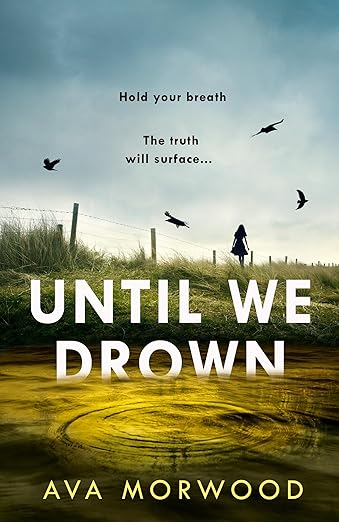
Until We Drown | Ava Morwood | HarperNorth | 9 April 2026 |
A slippery dreamlike psychological thriller woven through with folklore and otherworldliness, Until We Drown will have you gasping for breath before it lets you go. Morwood plants something small and wrong in the architecture of an ordinary family home, then watches it fester until the water rises and takes everything.
Until We Drown by Ava Morwood Review: A slippery dreamlike psychological thriller
The first time I saw a mermaid, she was drowning a man.
That’s not quite right. What I saw was a woman with golden hair, caught in the jaws of old farm machinery at the bottom of a peat-dark pool, her fingers still wrapped around a watch that wasn’t hers. But the image that stayed with me was something else: the way Morwood’s prose had already taught me to see mermaids not as creatures of beauty but as vessels for sorrow, rage, and the terrible things women do when they’ve been silenced long enough.
Until We Drown is a psychological thriller that wears its fairy tale bones on the outside. It’s also a domestic drama about a marriage that’s already drowned long before anyone hits the water. And it’s a folk horror novel that understands something essential about the British landscape: that the stories buried in it are never really dead.
Ellie Kellaway has dragged her family from the Yorkshire coast to the landlocked Peak District, hoping to leave behind the sea and everything it represents, her husband Ethan’s affair with a younger wild swimmer, the haunting memory of a childhood drowning she witnessed, the sense that her life has been shaped by guilt she can’t articulate. But the Peak District has its own water. Its own drownings. Its own mermaids.
The carving Libby finds in the new house is the first crack. A grotesque, barbaric mermaid hacked into a stone slab behind the staircase, one hand raised to comb her hair, the other pressed over her heart. It’s not pretty. It’s not a child’s toy. And it’s been waiting for them. That’s the thing about this book: everything feels like it was waiting.
Morwood writes the way water moves. The prose has a current to it, a pull. Short sentences hit like waves. Longer passages draw you under, holding you there until you start to feel the burn in your lungs. The novel is structured around fragments, “A postcard,” “A memory”, which gives the whole thing the quality of a half-remembered dream. Or a drowning, maybe. The way your life is supposed to flash before your eyes when the end is near.
Ellie is the kind of narrator who makes you question everything. Her grandmother had the sight, a kind of psychic sensitivity that Ellie has spent her life trying to suppress. Now she’s seeing things: a woman in the garden, a hare with blue eyes, her son Zack coming home with muddy feet and a hollow stare. Are these visions real? Is she losing her mind? Or is she finally seeing what was always there? The novel never gives you a clean answer, and that’s the point. The horror here isn’t about knowing. It’s about the space between knowing and not knowing. The water you can’t see through.
The folklore is impeccable. Morwood doesn’t just name-drop mermaid legends; she inhabits them. Blakemere Pond is really a small, dark pool in Staffordshire where, legend has it, a woman accused of witchcraft was drowned. Three days later, her accuser was found dead by the water, his face clawed to ribbons. Doxey Pool has Jenny Greenteeth, an evil mermaid who pulls men to their deaths. And the stories keep coming, layering on top of each other like sediment, until you realise that all these pools are connected not by underground tunnels, as the locals claim, but by something older. Something that feeds on grief and betrayal and the refusal to stay silent.
The marriage at the centre of this novel is a masterclass in slow-burn dread. Ethan is handsome, confident, the kind of man who tells his wife she’s the most beautiful girl on campus and means it in the moment. But there’s a void where his emotions should be. When Ellie touches his skin, she feels nothing. A barren seabed. No life. No love. Just grasping polyps reaching for whatever warmth they can find. Morwood doesn’t need to spell out what Ethan is. She shows you, scene by scene, the way he swims over other people to get what he wants. The way he lies without even seeming to know he’s lying. The way he makes everything about him.
And Ellie? She’s been telling herself stories for so long, she’s forgotten which ones are true. She’s the wife who threw away her daughter’s favourite mermaid doll before the move, hoping to cut the cord between her family and the sea. She’s the mother who watches her son drift away and can’t find the words to pull him back. She’s the woman who fell in love with a prince who was never really a prince at all. The novel asks a brutal question: what happens when you realise you’ve been living in someone else’s fairy tale? And what are you willing to do to write your own ending?
The answer comes in the water. Of course it does. The final sequences in Blake Mere Pool are among the most harrowing I’ve read in years, not because of the violence, though there’s violence, but because of the stillness. The way Morwood holds you under. The way she makes you feel what it is to drown, to have the cold seep into your bones, to watch the surface recede while someone’s hands push you down. And then the way she lets you surface again, gasping, changed.
This is a book that understands mermaids. Not the Disney version, all perky songs and happy endings. The real ones. The ones Andersen wrote about, the mermaid who gave up her voice, who felt knives with every step, who failed to win her prince and became nothing but foam on the ocean. Morwood takes that story and turns it inside out. What if the mermaid wasn’t the one who needed saving? What if she was the one doing the saving? What if the prince was the monster all along?
I’ve read Alison Littlewood’s work before, the Shirley Jackson Award-winning short fiction, the novels that blend folklore and psychological horror with such precision. But this feels different. More personal. More dangerous. It’s as if she’s been building toward this book her whole career, all those stories about houses with secrets and women who see things they shouldn’t, culminating in a novel that finally says what it means. The fairy tale as a weapon. The mermaid as avenger. The wife as something more than a victim.
Until We Drown sits at the intersection of several horror traditions: the folk horror revival, the psychological thriller, the fairy tale reclamation, but it doesn’t feel like it’s trying to fit into any of them. It’s too strange for that. Too slippery. It reminds me, in the best way, of Shirley Jackson’s The Haunting of Hill House: that sense of a narrator who can’t be trusted but who you can’t stop trusting, a house that feels alive, a horror that never quite resolves into something you can name. It also echoes Catriona Ward’s The Last House on Needless Street in its willingness to upend everything you thought you knew, to make you question reality itself.
But Morwood’s voice is her own. There’s a lyricism here that feels almost like poetry, balanced by a bluntness that cuts straight through. She writes about landscape the way a swimmer writes about water, with intimate knowledge and respect for its power. The Peak District becomes a character in its own right, with those rolling hills hiding dark pools, all that green earth sitting atop caves and tunnels and stories that refuse to stay buried.
The novel’s treatment of voice, who has it, who loses it, and who uses it as a weapon, is devastating. The little mermaid gave up her voice for love. Ellie gives up her voice for her family, burying the truth so deep it might never surface. Sienna, the other woman, is silenced in the most literal way. And Libby, the four-year-old who can’t stop talking, who shouts and sings and demands to be heard, she’s the one who might save them all. Because sometimes the loudest voice is the one that refuses to be quiet.
The last pages are perfect. They just let the water settle, let the surface still, and leave you staring at your own reflection. What did you see? What were you looking for? And what did the water show you that you weren’t ready to see?
This is a book about the stories we tell ourselves to survive. About the bargains we make with forces we don’t understand. About the women who are drowned and the women who do the drowning. And about the sea, always the sea, calling us back to where we began and where we’ll end.
Until We Drown is a siren song. You’ll hear it before you understand it. You’ll follow it before you know where it’s leading. And when you finally surface, gasping, you’ll wonder how you ever breathed air that didn’t taste of salt.
Until We Drown by Ava Morwood
When Ellie Kellaway and her family seek a fresh start in the tranquil Peak District, she hopes to leave behind her haunting memories of the sea – and of Ethan’s affair with the younger, beautiful wild swimmer he met there.
But Ellie’s new home harbours dark secrets, where ancient legends of mermaids intertwine with chilling realities. As eerie occurrences unfurl and truths rise to the surface, it becomes clear that the mermaid’s curse might be real. Ellie’s family is fast becoming entangled in a web of betrayal and vengeance, which threatens to drown them all…
A spine-tingling novel where love, loss, and the lure of the water collide in a terrifying crescendo.

Ginger Nuts of Horror: The Heart and Soul of Horror Reviews

Looking to get your horror book or film in front of the genre’s most dedicated audience? Ginger Nuts of Horror is one of Europe’s largest independent horror review websites, with over 30 contributors publishing horror book reviews and horror movie reviews almost every single day.
We offer far more than reviews. Authors, filmmakers and publishers can promote their work through in-depth horror book reviews, horror film reviews, comic and video game coverage, news features, and our popular author and director interviews like Five Minutes With. Our guest feature series, The Horror of My Life, Childhood Fears, The ? That Made Me and more, let creators tell their story while promoting their latest release.
Every feature is built to sell your work. We include backlinks to your website or Amazon author page, a full synopsis, and a universal purchasing link that sends readers straight to their local store. Add a large, engaged social following and an 18-year archive of trusted horror coverage, and you have a platform genuinely built to grow your readership.
Whether you’re an established author, an indie filmmaker, or a debut voice in indie horror, there’s a way for us to help you reach more fans. Explore our horror book reviews and horror movie reviews, then get your horror book or film featured today.