Off the Reservation | Stephen Graham Jones | Titan Books | 20 October 2026 |
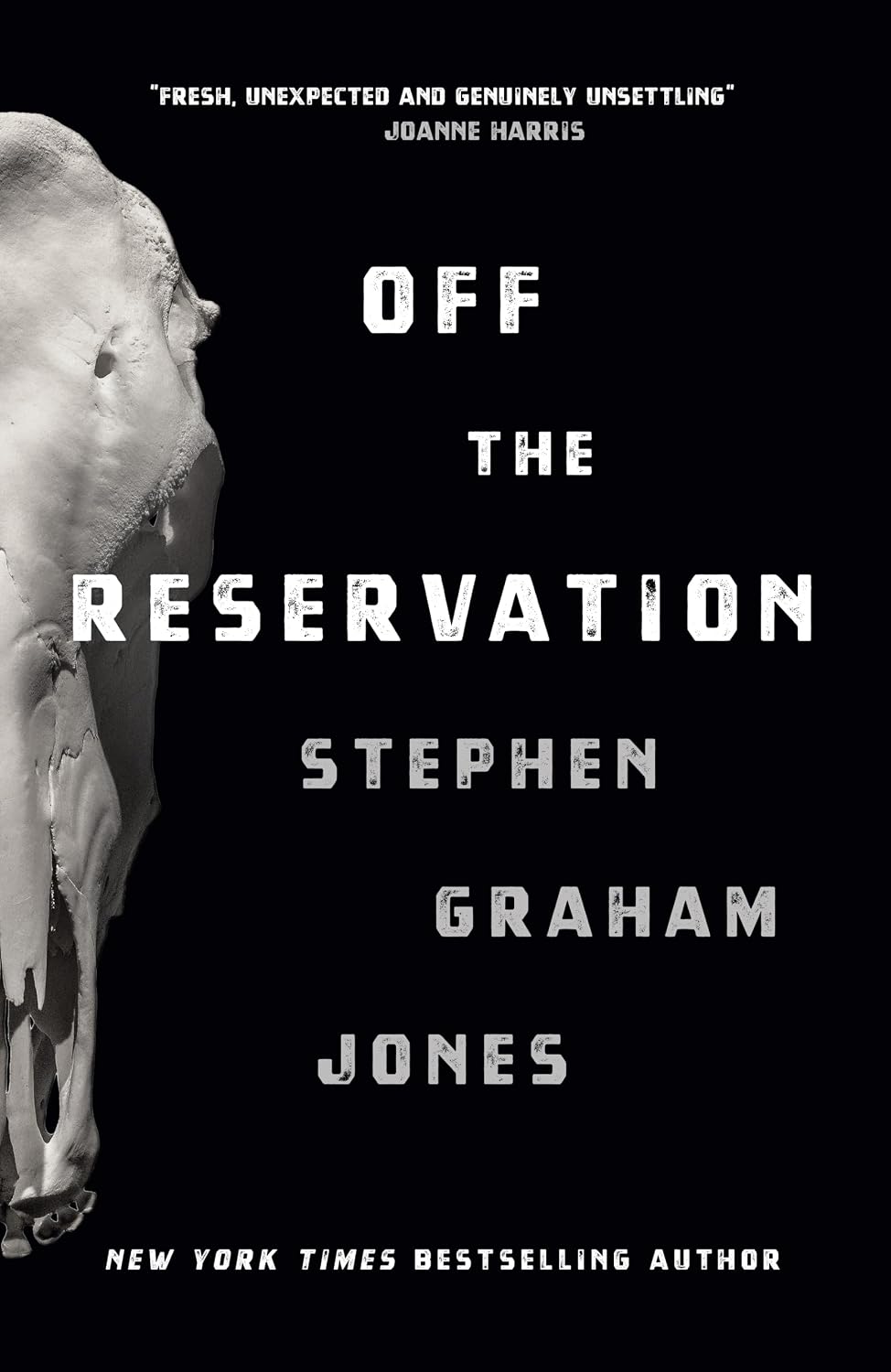
- Author Stephen Graham Jones
- Publisher Titan Books
- Publishes 20 October 2026
- Pages 496
- Format Hardback
- ISBN 9781807590352
- Subgenre Supernatural horror
Five years after surviving a massacre, Nate Yellow Tail joins three older Blackfeet in a run-down camper van to bring a boy’s bones home from the Carlisle Indian Industrial School. Something follows them back.
Stephen Graham Jones returns to the Blackfeet world of The Only Good Indians and The Buffalo Hunter Hunter with Off the Reservation, out from Titan Books in the UK on 20 October 2026. The three novels are not a trilogy in the strict sense. One is set more than a century before the others, and only two share a character. Read together, though, they make one long argument about what horror can do with history: revenge, survival, and the debts the living owe the dead. This feature traces that thread from an elk hunt gone wrong to a road trip with a child’s bones in the back, with spoilers for the earlier books only.
Across three novels the wrongdoer keeps getting bigger. Four friends with rifles. Then a cavalry column and a trade that emptied the plains. Then a school run by a government to erase children. Jones has had to make the horror grow, because the history it answers to was always this big.
The Survivor Who Keeps Being Spared
Nate Yellow Tail should be dead twice over. In The Only Good Indians he was the cop’s son who went into Cass’s sweat lodge and came out wounded but breathing, while the men around him did not. In Off the Reservation he wakes in a hospital bed after an accident that should have finished the job. His best friend Sebby is a few doors down, barely hanging on.
Jones keeps sparing him, and I think I know why. Look at what Nate does in the first book. When the shooting is over, Denorah puts him on a horse and sends him to town for help. He is the one who carries the news. He is the messenger.
That is his job across these books, even the one he is not in. Jones has been keeping a ledger of what is owed to the dead. Somebody has to be left standing to read it out, and somebody has to carry it home.
The Only Good Indians and the Debt That Came Due
The Only Good Indians came out in July 2020 from Saga Press, with Titan following in the UK. Even the title is a reckoning. It turns a slur most often pinned on General Philip Sheridan, the one about the only good Indian being a dead one, into the name of a book about Blackfeet men who are being killed one by one. Jones makes you say the slur every time you ask for the book. That is not an accident.
The crime at the centre is small and specific. Ten years before the story starts, four friends, Lewis, Ricky, Gabe and Cass, chase a herd into the part of the reservation kept for the elders. Hunting is not allowed there, by law or by tradition. They shoot a lot of elk. Lewis finds a young cow still alive, shoots her again, and finds she was carrying a calf.
Here is the detail that matters most to me. Lewis buries the calf and swears to use the whole animal. He means to give the meat to the elders and make some kind of amends. Then a game warden stops them at the truck and makes them throw the elk away. The wrong was theirs. The waste was forced on them by the rules of the place. Jones does not let either side off.
An Avenger in Borrowed Skin
The book is built in four parts, and each one is a different kind of horror. A prologue in North Dakota ends with Ricky beaten to death by white men in a bar car park, while elk eyes shine in the field beyond. “The House That Ran Red” is a study in paranoia. Lewis, who has left the rez and married a white woman, Peta, comes apart at home, sure that something has followed him off the reservation. He is right, and he is also wrong about almost everything else.
“Sweat Lodge Massacre” is a slasher set inside a friendship. Old grudges, a Thermos, a stolen-money misunderstanding, and two men who loved each other end up doing the elk’s work for her. “It Came from the Rez” hands the book to Gabe’s daughter, Denorah, a teenage basketball player who has to face the thing on a basketball court and then out in the snow.
What does the hunting is the Elk Head Woman. Critics have tied her to Deer Woman, the figure from many Native traditions who takes a beautiful human shape to punish men. Jones makes her wear people. She takes the form of a young woman, hitches back to the reservation, and passes as Shaney, Lewis’s Crow coworker. Only when she is hurt badly enough does the disguise drop.
Remember that detail about borrowed skin. It comes back.
The book won the Bram Stoker Award for best novel, the Shirley Jackson Award, the Ray Bradbury Prize and an Alex Award. Not everyone was sold. The Los Angeles Times felt it was straining to be a horror story and a set of character studies at once. When it came out, our own three-reviewer roundup of The Only Good Indians split too. Two of the three were won over. Tony Jones found it slow, and its men too alike.
That last complaint deserves an answer rather than a shrug. The men are alike. That is the horror. They are four versions of one bad afternoon, and the Elk Head Woman takes them one by one because, to her, they are one thing. Their differences are what they tell themselves. Her ledger has one line on it.
The ending is where Jones shows his hand. Denorah inherits a debt she never ran up. The elk spirit tells Gabe outright that his daughter is his calf, and so she is owed. The book ends when Denorah refuses to answer one killing with another. Revenge, in this world, can be stopped. It cannot be undone.
The Buffalo Hunter Hunter and Revenge the Size of a Massacre
On 23 January 1870, Major Eugene Baker’s cavalry attacked a Piegan Blackfeet camp on the Marias River in Montana Territory. The Army had been sent after Mountain Chief’s band. The camp they hit belonged to Heavy Runner, whose people were thought to be at peace and under government protection. Heavy Runner was shot as he walked towards the soldiers holding a paper that promised him safe conduct. Smallpox was already in the camp, and most of the able men were away hunting. Baker’s own rough count was 173 dead, most of them women, children and old men.
The Buffalo Hunter Hunter, published by Saga in March 2025, grows out of that day. Its narrator is Good Stab, a Pikuni man who says he was born in 1833 but looks to be in his late thirties. The night of the massacre, he meets a pale, long-fanged stranger he calls the Cat Man. Soldiers fall on Good Stab’s party. As he lies dying, the Cat Man’s blood gets into his mouth, and he wakes up as something else.
His story reaches us at third hand. Good Stab confesses, over weeks, to a Lutheran pastor, Arthur Beaucarne, in Miles City in 1912. Beaucarne writes it all down and hides the manuscript in the wall of his parsonage. It turns up in 2012, and his descendant Etsy, an academic, transcribes it. Jones had written about the dead coming back to a Blackfeet family before, in Mapping the Interior, but never on this scale.
You Become What You Feed On
Here is the rule that makes this vampire different, and it is the key to the whole set. Good Stab can only take blood, and he takes on the nature of whatever he feeds on. If he wants to keep a human shape, he has to feed on humans.
Read that as a statement about revenge and it gets very dark very fast. To stay a man, Good Stab has to keep killing men. The vengeance he takes on the white buffalo hunters is not a choice he makes once. It is a diet. It shapes his body. In the book’s own logic, he is made of the people he has eaten.
Now go back to the Elk Head Woman wearing Shaney’s face. Both books share one idea. Revenge wears the skin of what it hunts. It has to pass as human to get close, and the longer it hunts, the more human it has to look. Jones never says this outright. He just builds the same monster twice, a century apart, and lets you notice.
The scale has grown, too. In The Only Good Indians the wrong was done by four friends to one elk. Here it is done by an army to a people, and by a hide trade to the herds those people lived on. Good Stab’s hunger is the size of that wrong.
Look also at who has to listen. The man sitting with the vampire is not a Blackfeet elder. He is a white churchman, and the book cares as much about his guilt as about Good Stab’s. Confession runs both ways here, and the pastor’s half of the ledger turns out to be heavier than he admits at first. Anthony Watson’s review of The Buffalo Hunter Hunter made the case for it here last year. In June 2026 it took the Bram Stoker Award for Superior Achievement in a Novel.
Not a Trilogy, but One Argument
Strictly speaking, these books are not a set. The Buffalo Hunter Hunter shares no characters with the other two. It is set mostly in 1912 and in the decades of Good Stab’s memory, while the other two belong to the present day. Calling them a trilogy is partly a reader’s habit and partly a publisher’s. The copy for Off the Reservation names both earlier novels as the ground it returns to, and Cemetery Dance has been running a six-part reading guide that walks fans down the same road.
That is a fair objection, and it should be said plainly. Jones did not plan these as a sequence, as far as anything published says. You could read each one alone and lose nothing of its plot.
I’d still defend the grouping, because the thread is tighter than any shared cast. Look at who does the harm in each book. Four friends with rifles. Then a cavalry column and a hide trade that emptied the plains. Then, in Off the Reservation, a federal school built to strip children of who they were.
The wrongdoer gets bigger with every book. Jones has had to make the horror grow, because the history it answers to was always this big.
It helps to know who is keeping the ledger. Jones was born in Midland, Texas, in 1972, and he is an enrolled member of the Blackfeet Tribe in Montana. He teaches English at the University of Colorado Boulder. These are not books written from outside, looking in with a tourist’s guilt.
That shows in where they aim. The Only Good Indians holds its own men to account before it says a word about soldiers. Only once that debt is on the table does Jones turn to the Army, and then to the schools. The order matters. It earns the anger that comes after.
Carlisle and the Children Still Coming Home
The Carlisle Indian Industrial School opened in Pennsylvania in 1879 and closed in 1918. Its founder, an Army officer named Richard Henry Pratt, summed up its aim as “Kill the Indian, save the man.” Thousands of Native children passed through it, from well over a hundred nations. Close to 200 of them are buried in its cemetery.
This is not old history that sits still. In 2016, after a request from a member of the Northern Arapaho, the Army began working with tribes to bring those children home. It is slow. The graves are more than a century old, so the digging is done by hand. Families have to fill out forms and find a third party to vouch for the link.
In 2023 one of the children on the list was Blackfeet. Launy Shorty, of the Blackfeet Nation of Montana, died at Carlisle on 16 February 1892. He was eighteen, and tuberculosis killed him. The Army announced that year that he would finally go home.
It is still happening this very week. On 13 October 2026, the same day Off the Reservation came out in the United States, reports went out that the Army had returned the remains of eleven more Native American and Alaska Native students from Carlisle.
None of this is in the novel’s publicity, and I won’t claim Jones drew on any one case. But it is the ground the book stands on. A reader who picks it up this month is reading about a thing that is being done, by hand, right now.
Off the Reservation and the Road Home
On the publisher’s account, Off the Reservation opens five years after the sweat lodge. Nate is offered a chance to reset his life, and maybe to save Sebby. He climbs into a camper van almost as broken as he is, with three older Blackfeet. Their job is to find the bones of the lone Blackfeet boy who died at Carlisle and bring him home. When they get the bones, something terrible gets out with them.
Even the title is doing the same work as The Only Good Indians. “Off the reservation” is an idiom American pundits use for going rogue, and its roots are in the reservation system itself. Jones takes the phrase back and makes it literal. These people really are going off the reservation, across the country and back, to fetch one of their own.
Here is what strikes me about that premise. The first book is about taking: a life for a life. The second is about taking too: blood for buffalo. The third, for the first time, is about giving back. A boy carried home in a battered van is the most hopeful idea Jones has put in this world.
Notice who is in the van, too. In The Only Good Indians the older generation was the problem: four men carrying a bad day into middle age, and a daughter paying for it. Here, by the copy’s own account, the elders are the ones doing the carrying, and the young survivor goes with them. The direction of the debt has turned round.
It is also, on the cover copy’s own word, the book where opening a grave lets something loose. Jones will not let return be clean. Repair is the right thing to do, and it is still dangerous, because in these books the dead never come back quiet. If the monsters of the first two books wore the skin of what they hunted, I am very curious what shape this one wears.
Whether the novel lands is a question for a review, not this piece. But the shape of the argument is clear. Nate has spent five years as the one who lived. Now Jones has handed him the oldest bill in the ledger and told him to drive.
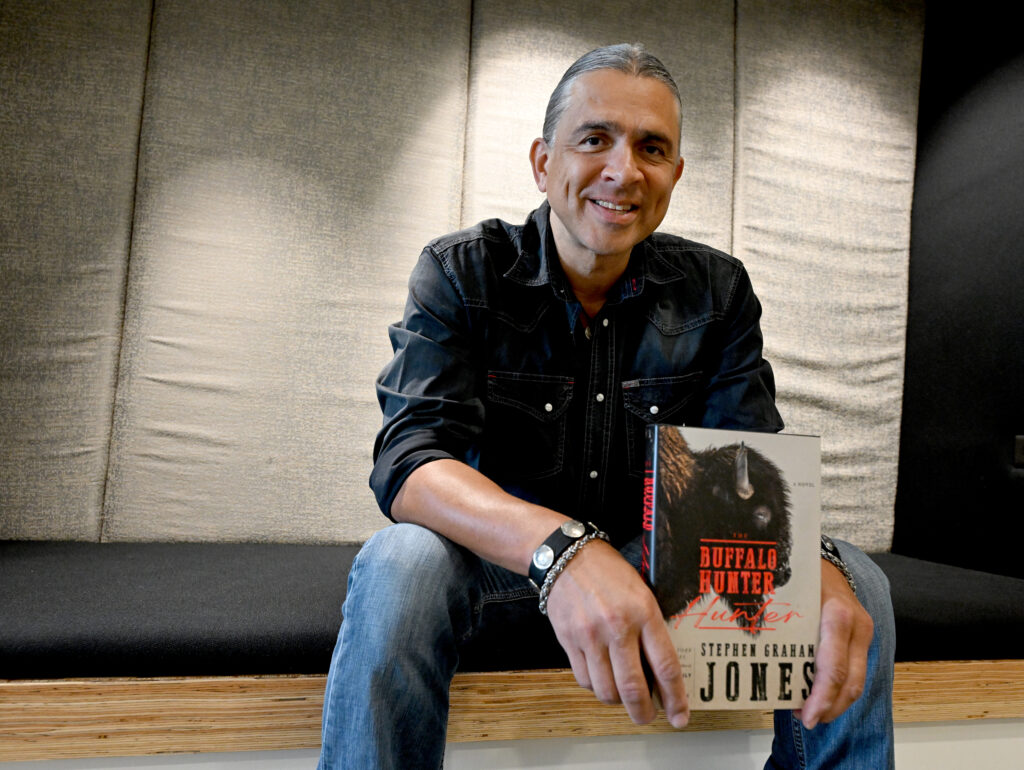
Stephen Graham Jones
Keep reading on Ginger Nuts of Horror
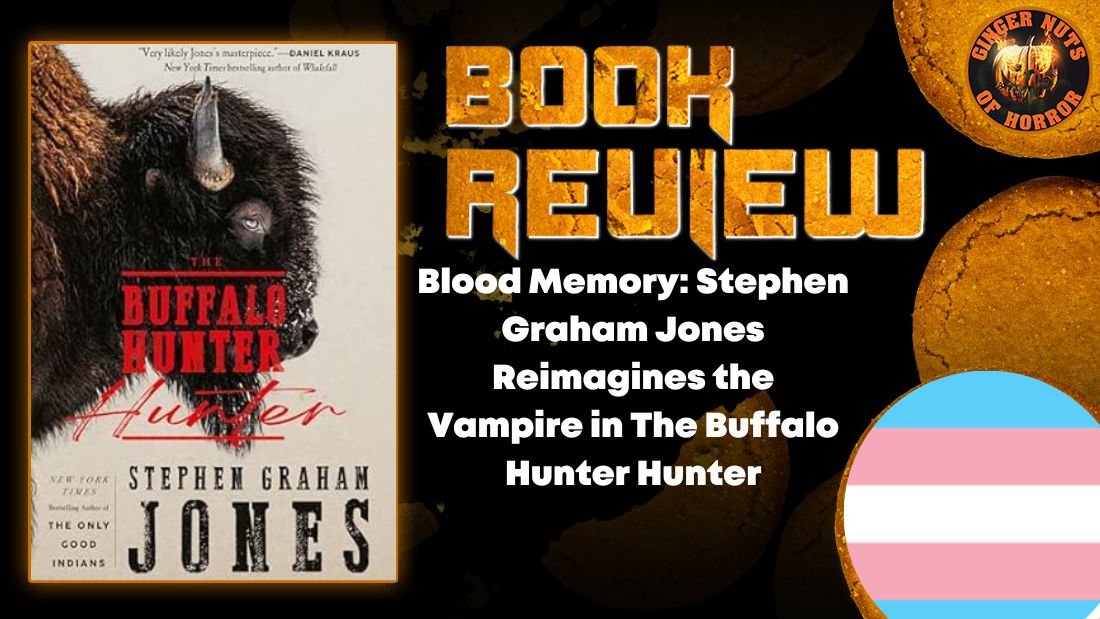 Blood Memory: Stephen Graham Jones Reimagines the Vampire in The Buffalo Hunter Hunter
 Women of the Weird West, edited by KC Grifant: The Frontier Reclaimed
 The Way It Haunted Him and the The Red Sacrament: Your 2026 Horror Preview from Titan Books
About Ginger Nuts of Horror
Ginger Nuts of Horror is an independent horror review and culture site based in Edinburgh, Scotland. Edited by British Fantasy Award nominee Jim McLeod, it publishes horror book reviews, film reviews, author interviews, features and cover reveals. Ginger Nuts of Horror won Best Inclusive Film & Book Review Platform at the SME News UK Enterprise Awards 2026.

Jim "The Don" McLeod has been reading horror for over 35 years and reviewing it for more than 16. He's the editor of Ginger Nuts of Horror, Europe's largest independent horror review and culture site, and a British Fantasy Award nominee for his work in the genre. When he's not busy inflicting his opinions on the horror community, he can be found annoying his family or getting thoroughly outwitted by his two dogs, Casper and Molly.