
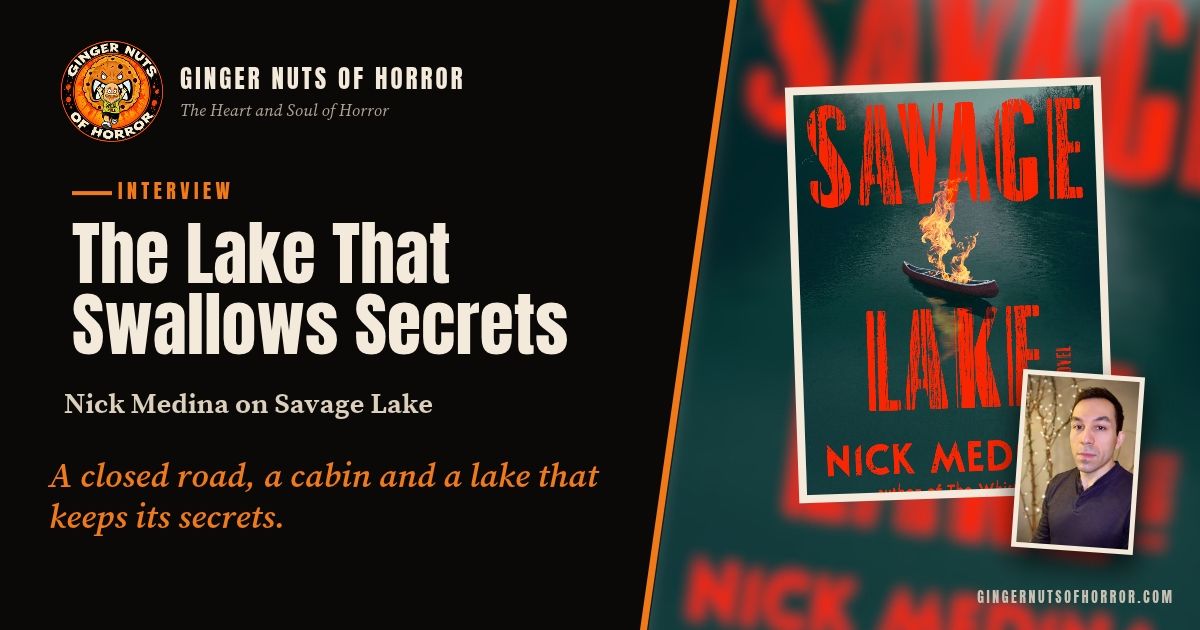
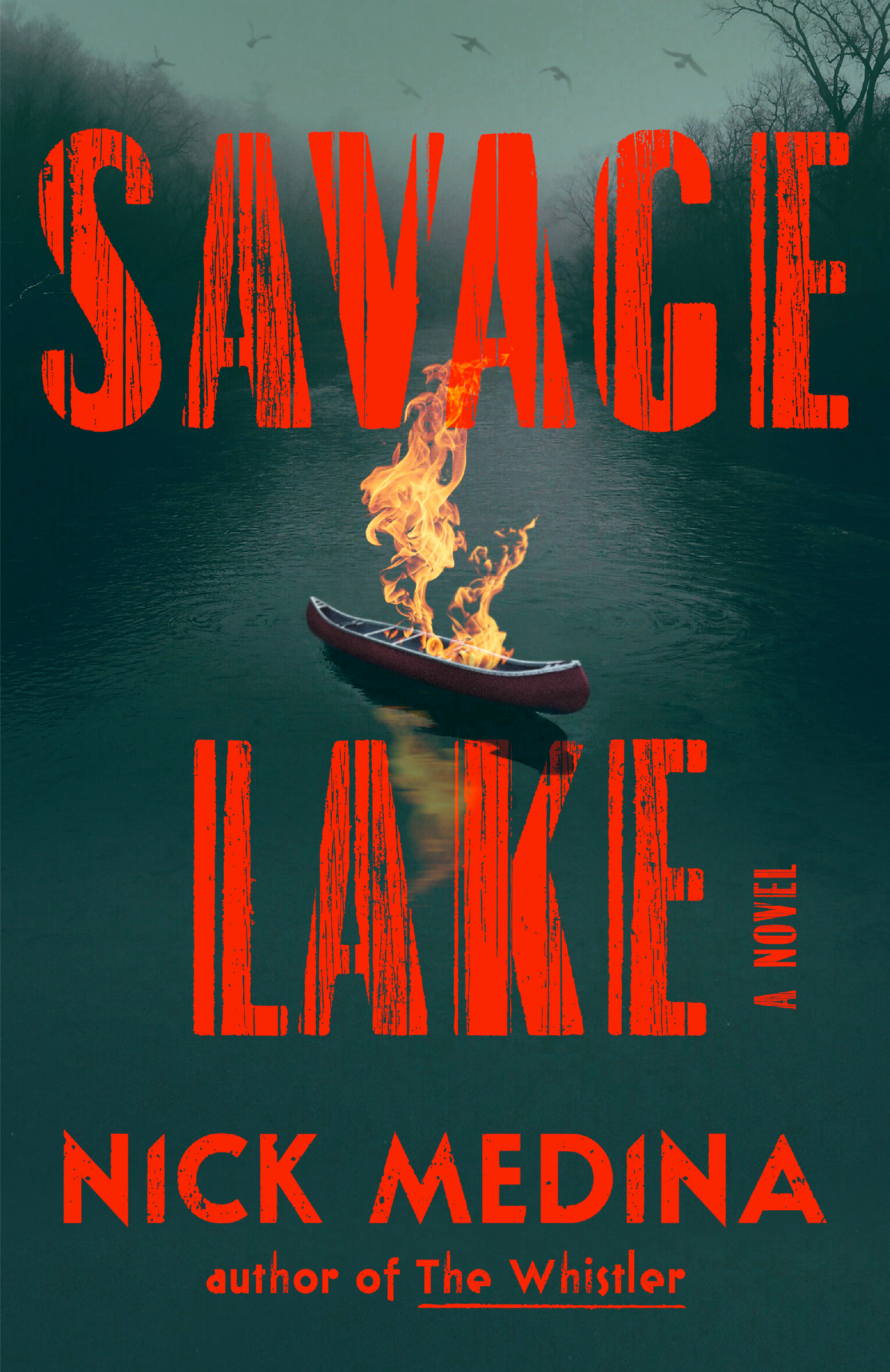
Savage Lake | Nick Medina | Berkley
- Author Nick Medina
- Publisher Berkley
- Published 27 October 2026
- Format Hardback, ebook, audiobook
- ISBN 9780593952177
- Subgenre Cabin horror, cryptid horror
After her estranged father dies, Nell Marin takes her teenage son Oscar back to the family cabin on Torchlight Lake, the place she swore never to see again, and finds the past waiting for both of them.
The barrier that traps the family in Nick Medina’s Savage Lake is a roadblock, and the people who put it there are within their rights. This Nick Medina interview digs into his fourth novel, in which a local Tribe closes the roads across its own land and leaves Nell Marin and her teenage son, Oscar, stuck at a falling-down cabin on Torchlight Lake, the one place Nell swore she would never see again. Oscar has watched enough horror films to know the rules. The lake does not seem to care about them.
Medina, a member of the Tunica-Biloxi Tribe of Louisiana, spent three novels building the Takoda reservation into one of the most lived-in places in modern horror, from Sisters of the Lost Nation through Indian Burial Ground to last year’s The Whistler. Savage Lake leaves Louisiana behind for what he has called a cabin-in-the-woods story with cryptids and a turn-of-the-century cold case. He joins Ginger Nuts of Horror for the latest in our run of horror interviews, and we begin where Nell does, at the end of a closed road.
Nick Medina draws the premise of Savage Lake from a real act of Tribal sovereignty, then turns his cabin in the woods into a story of inherited trauma, where a horror-literate teenager discovers that the genre’s rules stop protecting him the moment his own family history stops making sense.
The Nick Medina Interview: Sovereignty, Cryptids and a Cabin on Torchlight Lake
The thing that keeps Nell and Oscar at Torchlight Lake is not a dead car battery or a washed-out bridge. It is the local Tribe barricading the roads that cross its land, which is an act of sovereignty long before it is a plot device. Why did you want a Native decision, made on Native land, to be the wall that holds this family in place?
It felt like the decision was made for me. I’d always wanted to write a cabin-in-the-woods story, I just didn’t know what the inciting event that would leave my characters stranded would be. When I read about how a band of Lake Superior Chippewa had barricaded a number of its roads in the Northwoods of Wisconsin, it sounded like the perfect start for a horror story to me, especially since I like to shine a light on current challenges being faced by Native and Indigenous communities within my work.
So much of the fear in Savage Lake sits behind Oscar’s eyes, as he watches his mother become less like herself. A monster in the trees is one kind of threat; a parent you no longer recognise is another. What is it about a child watching a parent change that frightens you more than anything that could come out of the woods?
For many, a parent represents—and provides—safety, security, and dependability. But when a parent changes, becoming something else, safety and security diminish, which is scary, especially if you don’t know how to make things right again.
Oscar is a horror fan, and the publisher’s copy promises him a danger worse than any movie monster. A teenager who knows the genre’s rules gives you a character who can call out the clichés before the reader does. How did you decide when Oscar’s horror literacy should protect him and when it should let him down?
As a boy from the city, Oscar’s knowledge of horror movies helps him navigate and make sense of his new surroundings at a lakeside cabin in the Northwoods. His familiarity with tropes helps him predict what will happen next. But when he learns truths about his family history that contradict what he’s always believed, he can’t trust the tropes anymore, making him vulnerable to the same ghosts that have haunted his mother for the last twenty-seven years.
You have described the book as having a turn-of-the-century cold case at its heart, and Nell’s summer of 1999 runs alongside Oscar’s present. Indian Burial Ground set 1986 against the present day, and The Whistler split Henry’s life into before and after. What does a second timeline let you do to a reader that a single straight run of events never could?
Dual timelines allow me to show a reader what happened in the past rather than reporting what happened during a present timeline. I love seeing how a character changes and grows. Dual timelines also help build tension, and suspense because there’s always a gap between the two that leaves room for mystery and the unknown.
Your Takoda novels drew on two-faced creatures and the old warning about whistling at night, and now you have brought cryptids to the lake. Cryptids are a strange category of monster, because pop culture has spent decades turning them into merchandise and punchlines. What drew you to cryptid lore for this book, and how did you strip away the novelty to make it frightening again?
Without giving too much away, I wanted to take an approach to cryptids that I hadn’t encountered in books before. I’d also read about age-old Native beliefs about cryptids that fit perfectly within the story I wanted to tell. By incorporating ancient beliefs, I was able to avoid—or at least contradict—the modern punchlines. I went back to the roots to take a look at a (maybe) mythical being through the eyes of those who first lived among the creature.
Nell comes back because her estranged father has died and left her a run-down cabin she wants to fix up, sell and forget. Inheritance has driven horror since the first gothic novels, but here it arrives as a repair list and a property sale. How did the dull, practical business of clearing out a dead parent’s place shape the dread of the book?
Like her son Oscar, Nell saw her parents change when she was a teenager at Torchlight Lake. Returning to the cabin where she experienced trauma as a child brings that trauma back. And, unfortunately for her, she can’t just throw the painful experiences away the way she can throw away her father’s old things. The more Nell is reminded of her past, the more the dread grows.
Across Sisters of the Lost Nation, Indian Burial Ground and The Whistler, the Takoda world kept folding back on itself, with Roddy’s death opening Indian Burial Ground and returning in Henry’s story. Savage Lake steps outside that world. What did leaving the Takoda books behind free you to do, and what did you find yourself missing once you had gone?
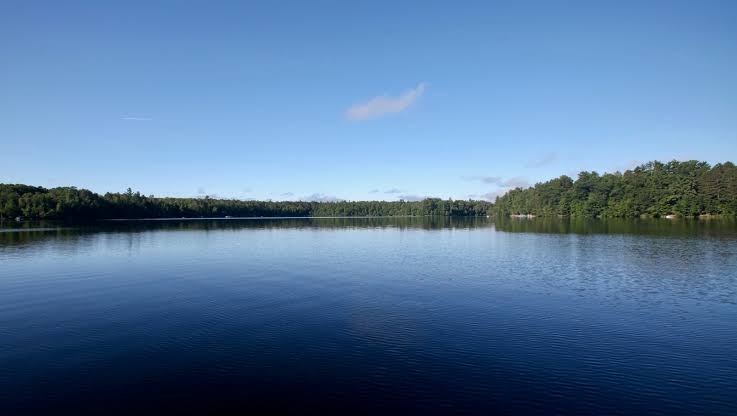
Taking a step away from the Takoda books allowed me to explore different settings, different beliefs, different folklore, and different fears. I also got to develop main characters without Native or Indigenous backgrounds. Having spent so much time within the Takoda world, though, I did find myself missing the familiarity of it. Despite the frightening things that have happened on the Takoda reservation, there is a sense of comfort there that feels like an extension of home.
Your own website still files Sisters of the Lost Nation and The Whistler as thrillers, while Indian Burial Ground landed on the preliminary ballot for the Bram Stoker Awards. Four novels in, how has your relationship with the horror label changed, and where do you think Savage Lake sits on that shelf?
Labels are difficult. I don’t spend much time thinking about them. That said, I’ve always loved horror, and horror elements always seem to find their way into my writing. I’ve heard critiques of my work saying my books are too this or too that to be one thing or another. It doesn’t bother me. I like when genre lines are blurred. I like to think of Savage Lake as a horror/thriller mashup. The past timeline is a true crime thriller. The present timeline is a horror story. I think they play well together.
Your titles have a habit of picking fights with old language. The Seattle Times noted that Indian Burial Ground took back a phrase that 1980s films such as Pet Sematary had used as shorthand, and now there is Savage Lake, a word with a long and ugly history in how Native people have been described. How deliberate is that pattern, and what does each title have to earn by the time a reader reaches its final page?
Titles are difficult too. Both Indian Burial Ground and Savage Lake started with very different titles. It wasn’t until the first couple of drafts were done that I was able to see what I was really writing about, and why reclaiming certain words within the titles was necessary.
Indigenous horror has had a remarkable few years, from Never Whistle at Night to Stephen Graham Jones’s The Buffalo Hunter Hunter, which you named among your favourite books of 2025. Publishing has a habit of turning any boom into a brand with its own expected furniture. What expectations do you feel pressing on a Native horror novel now that were not there when Sisters of the Lost Nation came out in 2023?
It seems that some readers expect all Indigenous horror to incorporate stereotypical elements of Native and Indigenous culture. I read a review of The Whistler in which the reviewer complained that the characters weren’t identifiably Native enough. To that, I say that Native and Indigenous individuals are modern people dealing with modern problems just like everyone else. They don’t always talk about Creator and dress in feathers, especially when they’re trying to secure adequate healthcare.
The cabin in the woods is one of the most trodden paths in horror, from The Evil Dead to The Cabin in the Woods, which took the whole idea apart and put it back together as a joke with teeth. Which cabin story, on the page or on screen, was in your head while you wrote, and which one were you determined not to write?
I can’t say that there was a single cabin story I was trying to emulate or avoid, but I have always loved the sub-genre. Misery, Cabin Fever, The Evil Dead, Near the Bone, The Troop, The Cabin in the Woods…. All of those horror stories (and more) have influenced me in one way or another.
Screams across water at night are a particular kind of terror, because sound carries oddly over a lake and you can never tell how far away it is. How do you write sound on the page, and what tricks did you find for making a reader hear something in Savage Lake that is not really there?
Setting and world building comes first. If you can make readers see and feel what it’s like to be isolated in the woods, it becomes easier to make them imagine other elements like scent and sound. It also helps to write a character’s response to a specific sound so that the reader will feel the same way about it.
Savage Lake folds a cold case, a cryptid and a family secret into one summer at a cabin, and each of those wants its own rhythm: the mystery wants clues, the creature wants set pieces, the family story wants quiet rooms and long silences. When those rhythms pulled against each other in the draft, which one did you let lead, and what had to go to keep the others alive?
There’s a lot going on in Savage Lake, but I worked hard to make sure that every piece of the story is essential. Everything has a purpose. Since each piece connects to something else in the book, I was able to find balance in that, letting each piece speak when necessary. I don’t think I had to cut anything out to keep the rhythms steady.
You told the Horror Writers Association a few years ago that you write about what unsettles you so that you can come to terms with it. Nell has a place she swore never to return to, because part of her died there. What place, real or remembered, did Savage Lake ask you to go back to?
There are a number of things in Savage Lake that were inspired by experiences I’ve had, particularly during childhood. Looking back at those things through an adult lens was an interesting experience.
Horror has spent a century telling audiences that the land is angry with them, usually without asking who the land was taken from. If Torchlight Lake could keep a grudge, what would it want Nell and Oscar to understand that no deed of sale could ever give them?
Torchlight Lake would acknowledge that it swallows secrets, and that it might even keep those secrets hidden for decades. But in the end, it’s the lake that decides if those secrets will stay hidden beneath the surface.
Get the book
Savage Lake by Nick Medina is out now from Berkley in hardback, ebook and audiobook.
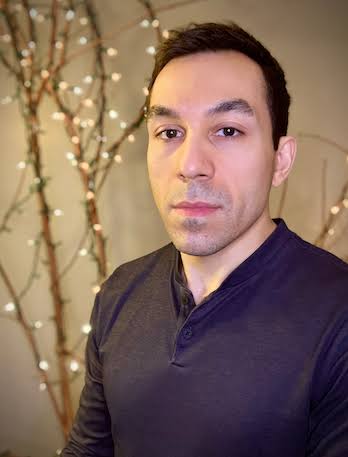
So the next time an estranged relative leaves you a lakeside cabin, take a lesson from this Nick Medina interview: read the deeds, learn the local folklore, and never assume the lake is on your side.
Keep reading on Ginger Nuts of Horror
 Sisters of the Lost Nation by Nick Medina -Book Review
 Dopefoot by Joshua Millican: Cryptid Horror With Teeth
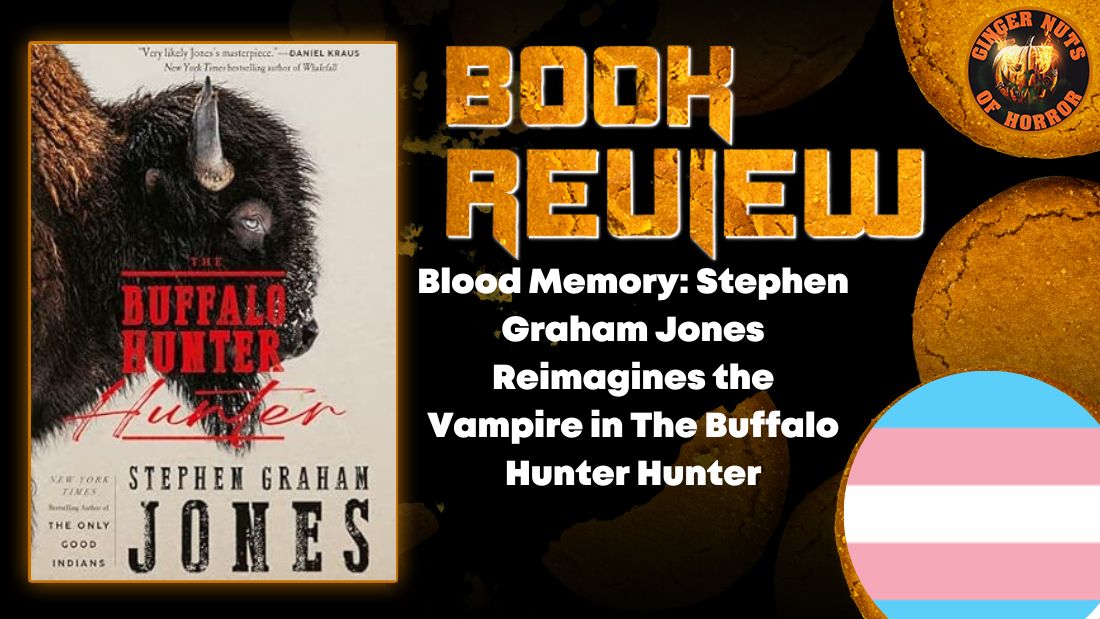 Blood Memory: Stephen Graham Jones Reimagines the Vampire in The Buffalo Hunter Hunter
About Ginger Nuts of Horror
Ginger Nuts of Horror is an independent horror review and culture site based in Edinburgh, Scotland. Edited by British Fantasy Award nominee Jim McLeod, it publishes horror book reviews, film reviews, author interviews, features and cover reveals. Ginger Nuts of Horror won Best Inclusive Film & Book Review Platform at the SME News UK Enterprise Awards 2026.