
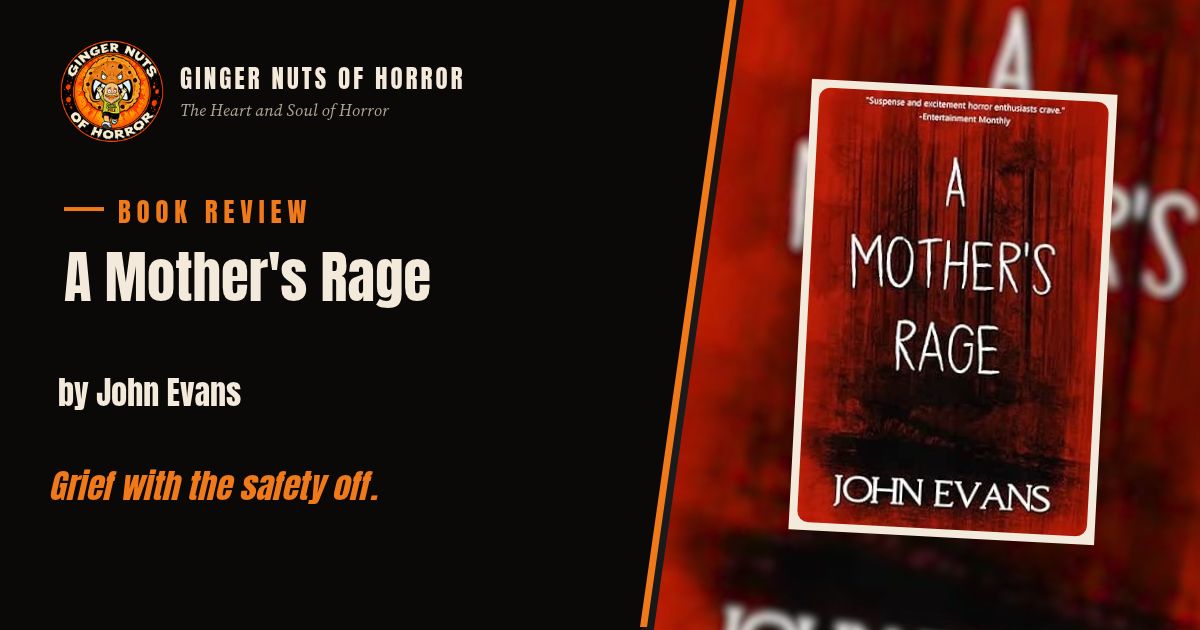
A Mother’s Rage Review | John Evans | Rowan Prose Publishing | 8 September 2026 |
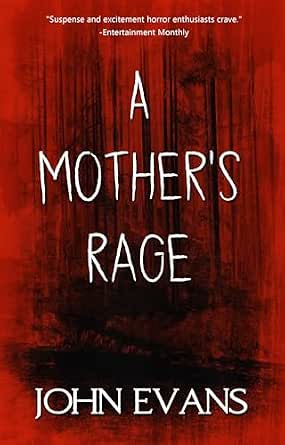
- Author John Evans
- Publisher Rowan Prose Publishing
- Published 8 September 2026
- Format Ebook
- ISBN 9798230379706
- Subgenre Revenge horror
- Reviewed by Jim McLeod
When trophy hunters in a helicopter gun down her twins in an Alaskan meadow, a badly wounded mother sets out across Aklak Valley to make everyone in her path pay.
A Mother’s Rage by John Evans is a revenge horror novel set deep in the Alaskan wilds. This A Mother’s Rage review comes with one plea: go in knowing as little as you can. Trophy hunters in a helicopter shoot a mother’s twins, and she sets out to make the whole valley pay. In her path stand a tired sheriff and a tiny New York dentist who should never have left Manhattan. Evans writes old-school splatter with a broken heart. The prose runs hot and the book runs long, but it hits hard. Here is why I think it earns a place on your shelf.
John Evans has written a revenge novel that grieves as hard as it kills. The prose runs loud and the second half sags under side stories, but the mother at its centre is unforgettable, the dentist is a joy, and the reveal is worth going in cold for.
A Mother’s Rage Review: John Evans Turns Grief Into a Body Count
Grief does not knock. It turns up on an ordinary afternoon, kicks the door in and starts moving the furniture. Most horror novels about loss let it creep. This one lets it charge.
Evans opens on a picture so pretty it feels like a trap. A mother picks blueberries in a meadow while her twins play tag round a hollow log. Bees work the wildflowers. Geese cross the sky in a neat V. Then a small helicopter drops low over the trees, men lean out with rifles, and a few shots end the day.
What follows is pure fury. Evans boils it down to a short, flat refrain: her children were alive, the hunters killed them, end of argument. It does more work than any of his adjectives. He repeats the shape of it a line later. The sentences shrink as her world does. There is no room left in her for grey, so there is no grey left in the prose. It is some of the best writing in the book, and it lands in the first chapter.
From there the novel runs on three tracks. The mother, shot and fevered, moves through the woods towards town. Sheriff Randy Pale-Horse, an Athabaskan lawman, has spent thirty quiet years running out the clock in Aklak Valley. Now he has to work out what is killing his neighbours. And Ephraim Klein, a dentist from the Upper West Side who stands a whisker under five feet, stays out on a guided hunt he has no business being on. Going home would mean his late father was right about him.

Ephraim is the big surprise. He could have been a punchline, and for a while he is one. He buys his blaze orange gear in the kids’ section. He has to scramble over logs the others just step over. He mourns the bagels of home over camp coffee that tastes like warm mud with a hint of rust. He is also stubborn in a way that is both foolish and oddly noble: when the sheriff tells every tourist to go home, he digs his heels in.
But Evans keeps pressing on the bruise underneath. Ephraim grew up the runt of the family above his father’s butcher’s shop. His father wanted him cutting meat; he became a dentist partly out of spite. The two never made peace, and one of the book’s quietest scenes turns on a postcard from a brother. Two words. It floors him.
His friendship with Colleen, a bodybuilding police sniper who hauls a dead mountain goat down a hillside like a gym bag, gives the novel its warmest and funniest pages. Their banter has real snap. She mocks his height, he mocks her muscles, and underneath it two people with rotten fathers find each other for a few days in the rain.
Pale-Horse gets the strongest chapter of all. Alone on his couch, craving a cigarette after ten years without one, he drifts back to a drunken night in his twenties and a car on a mountain road. He thinks of the father he walked out on and the grandmother whose stories he never quite believed. Then something skinless crawls across his ceiling. Evans handles the slide from memory into sleep paralysis with real control. The creature from his grandmother’s tales lands harder because we already know what the man is carrying.
The supporting cast earns its place too. Stephanie Tan, the town’s sharp-tongued medic, and Donald, the gentle volunteer who cannot keep his breakfast down at a crime scene, play like a TV double act. Dale Goggins, the local fixer with a hand in every business and a sneer for the sheriff, is a villain you will enjoy hating.
Aklak Valley itself is drawn with care. It is a town of loggers, drunks and one diner, three hours from the nearest hospital, propped up by tourists it quietly resents. A faceless firm called Trans National runs helicopter hunting tours out of the valley, and keeps a medical chopper on standby as the price of entry.
Evans is sharp on how a small town sells itself for a helipad. The weather turns on a sixpence. The roads hang off cliffs. Most of the locals seem to have come here to outrun something. That gives the book a lived-in grubbiness that suits the splatter. Nobody here is clean, which makes the one character with a clear reason for her fury all the more unsettling.
Is A Mother’s Rage Scary?
Scary is not quite the word. Brutal is closer, and sad is closer still. His author bio name-checks Stephen King and Gary Brandner, and his love of old-school horror shows on every page. Bodies come apart. A hunting camp turns into an abattoir. A set piece at the back door of the town diner, built round a heavy steel fire door that will not open from outside, is exactly the kind of scene paperback horror used to sell by the rack.
The dread works in a different way. We spend so long inside the mother’s head that the horror is less about who will die and more about watching someone burn through what is left of herself. Her chapters treat rage as relief at first. Then it turns into something worse. It becomes a rush she craves, the one thing that blots out the pain.
That is a bold thing to put at the heart of a revenge novel. Most revenge stories promise a clean release. This one suggests the release is the drug, and the comedown kills. A fever dream midway through, where a pale and sickly child calls the mother Mama and drives her on towards the meadow, is truly unsettling. It also plants a seed the closing pages harvest with real nerve. I will say no more. There is a reveal waiting in this book, and it recasts much of what came before. Go in cold if you can.
The targets are clear, if not subtle. Rich men who hunt from helicopters and pose with their kills. Fathers who measure their sons by how much blood they can stomach. A town happy to take the money and look away. Against all of that, Evans sets a mother whose grief has nowhere left to go. You can see the bones of the old revenge film, but the sympathy here runs in an odd and fresh direction, and the book is braver for it.
Fathers sit at the root of almost everything. Ephraim’s father belittled him for being small. Randy’s father fought the government for his people and lost, and the son walked away before he understood why. Colleen’s father thought women were good for two things, and neither was a rifle. Even the villains are men trying to look big in front of other men. Against all of them, Evans sets mothers who protect at any cost, and not only the one in the title. A dispatcher’s buried history, told in passing, turns on the same fierce love. The book can be clumsy in how it says this, but it says it with feeling, and the pattern gives the sprawl a spine.
John Evans came to this book from lighter ground. His debut, Midnight Falls, was a werewolf novel. The Tobias Halson Vampire Hunter books are urban fantasy, and if the praise for them is any guide, quick jokes are his calling card. You can hear that voice in Ephraim. He also has a collection, Long Drives and Lonesome Roads. A Mother’s Rage is sadder than any of that sounds, and more ambitious. It reads like a writer pushing past monster fun towards something with grief at the centre.
On the shelf it sits beside Jack Ketchum’s Off Season, another tale of backwoods carnage where small-town law arrives too late. Its cast of townsfolk with ugly secrets, the bigoted busybody, the bar owner on the take, the dispatcher with a buried past, is pure King. Closer to home, Kumar Sivasubramanian mixed gore with a mother’s love in Killarney Lake Massacre, and Gretchen McNeil found the same dread in the deep forest in They Fear Not Men in the Woods. Evans shares their taste for blood and their soft spot for the wounded.
Where A Mother’s Rage Overreaches
Here is the problem, and it is a real one. The novel is longer and louder than its story needs. Evans rarely meets a simile he will not stack on top of another. In the first chapter, a helicopter’s blades are likened to knives from a late-night TV advert. A few lines later the same machine becomes a dandelion seed on the breeze. Taken one at a time, fine. Taken in bulk, the prose becomes a chainsaw with the choke left out: loud, smoky, prone to stalling, and then suddenly through the bone.
The second half sags under side stories. Just as the final day gets going, the book stops for long backstories on people who are on stage for a page or two. Some of them are strong. All of them stall the pace exactly where the screws should be tightening. The narrator also likes to step out of the story to lecture, on gun shops, on rich hunters, on politics. Those asides read like an author holding forth at the pub rather than a character living on the page.
The copy edit needed one more pass, too. Ephraim’s name slips into Ephriam more than once. A sentence about the sheriff’s cigarette habit appears twice, almost word for word, in back-to-back paragraphs. Small things, but they add up in a book that already runs long.
Does any of that sink it? No. It costs the book a star, not the recommendation. The frame is strong enough to carry the extra weight, and the moments that land, the meadow, the couch, the dream, the diner door, land with real force. Plenty of tidier horror novels never risk this much. Evans risks it all on a mother nobody will forget, and she repays him in blood.
The Verdict: Is A Mother’s Rage Worth Reading?
4out of 5
The verdict
A grief-soaked revenge novel whose heart and nerve outweigh its overwritten prose and baggy second half.
Read it if: you love old-school splatter with real feeling under the gore, and a reveal that rewards going in cold.
Skip it if: tight, polished prose matters more to you than raw energy, or violence against children is a hard line.
Content warnings: graphic violence and gore, death of children, animal death, sexual content, references to child sexual abuse, domestic abuse, racism and racial slurs, homophobic slurs, drug and alcohol use, body horror and infection.
Keep reading on Ginger Nuts of Horror
 Wretch Review: Eric LaRocca’s Grief Horror and the Reverse Haunting
 Dopefoot by Joshua Millican: Cryptid Horror With Teeth
 Killarney Lake Massacre Review: Why This Splatterpunk Novel Hits Harder Than Its Urban Legend
About Ginger Nuts of Horror
Ginger Nuts of Horror is an independent horror review and culture site based in Edinburgh, Scotland. Edited by British Fantasy Award nominee Jim McLeod, it publishes horror book reviews, film reviews, author interviews, features and cover reveals. Ginger Nuts of Horror won Best Inclusive Film & Book Review Platform at the SME News UK Enterprise Awards 2026.