
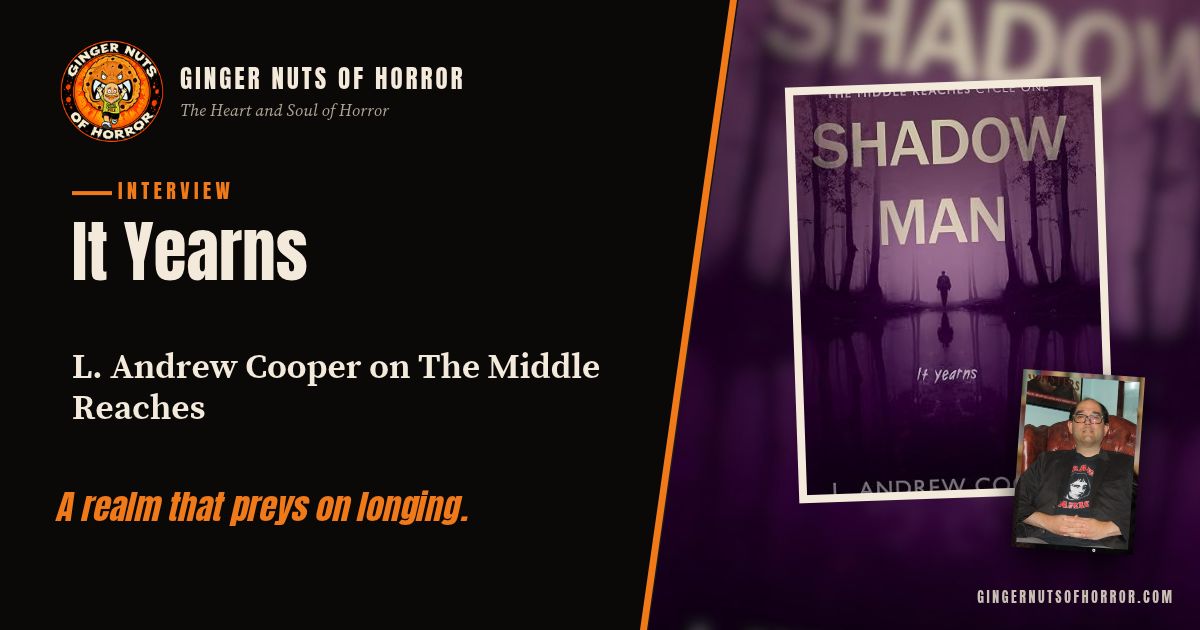
The Middle Reaches, Cycle One: Shadow Man | L. Andrew Cooper | Horrific Scribblings | 18 March 2025 |
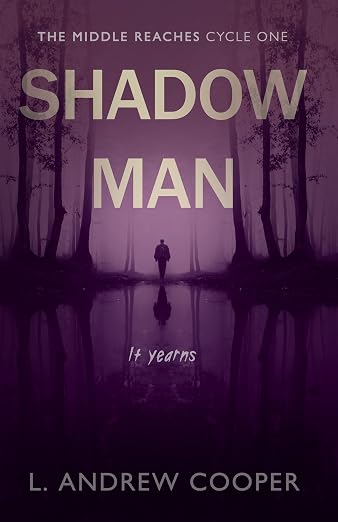
- Author L. Andrew Cooper
- Publisher Horrific Scribblings
- Published 18 March 2025
- Pages 217
- Format Trade paperback, ebook
- ISBN 9798991781312
- Series The Middle Reaches, Cycle One of Four
- Subgenre Weird horror, dark fantasy
Five friends reunite to find out what really happened to Sheldon, the school friend who vanished more than a decade ago, and the search leads them down a dark path into a realm that wants to keep them.
This L. Andrew Cooper interview takes us inside The Middle Reaches, his four-cycle series of weird horror and dark fantasy. Cooper specialises in the provocative, scary and strange. A writer of novels, novellas, nonfiction, anthologies and award-winning screenplays, he also owns and runs Horrific Scribblings, an imprint devoted to dark fiction. The Middle Reaches began life as a screenplay that won Best Horror Script at Hollywood Horrorfest, then grew, one weekly episode at a time, into four books.
Cycle One, Shadow Man, starts with five friends seeking the truth about Sheldon, a high-school friend who went missing years ago. What they uncover pulls them into a dangerous otherworldly realm, where a personal mystery opens into a much larger story, with tentacles, Carcosa and the King in Yellow waiting further down the path. We spoke with Andrew about where the series came from, how screenwriting and prose differ, and the fun of taking a story into ever stranger territory.
Cooper wants fear to do in fiction what it does so often in politics: shake people out of their comfortable assumptions and change their minds. The Middle Reaches puts that to work in an epic quest that preys on longing, where even gods and the King in Yellow yearn.
The L. Andrew Cooper Interview: Inside The Middle Reaches
Your work spans horror fiction, screenwriting, nonfiction, and editing. What continues to draw you to the provocative, scary, and strange?
My nonfiction is almost all about literature and film, so an interest in fiction, particularly fiction that shocks people out of their comfortable assumptions about life, unites my work and runs through everything I’ve published (or, for the screenplays, put into competition) in the last twenty years.
I’ve written in different genres, but horror is my favorite and, I think, the best for blasting away complacency: unfettered by the limits of anybody’s sense of “reality” and on a mission to freak people out, horror writers have spent centuries exploring the best ways to make people uncomfortable. The more uncomfortable—the freakier—the better. When people are uncomfortable, when they see their assumptions exposed, they’re likely to doubt their views of the universe and ask questions. Maybe they’ll be receptive to change.
Fear, as we see too often in politics (but not often enough in art!), provides powerful motivation. It changes minds. It’s transformative. If something is strange, the contrast with the normal shows that normal isn’t the only way. If it’s scary, it tears away comfort likely to discourage critical reflection. If it’s provocative, it invites thought. That’s what I want. Transformative, critical thought that challenges “normal.”
The Middle Reaches began as an award-winning feature screenplay before becoming a four-cycle book series. How did the project develop from that original concept?
I had a passionate love affair with screenwriting that lasted a few years, during which I wrote dozens of screenplays, most of them feature-length, a lot of them horror. They generally fell into two categories: practical projects likely to fit the budgets of the sort of producers who might pick up a “spec” script from a non-union writer with no production credits, and impractical projects of pure imagination for which I did not consider production limits.
The script for The Middle Reaches was of the latter sort. Visually, I planned spectacularly gory set pieces with FX that would be difficult/expensive to do well, such as maggots exploding from skin all over someone’s body (the scene occurs early in the book Shadow Man).
Story-wise, I wrote about events on multiple timelines, built a world and mythology far too big for a 90-minute horror flick, and established characters with backstories and relationships fully developed in my mind by only suggested by hints in dialogue or expressions. It’s bookish, and I didn’t think it would go over well, but it took home more than a few awards. The “Best Horror Script” award from Hollywood Horrorfest is probably my proudest screenwriting achievement.
So, some time after the script did its competition run, I heard about “Amazon Kindle Vella,” a now-defunct platform Amazon designed for authors to publish weekly “episodes” of continuing, longer-form stories, like soap operas, like streaming TV shows, or, as I saw it, like Charles Dickens publishing a serialized novel. I thought of trying it, and I thought of adapting The Middle Reaches almost immediately.
The story is a journey, which lends itself easily to episodic presentation, and the original script, which became the first book/cycle, Shadow Man, leaves a lot of story to tell. My favorite TV shows are like long, multi-volume novels, with a narrative arc planned in advance that unites all the seasons, but also with distinct arcs for each season (volume) and mini-arcs in each episode (chapter). The way the script drops unfollowed threads and layers timelines provide a foundation. I planned four cycles like four seasons of television or four volumes in one massive novel. Each cycle would have fifteen episodes. I started writing and publishing one episode per week. About sixty weeks later, The Middle Reaches was complete.
The story starts in Shadow Man as five friends reunite and search for answers about a companion who went missing years ago, when they were in high school, and their search leads them into the otherworldly Middle Reaches, a dark path to a strange Gate. While some characters continue from cycle to cycle, each cycle also adds new characters, timelines, and layers of story, building up to an interdimensional conflict involving gods and all kinds of monsters (the seeds of all of which were present in the original script).
After Amazon Kindle Vella died, I cleaned up my episodes and published the four volumes as books. Developing the story was quite an adventure. Reading it from start to finish—the real finish, the end of The Army of Ghosts—should also be quite a ride.
The first cycle, Shadow Man, begins with a missing-person mystery. Why was that a compelling starting point for a story that eventually expands into a much larger world?
Sheldon, the boy who went missing, was the soul of the character group’s childhood clique, and each of them—Ambrose, Celia, Leslie, Nick, and Pedro—had a special attachment to him. The tagline for The Middle Reaches is “It Yearns” because the place manipulates longing, preying on loss, and the group’s loss of Sheldon and then of each other provides the impetus for the journey from the familiar world into the unfamiliar as well as the emotional core that the darkness of the journey twists into horror.
Not really a spoiler: the whole group doesn’t survive Shadow Man. But all the characters and the characters’ losses remain important. Yearning twisted into horror appears throughout the series, staying at the center while the edges expand. We eventually learn that the God of the Citadel, mentioned briefly in Shadow Man but later an active character, lost his wife eons ago. Even the King in Yellow yearns.
The series combines weird horror and dark fantasy. What do these two modes of storytelling allow you to explore together?
Short answer: I get to do whatever the f**k I want!
The idea for The Middle Reaches came about because, though I’d written in those areas, I’d never written anything in the direct tradition of classic weird fiction—the vein of the Lovecraftian mythos. I wanted to play in that sandbox. Therefore, Shadow Man gives you tentacles and a mysterious portal in the first few pages. I don’t take anything directly from Lovecraft, but I do steal from The King in Yellow by Robert W. Chambers, both taking Carcosa as a setting (a place that originated with Ambrose Bierce) and the titular King as a character.
More fun than playing with someone else’s toys, though, was stripping away the rules of reality as situations become weirder and more fantastic. The monsters are delightful! The sky and “natural” surroundings mutate. Physics, time and space, misbehave.
More pertinent to the question of fantasy, dark or otherwise, is that The Middle Reaches is fundamentally a quest narrative. It’s an unconventional one, but it’s a journey like Lord of the Rings is a journey or, more apropos, like Stephen King’s The Dark Tower is a journey. The word “epic” is fine.
Your background includes both screenwriting and prose fiction. What differences do you find most important when developing a story for the screen versus developing it across several books?
Back when I taught writing and communication, we talked about taking advantage of the “affordances” of a medium, which basically means you’ve got to know about, think about, and use what a medium requires and allows in order to be effective with it. I like writing practical scripts because I intend them for indie filmmaking, which is what I can envision most easily in my head as I write.
Two of my most decorated scripts, Crash Café and Why She Did It, I wrote to be filmable on the cheap. The former takes place entirely in a one-room café and involves almost no FX. The latter takes place in one apartment, has only two characters, and involves only one FX challenge (solvable with practical means). Creating tension and scares to keep stories moving meant using visuals (movements and people and objects within locations, which meant a lot of thinking about props and sets and set dressing) and sound (not just dialogue but other noises and strategic stretches of silence) because film is a combination of visual images and sounds.
Books are about words, letters on pages, which rely on readers’ brains to react by summoning associations of the words with meanings and sensory information. Words require care and economy, but they don’t have FX budgets. Descriptions can be weirder, settings can be bigger… worldbuilding can much more easily involve entire worlds. And though words can’t deliver sights and sounds in the same ways as movie cameras, words can engage all senses, so fiction should, too (scary smells!), and, of course, while cameras have a hard time representing people’s thoughts, words on pages do not. In book form, The Middle Reaches gives you the characters much more as I know them. From the inside.
And then there’s scope. The Middle Reaches is, as I’ve mentioned, epic. Way too big for a movie. Unless Peter Jackson is available, probably too big for a quadrilogy. Four seasons of television… maybe… but honestly, I wrote it to play out in the imagination, not on screen, and I’m not sure it would translate. What the imagination can make grandiose, the camera might make silly. That’s why a lot of horror movie monsters stay offscreen.
The Middle Reaches grows from a personal search into a conflict with much larger implications. How did you approach expanding the story without losing the human element?
Each episode is locked inside one character’s perspective, so the entire story unfolds inside characters’ heads as they perceive what’s going on. Tensions within the group journeying into The Middle Reaches in Shadow Man fray their nerves almost as much as the monsters surrounding them. In A Rift in Time and Space, the second cycle, characters not only have different relationship dynamics but different reasons for being in The Middle Reaches that color their experiences. As the story evolves and humans find themselves encountering not only stranger and stranger phenomena but actual gods, they’re still humans, and you’re still seeing these encounters through their eyes.
The four cycles are Shadow Man, A Rift in Time and Space, The Flood, and The Army of Ghosts. What would you like readers to take away from the complete journey?
Maybe a sense of awe, that “it’s been a hell of a trip” feeling. I don’t write with a moral or message in mind. I do raise a few recurring questions, one quite directly: Which is more terrifying, hope or despair? Characters venture different answers. I don’t know, but perhaps readers will think about it in light of the journey they’ve experienced. I hope readers will question their realities because that will mean I’ve done my job. I hope readers will hold on to a favorite character or two and think of them from time to time.
For someone discovering The Middle Reaches for the first time, why should they begin with Shadow Man?
Shadow Man is the first cycle and the natural entry point to the series. It introduces The Middle Reaches, key characters, the disappearance of Sheldon, and other elements. It makes a foundational mold. The second cycle, A Rift in Time and Space, starts at a point seemingly disconnected from (but mentioned in) Shadow Man but quickly involves characters and events readers will not grasp fully unless they’ve read Shadow Man.
Progressing into the third cycle, The Flood, requires familiarity with all that has come before, and The Army of Ghosts, like any suitable grand finale, calls on details from all four cycles you might not recall even if you’ve read them all recently. It’s that kind of dark fantasy epic. Read it in order.
Get the book
The Middle Reaches, Cycle One: Shadow Man by L. Andrew Cooper is out now from Horrific Scribblings in trade paperback and ebook.
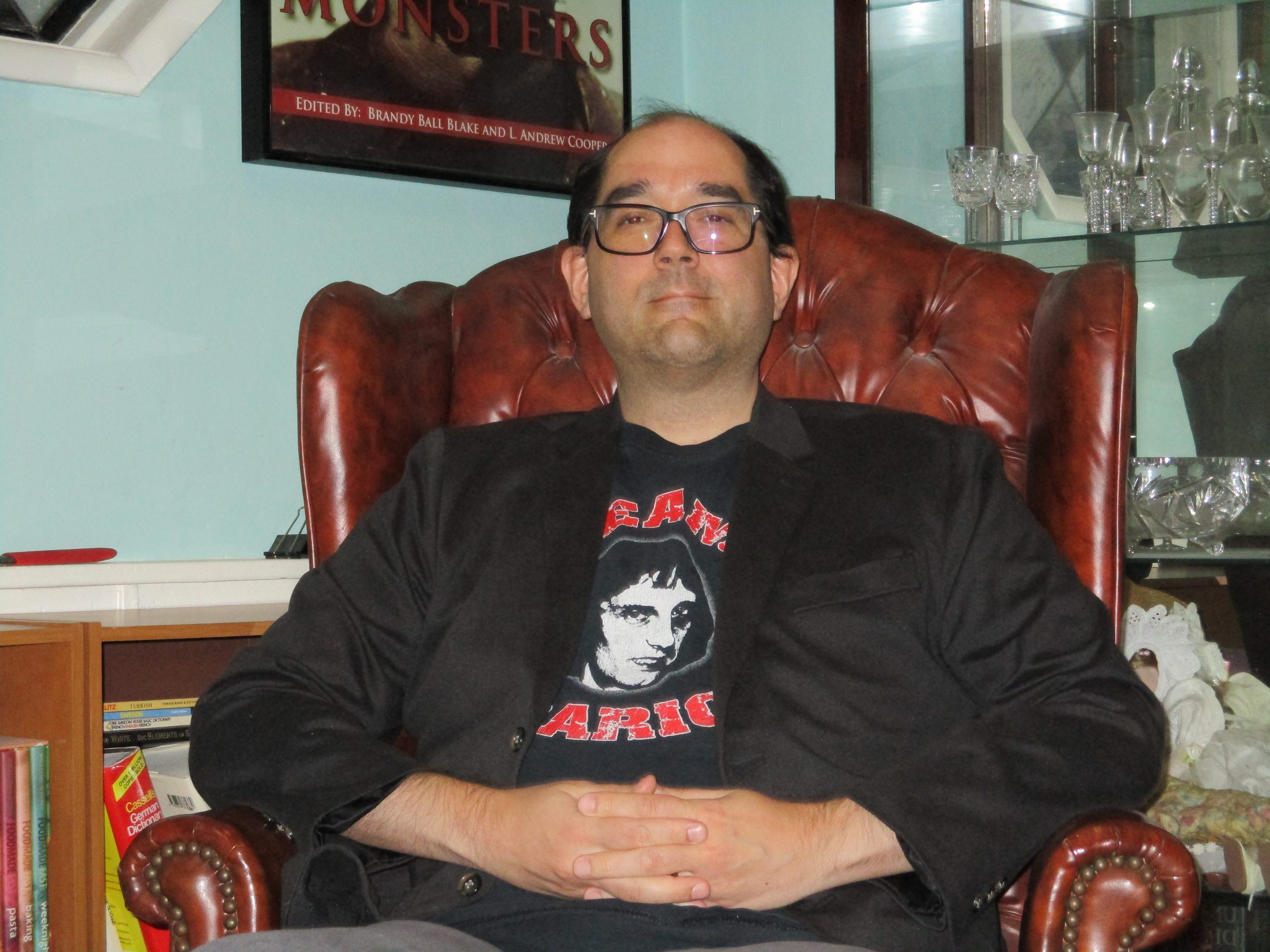
That wraps up this L. Andrew Cooper interview, and our thanks to Andrew for talking to Ginger Nuts of Horror. If the Gate is still yearning for you, there are plenty more horror interviews on the site to wander into, and we promise most of them have far fewer exploding maggots.
Keep reading on Ginger Nuts of Horror
 Hope Is a Weapon: Jonathan Maberry on Ghosts of the Void
 Little More Than Ants: Kevin J. Anderson on Nether Vortex
 Will Ludwigsen on A Scout is Loyal: Swift Boats and Deep Ones
About Ginger Nuts of Horror
Ginger Nuts of Horror is an independent horror review and culture site based in Edinburgh, Scotland. Edited by British Fantasy Award nominee Jim McLeod, it publishes horror book reviews, film reviews, author interviews, features and cover reveals. Ginger Nuts of Horror won Best Inclusive Film & Book Review Platform at the SME News UK Enterprise Awards 2026.