
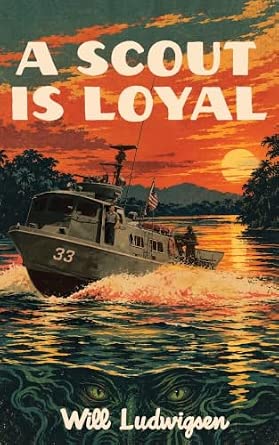
- Author Will Ludwigsen
- Publisher Lethe Press
- Published November 2026
- Pages 368
- Format Paperback
- ISBN 9781590218259
- Subgenre Lovecraftian war horror
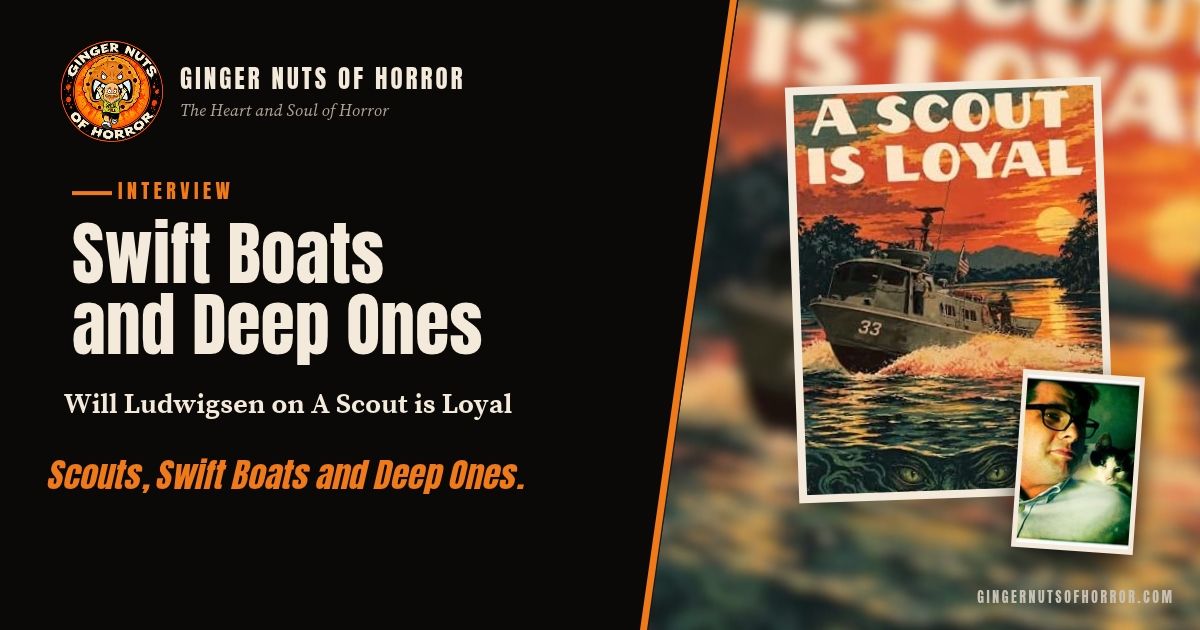
It is 1968, and Bud Castillo has traded the Scouts of Innsmouth for a Swift Boat in the Mekong Delta, where a conspiracy that reaches into American intelligence wants something ancient and hungry from the river.
This Will Ludwigsen interview heads back to Innsmouth with the author of A Scout is Loyal, the Lethe Press sequel to his Shirley Jackson Award finalist A Scout is Brave. Tony Jones loved the quiet, confessional voice of the first book in his review of A Scout is Brave here at Ginger Nuts of Horror.
Now it is 1968, and Bud Castillo is piloting a Swift Boat through the Mekong Delta. The war starts to look a lot like the fight against the Deep Ones he thought he had left behind. Ludwigsen talks about the “wouldn’t it be crazy if” questions that start his books, the writing advice he wishes he had ignored sooner, and the destroyer that ate 40% of his writing time.
He explains why a story about a man with a coffin on his back cracked his head open as a child. He also tells us why Shirley Jackson is his silent mentor and why Florida shaped him more than New York. Pull up a chair for one of our longer horror interviews.
Will Ludwigsen builds his horror from situations, voices and a lifelong urge to nudge the ordinary into a more eerie register. From Scouts in Innsmouth to Swift Boats in the Mekong Delta, his monsters stay close enough to psychology and biology that a desperate reader could almost explain them away.
The Will Ludwigsen Interview: Scouts, Swift Boats and the Sublime
Let’s start at the very beginning. Beyond the official bio, who are you when you’re not writing? What do you love, what fascinates you, and what would surprise readers to learn about you?
When I’m not writing, I collect vintage computers, play role-playing and war games, perform a lot of half-assed home maintenance for my hundred-year-old house, and run a gaming convention from that home called Willcon.
All of the things I find interesting seem to center around making the world stranger and more interesting than it appears, especially in retrospect. For decades as a kid, I wondered if I was “meant” to be a writer, but almost every single impulse I have is for nudging whatever is in my reach to a more eerie register.
I like feeling the presence of the sublime in my life, and I’ll put it there if I have to.
When a new project starts to take shape, what arrives first: a voice, a question, or an image you can’t shake? How does that first spark shape everything that follows?
It’s more often than not a situation that gets the motor started, usually in the form of, “Wouldn’t it be crazy/funny/horrifying if…”. In the case of A Scout is Brave, that situation was, “Wouldn’t it be crazy if there were Boy Scouts in Lovecraft’s Innsmouth?” For the sequel A Scout is Loyal, that question was, “Wouldn’t it be apt if Bud went to Vietnam and discovered that the war had parallels with the struggle against the Deep Ones?”
From that initial spark, I have some developmental questions I work through such as, “Who would be the worst person for this to happen to?”, and “What time or place would best reflect the conflict of this premise?”, and “What is everybody in the situation wrong about?”
I can’t really begin writing the actual words, though, without a voice: “What does this person sound like?” I like the role-playing aspect of the writing, and I can’t get far in a story without knowing how a person expresses themselves and perceives their world.
Maybe that makes me a Method writer, I don’t know!
What’s a piece of writing advice you were given early on that you now think is wrong, or that you’ve happily ignored?
When I was first starting out writing in the 1990s, there were lots of books about writing that focused on “structure,” this peculiar idea that there is a specific magical way to make a story satisfying to readers. It appealed to me, both as an English major interested in critical theory and as a programmer, because maybe there were switches to flip in the human brain to stroke our subconscious needs.
A decade of terrible clunking stories ensued in which I was asking myself about inciting incidents and internal conflict, following all that Save the Cat bullshit. It wasn’t until I leaned into what I did well, telling a story like a human being would, that I had more success.
What’s a horror book, film, or story you think deserves far more attention than it gets, and what would you say to convince someone to seek it out?
No one but me calls this horror, but Patricia Highsmith’s This Sweet Sickness is the only book that left me reeling for days wondering just how wrong I was about reality. In it, a man who has been dumped by his fiancée continues on as though this is only a temporary setback: buying a house, furnishing it for her, preparing for the moment when she comes to her senses.
Highsmith’s ability in her prose to make him feel completely rational while doing this is what makes the book terrifying. You think, “Wait, I feel rational, too. What am I deluding myself about?”
What’s the strangest research rabbit hole you’ve fallen down for a book? Did any of it make it onto the page, or are there things you found that were too disturbing, or too unbelievable, to use?

It feels like every man about my age gets assigned a war to be fascinated with, usually the American Civil War or World War II. Mine was Vietnam, perhaps because it was such a metaphor for everything right and wrong about my country: “We’re here to help whether you want us to or not, and if we make a buck in the process, who’s to mind?”
During all my research, I fell in love with Swift Boats, another perfect metaphor for America with overpowered engines and terrible maneuverability, crewed by daredevil showoffs.
What’s the first thing that genuinely frightened you as a child, and can you still find traces of it in your writing?
I discovered horror non-fiction before the fictional kind. My older sister read a lot of books full of putatively true weird stories about missing people and UFOs and ghosts. I’d sneak into her room and read them, including one by C.B Colby called Strangely Enough that included “Lord Dufferin’s Story.”
It goes like this: one night while staying at a friend’s country house, Lord Dufferin happens to gaze out to the moonlit garden and see a hideous figure trundling through with a coffin on his back. The man turns, snarls at Dufferin, and continues on his way. Some time later, Dufferin sees the man again working as an elevator operator in Paris and (wisely) decides not to take the lift…which falls from a snapped cable killing all aboard.
That story cracked my head open like an egg. Things like that really happened? How is it possible that people aren’t talking more about deadly threats like vampires or the Bermuda Triangle? Why isn’t there a huge government project to communicate with the dead? When are we going to get serious about finding whatever’s in Loch Ness?
I grew more skeptical as the years went on, but the idea that strange phenomena should be only mild mutations of reality still appears in my work. Most of the monsters in my work could have psychological or biological explanations…if you’re desperate enough to convince yourself.
Every book has its own problems to solve. What was the hardest puzzle you had to crack with this one: a plot hole, a character’s motivation, the structure, or something else entirely?

There are scenes in A Scout is Loyal aboard a destroyer called the Saber, and it took probably 40% of the writing time for the book to envision how my characters would navigate aboard the ship to execute their plan. I visited an actual Gearing-class destroyer to get a better sense of it, but it was still a challenge not to forget anyone: “Oh, crap: what’s that guy doing while everybody else is on deck?”
This is why I tend to write stories that don’t have a lot of characters!
Once a book is out in the world, it belongs partly to its readers. Has a reader or reviewer ever shown you something in your own work that you hadn’t seen yourself?
I wrote a short story called “In Search Of” in which a disembodied voice debriefs a dying detective about all the mysteries—public, professional, and personal—that he ever wanted answers for. It contains theories for things like who the Zodiac was, who shot John F. Kennedy, and what happened to Amelia Earhart.
I shared the story with a friend who is a contrary fellow, the kind of guy who thought the Lord of the Rings movies strayed too far from the source material by leaving out Tom Bombadil. He read the story and congratulated me on writing something so creepy.
“Imagine,” he said, “someone telling you all those lies on your deathbed.”
It never occurred to me that the debriefing didn’t have to be true!
Writing is demanding and often lonely. When a draft is fighting you, what keeps you at the desk: the thrill of discovery, the need to work something out, the thought of a future reader, or something less noble?
If I didn’t have crippling anxiety disorder, I would probably have been a performer or comedian because I thrill in the reactions of other people to my work. As a kid, I read stories voluntarily to my classes in elementary school and loved getting laughs and gasps from the audience.
(My family and upbringing were such that the two main modes we have of interacting with the world are making people laugh or scaring the shit out of them.)
I like doing readings of my work at conventions, and I live for even the slightest chuckle or shaking of the head. When the writing process gets tough, I imagine how an audience might react to the words. That’s my north star: focusing on what people might find interesting or entertaining or surprising to deliver that.
In that way, writing for me is an act of creative empathy, and when things get tough, I find returning to what a reader might love about it can get me back on track.
Beyond other books, what are the non-literary influences on your work, such as a piece of music, a historical event, a scientific idea, or a landscape, that have shaped how you tell stories?
Like many people who live in Florida, I’m both terrified and fascinated by it. We’ve got tourists, alligators, cockroaches as big as your hand, invasive snakes let loose from pet stores during hurricanes, the hurricanes themselves, weirdoes on the run from more civilized parts of the country, crackpots hoping for a new start, and conservatives carrying guns while barefoot on the beach.
It’s a place of strange, reckless freedom, full of people who are glaringly wrong about the world but still desperately confident to bend it to their will. From the very first settlers, it has always been a battleground between theory (“How hard can it be to build in paradise?”) and reality (“This place is a sweltering hellhole swamp.”).
Though I’m originally from New York, Florida’s deranged yet cheerful weirdness has been the greater influence on me…somewhat to my regret.
Is there an author, living or dead, you think of as a “silent mentor”? Not someone you imitate, but someone whose work gave you permission to write your own way?
I have a terror that Shirley Jackson would think I’m a hopelessly pedestrian hack who isn’t pushing far enough with my fiction, but I do see her as a silent mentor. She taught me so much about how the ordinary is much stranger than we think, especially in our skewed perceptions, and it was an honor to be nominated twice for the Shirley Jackson Award.
What scares you that you’ve never managed to put on the page, whether because it’s too personal, too hard to capture, or you’re not ready yet?
I have a strong fear of being falsely accused of a crime, something that probably jangles my brain stem from a childhood spent worrying about when I’d next be in trouble for something. Years of watching and reading true crime have taught me two things: nobody (even the innocent) escapes an encounter with the legal system unscathed, and the truth is at best an accidental byproduct of that process.
I’ve never thought of an idea worth the discomfort of writing such a story, and to be honest, Patricia Highsmith has cornered the genre with so many of her supremely uncomfortable books.
You have two minutes in a crowded bookshop with a reader who’s sceptical of the whole genre. They pick up your book and say, “Convince me. I don’t even like being scared.” What do you tell them?
“I get it; I don’t like being scared, either. I prefer feeling awe in the woods, like there are mysterious forces at work in the world, some on our side and some not, that remind us that we don’t know everything. That’s what this book is like, more about how we expand our perception to face the unexpected.”
Get the book
A Scout is Loyal by Will Ludwigsen is published by Lethe Press in November 2026, in paperback.
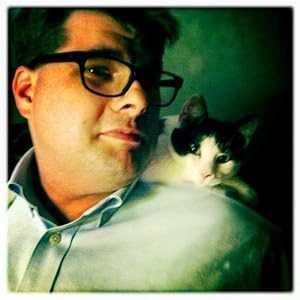
If a snarling man with a coffin on his back turns up after you finish this Will Ludwigsen interview, take the stairs.
Keep reading on Ginger Nuts of Horror
 A Scout is Brave by Will Ludwigsen
 The Ravening Deep by Tim Pratt, Book Review
 Nathan Ballingrud a Horror Author Interview
About Ginger Nuts of Horror
Ginger Nuts of Horror is an independent horror review and culture site based in Edinburgh, Scotland. Edited by British Fantasy Award nominee Jim McLeod, it publishes horror book reviews, film reviews, author interviews, features and cover reveals. Ginger Nuts of Horror won Best Inclusive Film & Book Review Platform at the SME News UK Enterprise Awards 2026.