A. Rushby talks about Victorian death photography, a house with a will of its own, and writing a life-affirming gothic about the dead.
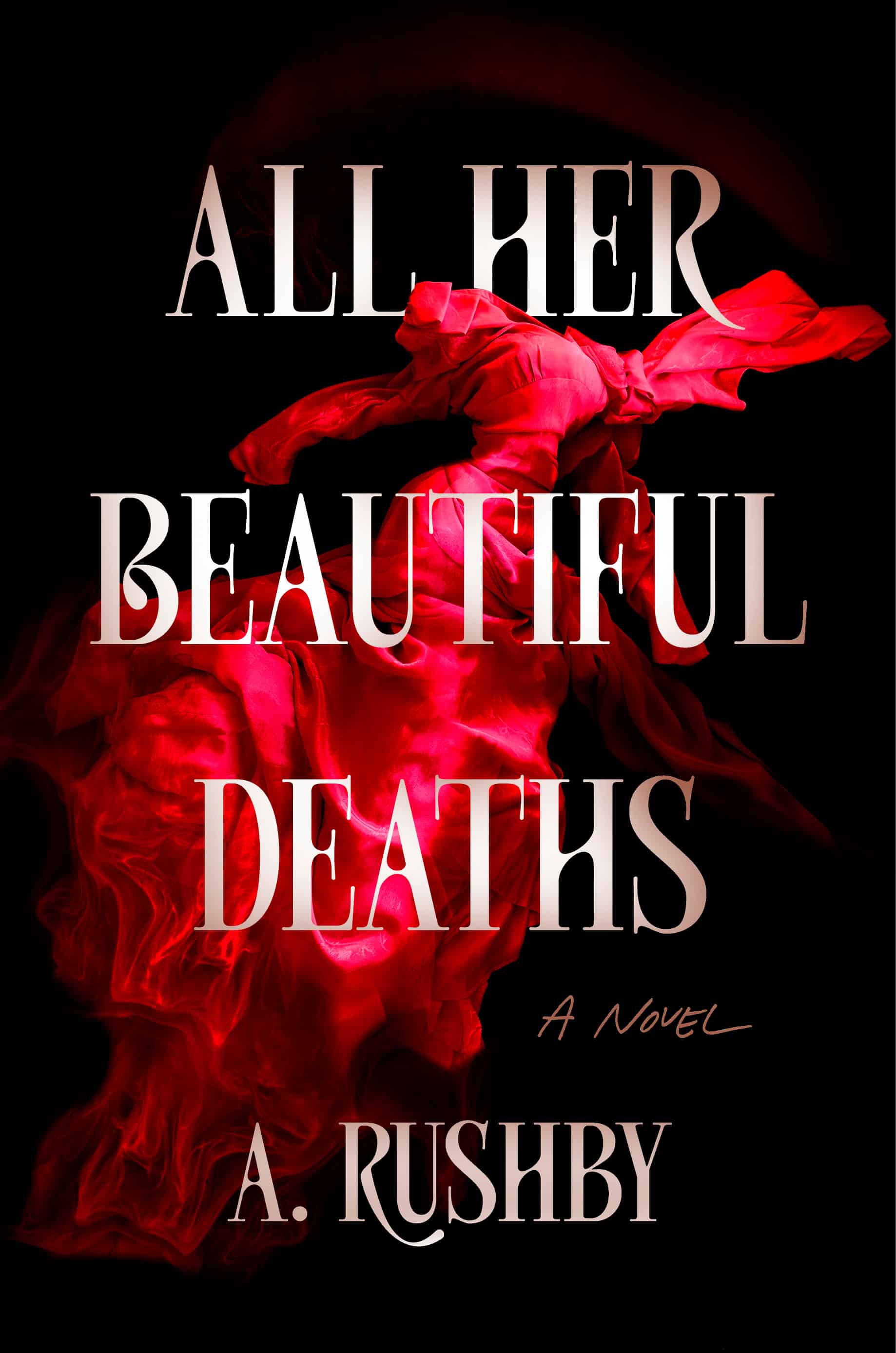
- Author A. Rushby
- Publisher Verve Books
- Published 1 September 2026
- ISBN 9780857309280
- Subgenre Gothic horror
In 1865, a maid called Minnie enters the strange London household of the Culpepper twins. Today, grieving artist Hadley is offered a fortune to hand over an album of Victorian death photographs and stay silent.
The Victorians photographed their dead. They propped bodies in parlour chairs, painted open eyes onto closed lids, gathered the living around a corpse for one last family portrait, and told themselves it was love. A. Rushby has built a novel on that practice. All Her Beautiful Deaths, out on 22 September, moves between 1865 and now, between a maid called Minnie inside the strange household of the Culpepper twins and Hadley, a grieving artist who cannot stop looking at an album of the dead.
It is Rushby’s second horror novel under this name, arriving a year after Slashed Beauties turned wax anatomical figures into instruments of revenge. Both books do the same unsettling thing. They take a woman’s body, make it an object to be looked at, and ask who profits from the looking. Rushby has called this the favourite of everything she has written. I wanted to know what it cost her, and where a book about photographing corpses finds room for tenderness.
Rushby treats Victorian death photography as grief before spectacle, and will not post the portraits online for that reason. All Her Beautiful Deaths turns that care into a gothic about worth, ownership and being looked at as an object, and after the darker Slashed Beauties it deliberately chooses yearning, decent people and a house that wishes its family well.

All Her Beautiful Deaths holds two women a century apart inside the same set of photographs. Before it became a book with two timelines, what was the first true fragment you had, the maid, the artist, or the album itself, and how did the second life grow out of the first?
It’s always so difficult to draw a line in the sand and say, ‘this is where this story idea began to come together’. I’ve been obsessed with Victorian cemeteries ever since I was a small child (I’m odd) and also with Victorian memorial photography, which I’ve been forever fascinated by.
But I do remember the idea of a maid chancing upon the photographing of a memorial portrait involving a girl and a swan came to me very early on. I knew that the reader would learn of this right up the front of the novel. And I knew that everything in the book would orbit around this one photograph of the girl and the swan on their sea of black velvet. From here I was able to begin to play around with a cast of characters and let them begin telling me things.
Slashed Beauties also braided a historical strand against a present-day one, and here you return to that architecture with 1865 pressing on Hadley’s story. The danger with dual timelines is that the contemporary thread becomes a delivery mechanism for the past rather than a life of its own. In what way did you build Hadley so that her half of the novel earns its place rather than framing Minnie’s?
I knew that I wanted All Her Beautiful Deaths to have quite a different feel to Slashed Beauties and that I wanted the two narratives to have a different weight to them, with the modern timeline being the actual story engine. Because of this, I spent a lot of time developing Hadley (her past, what formed her into the artist she is) and the secondary characters that surround her.
This did (ouch), make the writing of this novel lengthy to say the least. I think at one point the manuscript was around 150K. The finished product is around 135K, I believe. But I knew I would need the time and the space to let Hadley breathe in there, while still allowing Minnie (and Edith) to shine as well.
You split the household between the Culpepper twins, Edmund with his laboratory and Edith with her experimental photography, so that the science and the image-making sit in different bodies. What did dividing that work between a brother and a sister let you do that a single obsessive figure could not?
An interesting point! Despite Edmund and Edith being twins, I didn’t actually think about them like this at all. I thought more about pairing up Edmund in the past with Kit in the present and how their approach to their work (and righting the wrongs of the past) is similar in many ways. I was also quite determined to write a Victorian gentleman who was kind and decent to his sister and forward thinking (there is woman working in his laboratory etc.).
You have described Culpepper House as a sentient house, which is a stronger claim than a haunted one. A haunted house is acted upon by its dead; a house with a will has intentions of its own. How did you decide what the house wants, and how far you would let it reach for it?
I went back and forth on this one a lot. I knew quite early on that I wanted Culpepper House to be sentient and I wanted it to want the best for the Culpeppers. Apart from the house’s location atop Highgate Cemetery and the fact that the house has sadly suffered the deaths of three loved ones very soon after its construction, there was no reason that the house should be evil, or have terrible intentions.
At one point I considered removing this aspect from the novel entirely, but I’m glad I kept it in because I enjoyed writing about it tripping people up and catching at their clothes and also showing all the characters little snippets of future happiness. I’m quite cross that I can’t move into it.
The present-day plot turns on Kit Culpepper offering Hadley a great deal of money to make the album disappear. You have written a novel assembled out of images of the dead whose central question is who gets to control those images. What were you trying to work out about the ethics of looking at other people’s grief, and profiting from it?
I was just asked in an interview the other day why I haven’t shared more of these fascinating Victorian memorial portraits online and it’s been really important to me not to – to remember that they are, essentially, someone’s grief, no matter how long ago the portrait was taken.
This is partly why I developed the character of Hadley in the way that I did – I wanted her to have a very intimate understanding of grief as I knew she would very much connect with this special album of memorial portraiture and that she would have particularly strong feelings about what it was worth. It was this that I truly wanted to explore – worth, the commodification of art and ownership (of art, of a body/likeness/of women).
For all the corpses and cold plates, this is a book with warmth in it, and you have spoken about it turning toward gothic romance. Writing tenderness into a story built on death photography seems the hardest balance of all. How did you find the places where feeling was allowed in without the morbid tipping into the sentimental, or the romance curdling against the bodies?
It’s most definitely a romance in both past and present and I honestly believe it was the book I needed to write after Slashed Beauties, which was darker and had a bittersweet ending. I wanted it to be full of yearning and so deliberately set out to make it so. As I keep telling readers – ‘it’s the most joyous, life-affirming book about death photography that you’ll ever read!’. I wanted all the people held within its’ pages to be decent people, trying to do the right thing (even if they’re mostly going about it the wrong way, for we must have conflict…). Even the baddies are not all that bad.
Slashed Beauties made a woman’s body into wax and All Her Beautiful Deaths makes it into a photograph, and in both the body outlives the woman as an object other people own and display. When you look at the two books side by side, what is the preoccupation with the body as artefact really about for you, and has your answer changed between them?
I doubt there’s a woman alive who doesn’t know what it is to be perceived. To be looked at as nothing but an object and I think perhaps in All Her Beautiful Deaths I was hoping to free the women I trapped in Slashed Beauties. I think partly the reason I have a preoccupation with the body as artefact is because I live in a medical household (my husband is a medical specialist) and when we travel, we spend quite a lot of time in medical museums which is no great hardship to me.
We talk about bodies a lot more than most people, I think (for example, over dinner tonight we had a discussion about control in surgical theatres).
Before A. Rushby there was Allison Rushby, and more than thirty books across children’s, middle grade and adult fiction. Taking a separate name to write horror is a deliberate act rather than an accident of branding. What did the split let you do on the page that you could not have done under the name readers already knew?
Scarily, I have been many more people than this (I have a pseudonym I’ve used in educational publishing and quite a few others besides). I knew that I would, however, always be drawn back to writing this style of gothic historical fantasy and thus it was wiser to let readers know exactly what they’d be getting.
Slashed Beauties was your first horror novel, and a first book in any mode teaches its author something it takes the second to use. Setting aside where the idea came from, what did the actual writing of that first horror teach you about your own nerve or your own limits that shaped how you wrote this one?
When I wrote Slashed Beauties I honestly had no idea if it would sell. It was so… odd. No one knew what an Anatomical Venus was and whenever I tried to explain what I was writing (‘It’s about wax anatomical figures that come to life at night to murder the men who’ve wronged them!’), people would slowly back away.
All I knew was I was compelled to write it. It was quite freeing in many ways because I was able to write exactly what I wanted to write without worrying about what anyone else might want, or where it truly fitted from a market point of view. I think this did carry across to the writing of All Her Beautiful Deaths because in many ways it doesn’t make a whole lot of sense either – a life-affirming book about death photography.
Your work sits inside a very live moment for the feminist gothic, the current where women take the reins and the wronged woman gets her revenge. Yet in Slashed Beauties you made that revenge deliberately temporary and imperfect rather than triumphant. Where do you think this wave is heading, and what is the risk you see in the avenged-woman story if it hardens into a formula readers can predict?
I do know quite a few readers have been cranky that there wasn’t more stabbing of men in Slashed Beauties and, to be fair, when I started writing the novel, I thought there would be more stabbing of men. I discovered quite fast that the actual stabbing of men isn’t very interesting, but rage is fascinating. From the outset I knew that my characters based in 1769 could not triumph in a traditional sense, nor could their pet. Sex workers and exotic animals did not triumph in 1769. I’m really hoping readers and authors are still looking for a little realism in their historical fiction.
You have talked warmly elsewhere about Shelley, Sayaka Murata and Kazuo Ishiguro, so I want to steer you off those. What is a horror novel by another writer that genuinely unsettled you, the kind you rarely get asked about, and what precisely did it do to you that you have never quite shaken?
Oh, that’s easy! My absolute favourite horror novel is a YA title that gave me nightmares for several nights in a row (fun!) – The Call by Peadar O’Guilin. Teens are ‘called’ to the Grey Land where the Irish banished the Sidhe (faeries) thousands of years ago. There they must run for their lives for twenty-four hours in faerie time (only a few minutes in human time). Only one in ten children will return home alive and the ones who do are never the same again. The Sidhe are beautiful and cruel and absolutely terrifying like real faeries should be. It’s a truly fantastic read.
Minnie is a servant in 1865, and her interiority has to feel like a real Victorian woman’s rather than a modern one in costume, without slipping into the antique diction that makes historical voices sound like waxworks themselves. Was there a specific technical problem you hit in writing her voice, and how did you solve it?
It’s always a balance between flow and keeping the reader comfortable and the truth of what someone in Minnie’s position at that time would have done/thought/said and compromises always have to be made. We did hit one funny technical problem at one point – it’s not an easy task to explain to US readers what a stick of Brighton rock is!
Your horror works by pressure rather than gore; the reviewer of Slashed Beauties noted it is not a slasher, and the dread in your work tends to gather quietly. When the raw material is corpses and photographs of the dead, the easy move is to describe more. How do you build fear at the level of the individual sentence while holding back the thing a lesser book would show?
I really, really (really) didn’t want Slashed Beauties to be slasher book. I truly wanted the dread to be creeping – something that can’t be outrun – and to very much be in that feeling of being trapped (in your situation and also in a wax model). I think it’s the same in All Her Beautiful Deaths, especially when we look at Minnie. Each way she turns, there is nowhere to go and so she must succumb to her fate at Culpepper House. I think about it less at the individual sentence level and more at constantly turning the screw on my poor characters.
Death photography was, for the people who commissioned it, a way of keeping the dead in the room a little longer, a last act of holding on rather than a grim curiosity. After living inside that practice long enough to write a novel of it, what did it do to your own feeling about the images we make of the people we lose, or about one day being an image yourself?
I love discussing this with readers, because it’s such a strange concept to us – not having an image of a loved one to hold on to, particularly these days when you can take twenty photos of your breakfast if you like. I can’t say I particularly fancy having a death portrait taken of my loved ones, or of myself, but I loved having my character Elke (a photographer) control her death photograph from beyond the grave.
The title promises beautiful deaths, in the plural, as though beauty and death were things that could be arranged together on purpose. Do you believe there is such a thing as a beautiful death, or is the beauty only ever something the living compose around the dead for their own comfort, the way the Victorians posed the bodies and called it love?
I knew that the title would have to encompass many different kinds of deaths – both physical and metaphorical – all of them painful in their different ways, but pain is loss and we feel it most acutely when something beautiful has preceded it, so I believe they must go hand in hand.
Get the book
All Her Beautiful Deaths by A. Rushby is out now in the UK from Verve Books.
Ginger Nuts of Horror: The Heart and Soul of Horror Reviews

Jim "The Don" McLeod has been reading horror for over 35 years and reviewing it for more than 16. He's the editor of Ginger Nuts of Horror, Europe's largest independent horror review and culture site, and a British Fantasy Award nominee for his work in the genre. When he's not busy inflicting his opinions on the horror community, he can be found annoying his family or getting thoroughly outwitted by his two dogs, Casper and Molly.