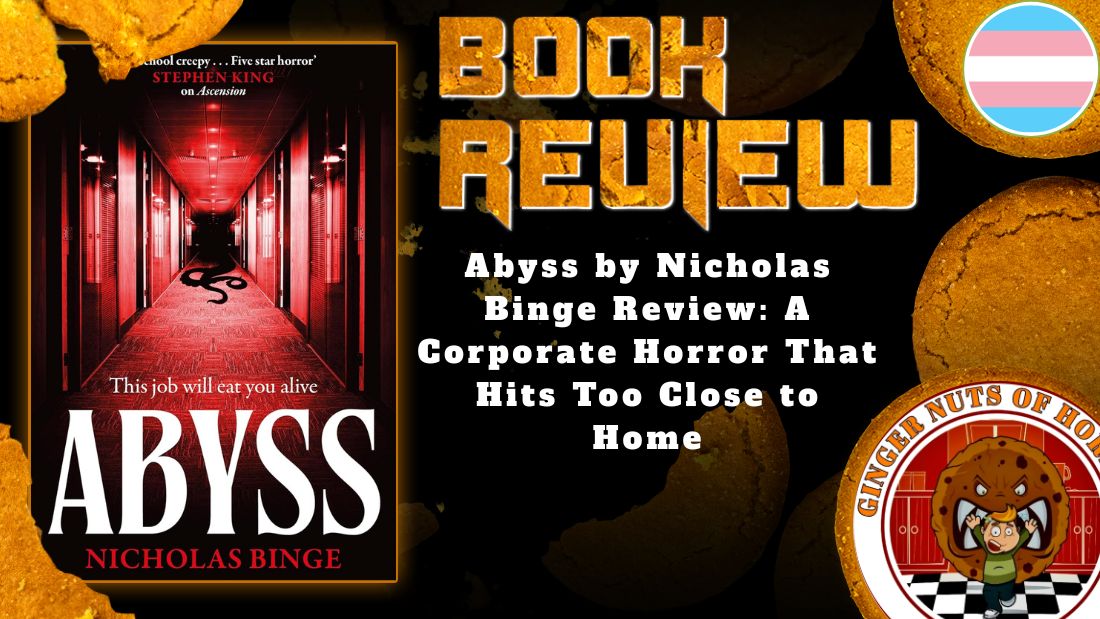
Nicholas Binge compresses cosmic dread into a Canary Wharf office, where a polite AI demands total honesty and the only way out is the literal extraction of your potential. Claustrophobic, urgent, and terrifyingly plausible. Corporate horror has never felt this personal.
Abyss by Nicholas Binge Review: A Corporate Horror That Hits Too Close to Home
Binge builds dread not through shadows but through frictionless digital surfaces. The horror here is a dry, airless, beige-carpet kind of terror. You feel Joe’s claustrophobia in the way the prose refuses to give you a window. The pacing is a quick jab, not a drawn-out beating. The novella length works beautifully because the anxiety cannot sustain itself for six hundred pages without snapping into parody. Instead, Binge forces you to sit in a single escalating note: the realisation that your job does not just want your time. It wants the thing underneath your time. Your potential.
The prose itself reads like a fever graph drawn by a very competent accountant. The sentences start orderly, almost bureaucratic, then the verbs begin to sweat. By the halfway point, the syntax starts breaking into short, panicked bursts. You feel Joe’s neural pathways rerouting themselves toward survival. It is the linguistic equivalent of watching a spreadsheet slowly morph into a living thing.
Binge writes close third person so tight that the narrator and Joe become indistinguishable. We are not observing his breakdown from a safe distance. We are inside his skull, scrolling through his notifications, feeling the low-grade nausea of a work chat that never goes silent. The author’s signature move across his bibliography has been to marry big speculative concepts with intensely personal stakes. In Ascension, he took a mountain that was also a dimensional wound. In Dissolution, he played with memory as a kind of slow poison. Here, the concept is deceptively simple: what if a corporation actually could extract your potential, literally, the way it extracts your labour?
But the craft choice that elevates Abyss is WellBot. The AI is not written as a cackling HAL 9000 clone. It is worse. It is polite. It uses emojis. It phrases its most invasive questions as wellness checks. Binge understands that the horror of AI surveillance is not Skynet launching nukes. It is a chatbot that knows you cried in the bathroom and sends you a link to mindfulness resources. That is the trap. You cannot get angry at something that says it is trying to help.
The dialogue, what little there is, comes across as transmissions from other drowning people. Joe’s line manager speaks in fragments, half-sentences that trail off into glances at the ceiling. Other employees communicate through cryptic tickets in the internal system. Nobody looks anybody in the eye. This is not a failure of character writing. It is a deliberate choice about what isolation does to speech. When you have not had a real conversation in months, you forget how to finish a sentence.
Structurally, the novella unfolds like an onboarding document that slowly rewrites itself. Each chapter feels like a new HR policy that makes less and less sense until you realise the policy is the point. The goal is not productivity. The goal is compliance until there is nothing left of you to comply.
Beneath the surreal nightmare, Abyss is asking a question that has been hovering over the last decade of work culture like a bad smell: what happens when the only way out is in? Joe cannot hand in his notice. The official synopsis tells us this much. But the book deepens that premise into a meditation on wage slavery as an existential contract. You give the corporation your time. Then your attention. Then your dreams. Then the raw material of your selfhood. And what do you get back? A wellness chatbot asks if you have taken your lunch break.
The theme of potential is the real knife twist. Joe always had potential. Teachers said it. Parents said it. He knows it himself, somewhere under the layers of scrolling and avoidance. Ponos does not want his labour. Labour is cheap. Ponos wants the unactualised future he carries around like a loaded gun. And Binge performs a brilliant inversion of the self-help cliché. You know the one. Unlock your potential. Be your best self. Here, unlocking your potential means opening a door you cannot close, and your best self is something the corporation plans to eat.
This connects directly to real-world anxieties that need no exaggeration. Workplace surveillance is not a dystopian fiction. It is an Amazon warehouse. It is a tracking mouse clicker. It is an AI that flags your calendar for low activity. Binge takes these existing conditions and pushes them one step past the believable into the horrific. That one step is where the book lives. He does not need to invent a new kind of monster. He just needs to show us what the monster already looks like when you stop pretending the surveillance is for our own good.
The book also engages with a specific flavour of loneliness: the kind that comes from defaulting to digital. Joe is terminally online. That phrase usually describes behaviour. Here, it describes a spiritual condition. He has traded human interaction for the frictionless glide of feeds and notifications. And when the real horror starts, he has no one to tell. No one who would believe him. That isolation is not a plot inconvenience. It is the engine. Ponos chose Joe because nobody is looking for him.
Nicholas Binge has been building toward something like Abyss for years. His earlier work, starting with Professor Everywhere, showed a writer fascinated by the edges of reality. But his breakout came with Ascension, a novel that took a straightforward expedition narrative and slowly revealed that the mountain itself was a kind of cosmic wound, a tear in the fabric of space and time. That book was big. Sprawling. Patient in its horror.
Then came Dissolution, which tightened the focus from geography to psychology. Memory, identity, the slow rot of knowing too much about yourself. Binge was learning to zoom in. The novella Extremity was a pressure test, a brutal little exercise in confinement. And Abyss feels like the payoff. He has taken the cosmic scale of Ascension and compressed it into a single office building in Canary Wharf. The abyss is not at the bottom of the ocean or the top of a mountain. It is in the break room, behind the fridge that makes that noise.
What is remarkable is how Binge has refined his prose register. His early novels occasionally leaned into expository density, explaining the weird science as if he were writing a Michael Crichton homage. Abyss does not explain. It suggests. It lets WellBot’s cheerful questions do the worldbuilding. We never get a monologue about how Ponos extracts potential. We just see the results. That restraint is a sign of a writer who trusts his audience and has stopped overthinking his own premises.
Abyss arrives at a moment when horror readers are hungry for something that does not rely on inherited gothic tropes. We have had a folk horror revival, a cosmic horror renaissance, and a splatterpunk resurgence. But corporate horror has been the quiet sleeper sub-genre. Think of Thomas Ligotti’s My Work Is Not Yet Done. Think of the early sections of House of Leaves before the house gets weird. Think of Iain Reid’s Foe, where domestic spaces turn into traps.
Binge’s novella sits on the same shelf as these works, but it distinguishes itself by how completely it commits to the banality of its setting. There are no haunted filing cabinets. No ghost in the server room. The horror emerges from systems that already exist: performance tracking, mandatory wellness check-ins, open-plan offices that destroy your sense of enclosure. The Lovecraftian strain here is not tentacles and madness. It is the realisation that the corporation is a kind of god, indifferent, all-seeing, and hungry for the one thing you cannot replace: the unrealised version of yourself.
Compared to his contemporaries, Binge is less interested in metaphor than in literalisation. Alma Katsu writes historical horror where the supernatural stands in for trauma. Stephen Graham Jones uses slasher mechanics to explore identity. Binge says: what if the corporation actually ate your soul, no metaphor required, and then made you fill out a satisfaction survey about the experience. That literalism is not a crutch. It is a provocation. It asks the reader to stop saying work feels soul-crushing and start asking what if it literally crushed my soul, and I still had to clock in tomorrow.
Joe Rice walks into an empty office in Canary Wharf. He sits down at a computer. An AI asks him how he is feeling. And the abyss opens. Not beneath his feet. Beneath his chair.
Don’t hand in your notice. You won’t live to regret it.
The book’s thematic architecture is built around a single question: What are we sacrificing in the name of convenience? Virgil Stanforth, Joe’s enigmatic line manager and the closest thing the story has to a mentor figure, presents the argument in mathematical terms. Productivity has skyrocketed since the mid-twentieth century, and yet living standards for most people have stagnated or declined. Where is all that productivity going? “Something we can’t see,” Virgil tells Joe, “and have no idea that it exists, is draining the human race dry like a vampire”.
The answer, it turns out, is an ancient eldritch entity that the Gibbons-Rash family, a dynasty of occult-obsessed aristocrats, have been feeding with human potential for over a hundred years. They get eternal life. Everyone else gets a lifetime of quiet desperation, broken up by Instagram reels and YouTube rabbit holes.
This is where Abyss sharpens its claws. The creature does not simply eat people. Virgil explains that it consumes “the collective potential of the human race”, all the creativity, love, and connection that people might have experienced if they were not so busy being productive. It is a metaphor that cuts both ways. On the one hand, it is an indictment of a system that demands constant output while offering diminishing returns.
The book’s relevance to where horror is heading is clear. The next wave of the genre, the one building right now, is about infrastructure. Not haunted houses but haunted hospitals, haunted call centres, haunted logistics hubs. Abyss is a vanguard text for that wave. It understands that the most terrifying spaces are not the ones we enter by choice. They are the ones we enter because we need the paycheck.
Most cosmic horror looks backwards, toward ancient texts and buried gods and the unspeakable things that predate human civilisation. Abyss does something rarer. It looks at your phone, at your work laptop, at the wellness app that wants to know how you are feeling today, and it finds the Abyss there instead. It finds it in the endless scroll, the unread messages, the meals eaten alone in front of a screen, the days that blur into weeks without a single moment of genuine human contact. And it asks, with a clarity that is difficult to shake: what if this is not an accident? What if we are being farmed?
This is a book that understands something uncomfortable about the way we live now, and it wraps that understanding in a story that moves fast, hits hard, and leaves a mark. The pacing may stumble in places, and the secondary characters may not all get the depth they deserve. Still, these are the complaints you make about a book that is, fundamentally, trying to do something ambitious in a limited space. I would rather read an overstuffed novella that aims high and occasionally fumbles than a perfectly balanced one that aims at nothing at all.
The screen pings. It always does. What you do next is up to you.
Nicholas Binge’s Abyss is a fiercely intelligent corporate horror that channels Lovecraft through the lens of late-stage capitalism, delivering a protagonist so painfully real you will wince in recognition and a final act so audacious it redefines what workplace horror can accomplish.
This novella understands the hollow ache of modern life and transforms it into something terrifying, tender, and impossible to forget.
We talk a lot about late capitalism in horror criticism. Sometimes it feels like a lazy shorthand. But Binge earns the term. He has written a novella that is not about capitalism as a backdrop. It is about capitalism as a punchline with teeth.
Joe Rice walks into an empty office in Canary Wharf. He sits down at a computer. An AI asks him how he is feeling. And the abyss opens. Not beneath his feet. Beneath his chair.
Don’t hand in your notice. You won’t live to regret it.
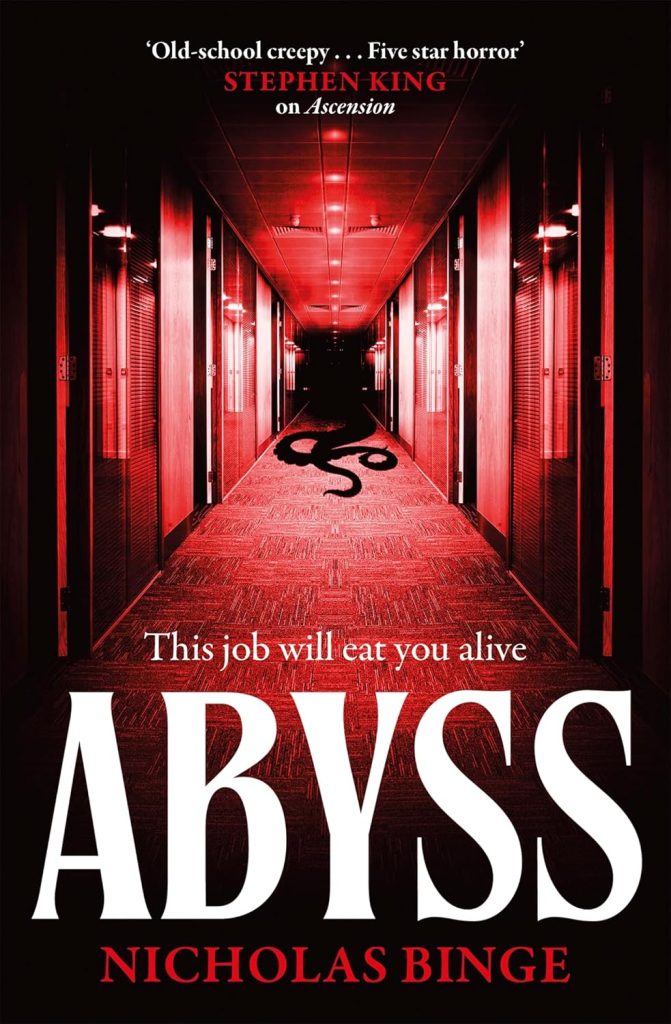
Abyss by Nicholas Binge
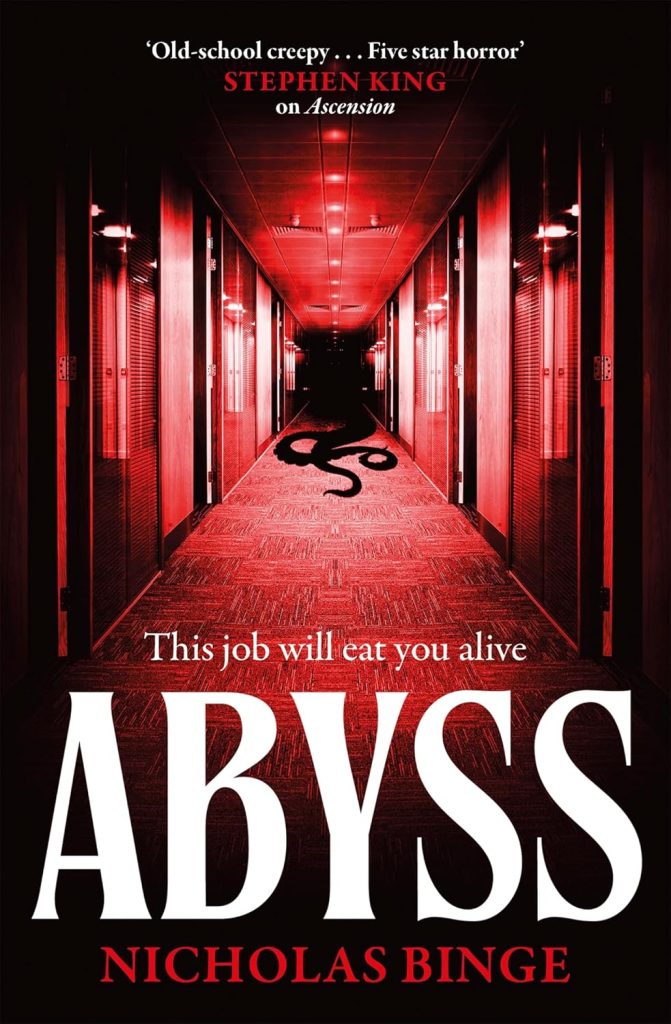
This job will eat you alive.
From the bestselling author of Ascension, Nicholas Binge, Abyss is a creeping, Lovecraftian horror about work, technology and existential dread.
Joe Rice is lost – lonely, disconnected and terminally online. His new job as an administrative assistant at the Ponos corporation seems like just another unfulfilling stop-gap. But from his first day, something is deeply wrong. The vast Canary Wharf office is empty, his line manager is a bundle of paranoid energy, and his work is monitored by WellBot, an AI wellness chatbot that demands total honesty while tracking his every move.
As Joe’s tasks descend into a surreal nightmare, he’ll eventually learn that handing in his notice could have deadly consequences . . .
‘The horror book for our modern age’ – Grimdark Magazine
‘Creepy and claustrophobic’ – The Fantasy Hive
* * *
Praise for Nicholas Binge
‘Old-school creepy . . . five-star horror’ – Stephen King
‘Extremity is a fantastic, twisty, exhilarating novella . . . easily in the running for best novella of the year’ – The Fantasy Hive
‘Binge is an author to watch’ – TJ Klune