Alex Hunter is done with monsters; the minds are what frighten him now.
Alex Hunter writes horror that would rather stay with you than shout at you. His recently published novel The House That Screamed is a haunted house story told through several forms of media, one that piles up the familiar tropes so it can take each of them apart. In this Ginger Nuts of Horror interview, Hunter explains why he now finds minds far more frightening than monsters, and why he is happy to leave the source of a horror unexplained.
He points to Peter Straub as the silent mentor who gave him permission to make his own rules, and to Paul Tremblay’s Horror Movie as proof that a reader can be trusted to decide for themselves what the real threat is. There is plenty on craft too: writing from the subconscious, letting landscape shape mood and behaviour, and drawing on his own experience of mental health to write the horror of losing control. For Hunter, horror is a way to talk about people, about our endless need to be entertained and our habit of quietly rewriting our own memories. This is a writer thinking hard about what genuinely unsettles a reader.
Alex Hunter has stopped chasing monsters and started chasing minds. He talks about horror as a way to say something true about people, about haunting a reader rather than startling them, and about loading The House That Screamed with every haunted house trope so he could pull each one apart.
Alex Hunter on The House That Screamed and Haunting the Reader
Let’s start at the very beginning. For our readers, please introduce yourself. Beyond the author bio, tell us a little about who you are when you’re not writing, what you love doing, what fascinates you, and what fuels your creativity.
Outside of my writing, I’m a corporate communications freelancer, so I spend my time writing even when I’m not ‘writing’. Aside from that, I love reading (essential for any writer) anything I can get my hands on, food and drink, and the gym three or four times a week (because of the food and drink).
In the early stages of a new project, what tends to come to you first: a compelling character voice, a central thematic question, or a vivid image/scenario? How does that initial spark then guide you in building the rest of the story?
It varies from project to project. My recently published novel The House That Screamed was written simply because I wanted to pay tribute to haunted house stories.
Conversely, I recently completed a manuscript because I had a vivid image of a teenage boy standing alone in a residential street after dark, clutching a backpack. I thought, Where are you going then? and walked at his side.
Every book has its own unique set of problems to solve. What was the most difficult ‘puzzle’ you had to crack while writing this book? Was it a plot hole, a character’s motivation, the structure, or something else entirely?
The House That Screamed is a meta-horror told through multiple forms of media. It has some pretty major twists and, in redrafting, I had to pull the whole thing apart like a wrecked engine and rebuild it piece by piece to make it work.
I think I pulled it off.
Once a book is published, it no longer entirely belongs to the author; it belongs to the readers and their interpretations. Has a reader’s reaction or analysis ever revealed something about your own work that surprised you?
Yes! Just last week, a reader told me that The House That Screamed is about ‘love’.
I’m pleased they enjoyed it, but I can’t quite see it myself. And that’s just fine. It’s not for me to decide how people should interpret a story, because every reader brings their own life experience to a book.
Writing is a demanding, often solitary pursuit. Beyond the apparent goal of ‘telling a story,’ what is the specific, personal fuel that keeps you going through the difficult stretches? Is it the joy of discovery, the need to understand something yourself, the connection with a future reader, or something else?
Increasingly, I write from my subconscious. The weird benefit is that I’m often surprised when I encounter scenes I have no recollection of drafting. I hope I’m not alone in this!
I love that feeling of discovery and, sometimes, I feel I understand myself more at the end of a project than I did at the start.
We often hear about authors being influenced by other books. What are some non-literary influences on your work, such as a specific piece of music, a historical event, a scientific theory, or even a landscape, that have profoundly shaped your storytelling?
My writing tends to be rooted very strongly in place. Landscape is becoming increasingly important to me, not simply as a backdrop but as something that shapes mood, behaviour and even the story itself.
I’m increasingly interested in what a place does to people, and what people leave behind in a place.
Is there an author, living or dead, whom you consider a ‘silent mentor’? Not necessarily someone you try to imitate, but whose approach to the craft made you feel permission to write in your own way?
The late, great Peter Straub. A man who understood horror so well that he had the confidence to make his own rules.
A true giant of dark fiction.
Horror is often most potent when it’s internal. Beyond external monsters, how do you explore the slow unravelling of a character’s sanity or the horror of their own mind?
As I continue my own journey as a writer, I’m less interested in monsters than I am in minds.
I’ve just revised a manuscript which, at its core, is about a young man who slowly loses his mind in the most relentless way because of the environment in which he finds himself.
As someone who has experienced mental health challenges, I’m acutely aware of the horror of not being in control, and I find myself leaning into that more and more as I develop as a writer, sometimes drawing on my own experiences.
Setting in horror is often described as a character in its own right. How do you approach transforming a location, whether a house, a town, or a landscape, into a source of active dread?
I really like embodied writing. A setting can be transformed through scent, sound and touch in a way that makes even somewhere completely ordinary feel uncanny, as if reality has slipped by just a few degrees.
Which of us hasn’t been walking in the woods, through a park, or even sitting at home and heard something that just sounds a bit ‘off’? I know I have, more than once.
Writing a terrifying buildup is one skill; delivering a satisfying payoff is another. How do you decide when to finally show the monster or reveal the source of the horror?
Sometimes I don’t.
As a reader, I find something immensely satisfying about having to decide for myself quite what the source of the horror is. Horror Movie by Paul Tremblay was a recent case in point.
As a writer, I find myself increasingly interested in ‘haunting’ readers. Something that goes ‘boo!’ can be scary for a moment. But other things, perhaps never fully explained?
Those things linger.
The horror genre is rich with established tropes and archetypes. How do you engage with these familiar elements, the haunted house, the ancient curse, the final girl, in a way that feels fresh and surprising? Do you consciously seek to subvert a trope, or do you focus on executing it with such depth and authenticity that it becomes new again?
With The House That Screamed, I made a conscious decision to deploy a lot of tropes in order to subvert them.
There was a particular joy in giving readers what I hoped they were looking for in a haunted house novel while also doing something fresh and new.
There’s a reason why tropes endure.
They work.
How do you approach writing scenes of intense terror or violence to make them feel physically impactful without tipping into gratuitousness?
It’s a hell of a balancing act!
I often like to cut away just before the worst thing happens, or keep it off the page entirely. That said, there are occasions when I think, Sod this, I’m going there.
I think gratuitous can work, but only if the story has earned its horrors. As the writer, part of my job is to take the reader by the hand and say, “Come on. Let’s go through this together.”
What is the specific, core truth you are trying to expose or explore through your horror?
For me, horror is a delivery mechanism for talking about humans and what makes us human.
The House That Screamed, for example, is an examination of our relentless need to be entertained, regardless of the source of that entertainment. I’m also fascinated by memory, particularly people’s endless capacity to alter their own recollections in order to keep functioning.
You have precisely two minutes in a crowded bookstore to hook a reader who is sceptical of the entire horror genre. They look at your book’s cover and ask, ‘Convince me. Why should I read this? I don’t even like being scared.’
Because horror isn’t just about being scared.
At its best, it entertains you, unsettles you and perhaps makes you recognise something about yourself you hadn’t quite wanted to look at before.
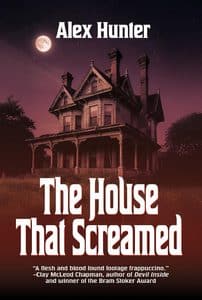
The House That Screamed by Alex Hunter
“Alex Hunter’s The House That Screamed is a flesh and blood found footage Frappuccino that blissfully blends The Amityville Horror, Paranormal Activity, Poltergeist, and just about every nightmare you’ve ever had into one hell of a spooky smoothie. The brain freeze from reading this one too fast is real, believe me.” —Clay McLeod Chapman, Bram Stoker Award-winning author of Devil Inside
Some houses are haunted by more than ghosts.
The Fleming family, recovering from a terrible loss, believe they’ve found a fresh start in sleepy Harrowridge. But at 1123 Jefferson Street, something is waiting.
Within weeks, whispers turn into screams. Family ties unravel. Blood is spilled.
The Flemings flee, leaving the house behind. Or so they think.
Now, decades later, after the family’s story has been transformed into a bestselling book and a film franchise, a team of podcasters reopens the door to America’s most infamous house, determined to separate truth from legend. To their horror, they begin to uncover what the legends got wrong.
Because at the house that screamed, not everything that hungers is dead.
Ginger Nuts of Horror: The Heart and Soul of Horror Reviews
Every feature is built to sell your work. We include backlinks to your website or Amazon author page, a full synopsis, and a universal purchasing link that sends readers straight to their local store. Add a large, engaged social following and an 18-year archive of trusted horror coverage, and you have a platform genuinely built to grow your readership.
Whether you’re an established author, an indie filmmaker, or a debut voice in indie horror, there’s a way for us to help you reach more fans. Explore our horror book reviews and horror movie reviews, then get your horror book or film featured today.

Jim "The Don" McLeod has been reading horror for over 35 years and reviewing it for more than 16. He's the editor of Ginger Nuts of Horror, Europe's largest independent horror review and culture site, and a British Fantasy Award nominee for his work in the genre. When he's not busy inflicting his opinions on the horror community, he can be found annoying his family or getting thoroughly outwitted by his two dogs, Casper and Molly.