- American Nightmare by Kelly McWilliams: Historical Horror of 1919 and the NAACP Spy Who Passed for White
- Wearing the Enemy’s Face: Kelly McWilliams on American Nightmare
The most frightening thing in this novel is not the ghost. It is the paperwork.
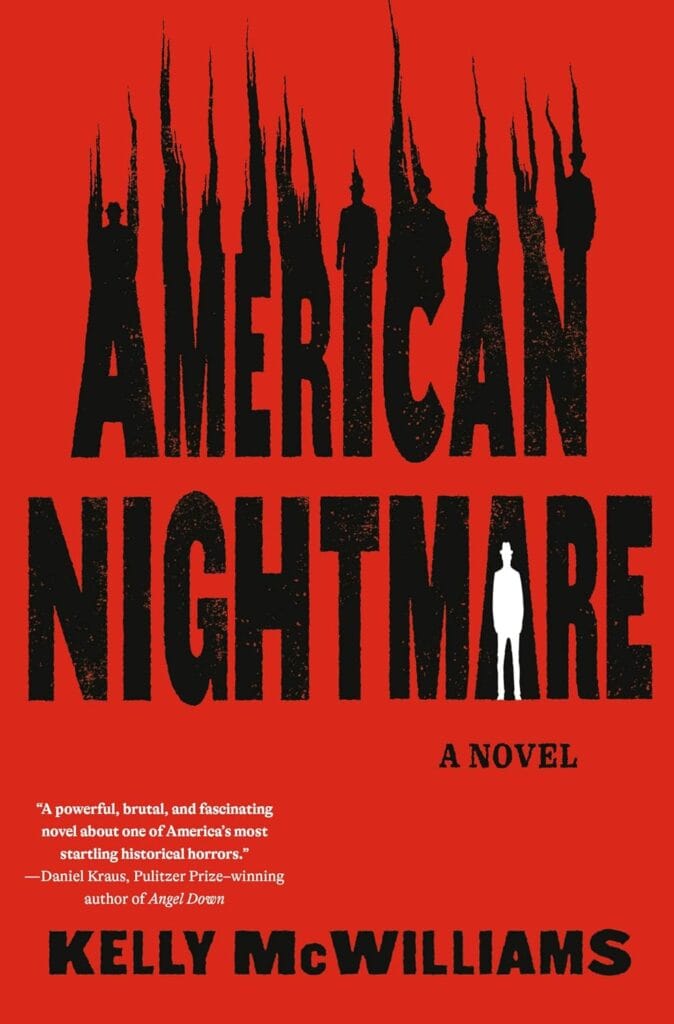
American Nightmare | Kelly McWilliams | Crown | 15 September 2026 |
Kelly McWilliams makes her adult debut with a historical horror novel built on the life of Walter F. White, the NAACP official whose fair skin let him walk into towns that had just committed murder and take down the names of the men who did it. American Nightmare gives that work to Clark Wendell White, a Black man light enough to pass, and sets him loose across the Jim Crow South during the Red Summer of 1919. Stalking him is a presence he has carried since childhood. Stalking him too is a Klansman who can see straight through the disguise. This is horror doing the job history books avoid.
McWilliams keeps the Nightmare vague in exactly the way racial terror was vague to the people living under it: everywhere, unaccountable, wearing whatever face the day required. Refusing to make it legible is the bravest thing in the book.
American Nightmare by Kelly McWilliams: Historical Horror and the NAACP Spy Who Passed for White
The most dangerous disguise is the one that fits. A costume comes off at the end of the night. A face does not, and the man wearing it has to decide every single morning what he intends to do with the thing he was born inside.
Kelly McWilliams builds an entire novel on that decision, and she builds it well enough that the horror arrives before you have finished admiring the architecture.
American Nightmare takes the life of Walter F. White and turns it slightly, the way you turn a coin to catch the light. White was the NAACP man whose fair skin, blond hair and blue eyes let him walk into a town that had just murdered somebody and take notes from the people who did it. McWilliams hands that job to Clark Wendell White, thirteen years old when the Atlanta massacre of 1906 comes down his street and his father stands guard over the family home. Something looks back at Clark out of the mob that night. He calls it the Nightmare. It never leaves.
Years later, turned away by a segregated army that will not put a man who looks that white into a Black regiment, Clark answers an advertisement at NAACP headquarters in New York. They want light-skinned Black men for dangerous undercover work. What follows carries him from Tennessee to Texas through the Red Summer of 1919, gathering the names of lynchers so the organisation can print them, shame them, and force Congress towards an anti-lynching bill.
Here is the fact the novel never has to state, because history states it loudly enough. That bill did not become federal law until 2022.
Two boys on the same street
The book runs on two points of view, and the second is where McWilliams earns her money. Sam Cahill was the boy in the mob. He grows up in parallel with Clark without ever meeting him again, a butcher in New York with a Klan membership and a talent for identifying Black men who can pass. The Klan is opening a chapter in the city. Cahill is precisely the recruit it has been looking for.
Structurally this is a lovely piece of engineering, and it is worth looking at properly rather than nodding at in passing. Two boys stand on the same Atlanta street on the same night in 1906. Both are refused by the army when the war comes, for opposite and equally stupid reasons. Both wash up in New York. Both consider themselves to be working for the improvement of their fellow men. McWilliams sets their chapters against one another and then does the hard thing, which is nothing. She lets the symmetry hold. Nobody stops to deliver a speech about how courage and hatred can share a silhouette. The reader is trusted to see it.
That restraint is the close-reading lesson of the whole novel, and it is most visible in how Cahill is assembled. Early readers who have gone through advance copies describe him as a man with a grievance rather than an idea: a broken nose, a mother who did the breaking, a face he believes was ruined, and a country that offers him a way to convert private humiliation into public power. Horror fiction is stuffed with villains who explain themselves at length. This one frightens more because the explanation is so small. He was hurt, and there happened to be an organisation waiting with a robe in his size.
Notice what that does to the title. The American nightmare is not a supernatural event that befalls a nation. It is a recruitment strategy.
The Klan takes Manhattan
The smartest historical decision in the novel is where it puts its hood-wearers. Everybody expects the Klan in Georgia. McWilliams grows a chapter in New York City instead, in the same streets where Clark is being trained to infiltrate white organisations, and the effect on the book is enormous.
It removes the escape route. A great deal of American horror set in this period runs on an unspoken geography where the South is the sick place and the North is where you go to be safe. Clark makes that journey in the opening act. He arrives at headquarters, he is given work that matters, and the thing he ran from is already there, unpacking, hiring, holding meetings. There is no free state in this novel. There is only the version of the disease with better manners.
It also does something quieter and nastier.
Clark and Cahill are both, by the standards of their own communities, ambitious young men making good in the city. They both got the New York job. One of them is compiling evidence to bring a murder charge; the other is teaching men how to spot a Black face under white skin, which is to say he is building a countermeasure to the exact skill Clark is being paid for. They are, functionally, rival professionals in the same emerging industry. McWilliams never says this out loud. She does not need to. The chapters do it by sitting next to each other.
The monster that will not hold still
The supernatural element here is deliberately thin, and I think that is a decision rather than a failure of nerve. The Nightmare is a presence, a smell, a wrongness behind a stranger’s eyes. It has no rules. It has no weakness you could look up in a library. It attaches itself to a frightened child and it feeds.
Some readers coming out of advance copies have wanted more of it, and I understand the appetite completely. A monster kept at the edge of the frame can look like a monster the author never finished. But a novel about lynching cannot afford a well-explained monster, because the moment a thing can be explained it can be contained, and containment is a lie this subject will not tolerate. McWilliams keeps the Nightmare vague in exactly the way racial terror was vague to the people living under it: everywhere, unaccountable, wearing whatever face the day required. Refusing to make it legible is the bravest thing in the book.
The same logic answers the other reservation doing the rounds, which is that the first half accumulates rather than accelerates. That is true, and I would not argue the tempo. I would argue the reason. Passing is not an action sequence. It is a slow, daily, grinding act of self-deletion, and a novel that sprinted through it would be telling you a comfortable lie about the cost. The setup is not delay. It is the bill being itemised before it is presented.
There is a ghost, too, and it belongs to Clark’s dead friend Davey. It functions less as a haunting than as an accusation, which is the correct use of a ghost in a book like this.
McWilliams writes clean. The prose sits plain on the surface and loaded underneath, and every so often it opens up and hands over a sentence that lodges somewhere behind the sternum. Reading her is like handling a well-made boning knife. Most of the time you are noticing the balance and the weight of the handle, and then it goes through something without appearing to try.
Agnes at the End of the World (2020), a Golden Kite Award finalist, splits its narration between two sisters. Mirror Girls (2022) puts biracial twins on opposite sides of the colour line in 1953 Georgia, one raised Black in Harlem, one raised as a white plantation heiress, cursed with a reflection that will not appear. Your Plantation Prom Is Not Okay (2023) came at the same wound from a different angle entirely. No One Leaves the Manor, published for young readers this July, dropped 1920s debutantes into a house that watches them.
Put Mirror Girls beside this one and the growth is impossible to miss. The earlier novel uses the mirror as its metaphor for passing and lets the metaphor carry the weight of the horror. American Nightmare throws the mirror away. There is no curse to break, no reflection to recover, no supernatural mechanism that can be defeated by love or cleverness. That is what moving into adult fiction actually looks like. Same preoccupation, minus the escape hatch.
The obvious neighbours are P. Djèlí Clark’s Ring Shout, Tananarive Due’s The Reformatory and Victor LaValle’s body of work, with Colson Whitehead’s The Nickel Boys and Percival Everett’s The Trees standing nearby from the literary side. What separates McWilliams is what she declines to give you. Ring Shout hands you Ku Kluxes you can put a blade through. The Trees hands you the deep, disreputable pleasure of vengeance. Neither is available here. There is no monster to kill, because the monster holds a membership card and a job and a mother and a grudge, and killing him would leave the chapter fully staffed.
That places American Nightmare in the harder half of the sub-genre, the one that refuses catharsis on principle. It also makes it the more useful book. A novel that lets you slay racism is a novel you can close.
The theme underneath everything is what survival costs when survival means looking like the people who want you gone. Clark spends the book wearing the enemy’s face and being told, by his own side, to prove he is not the enemy. Brit Bennett’s The Vanishing Half asks what passing takes from a life. McWilliams asks something meaner: what passing takes from a life spent using it as a weapon.
Nothing in this novel gets killed at the end. Nothing gets explained, either. McWilliams is brave enough to leave the thing standing exactly where it has always stood, out on the street, in the daylight, wearing a face you might recognize.
American Nightmare by Kelly McWilliams
“With its unflinching excavation of our dark past, American Nightmare is a page turner with a message.”—Tayari Jones, New York Times bestselling author of Kin
In this haunting historical novel, a light-skinned Black man goes undercover to investigate lynchings in the South, only to be confronted by the very evil that has pursued him since childhood…
Clark Wendell White first encountered the Nightmare as a child during the Atlanta Race Riot of 1906, when he and his father stood guard over their family home. In the eyes of the mob surging through his neighborhood, Clark sensed this malevolent presence. It was then that the Nightmare took shape, burrowing deep into his mind and feeding on his fear.
Years later, the same evil presence drives Clark to the NAACP’s headquarters in New York City, where he answers an ad seeking light-skinned Black men for dangerous undercover work. As a spy for the NAACP, Clark investigates lynchings, impersonating the very Nightmare that once tormented him.
As Clark descends deeper into this double life, another force rises: a new chapter of the Ku Klux Klan, finding a foothold in the storied streets of New York City. Among its eager recruits is Sam Cahill—the one man who can see past his disguise. Now Clark must outwit both the living and the dead, as he confronts a past that refuses to stay buried and a future where the act of passing exacts a soul-deep price.
Inspired by the life of civil rights activist Walter White, who passed as a white man to expose the brutality of lynchings from the South to the Midwest, American Nightmare is a gripping historical thriller that reveals the most terrifying monsters aren’t those that go bump in the night but those that walk among us.

Jim "The Don" McLeod has been reading horror for over 35 years and reviewing it for more than 16. He's the editor of Ginger Nuts of Horror, Europe's largest independent horror review and culture site, and a British Fantasy Award nominee for his work in the genre. When he's not busy inflicting his opinions on the horror community, he can be found annoying his family or getting thoroughly outwitted by his two dogs, Casper and Molly.
Ginger Nuts of Horror: The Heart and Soul of Horror Reviews
Every feature is designed to help sell your work, build your audience and connect your horror story with readers who are actively looking for their next frightening read. Our horror book reviews and features include backlinks to your website, publisher page or Amazon author page, a full synopsis, relevant author information and a universal purchasing link that directs readers to their local bookseller or preferred retailer.
All editorial coverage is provided completely free of charge. We do not charge authors, publishers, filmmakers or creators for reviews or features. Ginger Nuts of Horror exists to support the horror community and help great books, films and independent voices find the audiences they deserve.
With a large, engaged social following and an 18-year archive of trusted horror coverage, Ginger Nuts of Horror is a horror review website built to support authors, filmmakers and creators. Our coverage spans horror novels, indie horror, gothic fiction, folk horror, psychological horror, supernatural fiction, dark fantasy, horror films and the wider creative world surrounding the genre.
Whether you’re an established horror author, an indie filmmaker, a publisher, or a debut voice in indie horror, we offer opportunities to place your work in front of dedicated horror fans, readers, viewers and genre enthusiasts. A feature on Ginger Nuts of Horror can help improve discoverability, strengthen your online presence and give potential readers a clear route from discovering your work to finding out more or making a purchase.
Although our coverage is free, we do have a Ko-fi page for readers, authors and supporters who would like to help us continue promoting horror books, films and creators. All donations are entirely voluntary and greatly appreciated. Every contribution helps support the time, research and ongoing work involved in running an independent horror review website.
Explore our horror book reviews and horror movie reviews, discover the kind of horror coverage we publish, then get your horror book or film featured today.