Faith without proof is a virtue. In a locked house, it is a life sentence.
An Immaculate Deception | Isabela Livino | Dutton | 1 September 2026 |
An Immaculate Deception is Isabela Livino’s debut Gothic horror, a slow-tightening novel set in 1870s Brazil where a young, devoutly religious woman named Madalena wakes at her lover’s isolated estate after a carriage accident and slowly understands that the family has made a bargain no prayer can undo. Livino builds her dread out of vanishing mirrors, a perfume with no source, and pages that disappear from the Dante she was raised on. The atmosphere is superb and the central deception genuinely lands. Gothic credulity. A striking arrival all the same.
A Gothic debut that understands the oldest horror is not the devil in the house but the people who tell a frightened woman she imagined him.
An Immaculate Deception by Isabela Livino: A Gothic Debut That Traps You in the House
Belief and being believed are two different things, and the gap between them is where most horror actually lives. You can hold a faith so total it organises your whole day, every meal blessed, every fear handed upward, and still find that when you say something is wrong in this house, the people who love God alongside you look at you as though you have started speaking in tongues. That gap is the real haunted room in An Immaculate Deception, and Isabela Livino furnishes it with unusual care.
Her debut drops us into 1870s Brazil, into the aftermath of a carriage accident during a storm. Madalena, pregnant and pressured toward a marriage she half wants and half dreads, comes to at the secluded estate of her lover, Leandro Neves, under the watch of a physician named Doctor Lobo. Lobo means wolf. Livino is not shy about her signposts, and she does not need to be, because the pleasure here is watching a woman raised on the geography of Dante’s hell recognise the circles as she descends through them.
Leandro has changed. The man Madalena knew has gone quiet, watchful, obsessive, the sort of transformation that a lover notices long before she can name it. The house does the rest. Mirrors go missing from the walls. A perfume drifts through rooms with no wearer to account for it. Pages vanish from her copy of the Inferno, the one fixed text of her life, as though the house is editing her certainties one leaf at a time. None of this arrives with a thunderclap. It accumulates, which is a harder thing to write and a rarer thing to get right.
Livino is precise about the frame she has chosen. A woman raised on Dante does not experience fear as chaos. She experiences it as descent, as a series of gates each worse than the last, a moral architecture in which suffering has an order and a meaning. Madalena reads her own ordeal that way, and the novel lets her, which is what saves the religious material from becoming decoration.
Her faith is not a costume the book puts on to look Gothic. It is the operating system through which she processes everything that happens to her, and the horror of the estate is precisely that it keeps corrupting the software. If damnation has circles, what is a woman to do when she cannot tell which one she is standing in, when the map keeps losing its pages? Livino has taken the oldest anxiety of the devout, the fear of a God who has gone silent, and given it a physical address.
What Livino has grasped, and what a lot of atmosphere-first debuts miss, is that the supernatural only frightens when the mundane has already failed you. The scares in this book are never really the mirror or the scent. They are the moment afterward, when Madalena turns to the people around her and finds every one of them prepared to explain her back into calm. Pregnancy makes her suggestible, they imply. Grief, nerves, the accident, the storm. Her devotion, once a strength, becomes the very thing used to file her testimony as hysteria. She believes in the unseen. So of course she would see things.
The novel works as a dual, unreliable narration, and the second voice reframes the first in ways I will not spoil. It is enough to say that the design rewards attention, and that readers who reach the reveal tend to want to start again from page one to watch the trick reassemble. I understand the impulse. Livino plants her clues in plain sight, dressed as domestic detail, and the coherence of the puzzle when it finally clicks is the thing most likely to send this debut around by word of mouth.
Consider the three recurring motifs, the mirrors, the perfume, the missing pages. A lazier book would deploy these as jump cues, a spooky inventory to be checked off. Livino instead uses them as a single sustained argument about gaslighting rendered in objects. The vanished mirror denies Madalena her own reflection, her one impartial witness to what her body and face are actually doing.
The perfume insists another woman has been here, present and erased, a rival or a predecessor the house will not let her confirm. And the excised pages of the Inferno strip her of the map she has used since childhood to orient herself against damnation. Read together, these are not three hauntings. They are three ways of removing a woman’s ability to check reality against anything outside the word of the men who surround her. That is the close reading the novel earns, and it is why the horror sticks after the plot mechanics fade. The technique is showing, not the ghost.
The prose carries it. Livino writes in a register that is lush without turning to syrup, sentences that pool and darken like altar candles guttering in a draught, the light never quite steady, the shadows always reaching a little further than you would like. She came to fiction from philosophy, which you can feel in the book’s patience with an idea, the willingness to hold a single image up to the light and turn it.
A native of Pernambuco, she gives the Brazilian setting a specificity that the Anglophone Gothic rarely affords it, heat and faith and colonial rot braided together rather than used as exotic backdrop. This is not a European haunted house shipped south. The place is the point.
There is a political charge under the surface too, quiet but unmistakable. This is Brazil three years before abolition, a household whose comfort rests on a system it does not discuss at the dinner table, and Livino lets that rot seep into the walls without turning the book into a lecture. The bargain the family strikes with the dark is of a piece with the bargains such families struck every day to keep their estates standing.
Evil, in this reading, is not an intruder from outside the natural order. It is the natural order of the place, given a face. The perfume of a woman erased, the reflection a house will not return, these are the small hauntings of a culture built on people made to vanish. The book does not italicise the point. It does not have to.
The theme that lingers, in the end, is not the devil at all. Strip out the occult and you are left with a book about a woman whose credibility is dismantled by the very people charged with her care, her faith turned into evidence against her, her senses overruled by consensus.
That is a horror far older than any bargain, and it puts Livino in conversation with a tradition that runs from Charlotte Perkins Gilman’s The Yellow Wallpaper through to every recent novel about a woman told, gently and repeatedly, that she is the unreliable one. Livino knows it, which is why the supernatural in An Immaculate Deception never has to work very hard. The house is only finishing what the marriage started.
Believe her. Everyone in the book had the chance, and look how that went.
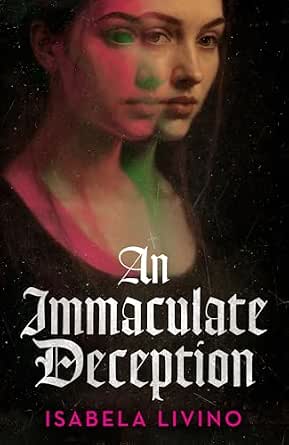
An Immaculate Deception by Isabela Livino
THE UNMISSABLE GOTHIC HORROR EVENT OF 2026
Pernambuco, Brazil, 1877. Raised in a deeply religious household, Madalena knows Dante’s Inferno by heart and fears her mother’s reaction as much as she fears God. When she falls pregnant with a child conceived in sin, her mother issues a threat: marry or surrender the baby.
Confident that the father, the dashing Leandro Neves, will propose, Madalena sets off to his sprawling estate. After a storm wrecks her carriage, she awakens in Leandro’s crumbling mansion, tended to by the magnetic Doctor Lobo. Leandro is there… but he is no longer the charming poet she knew. He’s silent. Obsessed. Always watching.
Strange perfume haunts a locked room. Pages vanish from books. Jewels lie untouched in a forgotten wardrobe. And mirrors begin disappearing after Madalena sees something – or someone – ghastly in the reflection.
Leandro is unravelling. Doctor Lobo may be hiding something even darker. Trapped in a decaying house of secrets, Madalena must uncover the truth before the men around her destroy her, and before the hell she fears becomes the one she’s living in…
****
PRAISE FOR AN IMMACULATE DECEPTION
‘A wild ride. Vivid and exhilarating, with a breath taking twist, An Immaculate Deception is a stunning debut’
SHEN TAO, AUTHOR OF THE POET EMPRESS
‘Alluring, eerie, and impossible to put down, this book consumed me completely. And the twist left me reeling!’
CAROLINA FLÓREZ-CERCHIARO, AUTHOR OF BOCHICA
‘Completely unforgettable, this is a book that will stay with you long after you’ve put it down, certain to haunt your dreams and creep into your waking thoughts’
DORIAN RAVENSCROFT, AUTHOR OF THE WHITE NORTH HAS THY BONES
‘Transported me to a world of grand decay and puzzle pieces that couldn’t possibly fit – until they do. I loved every second of it’
BAR FRIDMAN-TELL, AUTHOR OF HONEYSUCKLE
Ginger Nuts of Horror: The Heart and Soul of Horror Reviews

Every feature is built to sell your work. We include backlinks to your website or Amazon author page, a full synopsis, and a universal purchasing link that sends readers straight to their local store. Add a large, engaged social following and an 18-year archive of trusted horror coverage, and you have a platform genuinely built to grow your readership.
Whether you’re an established author, an indie filmmaker, or a debut voice in indie horror, there’s a way for us to help you reach more fans. Explore our horror book reviews and horror movie reviews, then get your horror book or film featured today.


Jim "The Don" McLeod has been reading horror for over 35 years and reviewing it for more than 16. He's the editor of Ginger Nuts of Horror, Europe's largest independent horror review and culture site, and a British Fantasy Award nominee for his work in the genre. When he's not busy inflicting his opinions on the horror community, he can be found annoying his family or getting thoroughly outwitted by his two dogs, Casper and Molly.