Twelve stories of angels, cures and bad dinners in a funny, frightening first collection from the salt marshes to the suburbs.
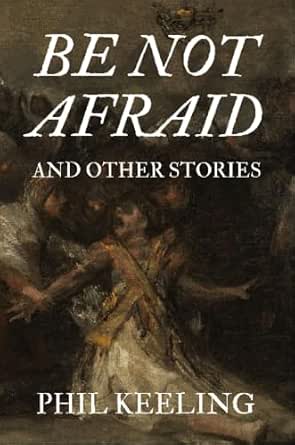
- Author Phil Keeling
- Publisher Phil Keeling (self-published)
- Published 9 October 2026
- Pages 144
- Format Paperback, ebook
- ISBN 9798234071774
- Subgenre Horror short story collection
- Reviewed by Jim McLeod
Twelve stories run from the fall of Babel to a low country monster hunt, a root cellar and a mall fitting room, where every angel, cure and dinner comes with a price.
Be Not Afraid is the debut horror short story collection from Phil Keeling, a playwright whose story The Elevated Table made the Bram Stoker Award preliminary ballot. Its twelve stories run from the ruins of Babel to the salt marshes of the low country, a suburban root cellar and a department store fitting room. Angels turn up, cures are sold, dinners are served, and nobody gets what they were promised. In this Be Not Afraid review I look at how Keeling mixes faith, hunger and dark humour, where the book sits in Southern weird fiction, and why a self-published first collection this sure of itself deserves your time. It starts, as these things often do, with a promise.
Be Not Afraid Review: Holy Things With Too Many Eyes
In scripture, the angels nearly always lead with the same line. Fear not. It is rarely about the news, which is often good. It is about the messenger, who is awful to look at, and the line is less a comfort than a bit of crowd control. A very old bit, at that.
Phil Keeling has built a whole book in the gap between the promise and the thing making it. This is his first collection, twelve stories long, and it is stuffed with offers. A cure in a bottle. A wife who never argues. A small man in a patchwork suit who will clear a town of roaches, for a fee. An angel in the root cellar who only wants a wee song. Each of them means it, in its way. Each of them sends the bill later.
It opens with Babble, and that choice tells you a lot. The Tower of Babel is told by the builders themselves, in a shared “we” that sounds like a parish newsletter written the day the sky fell in. They only wanted to get close to God. They kept building long after anyone could say why. Keeling does not wink at us or dress the myth up. He lets pride and love look exactly alike, which is the horror of it, and then he brings the whole thing down on people who were only looking after the dying. Five pages. Not a word to spare.
Then he swaps the ancient world for a small fishing boat.
Hellbender follows three men into the salt marshes of the low country to kill a creature that has been eating fishermen. Onion Davis leads, a man from Vidalia with a broken nose and no speeches in him. The narrator, Smith, does the rigging and the worrying. Greg Halsey, the new lad, does the grinning. A crowd waits on the dock with fried fish and vodka tonics, cheering them off like it is a high school football game, and the bait is beef lung from the butcher.
Keeling casts these men as dragon slayers in work boots, and he means it with no irony and with plenty of irony at once. The hunt is a rattling, soaking, desperate chase that feels like being towed behind a speedboat on a rope. What lingers, though, is the last page, where the story quietly lays out the sums behind monster hunting and you see that nobody on that boat wants the job to end. It has the feel of Nathan Ballingrud at his most working class, with the sound of a cold can being cracked open at the end of a shift.
Is Be Not Afraid Scary?
It is, and in more than one key.
The title story is the place to start. Joanna is six. A small plane has come down over her uncle’s church, and the grown ups at dinner laugh at the rumour that it hit an angel. Later, clearing her toys from the leaves in the back garden, she hears a voice under the pile. What she finds has wings, and more eyes than anything should, and it tells her not to be afraid. So she isn’t. She carries it down to the root cellar. She asks if it needs a jumper. She asks, with a child’s grave good manners, whether it goes to the toilet. Then her nose starts to bleed.
Keeling writes Joanna from the inside without once making her cute, and he lets the dread gather on her parents’ side of the house: the low hum they both hear at night, their girl throwing herself at a locked cellar door, the song she sings in her sleep. The angel asks her to sing You Are My Sunshine, and that old tune will not sound the same again.
Uncle Stuart, a priest with a jar of blessed tap water and doubts he keeps to himself, is the kind of adult Keeling does best. He is decent, out of his depth, and honest enough to know it. The end turns on a mother, and on an axe bought for a life the family never lived, and it lands as both a proper fright and a sly joke about what we choose to kneel to.
Other stories scare in other ways. The Changing Room takes a woman named Abby into a mall fitting room with a cheap lavender dress whose beads hold the whole cold night sky, and it is cosmic horror done in the time it takes to try on a frock. The Little Things is creature horror inside a marriage that is too good to be true, told through a new husband who keeps finding soggy tea bags about the house.
The Medicine Box sends an outlaw after a travelling tonic seller on the plains near Billings and gives us a black glass box that scratches all night. None of them stays too long. Most of them end two lines before you expect, and that is a skill plenty of writers never learn.
The Blasphemy in the Box may be the oddest thing here. Wulfric is a highwayman on the road to Cologne in a summer so dry the Rhine is shrinking. He kills a priest and his guard for a cart and finds a box the size of a child’s coffin.
Inside is something like a baby, if a baby had been drawn by someone who had only heard one described. Keeling’s note at the back ties the story to the great flood of 1342, which followed just such a drought, and the story wears its history lightly. What that thing does next I will leave for you to find. It is tender and foul in equal parts, and Keeling knows exactly how long to hold the shot.
How Be Not Afraid Weighs Faith, Hunger and Money
The Wasps are Coming for All of Us is where the book shows its heart. A college student home for Christmas starts to visit the Old Man down the street, who is being slowly swallowed by his own house. The boy has never learned his name. The boy tells his mother he is taking over a quilt; he is really after a quiet smoke.
The Old Man spits sap, talks about canning meat and siphoning petrol, and grumbles that a man should be free to make a mess in his own home. He swears he no longer needs to eat. Then he sees a devilled egg on the boy’s plate, and drools, and explains himself. Devilled eggs, he says, “Aren’t about nourishment, boy. They’re about something else.”
Look at what that line is doing. On the surface it is a joke, the sort of thing a grandad says about comfort food. Underneath, it is the thesis of the story, and maybe of the book. Nobody here eats, or prays, or stays, for the reason they give. The hum that rises from inside the wood a moment later is the other half of the joke, and the Old Man’s short answer only makes it worse. Keeling trusts the image.
Pages later the line comes back in a new mouth, drawled out to copy an accent, and by then it has become a way of mourning a man whose name the boy never learned. It is a small piece of craft. It is also the whole trick of the collection in miniature: a laugh, a sting, and a kindness you did not see coming.
That mix is what makes Keeling so easy to trust and so hard to shake. His prose is plain and quick, with an ear for how people talk in kitchens and on docks. His images are sharp without showing off. The Old Man’s slow vowels drift like bees through smoke.
The hellbender has a flat face you could park a car in. The label on Abby’s dress is stitched in a jumbled script that looks backwards. Reading him is like buying a pie at a church bake sale that someone is running out of the back of a butcher’s van. The welcome is warm, the prices are fair, the ladies behind the table are lovely, and you only notice the hooks along the ceiling once you have paid.
He is also very funny, and the jokes do real work. Hamish and the Impossible Flowers is a petty revenge comedy about a grumpy school security guard, the art teacher who has just left him, her giant sunflowers and her spoiled Persian cat, Apple. It is the daftest story in the book and one of the best, a man losing a war with a garden and deserving every sting.
The Beguiler of Swarms rewires the Pied Piper for Spoil, Georgia, a coastal town overrun by flying cockroaches, with an insect expert at its centre and a stranger in clashing animal print who plays a recorder nobody can hear. Keeling’s notes call it his only try at splatterpunk and admit it is tame by those standards. He is right, and it does not matter, because the cruelty here is in the invoice, not the gore. You know how the old tale ends. Knowing does not help.
The Elevated Table closes the book. It is a TV chef’s last live episode, told by someone picking through the footage years later, with the fan theories and the think pieces and the comment sections all mixed in. Keeling spent years in the wine trade, he tells us, and met some fine people and some dreadful snobs there. Every line of Chef Domery’s speech about taste and class has the ring of something overheard at a tasting. It is easy to see why it made the Stoker preliminary ballot. It is savage and very funny, and its last page is the sharpest in the book.
This is Keeling’s first collection, after his novella Juice, and he is a playwright too, which shows. His dialogue does work other writers hand to exposition: the dinner table in the title story, the bickering on Onion’s boat, George trying to reach a wife who only ever agrees with him.
The Notes and Origins at the back are a treat in their own right, frank about where each piece came from and where it first ran, from Night Terrors to The Siren’s Call. Samael Grove, about a one dollar bet and a boy left overnight in a cursed clearing, is the oldest story here, and Keeling says himself that he wrote it in his early twenties. It is the one piece that leans on familiar beats: the dare, the witch nobody has seen, the older boy who knows the way. That is a small quibble. Its last page, about a guilt no amount of reasoning can shift, earns its place anyway.
So where does it sit? Be Not Afraid belongs with Southern weird fiction, the kind where working people meet the uncanny on their lunch break, and North American Lake Monsters is its clearest cousin. There is some of John Llewellyn Probert’s Made for the Dark in it too, that sense of a host who loves the show, though Keeling’s wink is more Georgia than Hammer. He names Andrew J. Stone’s All Hail the House Gods as a likely spark for the wasps story, and you can feel that bizarro streak in the stranger pieces.
What marks him out is the religion. Angels, relics, priests and prophets run all through the book, and not one of them is quite what the faithful were sold. Yet the book never sneers at belief. Stuart’s doubt is handled with care. A friar on the road to Cologne gives last rites to a man he would rather not touch.
Keeling is less bothered about whether God is there than about what people will swallow, in several cases quite literally, when they are told it will make them whole. Every story has a price tag somewhere. Whistle wants a house. Big Bob Fixx wants a cure. Chef Domery wants to be understood. Abby’s dress is far too cheap. The bill always comes.
The cover tells you not to be afraid. For 144 pages Keeling makes a liar of it, and you will thank him for every word.
The Verdict: Is Be Not Afraid Worth Reading?
The verdict
A funny, frightening and oddly tender debut where every angel, cure and dinner comes with a price, and Keeling collects on all of them.
Read it if: you like your weird fiction Southern, your religious horror sharp and your jokes with a sting in the tail.
Skip it if: you want one long slow burn rather than twelve quick bites, or a story about cockroaches will put you off your tea.
Ginger Nuts of Horror: The Heart and Soul of Horror Reviews

Jim "The Don" McLeod has been reading horror for over 35 years and reviewing it for more than 16. He's the editor of Ginger Nuts of Horror, Europe's largest independent horror review and culture site, and a British Fantasy Award nominee for his work in the genre. When he's not busy inflicting his opinions on the horror community, he can be found annoying his family or getting thoroughly outwitted by his two dogs, Casper and Molly.