
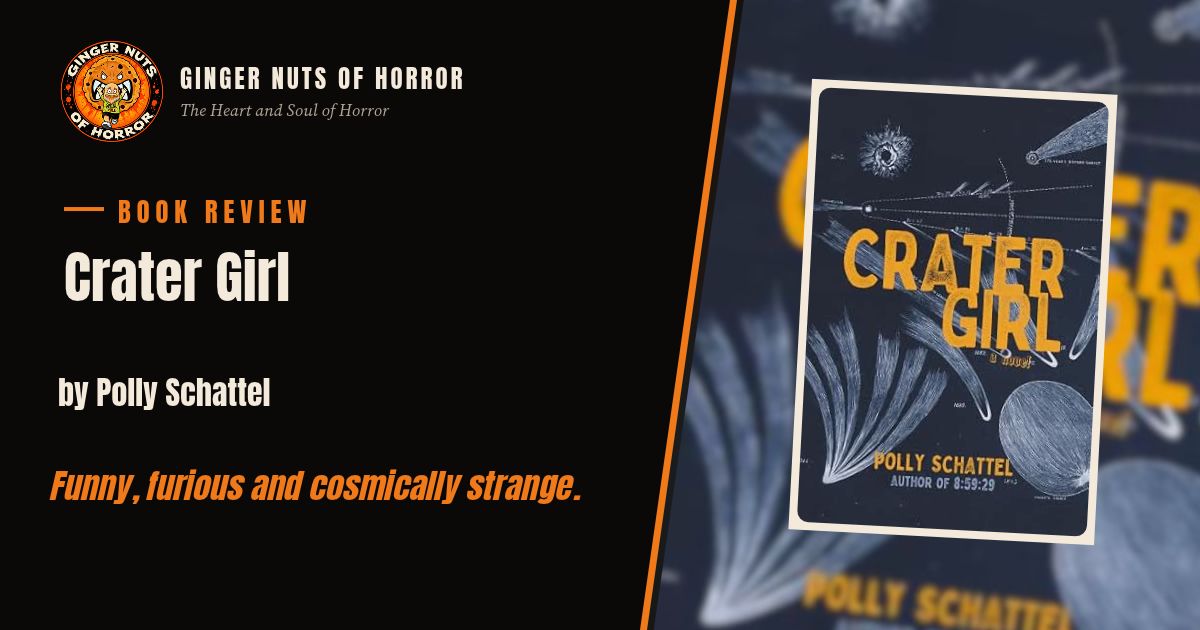
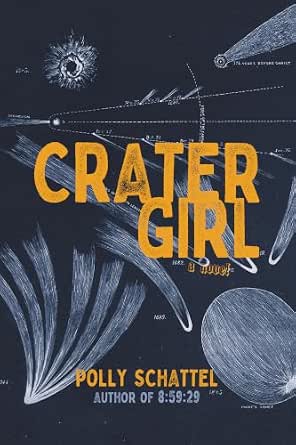
- Author Polly Schattel
- Publisher JournalStone
- Published 26 June 2026
- Format Paperback, ebook
- Subgenre Southern weird, cosmic horror
- Reviewed by Jim McLeod
When her friend Suhey disappears and the police are no help, former priest Greta Tyler starts asking questions of her own. The answers lead somewhere stranger than Cumberland Heights is ready for.
Some people go through life feeling like furniture in somebody else’s photograph. Everyone else is sharp and well lit. They are the odd corner of wall, the gap between two trees. It is a lonely way to live. It also makes a very good plot device for a horror novel.
That feeling sits at the centre of Crater Girl, Polly Schattel’s new book from JournalStone. She turns it into something far bigger than a mood. It becomes a mystery, a conspiracy, a road trip, a rescue story and, by the end, a full-blown cosmic nightmare. It is also one of the funniest horror novels around this year. I did not expect to type that sentence.
Crater Girl Review: The Narrator Who Learns to Look Back
Greta Tyler is a trans woman and former Episcopal priest. She runs the Asilo Community Center in Cumberland Heights, Alabama. The centre is her job, her family and her best reason to get out of bed. Then her friend Suhey Moreno disappears. A stranger in carefully ironed jeans slips out of the centre’s party. And Greta learns how little help exists for people who are missing and undocumented. Calling the police is not an option she trusts. So she starts asking questions herself.
The trail runs from a half-dead shopping centre to a wig shop that smells of dye and melted plastic. It runs to a flood-prone trailer deep in the hills. There she meets Merten Haggerty, a rollator-pushing hacker with a huge mouth and a surprisingly soft heart. Then it climbs towards a mountain in the north east of the state. Noir, conspiracy thriller, comedy of manners and cosmic horror all take turns at the wheel. Schattel never lets them fight over it.
What holds it together is voice. Greta is wry, self-lacerating and sharp. She notices everything, because she has spent a lifetime watching rooms from the edge of them. Her jokes are never just jokes. They are how she keeps her footing.
The supporting cast earns its place too. Merten steals every scene he is in. He talks like a radio left on in the next room, and he carries a torch for Greta’s ex-wife, Monica. Felix, Greta’s loyal and prickly deputy, has grievances of his own, and they matter. Suhey is vivid even when she is off the page. You want her found as badly as Greta does. Even the minor players get a sharp detail. A waitress named Alba talks about the customers who watch the whole room and never touch their food. It is enough to raise the hairs on your neck.
The opening chapter shows what Schattel is up to. Greta remembers a substitute teacher, Mr Scharpley, who talked about something he called the dead eye. He had borrowed the idea from a blind friend who took photographs. From across a room, those photographs looked fine. Up close, they held too much floor, too much wall and too much sky. Horizons tilted. You could not tell what any picture was about. As Greta puts it, “The pictures took something out of you.”
That small passage is the thesis of the whole book. An indifferent intelligence looks at the world. It decides who counts as the subject and who counts as furniture. Greta recognises herself in it at once.
Then the novel keeps framing scenes that way. Greta questions a waitress outside the El Que Más about missing girls. While they talk, a runaway supermarket trolley drifts across the car park and out into four lanes of traffic. Nobody remarks on it. The camera simply rests there. It is comic and ominous in a single image. It shows Schattel refusing to tell you what the picture is about.
The prose itself works like a pawnshop window. Cheap jokes, a wedding ring and a loaded pistol sit on the same shelf, all priced in the same handwriting. It should not work. It does, over and over.
If there is a quibble, it is a small one. Greta’s asides are generous. A reader in a hurry might want her to take the next exit sooner. But the digressions are where the book keeps its heart, and the final act repays every one of them.
Is Crater Girl Scary?
Yes, in layers. This is dread more than jump scare, and it arrives by stages.
The first act runs on dark comedy, and the laughs are real. Then a supermarket stunt tips from farce into menace in the space of one line. After that the mood never quite recovers its balance. That is exactly the point. Schattel understands that a laugh is a good way to lower a reader’s guard.
Small set pieces do as much work as the big ones. The wig shop is a fine example. Thirty or so bewigged polystyrene heads stare out of the window. For a moment Greta feels as if the dead eye has borrowed their faces. Nothing happens, and it is still unnerving. Schattel trusts an ordinary room to do the work.
The mountain compound is where the book shows its teeth. It is not a crumbling castle. It is clean corridors, sliding wall panels, biometric locks and guards in matching yellow scarves. All of it is funded by serious money. Cruelty that looks this well organised is much harder to shrug off than a haunted house.
When the violence comes, it lands. Nobody here is a disposable extra. The later chapters stack up set pieces on a genuinely cosmic scale, and I will say nothing more about them. If you like the kind of horror where something vast is looking at you and has not yet decided what you are, you are in the right place.
How Crater Girl Compares to Other Southern Weird
Readers who know Schattel’s earlier work will see how far she has travelled. Her previous books include The Occultists, a historical dark fantasy from 2020, and Shadowdays, from 2022. There is also 8:59:29, a Stoker Award long-listed novella set in a film department in the Appalachian hills.
She came to novels after making films. Those include Sinkhole, Alison and Quiet River. That background may explain how precisely her scenes are framed. Crater Girl feels like her widest swing so far.
Within the genre, it sits closer to Joe R. Lansdale than to Caitlín R. Kiernan’s The Red Tree, and it adds a trans narrator to the shelf of queer Southern Gothic. Lansdale lets a joke and a corpse share a paragraph, and so does Schattel. Kiernan’s slow, cold Southern unease is a different mood. Yet Schattel borrows Kiernan’s interest in what the land might remember. She also plays with familiar machinery. There is the hacker mentor, the shadowy agency and the villain with a fortune and a theory. She handles them with affection, and then she bends them.
The themes stay with you. Self-sabotage is one. Greta suspects it is less a personal failing than a force that visits people. Found family is another. So is faith, and what is left of it when the institution that taught it to you has shown you the door.
The strongest theme is the question of who gets looked for. Merten rails about how many Latina women go missing without anyone filing a report. The book keeps that anger close. Its quiet argument is that attention is a form of care. The opposite of the dead eye is a community that notices.
The author’s note adds a lovely touch. Schattel says the book began as a love letter to her trans friends and ended up as a love letter to Alabama. You can feel both in the writing.
Spoiler warning: the next section discusses the final act. If you want to go in fresh, skip ahead to The Verdict.
The compound has a ritual purpose. Gerald Pracke wants eleven young women as a dowry for a deity called Xalia. The cave sequence that follows is the book’s centrepiece. A shattered cage releases the Godchild, and for a few awful minutes it is a monster. Then Greta realises it is an actual child, and the horror changes shape. The tendrils tear through the men and leave the maidens alone. The whole thing starts to look less like an accident and more like a design.
Greta holds a vial of Sentanyl that the compound’s mute doctor, Alice, slipped into her shoe. She could use it on herself, or on the Godchild, or on the whole cave. Instead she does the thing she has feared all her life. She walks into the dead eye on purpose. The novel earns that moment, because the first chapter set the terms so carefully.
The coda is just as good. A betrayal by one of her supposed allies lands hard. A midnight confrontation with Merten balances menace and tenderness. A phone call from Coleman offers her a job. Readers who browse the horror book reviews for something that ends on tenderness rather than a sting will want this one. It ends at a rest stop at dawn, with Greta asleep in her car. After everything, she is still here.
The Verdict: Is Crater Girl Worth Reading?
Yes, and without reservation. Five stars.
This is a book for readers who like their horror driven by voice. It suits anyone who enjoys a genre mash-up that actually commits, and who wants humour and dread to share the same room. Fans of Southern weird, conspiracy thrillers and cosmic horror will all find something to love. Be aware that it contains strong language, sexual content, graphic violence and themes of trafficking and abduction.
Plenty of horror novels stare back at you. Crater Girl hands you the camera and dares you to point it somewhere new.
5out of 5
The verdict
A very funny Southern weird novel that finds real dread in who gets looked for.
Read it if: you like horror driven by voice, and want humour and dread in the same room.
Skip it if: strong language, sexual content, graphic violence or themes of trafficking and abduction are a dealbreaker.
Keep reading on Ginger Nuts of Horror
 Wolf Worm by T. Kingfisher: A Gothic Horror That Crawls Under Your Skin
 A Review of They Fear Not Men in the Woods by Gretchen McNeil, Will You Go Into The Woods Today?
 Horror Novels, Career-Defining Debuts You Should Know About

About Ginger Nuts of Horror
Ginger Nuts of Horror is an independent horror review and culture site based in Edinburgh, Scotland. Edited by British Fantasy Award nominee Jim McLeod, it publishes horror book reviews, film reviews, author interviews, features and cover reveals. Ginger Nuts of Horror won Best Inclusive Film & Book Review Platform at the SME News UK Enterprise Awards 2026.