The monster was the empire all along.
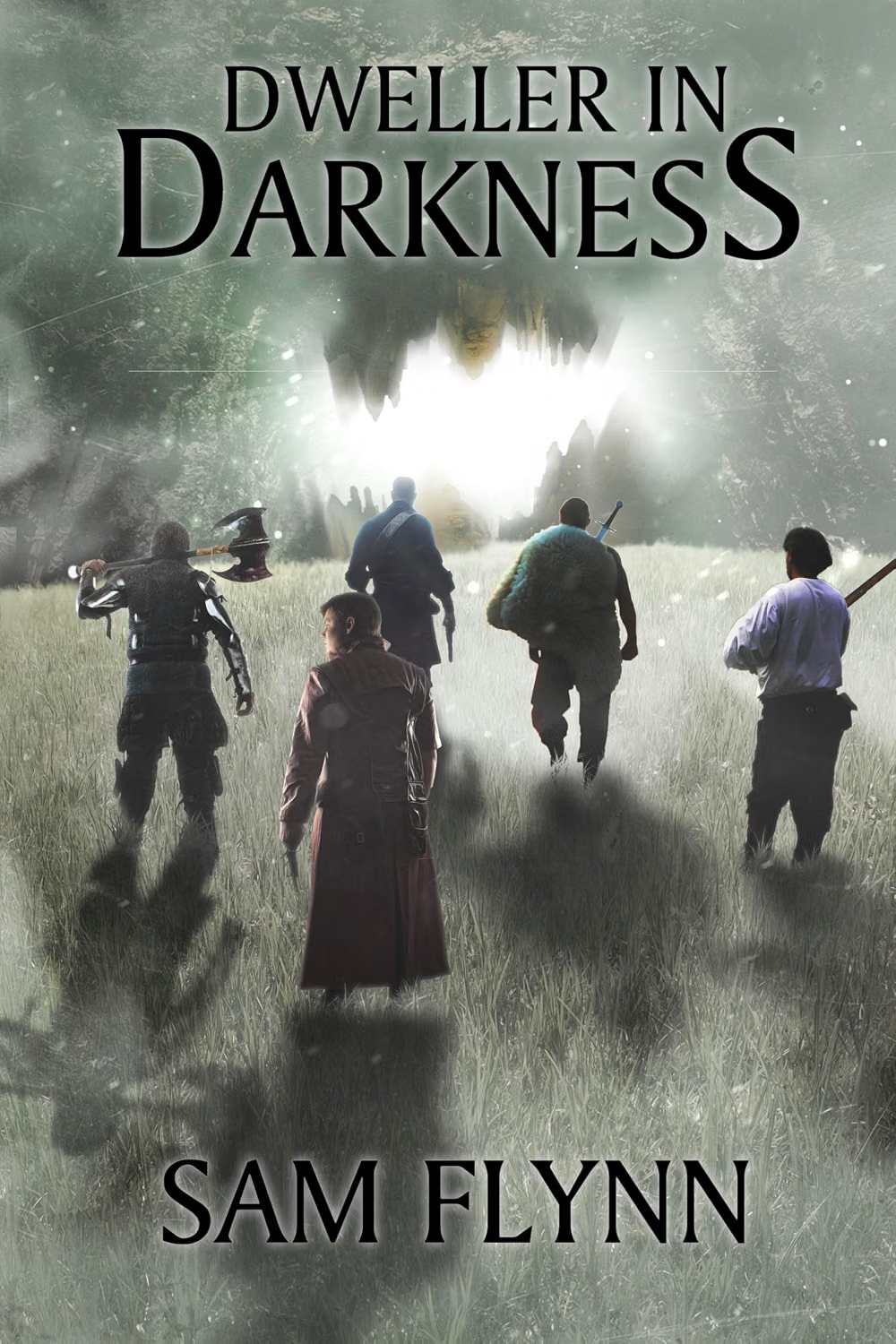
Dweller in Darkness | Sam Flynn | Timber Ghost Press | 22 September 2026 |
Sam Flynn’s Dweller in Darkness closes the Deadlights Duology with the confidence of a writer who knows exactly where the trapdoor is and waits until the last possible moment to pull it. This grimdark cosmic horror novella from Timber Ghost Press follows Cassius, a vain young Lightbringer marched underground to kill a monster his empire needs everyone to keep believing in.
Told through audacious second-person narration and the journal of a dying boy, it turns a doomed expedition into a study of complicity, manufactured enemies, masculinity and colonial violence. The result is strange, angry and remarkably controlled.
Flynn turns cosmic horror back on the society that created it, exposing empire, complicity and manufactured fear beneath the monster story, then makes the reader stand inside the consequences.
Dweller in Darkness by Sam Flynn Review: Grimdark Cosmic Horror With Teeth
A frightened country will always find itself a monster. It has to. The alternative is to turn and look at the thing doing the frightening, and that thing tends to wear the robes of whoever is turning a profit from the fear.
The empire of Yorgos has found itself a very good monster indeed. A serpent queen said to command witches and snakes, coiled in the endless tunnels beneath the land, blamed for the blight the locals call the Rot. Twice a year, every town sends seven of its finest young men down into the dark to kill her and end the ruin. They are called Lightbringers. Only one of the seven ever comes back, if any do at all, and he comes back white-haired and broken, aged half a century in a season.
Nobody seems to notice that the arithmetic has never once favoured the living.
Sam Flynn’s Dweller in Darkness is built on that unnoticed arithmetic, on the things a society trains itself not to count, and on a narrator who has done the sums and decided the clever move is to make sure he ends up on the profitable side of the lie.
Gaius Cassius Marius is sixteen, vain, intelligent and clever in exactly the way that gets a boy killed. Named for the martyred Hero of Hathur and stepson to the Grand Arcanist who runs the Church of the Pale King, he already knows the faith surrounding him is fraudulent. Researching a biography of the Hero has shown him the body buried beneath the legend.
What sets Cassius apart from the usual reluctant chosen one is what he does with that knowledge.
Nothing noble.
He does not want to expose the lie. He wants to become the person telling it.
Faith is a con, and Cassius would rather run the con than fall for it. He wants status, power and the comfortable certainty that comes with knowing everyone else is more gullible than he is. That makes him a wonderfully unpleasant centre for a story about institutional rot. Flynn does not ask us to admire Cassius, nor does he reduce him to a convenient villain. He lets the boy remain recognisably human enough that every bad decision hurts more.
Cassius is what Yorgos produces when its values work exactly as intended.
The descent is where Flynn’s horror engine starts to hum, and it is a genuinely nasty piece of machinery. The thing in the dark does not simply lunge from shadows. It talks. It speaks in the voices of people the Lightbringers know and love, grows phosphorescent mould through their skin, toys with memory and suspicion, and mostly allows frightened boys to do its work for it.
Seven armed young men descend into the tunnels carrying all the prejudice, pride and ideological poison their country could fit inside them. The darkness barely needs teeth.
One of the novella’s finest images arrives when the cohort discovers a cavern filled with the equipment of previous expeditions. A pot from one journey. Muskets from another. Powder from another. The discarded archaeology of generations of young men sent beneath the earth under precisely the same promise.
Cassius notices what is there.
Then he notices what is missing.
Bodies.
It is the sort of image horror writers spend whole novels trying to find, simple enough to describe in a breath and large enough to change the shape of everything around it. Flynn does not hammer the implication. He leaves the absence sitting there.
That restraint matters because Dweller in Darkness understands something many cosmic horror stories forget. Explanation is not always the enemy of fear. Sometimes knowledge makes the room darker.
Consider what happens when Flynn lets a doomed man speak for himself. Cassius encounters the final writing of a predecessor, and the prose begins to fracture alongside the mind producing it. Sentences shorten. Connections disappear. Thoughts arrive without the bridges that ought to hold them together. Language stops behaving like an ordered account of reality and starts resembling debris.
Reading those passages is like listening to a radio lose its signal in a storm. Meaning still gets through, but only in flashes, and each flash makes the static worse.
That is close to the heart of Flynn’s technique throughout the novella. His horror rarely depends on withholding everything. Instead, he gives us enough understanding to recognise the pattern before Cassius can fully accept it. We see the machinery turning. We understand that the stories Yorgos tells about itself do not fit the physical evidence beneath its feet. The dread comes from waiting for a boy who has built his identity around being the smartest person in the room to discover that he has misunderstood the room entirely.
Second person can easily become a stunt. It can draw attention to itself until the reader starts admiring the grammatical balancing act rather than inhabiting the story. Flynn avoids that trap because the form is not decoration. It is architecture.
Threaded through the address are Cassius’s own journal entries, first person and increasingly immediate as his certainty, his body and eventually the reliability of his own senses begin to fail. The two modes create an odd pressure. One voice tells Cassius what he did. Another lets Cassius tell himself who he thinks he is.
The gap between them keeps narrowing.
Eventually, the question that has been sitting behind the narration becomes impossible to ignore.
Who is speaking?
Flynn knows exactly why he has asked the reader to tolerate that uncertainty.
The eventual answer reconfigures the novella rather than merely explaining it. Suddenly the second person is not an eccentric stylistic choice but an act of reconstruction, accusation and possession all at once. The person telling Cassius’s story has been standing somewhere inside the narrative from the beginning.
And then the book does something better.
It turns that “you” outward.
That move could have been unbearably pleased with itself. Instead, it lands because the entire novella has been concerned with inherited stories, with people being told who the enemy is, who the hero is, what history means and which sacrifices are necessary.
Second person becomes political.
Someone is always telling you where to stand.
Flynn’s prose is equally comfortable with that ambiguity. He writes Cassius by the light of the Rot growing through him, illumination and consumption happening in the same motion. The deeper he goes, the more difficult it becomes to decide whether seeing clearly is saving him or merely revealing the next horror.
The prose feels like an old pulp illustration held over a modern flame. Heavy shadows remain, the monsters remain, the fatalism remains, but the image beneath them has changed.
Flynn can be ornate, particularly as the cosmology expands, yet the language rarely loses its physical connection to Cassius. Bodies matter here. Mould matters. Light matters. The damp underground spaces never become mere scenery for philosophical discussion because the philosophy is growing through people’s skin.
The final third broadens dramatically. Personal terror opens into history, theology and the machinery on which Yorgos has built its identity. Myths invert. Old stories acquire new owners. Names and revelations accumulate quickly.
It is dense.
It should be.
The temptation with a novella this tightly engineered would have been to keep the ending purely visceral, preserve the mystery and let suggestion carry everything. Flynn chooses the harder route. He reveals the ideological structure behind the supernatural one because the distinction between them is the point.
There is a deliberate echo of Ursula K. Le Guin in the moral architecture here, particularly in the idea of an apparently functioning society whose prosperity depends upon suffering carefully hidden from public view. Flynn is working adjacent ground, but he pushes the question through grimdark fantasy and cosmic horror rather than philosophical parable.
That inversion binds the political argument to the supernatural horror so tightly that trying to separate them becomes pointless. The thing beneath Yorgos is not simply an unknowable creature from outside human concerns. It is hierarchy, greed, hatred and conformity given appetite. It feeds because people keep supplying the conditions in which it can exist.
The cycle survives because everyone has been taught to misidentify cause and effect.
The empire points downward and says monster.
Nobody looks up.
This is where Flynn’s cosmic horror becomes particularly interesting. Traditional cosmic horror often insists upon human insignificance. The universe is vast, indifferent and incapable of caring about us. Flynn is interested in another scale of terror. Human beings matter terribly because their choices matter. The darkness does not erase responsibility.
It magnifies it.
The Rot works because Yorgos works.
That distinction gives Dweller in Darkness more bite than another exercise in unknowable gods and doomed explorers. The cosmic element does not absolve anyone. Nobody gets to shrug and say the universe is cruel.
People built this.
People keep feeding it.
The novella’s title consequently acquires a neat double edge. There is a literal thing beneath the earth, yes, but darkness has never respected geography. It exists in institutions, histories, compromises and stories repeated because questioning them would cost somebody something.
The serpent is almost beside the point.
Career context sharpens what Flynn is doing. Dweller in Darkness follows The Mystery of the Pale King and completes the Deadlights Duology. The relationship between the two novellas goes beyond simple continuation. Flynn changes perspective and form so that the sequel revises the reader’s relationship with what came before.
The first book places Faron, the assassin who killed the Hero, at its centre. Here the perspective shifts towards Cassius while Faron occupies a radically different narrative position. Events and ideas begin reflecting across the two books, each one changing the moral temperature of the other.
More importantly, it suggests Flynn understands sequel writing as an opportunity to alter the original rather than merely extend it. Dweller in Darkness does not feel like the second half of a story withheld for another volume. It feels like a mirror placed beside the first novella so that suddenly there are things visible in the reflection you did not know were standing behind you.
Put Cassius on the grimdark shelf and he finds plenty of relatives. There is something of Mark Lawrence’s Jorg in the combination of intelligence, entitlement and cruelty, although Cassius lacks Jorg’s almost mythic self-possession. Joe Abercrombie’s characters are another useful point of reference, people who understand their own flaws just well enough to explain why they intend to continue having them.
The second-person construction and apocalyptic transformation also invite comparison with N. K. Jemisin’s Broken Earth trilogy, particularly in the way narrative form eventually reveals a relationship between teller, subject and reader. Flynn is operating on a smaller canvas, but the comparison is useful because both works understand point of view as something capable of carrying thematic weight.
And then there are the deadlights.
The term inevitably nods towards Stephen King, but Flynn does more than borrow a little cosmic vocabulary. His creatures belong to the same broad tradition of reality buckling under pressure from something larger and older, yet Dweller in Darkness refuses the comfort of treating the horror as wholly external.
Not cartoonish evil. Not the rare monster who wakes up wanting to destroy the world. Ordinary accommodation. A shrug. A ritual everybody knows is terrible but nobody wants to be the person who questions. A belief that the system must be right because admitting otherwise would make the sacrifices unbearable.
The Lightbringers carry a culture of strength, endurance and aggression underground with them. Fear has no healthy outlet because vulnerability is incompatible with the role they have been told to perform. Suspicion therefore becomes violence. Anxiety becomes accusation. Their idea of manhood helps the horror spread because they have been trained to treat openness as weakness.
Colonial violence sits beneath all of this. Conquered people and their gods are rewritten by those who replace them. The old sacred order becomes demonic. History acquires official versions. The people responsible for destruction eventually inherit stories in which they were defending civilisation from whatever they destroyed.
Yorgos survives through narrative control as much as military or religious power. Whoever defines the monster controls where everyone points the sword.
At the beginning, he thinks recognising the lie places him outside it. That is his great mistake. He knows the mythology is false, therefore he assumes he is free of its power.
He is not.
There are few more useful ideas in political horror than that one. Seeing propaganda as propaganda does not automatically make you immune to the world it has built. Cassius rejects the truth claims of Yorgos while embracing its hierarchy, its vanity, its appetite for dominance and its belief that somebody deserves to stand above somebody else.
He has escaped the church’s theology while carrying its soul underground with him.
That is why his voice works so well.
His vanity is funny until it isn’t. His cleverness is attractive until you see what he uses it to excuse. His certainty offers the reader a comfortable little perch, then Flynn steadily removes the supports beneath it.
By the closing pages, Dweller in Darkness has moved a remarkable distance without abandoning the simple shape with which it began.
Seven boys walk into a hole to kill a monster.
Everything else depends on who taught them the monster was there.
Five stars.
Not because every answer arrives neatly or because Flynn makes the descent easy. Quite the opposite. The book trusts formal risk, political anger, pulp horror and moral ambiguity to occupy the same cramped tunnel without one strangling the others. It makes its supernatural machinery carry the weight of its argument, then makes the argument frightening enough to justify the machinery.
Yorgos sends its young men underground because every empire needs them looking in the wrong direction.
Dweller in Darkness turns their heads around.
Dweller in Darkness by Sam Flynn
God-killing seemed a lofty ambition. Then again, is that not what we’re here to do in our hunt for the Dweller in Darkness?”
All of Cassius Marius’ life has been spent in service to the Pale King. Ever since his birth sixteen years ago on the night the Hero of Hathur died, his mother prepared him to join the Lightbringers: seven young men selected every equinox by the Church of the Pale King to descend underground to hunt and destroy the Dweller in Darkness, a chthonic entity the Church names as source of an unnatural blight ravaging Hathur and beyond, year after year.
Cassius has known since he could speak that he was destined to destroy the great evil poisoning his home. His inevitable confrontation with the Dweller on his holy descent changes him inside and out and puts him on a collision course with the Pale King he once worshipped. With his world and body crumbling around him, Cassius must choose between loyalty and honor, family and humanity, not to save his home. But to destroy it.
The sequel to The Mystery of the Pale King and conclusion of the Deadlights Duology, Dweller in Darkness traverses a doomed empire polluted by corruption to ask if the world was ending, what would you save? And what would you leave behind?
Jim "The Don" McLeod has been reading horror for over 35 years and reviewing it for more than 16. He's the editor of Ginger Nuts of Horror, Europe's largest independent horror review and culture site, and a British Fantasy Award nominee for his work in the genre. When he's not busy inflicting his opinions on the horror community, he can be found annoying his family or getting thoroughly outwitted by his two dogs, Casper and Molly.
Ginger Nuts of Horror: The Heart and Soul of Horror Reviews
Every feature is built to sell your work. We include backlinks to your website or Amazon author page, a full synopsis, and a universal purchasing link that sends readers straight to their local store. Add a large, engaged social following and an 18-year archive of trusted horror coverage, and you have a platform genuinely built to grow your readership.
Whether you’re an established author, an indie filmmaker, or a debut voice in indie horror, there’s a way for us to help you reach more fans. Explore our horror book reviews and horror movie reviews, then get your horror book or film featured today.