

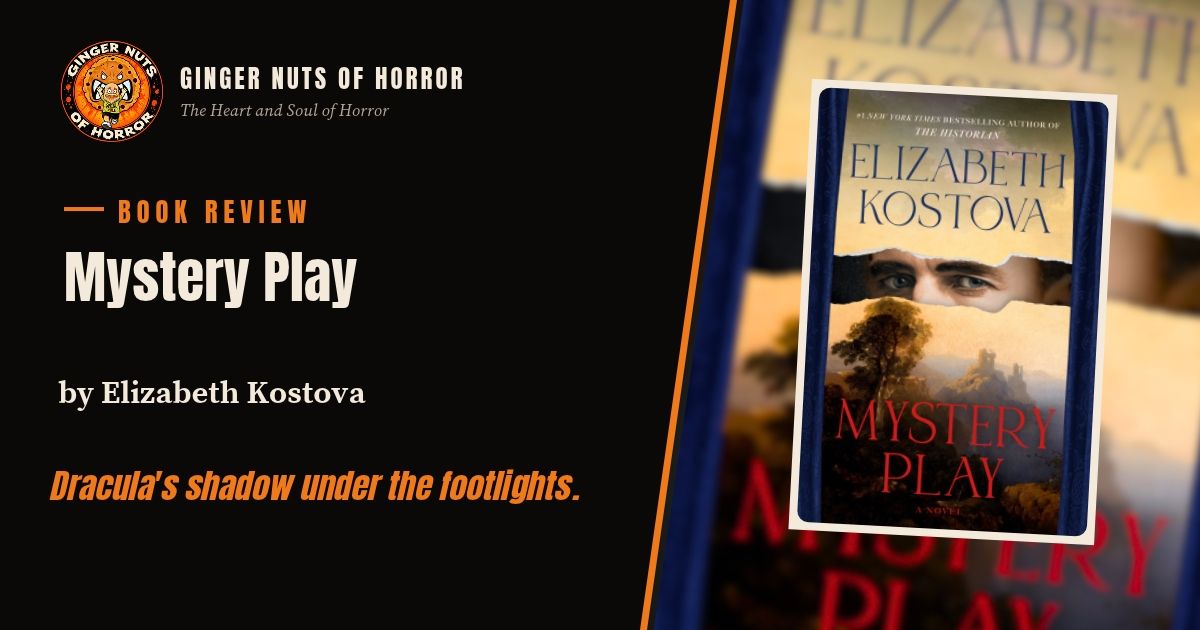
Mystery Play | Elizabeth Kostova | Ballantine Books | 13 October 2026
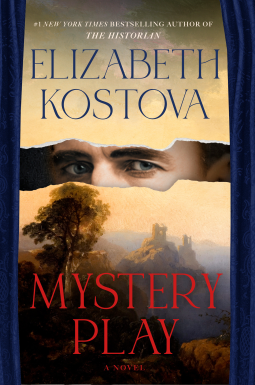
- Author Elizabeth Kostova
- Publisher Ballantine Books
- Published 13 October 2026
- Pages 592
- Format Hardback, ebook, audiobook
- ISBN 9781524799649
- Subgenre Historical gothic, vampire fiction
- Reviewed by Jim McLeod
A grieving history teacher inherits a book his mother swore she had given away, and follows a dead Victorian actor’s trail into a theatre company that treated Dracula as something far more serious than a role.
Mystery Play is Elizabeth Kostova’s first novel since The Shadow Land, and her first trip back into Dracula’s shadow since The Historian. This Mystery Play review comes from a reader who has waited a long time for that return. The book follows Jay Turner, a Boston teacher clearing out his late mother’s home, who finds a name, a book and a set of bloody footprints. The trail leads to Gael Brogan, a star of the Gilded Age stage, and to the young actress who fell under his spell. I gave it five stars. Here is why it earns every one.
Mystery Play is Kostova at full power: a slow, lamplit hunt through archives, diaries and old playhouses that turns the theatre itself into the oldest ritual of all. It asks for patience and pays it back with dread, grief and a villain who never stops performing.
Mystery Play Review: Every Stage Is an Altar
Every theatre is a kind of church. The lights go down. The crowd falls silent. A stranger walks out, dies in front of you, and gets up again for the curtain call, night after night, for as long as the run lasts. We call it pretend. Some of the oldest plays on record were never pretend at all.
That is the idea at the cold heart of Mystery Play. The title is a clue in plain sight. A mystery play was a medieval religious drama, Bible stories staged for the parish. Kostova pulls the thread further back, past the church steps and into the older rites that drama grew out of. Then she asks a simple and nasty question. What if someone remembered what those rites were for?
The man who remembers is Gael Brogan. He was a star of the late nineteenth century, an actor, writer and impresario. His last and most famous role was the Count in a stage version of Bram Stoker’s Dracula. He is long dead when the book opens. Or he should be.
Jay Turner finds him by accident. Jay is a young history teacher who has taken leave from his boarding school after his mother’s sudden death. She was a secretive woman. In her Boston home he finds a scrap of burnt newspaper with Brogan’s name on it. Then a parcel arrives. Inside is a small leather-bound book, one of a set commissioned by Vlad Țepeș shortly before his death in 1477. Jay knows it at once. His mother warned him about that book his whole life, and she gave it to a museum before she died. Yet here it is, back on his table.
Readers of The Historian will feel the floor tilt at that moment. Jay belongs to the family whose story that book told. You do not need to have read it, though. Kostova gives a new reader all they need, and saves the deeper echoes for those who remember.
I want to stay with that parcel for a moment, because it shows exactly how Kostova builds fear. I am paraphrasing the scene rather than quoting it. The delivery is handled almost flatly. A man drops off a package. When he has gone, there are two footprints in blood where he stood.
That is all. Nobody screams. Nobody gives chase. The delivery man never becomes a character. Kostova leaves the prints on the step like a stage direction with no actor to follow it, and she trusts the reader to fill the gap. It is a theatrical trick, which is the point. The whole novel is about how a gesture on a stage can carry more weight than the person making it. Here the gesture arrives without a body, and it is far worse for it.
Most horror novels would cash that image in quickly. Kostova banks it. She makes you wait. She makes you wonder who walked away, and why their feet were wet with blood. The footprints sit at the back of every scene that follows, a debt the book has not yet called in. When the violence does come, and it comes hard and bloody, it lands on a reader who has been tense for a hundred pages.
Kostova writes like a historian who has learnt to tell ghost stories. Her sentences are clear and unhurried. She lets a room fill up before anything moves in it. Reading her is like watching old gaslight play on a painted backcloth: it never glares, and it lets the eye settle until the painted forest starts to look like a real one.
The book is built from documents, as The Historian was. Jay narrates, but his story keeps opening onto other voices. There are letters, records and, above all, the diary of Fern Quinn, Brogan’s leading lady in the 1890s. Fern’s pages are the novel’s second heart. Through them we watch a gifted young woman drawn into a company where the line between rehearsal and rite grows thinner every week.
Some readers have found those diary sections slow. I think they are the reason the book works. Fern’s voice gives Brogan his weight. Without her, he would be a name in an archive. With her, he is a man in the room, charming and impossible to refuse, and the reader feels the pull of him before they understand the cost. Kostova knows that a villain is only as frightening as the person who once trusted him.
Jay is not alone in the present day, either. He is helped by Rhiannon, a history student he meets in grim circumstances. Their partnership drives the modern thread. The search takes them from Boston to a cottage in Maine, and out across the Atlantic to Ireland, Italy and the far Scottish isles. Kostova is very good on place. She makes a reading room feel as tense as a crypt. Special collections rooms, museum stores and shuttered houses all feel lived in and slightly watched.
Is Mystery Play Scary?
Yes, though not in the way a slasher is scary. This is dread by accumulation. Small wrong details pile up until the reader is jumpy at a creak. The fear here is the fear of the archive: the sense that the past is not finished with you, and that every document you open might be opening you in return.
When the horror turns physical, it is sudden and nasty. Kostova does not linger on gore, but she does not look away from it either. The contrast works. After long stretches of quiet scholarship, one violent page hits like a slammed door in an empty house.
There is a deeper chill too, and it belongs to Brogan. He wants what the Count wants: to go on. He sees an audience as something to feed on, and a company of actors as a congregation. The idea that applause might be a form of worship, and worship a form of feeding, is the book’s quietest and most lasting horror.
How Mystery Play Compares to The Historian
The Historian came out in 2005 and became a phenomenon. It was a vast, document-led quest across Europe for the truth about Vlad the Impaler, and it made Kostova famous. She did not rush a follow-up. The Swan Thieves turned to painting and obsession. The Shadow Land took her to Bulgaria and the brutal history of its labour camps. Neither book touched Dracula.
Mystery Play is a return, but it is not a retread. The Historian looked east, into monasteries and Ottoman history. This book looks west, to the American stage in the age of electric light and grand playhouses, when a handful of women were finally building careers in the theatre. The Count is still here, but he is a role now, a story that people perform. That shift is the book’s cleverest move. The question is no longer who Dracula was. It is what happens to the people who play him.
You can feel twenty years of craft in it. The control of structure is tighter than in her debut. The handling of grief, which runs right through the book, is more personal. Jay’s loss of his mother is no plot device. It colours every choice he makes, and the novel ends up being as much about a mother’s protection as about any monster.
Mystery Play belongs to a proud line of document-driven gothic. Its first ancestor is Stoker’s own Dracula, told in letters, diaries and cuttings. It sits comfortably beside A. S. Byatt’s Possession, another dual-timeline story in which scholars chase a dead romance through archives and find themselves changed by it. Lovers of Carlos Ruiz Zafón’s The Shadow of the Wind, with its hunt for a vanished author, will feel at home here as well.
It also earns a place in the long history of the vampire story. Readers who followed our feature on how Brian Lumley and Keith Rosson reforged modern vampire mythology will find Kostova taking the opposite road. Where those writers made the vampire more monstrous, she makes the vampire idea more ancient, older than any castle and closer to the oldest forms of worship. Anyone who has followed our horror book reviews for long will know how rarely a book this big earns its size. This one does.
Performance is the obvious theme, but the book is really about possession in its oldest sense. An actor lends his body to someone else for a night. Kostova asks what happens if the someone else will not give it back. That question runs through Brogan, through Fern, and through Jay, who finds himself acting out a role his family was cast in long before he was born.
Immortality is the other great subject. Brogan wants to last, and the book is clear that lasting has a price, paid by others. Set against him is Jay’s mother, who spent her life trying to keep her son out of the story. Her love is the counterweight to Brogan’s hunger. It gives the novel a warmth that most vampire fiction never finds.
There are small flaws, and they are worth naming as small. A couple of early coincidences hurry Jay along a little too neatly. One or two answers arrive late in the book. Neither dents the whole. They are the scuffs on a well-used stage, not cracks in it. The length is part of the pleasure, not a cost. Big books need room to breathe. This one uses every page of it. It is slow in the way a good fire is slow: you sit with it, and the heat builds. This is a book to live inside for a fortnight, and it rewards every evening you give it.
The house lights come up on the final page, and you will sit there a while longer, half expecting someone to step back out for one last bow.
The Verdict: Is Mystery Play Worth Reading?
5out of 5
The verdict
Kostova’s return to Dracula is a patient, absorbing gothic epic that turns the theatre into a place of worship and dread.
Read it if: you loved The Historian, crave slow-burn dread, or like your horror found in diaries, archives and old playhouses.
Skip it if: you want fast scares and a body count from page one, or have no time for a near six hundred page journey.
Content warnings: violent death, blood and gore, bereavement and grief, coercion and manipulation of a young woman.

Keep reading on Ginger Nuts of Horror
 The Temptation of Charlotte North Review: Camilla Bruce’s Dark Gothic Triumph
 Keith Rosson’s Coffin Moon A Gripping Descent into Darkness:
 The Ghosts of Merry Hall Review: A Gothic Haunting of Freak Shows and Female Resilience

About Ginger Nuts of Horror
Ginger Nuts of Horror is an independent horror review and culture site based in Edinburgh, Scotland. Edited by British Fantasy Award nominee Jim McLeod, it publishes horror book reviews, film reviews, author interviews, features and cover reveals. Ginger Nuts of Horror won Best Inclusive Film & Book Review Platform at the SME News UK Enterprise Awards 2026.


