

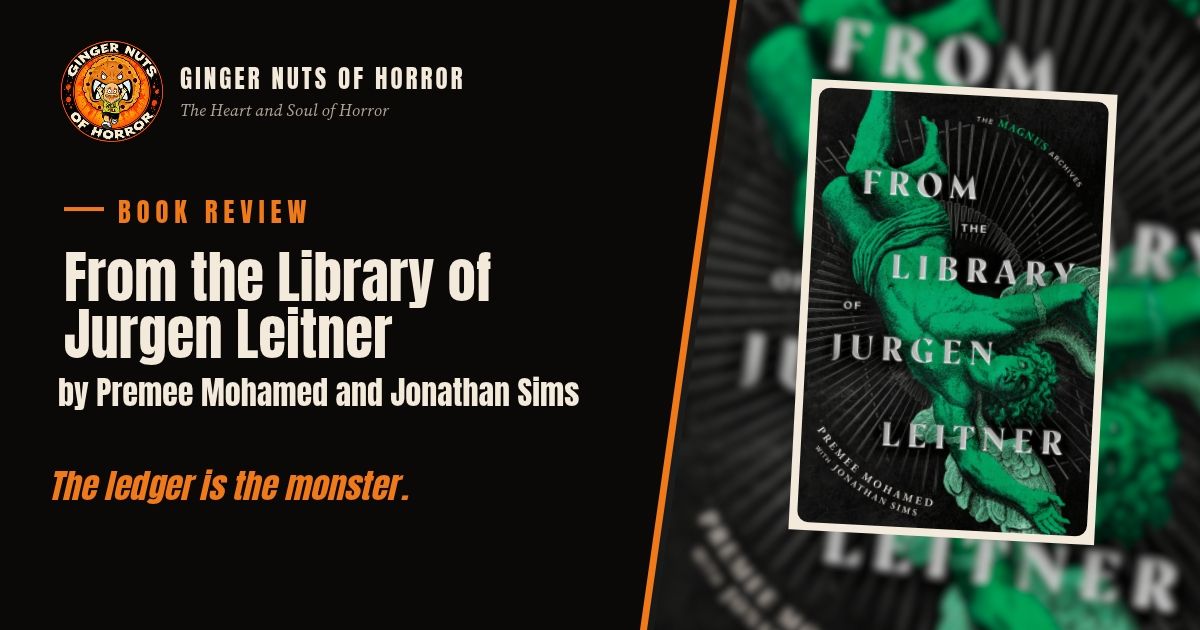
From the Library of Jurgen Leitner | Premee Mohamed and Jonathan Sims | Del Rey |
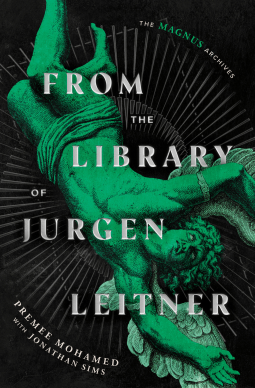
- Authors Premee Mohamed and Jonathan Sims
- Publisher Del Rey
- Published 27 October 2026
- Format Hardback, ebook, audiobook
- ISBN 9781529999228
- Series The Magnus Archives, standalone prequel
- Subgenre Gothic cosmic horror
- Reviewed by Jim McLeod
In 1992 and 1993, two men go to work in collector Jurgen Leitner’s private library of deadly occult books, a place where the staff keep dying and the paperwork carries on regardless.
From the Library of Jurgen Leitner, by Premee Mohamed with Jonathan Sims, is the first novel set in the world of The Magnus Archives. This From the Library of Jurgen Leitner review looks at how a prequel with a known ending still finds a way to frighten.
Del Rey publishes it in the UK, and it takes us inside the private library the podcast only described, where occult books are locked away and the people who guard them keep dying.
From the Library of Jurgen Leitner turns a cursed library into an office where the staff die and the paperwork carries on. Premee Mohamed and Jonathan Sims make the ledger scarier than the books. It states its case once too often, but this is tie-in horror with real teeth.
From the Library of Jurgen Leitner Review: A Workplace Where the Books Bite
Every workplace keeps a number it never says out loud. Accidents per year. Staff turnover. The cost of doing business. Most of us never see it written down, and that is a mercy, because once you see it you start to wonder whose name goes in the next column.
Jurgen Leitner writes his number down. He does the sums on how many of his staff can die before the work stops being worth it, and he lands on a figure he can live with. He is not a cackling villain. He truly thinks he is keeping the world safe from books that kill, and he thinks it with the calm of a man who has never had to mop up after one.
That calm is the cold heart of this book, the first novel set in the world of The Magnus Archives, written by Premee Mohamed with Jonathan Sims. It is a novel about cursed books, yes. Mostly, though, it is about the people paid to stand next to them.
Two men take the job. In 1992, Hugh Franklin joins the library as a research assistant. He can sight-read Latin and he translates well, and he is worn out from losing the fight for a post in academia. A year on, Sebastian Everett works there as an acquisition specialist, the man who goes out into the world and brings the books home. Hugh is anxious, broke and grateful. Sebastian is rich, smooth and sure that rules are for other people. Leitner treats him almost like an heir. The chapters swap between the two of them, a year apart, walking the same aisles.
Anyone who knows the podcast knows how the library ends. Mohamed does not pretend otherwise, and there is no false suspense about whether the place falls. The question is how it was built, who kept it standing, and who it crushed on the way down. That is a braver choice than it looks. A prequel that hides its ending is a magic trick. A prequel that shows you the ending and still makes you dread every page is a novel.
Is From the Library of Jurgen Leitner Scary?
Yes, though maybe not in the way you expect. The books are a cabinet of nasty wonders. There is a cloth-bound hardback that drives its reader to dig, and keep digging, at whatever is close to hand. There is a cookbook that starves. There is an old scroll that sends a cold, hunting breeze across the room. There is a butcher’s guide that sees a person only as meat. The deaths they cause are grim and often gory, and the novel does not look away. Anyone who came to Magnus for the slow chill of a statement read aloud may be startled by how wet some of this gets.
The deeper fear is quieter. Leitner’s library is run like an office. There are testing rooms that seal shut. There are progress meetings, reports and leave forms. A colleague dies, and someone puts the kettle on. Success means the book stayed in its room, even if the person in the room did not. Chuck Varma keeps the files and tries, in small ways, to make the deadly rules a little less deadly. It is a very British kind of horror: a system so well run that nobody feels they have the right to stop it.
This is where Mohamed is at her best. She knows that cruelty rarely needs a monster. It needs a rota.
Mohamed’s prose is plain on purpose. She does not dress it up, and she does not need to. Reading it is like watching a conservator mend a torn page with fine tissue: patient, neat, almost tender, until you notice that the tear runs right through someone’s name. The calm is the point. When something awful happens, the sentences do not flinch, and that refusal makes the awful thing land harder.
She lets the comedy in, too. Much of it comes from how dull the job is, the forms and memos and polite meetings held in the shadow of a book that wants to eat you. Sebastian is a gift here. He is a dreadful man and fine company on the page, the sort of colleague everyone has met and nobody would cross the road to help. Hugh is harder to love at first. He says sorry too much and asks for too little. But his slow turn from gratitude to anger is the moral spine of the book, and when he at last faces Leitner over the dead, the scene has real force.
The pairing works because the two men come from opposite ends of the British class ladder. Hugh needs the wage. Sebastian needs nothing, except more. The library flatters each of them in the same way, telling both that they are special, that they are not like the staff who die. Fans of the podcast will know which of its powers likes to work like that, pressing on old wounds and then waiting for its victims to call the result a free choice. The novel never quite settles how much blame the two men deserve, and that unease feels earned rather than dodged.
The one real flaw is that the book does not always trust you. Mohamed’s case about ownership is sharp and clear, and then it is made again. Several characters reach the same conclusion, and then a conversation spells it out in case you missed it.
A few of the fears are explained a beat after they have done their work, which lets a little air out of them. Early on, the jumps between the two years land a touch too neatly on cliffhangers, so you can feel the hand on the lever. None of this breaks the book. It is the gap between a very good novel and a flawless one, and it is the half star I am holding back.
How From the Library of Jurgen Leitner Compares to Other Cursed Book Horror
Books about deadly books are an old tradition. M. R. James got there early, with scholars who open the wrong volume in the wrong reading room, and Lovecraft built a whole mythos around a book you should never read. More recently, the anthology Bound in Blood, edited by Johnny Mains, filled a shelf with cursed books and damned libraries, and Cassandra Khaw’s The Library at Hellebore took dark academia somewhere bloody and political. Some readers have reached for The Name of the Rose, and the comparison is fair: a library as a fortress, and knowledge as something to guard and to kill for.
What sets Mohamed and Sims apart is that they care less about the forbidden text and more about the payroll. The cursed book here is not a puzzle to solve. It is a hazard to manage, and the managing is the horror. In that sense the novel sits closer to a workplace story than to the usual occult thriller, and it is all the fresher for it.
For Mohamed this is a homecoming of sorts. Her debut, Beneath the Rising, was cosmic horror with a hard eye for how power uses people, and her award-winning novella And What Can We Offer You Tonight turned the same eye on a city where the rich buy and discard people. The Butcher of the Forest and The Siege of Burning Grass showed a writer who likes her moral questions tough and her fairy tales cruel. All of that is here, turned on a library. Around the launch she said that almost everyone in the book apart from Leitner is her own invention, and it shows. Hugh, Sebastian and Chuck feel like hers, not like fan service.
Sims has form with this shape of story as well. His first novel, Thirteen Storeys, built a haunted tower block out of separate lives that only meet at the end, and he followed it with Family Business. You can sense his hand in the lore and in the shape of Leitner himself. On the audiobook, read by Christian Coulson, Jonathan Sims and Paul Sims, long-time listeners get a further treat.
Do you need to know The Magnus Archives? No. The trouble the staff are in needs no lore, and Mohamed rarely stops for a lecture. Fans get an extra layer: names they know, powers they will spot, and the grim pleasure of seeing a story they only ever heard second hand play out in full. Newcomers get a self-contained gothic horror with a strong idea at its core. Both will see the broad shape of the ending coming. Neither should mind, because the how is the whole show.
Leitner’s library was always going to fall. This is the book that shows you who was standing underneath it.
The Verdict: Is From the Library of Jurgen Leitner Worth Reading?
4.5out of 5
The verdict
A sharp, cruel prequel that turns a cursed library into a workplace you will be glad to clock out of, held back only by a habit of saying its point twice.
Read it if: you like your horror bookish, bloody and angry about who pays the price for a rich man’s hobby, whether or not you know the podcast.
Skip it if: you want a twisty mystery whose ending you cannot guess, or a lead you can warm to from page one.
Content warnings: gore, graphic workplace deaths, body horror, psychological manipulation, references to madness.


Keep reading on Ginger Nuts of Horror
 The Way It Haunted Him Review: Laura R. Samotin’s Dark Academia Horror Is the Real Thing
 Michael Wehunt’s The October Film Haunt and the Curse of Loving Horror Too Much
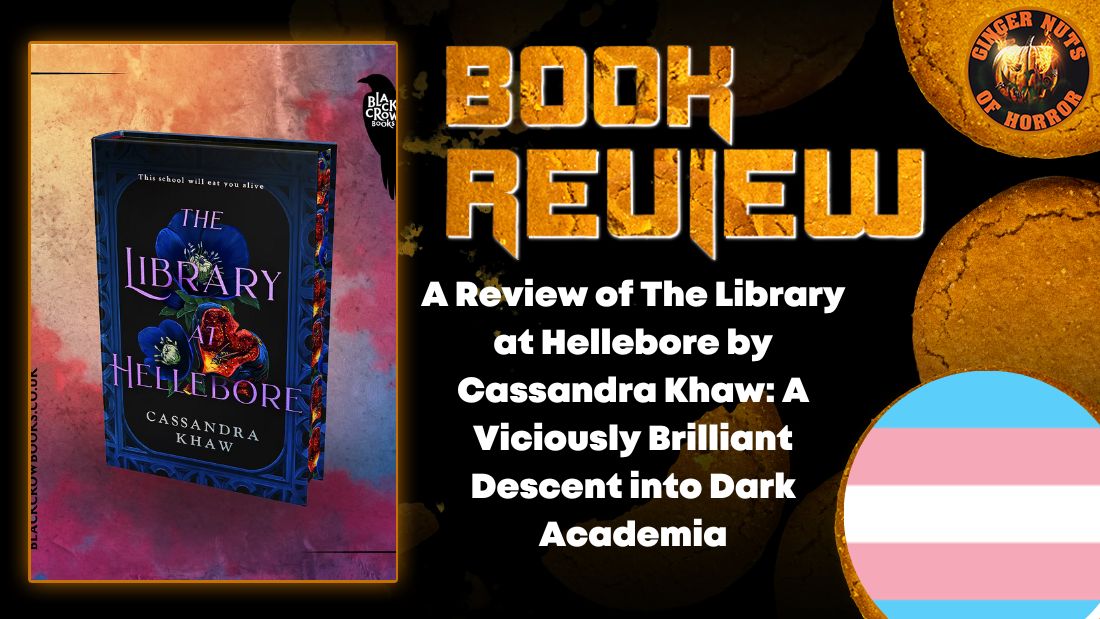 A Review of The Library at Hellebore by Cassandra Khaw: A Viciously Brilliant Descent into Dark Academia

About Ginger Nuts of Horror
Ginger Nuts of Horror is an independent horror review and culture site based in Edinburgh, Scotland. Edited by British Fantasy Award nominee Jim McLeod, it publishes horror book reviews, film reviews, author interviews, features and cover reveals. Ginger Nuts of Horror won Best Inclusive Film & Book Review Platform at the SME News UK Enterprise Awards 2026.


